Priest says OTSUS is accelerating Papuan extermination

(WestPapuaMedia note: we are aware of the allegations of mysterious killings in 2010, however the reports given are not containing enough information to make any detailed report).
JUBI, 6 April 2011 

OTSUS IS ACCELERATING  PAPUAN EXTERMINATION

A priest in Nabire has described the special autonomy law, known as OTSUS, as being a move by the Indonesian government that was intended to accelerate the extermination of the indigenous Papuan people.

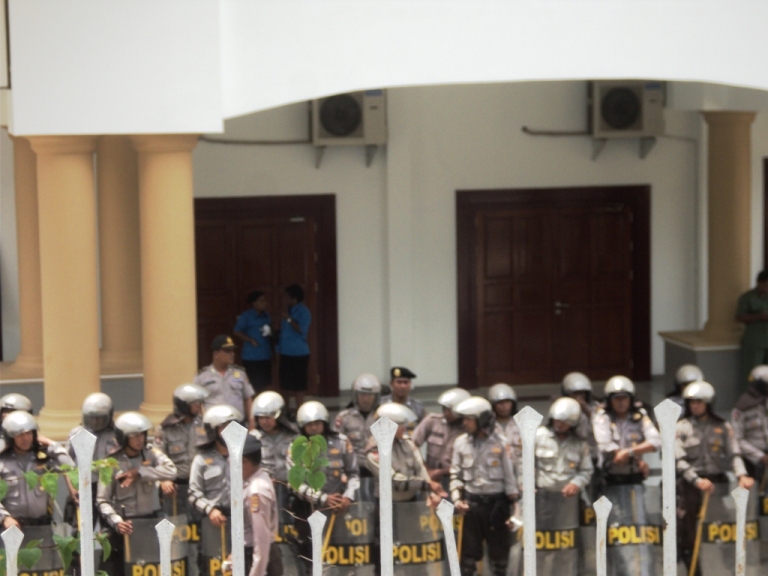
The Rev. Daud Auwe said that ‘the intention  is clear from the systematic and violent killings which have taken place up to now.’  He mentioned in particular the case of the Rev. Kindeman Gire in Puncak Jaya, and the shooting of Melkias Agapa and Abetnego Keiya in Nabire. He was speaking at a demonstration of several hundred people outside the office of the Nabire  provincial legislative assembly.

There was also the case of the mysterious killing of ten people in Nabire [no time mentioned] and the killings of 1,435 people  that occurred during the four years from 2006 to 2010.

Another speaker, Yones Douw spoke about the culture of dependency and the destruction of the people’s economy, the appalling condition of education and healthcare facilities for Papuan people, all of which were the result of OTSUS. ‘294 people in Dogiyai died of diarrhoea in 2008, 42 people died of malaria and 41 people died of starvation in the district of Nduga.’

Other factors were the destruction of Papuan culture, the uncontrolled increase in the number of inhabitants that has been occurring annually, all of which has led to a lack of protection for indigenous Papuan people.

Yones also condemned the government’s UP4B programme which is now being promoted by the central government, which he described as a public cover-up for the failures of OTSUS. ‘While there is no legal basis for the UP4B programme, the OTSUS law which is within the legal framework has not been properly implemented by the government.’

Manipulation: Komnas HAM report on 2003 arms dump assault

JUBI, 5 April 2011 

Assault on arms dump in Wamena was a manipulation, says Komnas HAM member

The deputy chairman of the National Human Rights Commission, Papua branch  Matius Murib, has told the press that the solution to the assault on the arms dump of the Wamena district military command on 4 April 2003 now depends on the state and the attorney-general’s office.

‘The Komnas HAM, as a state institution, has completed its task of conducting a pro justicia investigation and has delivered its evidence and associated data to the attorney-general. But the attorney-general has responded, saying that the evidence is not strong enough,’ he said. ‘Our job is finished and we cant do anything more on the matter,’ he told JUBI.

The pro justicia report recorded that nine people were murdered, 38 people from 25 kampungs were forcibly evicted, 42 people died from starvation and fifteen others were treated unjustly.

With the Konmas HAM having done its work, it now depends on the goodwill of the state and the attorney-general’s office  to solve the case. In his opinion, this would mean bringing the case before the judiciary, and in this case, this would mean submitting it to the human rights court because, he said, ‘ this was a case of gross violation of human rights which must be heard before the human rights court.’

He went on to explain that this was not a case involving any bloodshed. It should be regarded as something that was deliberately manipulated. ‘I was at the location at the time,’ he said. ‘Just imagine, the arms dump is in the centre of town, yet even so an assault took place. This can only have been a deliberate manipulation,’ he said.

He also referred to the Wamena Tragedy of 6 October 2000 which resulted in many casualties and much spilling of blood. ‘Many ordinary (people) were tortured. This was also a case of serious human rights violations,’ he said.

Tunisia… Egypt… Libya… Let’s look closer to home

by Daniel Scoullar

originally appeared at http://www.onlineopinion.com.au

The mass uprisings in Tunisia, Egypt, Libya and other nearby countries have put despotic rulers, human rights abuses and self-determination into our nightly news bulletins and daily conversations in a way that happens very rarely.

The seemingly contagious way these movements for freedom have spread from country to country makes them particularly fascinating, but there is another reason why they have captured the public imagination. It’s because Australians recognise the ‘fair go’ principle, which can also be put in terms of the human right for every person to be safe from harm, to have control over their lives and to have a say in how their country’s run – regardless of whether they live in Bundoora or Benghazi.

In turn, many of us would also be surprised to hear that we have state sponsored violence and political exclusion much closer to home. They would be further surprised to hear these abuses are taking place within Indonesia, a case study for positive social, economic and political reform.

Despite holidaying in Bali, seeing Jakarta on the news or even watching a wildlife documentary shot in the Sumatran jungle, you could be excused for never having heard of West Papua. It comprises the western half of the island of New Guinea (the eastern half belongs to Papua New Guinea) and a collection of small islands.

West Papua’s landscape is one of tropical islands, coconut strewn beaches, impenetrable rain forests and rugged snow capped mountain peaks. It is home to around three million people, including some of the last remaining humans still untouched by the modern world.

West Papua’s modern history is marked by exploitation and resilience. Colonial explorers claimed it as Dutch territory in the 1600s, the Japanese and Americans made it a key battleground of World War II and the newly independent Indonesian nation invaded and forcibly occupied the territory in 1962, just 13 years before they would do the same in East Timor.

In the 50 years since then, West Papua has been ruled as a country-apart within Indonesia. This is somewhat ironic given West Papua is physically, culturally and historically separate from the rest of Indonesia. Its traditional ties run east and south to Papua New Guinea, Melanesia, northern Australia and the Pacific.

Where military and police abuses were curtailed elsewhere, they were encouraged in West Papua. While ‘unity in diversity’ was the national motto, West Papuan traditional culture was violently suppressed and almost a million ‘transmigrants’ were shipped in and given the reigns of local government and the economy. Even as the post-Suharto human rights reforms resulted in greater freedom of speech for those in Jakarta, incarceration or death are still the standard penalties for raising the Morning Star flag in West Papua. An estimated 100,000 local people have been killed during the occupation.

In 2007 I travelled from East Timor through Indonesia, West Papua and Papua New Guinea on my way back to Australia. My lasting memories are of friendly West Papuans inviting me into their homes to practice English with their children and heavily armed military personnel/police stopping me in the street for seemingly random questioning. When I returned to Melbourne, I met members of the West Papuan refugee community here and learned more about the extent of the abuses taking place in their homeland.

A recent example captured on video and shared on the internet, shows two Papuan men being cruelly tortured by security forces, including one having his genitals burnt. Other examples include activists being shot at demonstrations – or just disappearing. Local prisons are full of political prisoners who have committed no crime other than raising their voice.

It is also important to differentiate this critique of state sponsored human rights abuses and a lack of self-determination from a more general attack on Indonesia as a nation or its culture.

As someone who speaks Indonesian moderately well and has lived and travelled in the region, I know first hand the beautiful diversity within Indonesia’s awe inspiring 17,500 island archipelago. The majority of its 240 million people are not disputing their place in this nation state and democratic, social, economic and political progress continues in most areas.

Nevertheless, acknowledging Indonesia’s strengths is not the same as writing a blank cheque to the worst elements within its military and government. After 24 years of silence, Australia finally found the moral and political strength to take a stand on behalf of the East Timorese people and this is what is needed again, not just from our Prime Minister Julia Gillard, but from other world leaders within our region and right across the globe.

We all know that international diplomacy can be a dirty business where economic and political interests take precedence over doing what is right. We should acknowledge that it is politics and economics that are the key barriers blocking the Australian government from advocating on behalf of the West Papuan people. There is no easy villain such as Muammar Gaddafi to hold up as a symbol of evil. It’s more complicated than that.

International diplomacy can also be a powerful force for improving lives. While East Timor remains poor, I didn’t meet a single person there who wanted to go back to Indonesian rule. Australia is a regional leader, particularly in the areas of good governance and human rights protection, and we should not shy away from this role. We have the power to make a difference in West Papua and, in turn, we carry the corresponding responsibility to do so.

If we simply cast our gaze to distant parts of the world, where people are paying with their lives for basic freedoms, we will overlook those closer to home paying with their own lives for those same freedoms.

The Indonesian Government: closing window for peace in West Papua

This article originally appeared at
Jason MacLeod

Just as Indonesia’s president Susilo Bambang Yudhuyono was being feted globally for being a democrat, the Indonesian government was entrenching Papua’s reputation as Indonesia’s last bastion of authoritarian military rule. Now Peace Brigades International has finally been forced out.

The latest casualty in the Indonesian Government’s efforts to seal off West Papua from international scrutiny is Peace Brigades International (PBI). In January this year the international non-government organisation was finally forced out of Indonesia. Since 1981 at the invitation of local people, PBI has been providing unarmed protection to human rights defenders at risk in conflict zones around the world. International accompaniment is literally the embodiment of the international community’s concern. The presence of internationals increases the cost of attacking human rights workers and expands the political space for local activists. All this is made possible by an elaborate communication network. PBI staff meet with local police and military personal as well as their superiors in regional and national capitals to let them know exactly who is being accompanied. This acts as a deterrent. The PBI volunteers are the eyes and ears of the international community, communicating the human rights situation on the ground to an international network of governments and civil society actors. It is a tried and tested approach that has worked in places as diverse as El Salvador, Guatemala, Colombia, Haiti, Sri Lanka and Nepal.

Members of the PBI Indonesia Project were invited by Acehenese activists to accompany them through the darkest days of martial law. Acehenese civil society organisations like Flower Aceh and Koalisi HAM (the Human Rights Coalition) were able to continue their work because of PBI protective accompaniment. It gave local workers a sense that the international community cared about their situation and sent a clear message to the Indonesian army that they were being watched. PBIs protective accompaniment helped expand the space for peace in Aceh in the lead up to the historic Helsinki Peace Agreement. But in West Papua, home to Indonesia’s longest running separatist conflict, the world’s oldest international nonviolence organisation has finally met its match. After years of harassment from the Indonesian security forces the PBI Indonesia Project was closed down.

My colleagues and I helped set up the PBI West Papua project in 2003. I left the organisation in 2004 but kept in close contact with many of the organisers and staff members. One of the reasons PBI responded to an invitation from Papuan human rights defenders was because for years the Indonesian government has closed off access to West Papua to humanitarian organisations, journalists and even diplomats. It is important that Papua is opened up to the international community if human rights are to be addressed. But while the rest of Indonesia moved towards greater democracy, Papua slid back into an authoritarian backwater ruled by the Indonesian security forces as if it was their own private fiefdom. Since PBI established a presence in West Papua Amnesty International, Human Rights Watch, the Dutch NGO CordAid and even the Red Cross have all been denied access. This level of hostility by a State to international scrutiny of a human rights situation is unusual. Even during the height of apartheid, the South African government permitted the Red Cross access to political prisoners. Not so in West Papua.

Prior to being forced out of West Papua, PBI was the only international human rights organisation with a permanent presence in Indonesia’s restive Pacific periphery. A group of long-term international volunteers based in Jayapura, the capital and in Wamena, in the troubled highlands, provided unarmed protection for Indonesian and Papuan human rights defenders and monitored the situation on the ground. PBI helped protect human rights defenders and lawyers trying to expose police brutality during the ‘Bloody Abepura’ trial in 2004. PBI also protected Papuan human rights defenders who were investigating the security forces after they cracked down on Papuans in the wake of the March 16 2006 blockade of the main road outside the University of Cendrawasih in Jayapura.

PBI is governed by a strict mandate. The organisation only supports unarmed actors, they do not take sides and they do not tell Papuans how they should run their struggle. Despite this the Indonesian government was petrified of PBI. I experienced this personally. When I was taken in for questioning in West Papua in 2007 after observing a demonstration in Papua, the very first question the Indonesian police intelligence agent asked me – even before enquiring whether I was a journalist or spy – was “Are you PBI?” By then I had left the organisation but it revealed the depth of the intelligence services concerns about PBI.

Almost from the moment PBI started work in West Papua the Indonesian government acted to restrict PBI’s access and ability to work. In 2009 the organisation was pressured to close the Wamena office in West Papua’s remote highlands, the scene of frequent human rights violations by the Indonesian military. PBI staff were refused permission to work as the police and intelligence services launched an official investigation into the organisation’s status. National Indonesian staff started to receive threatening phone calls. They felt increasingly vulnerable.

By late 2009 all one-on-one protective accompaniment had ceased. In an effort to stay in Papua protective strategies were reduced to regular check-in calls with PBI clients who felt threatened by state security forces. Then on 30 July 2010 Ardiansyah Matra’is’s naked, handcuffed body was found in the River Gudang Arang. His arm had been tied to a tree to prevent his body from floating downstream. Matra’is was a journalist working for Papua’s only national independent paper, Jubi. Matra’is had been critical of illegal logging operations run by the Indonesian military in Merauke and had taken photos of their activities. Matra’is was also a PBI client. His murder was the first time in Indonesia that a current PBI client had been killed.

The writing was on the wall: PBI was no longer making space for peace in Papua. In fact the opposite was happening. The Indonesian government was closing space for peace in Papua, and PBI appeared powerless to halt the slide into greater military impunity. Just as Indonesia’s president Susilo Bambang Yudhuyono was being feted globally for being a democrat, the Indonesian government was entrenching Papua’s reputation as Indonesia’s last bastion of authoritarian military rule.

But the Indonesian government’s restriction of access to West Papua is not just confined to grassroots international nonviolence organisations. Jakarta is even willing to snub the US government. In late 2010 the US Ambassador, Scott Marciel asked the Indonesian government if staff from the Embassy could observe the trial of three soldiers involved in torturing Papuan civilians. The torture, which including burning a man’s genitals with a stick, was filmed on a mobile phone camera and leaked to transnational human rights networks. When the footage was uploaded on to YouTube and featured on domestic and international news networks it generated massive moral outrage not just internationally but inside Indonesia as well. When the trial went ahead last month, Mr. Marciel was notified by the Indonesian government only 24 hours beforehand, not enough time to apply for a surat jalan, a letter of permission to travel to West Papua required by the Indonesian government. It was not an official denial from the Indonesian government but it may as well have been.

The Indonesian government is blocking access for all those who want to shine a light into West Papua. The problem for the Indonesian president, Susilo Bambang Yudhuyono is that he has allowed the Indonesian intelligence services to dominate decision-making processes in West Papua. The intelligence services determine who gets access into West Papua and who does not. They are the ones who assess the applications of foreign NGOs, journalists and even diplomats who want to travel to West Papua. Access to West Papua should be subjected to the rule of law and not to surveillance principles. If democracy and rule of law was present in West Papua, the surat jalan regime would be abolished altogether.

The Indonesian government cannot have it both ways. The human rights situation in West Papua cannot be fine while at the same time the Indonesian government and its intelligence and security forces insist the territory is off limits to foreigners. Either human rights are respected in West Papua or they are not. The closure of PBI in Indonesia only sharpens the international community’s perception that the Indonesian government has something to hide in West Papua.

Jason MacLeod worked for the PBI Indonesia Project from 2000 to 2004. He teaches civil resistance at the University of Queensland.

Sokrates Yoman launches book titled ‘OPM’

JUBI, 12 March 2011

The Rev. Sokratez Sofyan Yoman has launched a new book titled: Otonomi, Pemekaran dan Merdeka [OPM] – Autonomy, Division and Independence. The 136-page book bears a sub-title: ‘Time to Speak the Truth in the Land of Papua’.

Speaking at the launch, the author, who heads the Alliance of Baptist
Churches in Papua, he said that he had taken the decision to write the
book as a calling from God. He said that when he meets his Maker and is asked what he has done and whether he should go to heaven or to hell, he would accept whatever would happen to him.

The book will cost Rp. 30,000 a copy but the author has decided not to sell it through the bookshops. ‘I will ask students to sell it so that
they can earn something from the profit they make selling it.’

Speaking at the launch of the book, Herman Awom said that the
significance of the book could be judged by the fact that past books of his have all been banned.

‘Why are his books banned by the Attorney-General? Because they speak about the experiences of the Papuan people, about their history, about the failure to uphold human rights in Papua and about the use of violence in Papua.’

Herman Awom said that this book was a way for Rev Yoman to deliver his sermons; not all the churches were willing to write in the way that he does. The title of the book in bahasa can be abbreviated to OPM.

Create a website or blog at WordPress.com

Up ↑
