Movement Against Freeport is set up by Papuan Students

Bintang Papua,28 October 2011

A number of UNCEN student organisations along with the KNPB, the
National Committee for West Papua, have announced the establishment of
a movement to oppose Freeport. They regard this company as having been
the cause of many problems in Papua. The students unfurled two banners,
one of which depicts the US flag intertwined with the logo of Freeport,

The new organisation is called People’s Movement Against Freeport Crimes
– Gerklaf. The co-ordinator of the new organisation is Fanny Kogoya and
Bovid Defa is the secretary.At the end of the ceremony, the US flag was
set on fire. This opposition movement regards the presence of Freeport
as having come about as the result of a political contract between the
USA and its allies in order to ensure the continuance of Papua within
the Unitary Republic of Indonesia.

The integration of Papua within Indonesia, according to wording on the
banners, goes back to 1963 and the New York Agreement of 1963, the
contract concluded with Freeport in 1967, the Act of Free Choice in 1969
and the Bunker Proposal [Bunker was the US diplomat who was involved in
the conclusion of the New York Agreement.].

Before the declaration was announced, the leaders of eight student
organisation delivered speeches. Fanny Kogoya said that the new movement
would press for the consolidation of the movement throughout the whole
of Papua, to strengthen opposition to Freeport.

They also said that any plans to renegotiate the contract with Freeport
should involve indigenous Papua people.[This is a reminder of the fact
that past contracts with Freeport have all been concluded with the
Indonesian government, without the presence of the representatives of
the Papuan people.]

The declaration that was read out by Bovid called on the one hand for
the expulsion of Freeport, while on the other hand saying that Freeport
should become the property of the Papuan people.The words on the banner
were:’The Papuan people must assert their sovereignty over their
natural resources.’

End the theft, end the violence, close Freeport now Joint statement in solidarity with Freeport Indonesia worker – Indonesian Labour Unions

October 20, 2011

PT Freeport Indonesia,  a subsidiary of Freeport McMoran Cooper and Gold – of which 90.64 percent of the shares are owned by Freeport CEO James R. Moffet – is the largest mining company in the world. Freeport contributes 95 percent of the entire production of gold by Freeport McMoran and a significant percentage of its copper production.The controversial corporation obtained the exploration and mining rights through Work Contract I, several months before the enactment of Law Number 1/1967 on Foreign Capital Investment and Law Number 11/1967 on the Basic Provisions of Mining during the rule of the New Order regime of former President Suharto. Odd but true!

Work Contract I was then renewed by Suharto in 1991. As a result Work Contract II will expire in 2040 and the area of exploration and exploitation was extended to cover 6.5 percent of the total territory of Papua province. It also includes the right to conduct of underground exploration. Freeport began operating 44 years ago but it was not until 1971 that the company began extracting minerals (gold, copper, silver, molybdenum and rhenium).

In the first decade of its operations, Freeport extracted more than 1 million tons of gold, copper and shiver annually. By 2010 this had reached 3.4 million tons a year. Freeport reaps profits of as much as 114 billion rupiah a day, so in one year Freeport’s net profit is a high as 41.04 trillion or US$45.60 billion.

The irony is that the total combined wages of all Freeport’s employees is only 1.4 trillion rupiah a year or $2.1-3.5 dollars US per hour. This is far lower than the wages received by Freeport workers in other countries who receive US$15 or 128,250 rupiah per hour. The proportion received by workers is only 3.4 percent of Freeport’s total profits and 60 percent of its net profit are turned over to Freeport McMoran.

Based on this compression, it is understandable that the Freeport Indonesia All Indonesia Workers Union (SPSI) is demanding a wage increase of between US$17.5 to US$43 per hour. Never mind that Freeport workers in the US receive 30-250 dollars US per hour. Meanwhile the wage increase awarded to Freeport Indonesia workers every two years have only been US40c an hour.

The Freeport Indonesia management meanwhile has responded to workers’ demands with accusations of separatism, psychological intimidation, prohibiting workers from joining the strike, criminalisation of workers and most recently repressive acts by police that resulted in the fatal shooting of two people, Petrus Ayamiseba and Leo Wandagau, and the wounding of seven others.

Acts of violence involving Freeport are not new. During its 44 years of theft, there have been numerous cases of violence in Papua and the Freeport mining area of Timika against Freeport workers and indigenous Papuans.

This clearly demonstrates that Freeport is using violence as a tool and means to secure its vital assets. And, of course, the state since the time of the Suharto regime through to the current administration of President Susilo Bambang Yudhoyono and Vice President Boediono, has fully supported Freeport’s interests.

It is already public knowledge that since the 1970s Freeport Indonesia has been providing a huge sums of money for security. A number of documents have cited that between 1998 and May 2004, Freeport paid at least 20 million dollars (around 184 billion rupiah) to the TNI (Indonesian military) and the police in Papua. There has also been an additional 10 million dollars (around 92 billion rupiah) paid to the military and police over this period bringing the total to around 276 billion rupiah. And as admitted by the Papuan regional police themselves, out of a total of 720 police and military personnel that are deployed in the Freeport exploration area, each officer receives 1.25 million rupiah a month in additional wages outside of regular funds.

In contrast to this, in 2011 the Central Statistics Agency (BPS) recorded that the poverty rate in Papua province stood at 80.07 percent or 1.5 million people living in poverty. This is clear evidence that Freeport does not provide any contribution to the welfare of the Papuan people.

Freeport, which is the largest gold and cooper mine in the world, not only steals the country’s natural wealth, muzzles democracy, violates human rights and impoverishes the Papuan people, but also destroys the environment. In a single day of operation, Freeport disposes 230,000 tons of waste into the Aghawagon River and other rivers in the vicinity. The acid rock drainage, or the disposal water containing acid (around 360,000-510,000 tons a day), has already destroyed two valleys covering an area of 6.5 kilometers to a depth of 300 meters.

It becomes increasingly clear that there are no grounds to for Freeport Indonesia to be allowed to continue its exploration and mining activities. Freeport must be closed down!

Based upon the fact above we make the following demands:

– The withdraw all non-organic TNI and police personnel from the Freeport area and Papua
– The arrest of James Moffet, Freeport Indonesia President Director Armando Muhler, Freeport Executive Vice President Sinta Sirait and company spokesperson Ramdani Sirait
– The broadest possible dialogue for the Papuan people that is democratic and free from coercion
– A full investigation into human rights violations at Freeport and in Papua;
– An end to union busting
– An end to the use of contract labour
– An international standard wage
– Freeport must be held liable for its past and current crimes
– Dismiss the national police chief, the Papua regional police chief and the Timika district police chief
– Freeport must take responsibility for the environmental damage it has caused

We call on all people, let us unite. We are the 99 percent in the world who are oppressed. Freeport, James Moffet, President Yudhoyono and Vice President Boediono, the political elite and the Indonesian political parties that benefit from Freeport, are the 1 percent that oppresses the rest of us. Yesterday it was Petrus Ayamiseba and Leo Wandagau who were murdered. Next anyone who resists will suffer the same fate. We must therefore unite, act in solidarity and fight back!

44 years of theft, 44 years of state protection, end the violence and close Freeport now

Jakarta, October 20, 2011

Tri Puspital
Public Relations Officer

This joint statement is supported by:

The Student Alliance Against Neoliberalism (AMAN), the Working People’s Association (PRP), the People’s Liberation Party (PPR), the Commission for Missing Persons and Victims of Violence (Kontras), the Papua Student Alliance (AMP), the Free Women’s National Network (Perempuan Mahardika), the Papuan Traditional Social Community Against Corruption (Kampak), the Indonesian Legal Aid and Human Rights Association (PBHI), the Indonesian Trade Union Congress Alliance (KASBI), the National Solidarity Committee (KSN), the Papuan NGO Forum for Cooperation (Foker Papua), the PT Freeport Indonesia All Indonesia Workers Union (SPSI PT FI), the National Students Front (FMN), the Association of Independent Trade Unions (GSBI), the Indonesian Independent Union (SMI), the Greater Jakarta Workers Federation of Struggle (FPBJ), the Indonesian Center for Labour Struggle (PPBI), the Student Struggle Center for National Liberation (PEMBEBASAN), the Indonesian Transportation Trade Union of Struggle (SBTPI), the Working People’s Association-Organisational Saviours Committee (KPO-PRP), the Green Indonesia Union (SHI), the State Electricity Company Trade Union (SP-PLN) and the United Student Action (KAM Laksi).

[Translated by James Balowski.]

Journalists protest over reporter beaten up in Freeport mine clash

Tabloidjubi, with PMC

Leo WandagauLeo Wandagau … wounded in a separate Freeport mine clash when security forces opened fire. He died later in Timika District Hospital. Photo: Jubi

Pacific Scoop:
Report – By a special correspondent in Timika

Dozens of journalists have demonstrated in Manokwari to protest in solidarity with a colleague who was allegedly beaten up by workers of  Freeport-McMoran during a clash in Timika, Papua, as tension worsens at the giant Grasberg copper mine.

Duma Tato Sanda, a journalist working for Cahaya  Papua, suffered from bruises and swelling  in his cheeks, lips and his waist and was punched in the chest.

Sally Pelu, coordinator of the Papuan People’s Solidarity Action for Press Freedom, said:  “Journalists are continually being subjected to acts  of violence and there is no guarantee that we can do our work of  gathering information freely.”

The journalists condemned the violence used against their colleague and called on the DPR, the central legislative council, to support the right of journalists  to conduct their work freely.

The journalists met a member of the DPRP West Papua, Jaxat, who apologised for the fact that many members of the DPRP were absent, because they were involved in other activities.

According to reports, Duma also lost his camera, handphone and motor-bike which were all seized by Freeport workers.

“They beat me , grabbed my camera and took my motorbike,” said Duma.

Trucks burned
When he was attacked he was gathering information about the burning of three trucks belonging to Freeport which had been set on fire by Freeport workers.

The trouble occurred after people heard that three of  their colleagues had been shot dead during a demonstration.

“I said that I was a journalist but nevertheless they beat me and threw stones at me.  Luckily, someone came by on a motorbike otherwise I could have been killed from being beaten by so many people.”

He wadded that he was later chased by about ten people – “my sandals fell off while some people pelted me with stones”.

Johannes Samuel Nussy, the chairman of the Timika Community of  Journalists, also condemned the acts of violence against Duma and said that another journalist working from Radar Timika, Syahrul was also attacked by Freeport  workers in Gorong-Gorong, Timika and was bruised in his face.

“They beat me because they didn’t want journalists to be there.” he said.

Freeport ‘relationship’
According to  Nussy, some journalists in Timika have formed a relationship with Freeport.

“They [the protesting workers] see the work of journalists as  something threatening. They say we are defending Freeport, which is not true. We hope that the workers trade union can urge their colleagues
not to see journalists as a threat.”

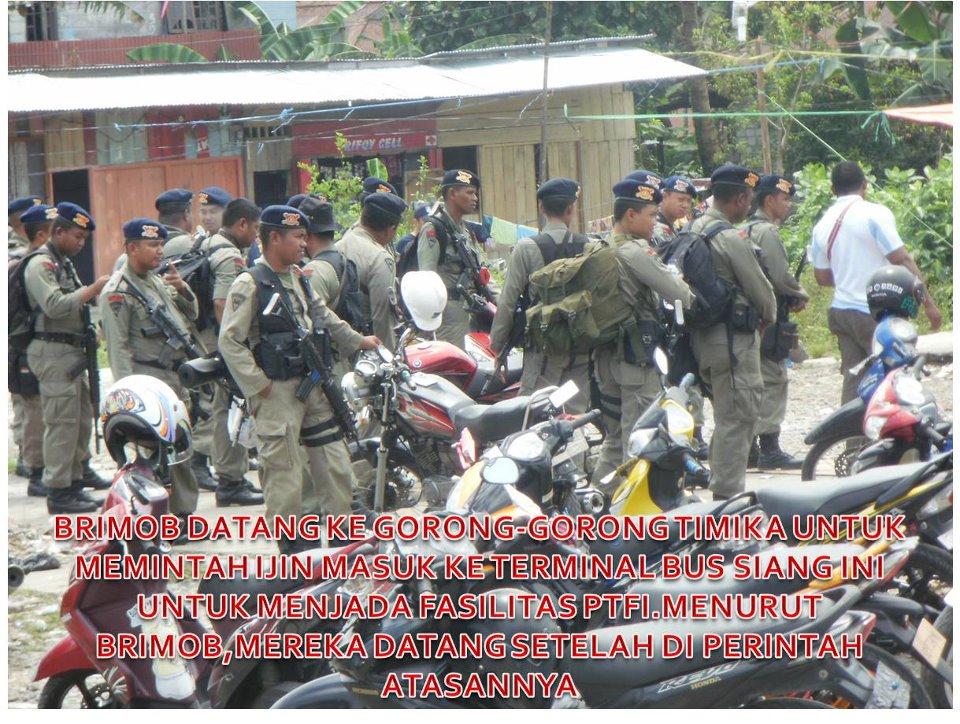
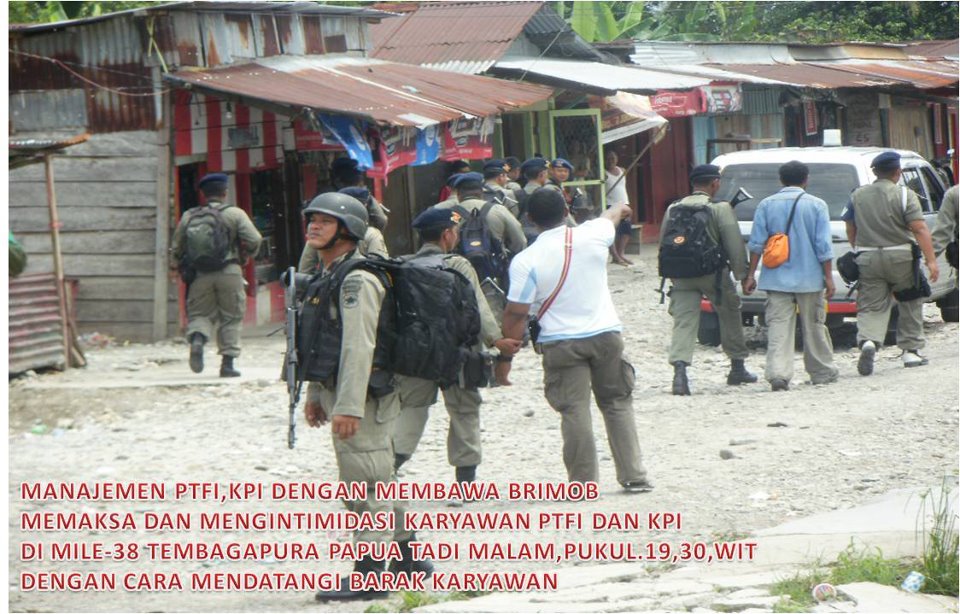
The independent Papuan tabloid Jubi reported that Leo Wandagau, victim of a separate clash between security forces and Freeport workers in Gorong-gorong Terminal on October 10 died on Saturday in Timika. He was shot by security member during the riot.

Wandagau was shot in his back (see picture) and treated in Timika District Hospital. Beside Wandagau there are several others who were also wounded in that clash. They are Melkias Rumbiak (36), Ahmad Mustofa,  42; Yunus Nguvuluduan; Charry Suripto, 35; Philiton Kogoya, 34; Alios Komba, 26; and Rudolf Rumbino.

The Workers Union (PUK-SP-KEP-SPSI-PTFI) told Jubinews by email that the family of Wandagau had not given any approval for autopsy.

They said Wandagau looked alright and not in critical condition in the video shot when he was admitted to hospital.

There might be other causes on his death, the family stated which was quoted by the union in their email.

The Freeport mine management did not release any explanation over the shootings.

Spokesman Ramdani Sirait  said nothing about the incident until Jubi reported the news.  (Reported by Victor Mambor, translated for the PMC by Sony Ambudi)

Media freedom report
Meanwhile, Pacific Scoop editor David Robie, who is director of the Pacific Media Centre, today spoke to Radio Australia’s Pacific Beat about the threats to media in West Papua.

A new Pacific media freedom report by the centre’s Pacific Journalism Reviewsays repression in the province has now also reached the news media.

It adds that violence against journalists in West Papua has replaced censorship in Fiji as the most urgent media freedom issue in the region.

“We made a particular feature of West Papua, although, of course, there are major sections in the report that deal elsewhere with Fiji and Vanuatu, in particular, that are ongoing freedom concerns,” Dr Robie said.

The report was co-authored by Pacific Media Watch editor Alex Perrottet and Dr Robie with assistance by West Papua Media’s editor Nick Chesterfield and other journalists, including Giff Johnson, Bob Howarth and Nic Maclellan.

Source: The alternative Papuan tabloid and news portal Jubi.

Pacific media freedom report on West Papua

West Papua new Pacific media black spot

Journalists assaulted in Freeport mine strike

Journalist covering events around Freeport is beaten and injured

JUBI,  13 October 2011Dozens of journalists demonstrated in Manokwari to protest against the beating of a colleague, Duma Tato Sanda, a journalist working for Cahaya Papua, who was beaten up by workers of Freeport during a clash in Timika.and suffered from bruises and swelling  in his cheeks, lips and his waist and was punched in the chest.

Sally Pelu, co-ordinator of the Papuan Peoples Solidarity Action for Press Freedom, said ‘Journalists are continually being subjected to acts of violence and there is no guarantee that we can do our work of gathering information freely.’

The journalists condemned the violence used against their colleague and called on the DPR, the central legislative council, to support the right of journalists  to conduct their work freely.

The journalists met a member of the DPRP West Papua, Jaxat who apologised for the fact that many members of the DPRP were absent, because they were involved in other activities.

According to reports, Duma also lost his camera, handphone and motor-bike which were all seized by Freeport workers. ‘They beat me , grabbed my camera and took my motor-bike,’ said Duma.

When he was attacked he was gathering information about the burning of three trucks belonging to Freeport which had been set on fire by Freeport workers. The trouble occurred after people heard that three of their colleagues had been shot dead during a demonstration. ‘I said that I was a journalist but nevertheless they beat me and threw stones at me. Luckily, someone came by on a motor-bike otherwise I could have been killed from being beaten by so many people.’

He went on to say that he was later chased by about ten people, ‘my sandals fell off while some people pelted me with stones.’

Johannes Samuel Nussy, the chairman of the Timika Community of Journalists, also condemned the acts of violence against Duma and said that another journalist working from Radar Timika, Syahrul was also attacked by Freeport  workers in Gorong-Gorong, Timika and was bruised in his face. He said: ‘They beat me because they didn’t want journalists to be there,’

According to  Johannes, some journalists in Timika have formed a relationship with Freeport. ‘They see the work of journalists as something threatening.. They say we are defending Freeport, which is not true. We hope that the workers trade union can urge their colleagues  not to see journalists as a threat.’

DAP chairman calls for the withdrawal of police and army from around Freeport

JUBI, 13 October 2011In connection with the shooting dead of Petrus Ayamiseba  who worked at the catering department for workers at Freeport, the Dewan Adat Papua  has declared that  it is essential to withdraw army and police troops from area around the Freeport mine.

Speaking on behalf of DAP, Dewan Adat Papua, Forkorus Yaboisembut said that the chief of the Indonesian police, the chief of police in Papua and the commnder of the XVII Cenderawasih Command should withdraw all their troopa who are currently deployed in the vicinity of the mine. He said that it was important for the police and the security forces to stop exerting pressure on the company. They should also be ordered to stop exerting pressure on the workers.

‘The security forces should stop interfering in any way with the company,’ he said. ‘The two sides involved in a dispute must find a solution together. If they are subjected to pressure, the dispute will never be solved,’ he said.

He also said that the Indonesian govrnment should urge the company to provide a clarification about its  revenues. ‘If the government can convince the company to review the wages that they  pay to the workers, the dispute can be speedily resolved,’ he said.

Meanwhile, the lawyer, Yan Christian Warinussy said that the shooting of Petrus Ayamiseba was a gross violation of human rights, and he hoped that the Papua branch of the National Human Rights Commission would speedily hold a meeting with  the chief of police in Papua, Police Inspector-General  Bigman Lukkaman Tobing to press for this shooting incident to be resolved in the human rights court. He said that if this does not happen,  the police will claim that this was nothing more than a criminal act.

He want on to say that the shooting to death was a breach of Law 39/1998 regarding safeguarding actions undertaken by the people.

Warinussy also said that  the company should halt all their provocative actions. ‘The company and the workers should sit down together to discuss the rights of the workers.’

Warinussy said that he was currently in Timika and was carrying out his own investigations and he said that he would be having a meeting with the chief of police in Mimika and with the company. The results would be conveyed to the chairman of the  Papuan branch of the National Human Rights Commission. Matius Murib.

Petrus Ayamiseba who was 36 years old died when he was struck by a burning rod of tin belonging to the police while he was taking part in a demonstration at the Gorong-Gorong Terminal.

During the incident, another person was also killed, namely  Jamil, a member of Brimob.

Create a website or blog at WordPress.com

Up ↑