How the National Government Is Encouraging Papua to Break Away

Exceptionally powerful article appearing the Jakarta Globe: a must read for all Indonesians who are concerned for Papua, either for or against.
Bramantyo Prijosusilo | November 22, 2011

Transparency and accountability are universally accepted as the cornerstones of good governance. With neither present in Papua, we can be sure that the natural riches of the region will never come to benefit local communities, but will rather bring about the so-called “resource curse” in the form of economic, cultural, social and political strife and ecological disaster.

The massive destruction caused by Freeport-McMoRan, the American mining conglomerate, can now be witnessed by anyone with an Internet connection thanks to Google Earth. The continuous stream of stories of torture and murder that leak out of the region is proof that people are unhappy and that the national government is acting less than honorably there.

What the central government claims about goings-on in Papua cannot be trusted because its claims can be disproved immediately. Since the act of free choice in 1969 (called “the act of no choice” by Papuans resisting Indonesia’s “occupation”), the western half of Guinea island has been covered by a “batik curtain.” Foreign independent journalists are banned from working there freely, as are international NGOs.

However, with the advance of information technologies and the fact that more and more Papuans are receiving modern education, the contemptuous treatment of indigenous people at the hands of the nation’s police and military is becoming more and more difficult to conceal. Gleaning information on Papua from the Internet it becomes obvious that there are powerful forces at play in Papua that are bent on reaching the point of no return — where either all Papuans must be exterminated, or a second and more honest “act of free choice” is conducted, for the world to witness the true aspirations of the people of Papua in terms of their relationship with the Indonesian state.

The powerful forces bent on forcing Papuans to separate from Indonesia are none other than the central government, especially its military and police force.

Since the brutal murder of Papuan leader Theys Eluay a little over 10 years ago, the world has seen how Indonesia has yet to reform its approach to the issue of Papuan independence. As we near Dec. 1 — the date that Papuans consider to be their independence day — the world is fearfully expecting to witness more state violence against Papuans peacefully expressing their aspirations. Indeed, in the past few months we have witnessed attacks on journalists and peaceful protestors, including the still unclear circumstances surrounding the latest fatal shooting of eight gold prospecting civilians in the Paniai district.

On the issue of the Freeport workers on strike demanding better pay, the world witnesses how the central government’s actions toward the Freeport strikers differs from the government of Peru’s reaction toward the same sort of strike at a Freeport mine there. While the government of Peru visibly takes the role of a mediator that holds the interests of its own people foremost, Indonesia appears to unashamedly play the role of Freeport’s guard dog, and without hesitating to release live ammunition on its own people.

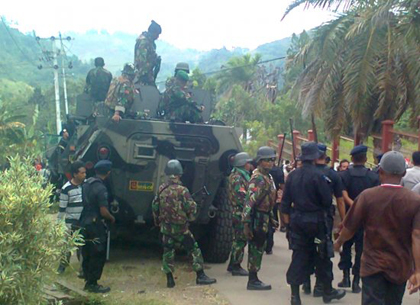
The recent armed police and military raids of Papuan students’ dormitories in Java and Bali are an indication of what is likely to come on Dec. 1. The recent Papuan voices that have leaked out thanks to the Internet indicate that there are plans for at least a “Morning Star” flag rising in Papua on that date. Although the government has cracked down hard on similar events in the past, it is unthinkable to imagine that the people of Papua have been cowed into submission by these repressions. Just as Indonesian youth defied the Dutch colonialists in the early 20th century and continued to raise the “Red and White,” so will the youths of Papua. After all, most Papuan youth leaders were educated in Indonesia, so they fully understand that perseverance pays and aspirations for independence cannot be stifled by force. Yhe more Indonesia uses force to keep its hold on Papua, the stronger its independence movement will become.

Papuan activists can also see how Islamists in Indonesia can actively work to destroy the country not only with impunity, but also with the tacit support of the state and members of the government. The Islamist party, Hizbut Tahrir, for example, openly agitates for the fall of the republic to build a global Islamic caliphate in its place, but the authorities tend to aid and support it rather than take action to hinder its activities. Islamists in the country openly work for the resurrection of the age of the Islamic caliphs, or at least work toward their version of Shariah being enshrined as state law, but even though these activities are in blatant contempt of our constitution, the government has never done so much as lift a little finger in defense of the republic and its principles in the face of these orchestrated attacks.

Therefore it is natural that activists from Papua feel that they are being continuously discriminated against, for they receive the harshest treatment for the simple activity of raising a flag.

So who is it that is working hardest to compel Papua break away? Are the people of Papua to blame for objecting to having their sacred lands ripped apart by corporations making profits for shareholders far away? Are they to blame if they do not trust Indonesia’s capacity or intent to develop the country along the lines of the constitution?

If Indonesia wants to keep Papua as part of the family, it needs to clean up its act, especially in curbing Islamist treason and protecting minorities. It also needs to open up Papua to the world and come clean and apologize for the wrongs it has inflicted on the people there. As Dec. 1 approaches, we can expect that the national government will try to further alienate Papuans to a point where the only way forward will be through a sea of blood.

Bramantyo Prijosusilo is a writer, artist and broadcast journalist in East Java.


SIGHTS AND SOUNDS FROM THE FREEPORT DISPUTE

by Lococonut

via our partners at EngageMedia.org

A snippet of footage and chatters around the Freeport strike in West Papua. The Freeport workers’ union says it is a matter of simple “revenue transparency”, the international trade union says the dispute “has nothing to do with” West Papua politics, and a worker recorded in his video testimony that the walk-out was something “important” and worth keeping.

 05:36
video information
produced by Lococonut
produced Nov 04, 2011
FULL DESCRIPTION

The Geneva-based International Federation of Chemical, Energy, Mine and General Workers’ Unions (ICEM), its Australian affiliated group Australia’s Construction, Forestry, Mining and Energy Union (CFMEU) and the Freeport Indonesia Workers’ Union, SP KEP SPSI, met in Jakarta from October 30 to November 2, 2011.

In this video, SP KEP SPSI was represented by Airan Koibur, ICEM was represented by Information and Campaign OfficerDick Blin, and Wayne McAndrew spoke for the CFMEU.

Freeport strike: Police accused of siding with Freeport. Union given one-day ultimatum

Bintang Papua, 31 October 2011
[Abridged in translation by TAPOL]Timika: The actions taken by the police in Mimika have created the impression that the police are siding with Freeport-Indonesia, said a commissioner of Komnas HAM, the National Human Rights Commission, Ridha Saleh. In an interview with Kompas, he said that the police have warned that firm measures are being planned against the strike and the blockade set up by Freeport workers if  the blockade is not lifted within two days.

‘The measures being planned by the police reinforce the impression that, along with the money being paid by Freeport to the security forces, they are siding with the company,’ he said.

Ridha said that there was nothing unconstitutional about the strike and therefore workers should not be dispersed. The police in Mimika are going too far, he said. These measures would also  damage the negotiations now under way between the two sides  which are currently proceeding well.

‘We intend to talk to the police and ask them to abandon these measures. We also intend to speak to the national chief of police and the chief of police in Papua.’

The strike which started on 15 September is intended to persuade the company to pay attention to the welfare of the workers. The increase in wages offered by the company is not acceptable, in view of  terrain in which they work and the risks involved.

Police ultimatum to the workers:

The executive of the Freeport branch of the trade union, the SPSI, have been given an ultimatum by the police in Mimika, not to spread the strike to Mile 28, Mile 27 and Gorong-Gorong. The ultimatum was contained in a letter dated 30 October, along with a request to open access  which has been blocked by strikers. The police along with other security forces have given an ultimatum of only 24 hours, starting from the moment this request is made, for the strikers to conform with the regulations in force. ‘If this does not happen, the police will take firm action in accordance with the regulations in force,’ the letter from the police says.

The SPSI was also told to co-ordinate with the strikers  and ensure that the laws in force are not violated.

According to the police, the basis for these measures is the Criminal Code, Law 9/1998 on Freedom of Expression and Law 13/2003 on Labour Relations.

The chief of police in Mimika has also said that conditions  in the vicinity of Freeport-Indonesia are becoming less and less conducive  as a result of the strike which is, according to the police, being conducted in violation of the earlier notification given by the trade union.

According to the police, a number of anarchic actions have occurred in violation of strike regulations. Moreover, the workers have started holding demonstrations  without having informed the police, blocking access to a ‘vital national asset’ and disturbing the public order. [The police ultimatum goes on  mention a long list of laws and regulations which are deemed to have been violated by the strikers.]

The police ultimatum to the SPSI has also been sent to the governor of Papua, the chairman of the Mimika DPRP, the commander of the Cenderawasih Military Command, the President-Director of Freeport and other relevant agencies.

Maire Leadbeater reflects on West Papua’s ‘Arab Spring’

November 1, 2011
Indonesian forcesIndonesian security forces staking out the Third Papuan People’s Congress in Jayapura earlier this month. Photo: West Papua Media

Pacific Scoop:
Opinion – By Maire Leadbeater

It was not in the headlines, but our neighbourhood has had its own ‘Arab Spring’. The Melanesian people of Indonesian-controlled West Papua, have shown the same determination to pursue non-violent struggle as their counterparts in Egypt and Syria.

A 5000-strong Third Papuan People’s Congress took place over three days in a Jayapura field ringed with menacing armoured riot control vehicles and heavily armed police and soldiers. It was led by Forkorus Yaboisembut, chair of the Papuan Customary Council, who is highlighted on the Indonesian military’s leaked watch list of dangerous “separatists”.

As the Congress came to an end on October 19, Forkorus read a Declaration of Independence first penned in 1961, prior to the Indonesian take-over of the territory.

He then announced that he had been elected to be the “President” of the “Democratic Republic of West Papua”.

As the gathering began to disperse, the military began firing from their assault weapons and launched themselves on the crowd, arresting and beating some 300 people. Forkorus was forcibly arrested along with his “Prime Minister” Edison Waromi and they and three others now face charges of treason.

Dozens were injured, many with gunshot wounds, and up to six people were killed. The first death to be confirmed was that of a law student Daniel Kadepa who was shot in the head as he tried to flee.

Many terrified delegates tried to seek refuge in the nearby Catholic Seminary. Fr Neles Tebay, a prominent advocate for peaceful dialogue, has supplied a detailed account of the violent disruption and brutality displayed as the soldiers invaded the sacrosanct mission complex.

Terrified students
Terrified students were tear-gassed and threatened at gunpoint while one Franciscan brother was taken into custody despite the serious injuries he sustained in the attack.

A menacing security force presence is also ongoing in the remote Timika region, location of Freeport McMoRan mine, where an American multinational makes vast profits from the largest recoverable reserves of gold and copper in the world. About 8000 workers have been on strike since September seeking to lift their wages from the current hourly rate of around NZ $1.80 to $3.60 to parity with the wages paid to Freeport’s workers in other parts of the world.

Petrus Ayamiseba, one of the striking workers, was shot dead by the Indonesian police on October 10, provoking Papuan outrage and an unprecedented level of international union solidarity for the Freeport workers. Since then at least three others have been killed in the area by unknown assailants.

Rather than conciliation, the mine management has resorted to hiring contract workers as scabs.

Freeport McMoRan has had a dream run for more than 40 years. The first contract negotiated with President Suharto gave the mining company virtually free rein as well as generous tax concessions. This was in 1967 when Indonesia did not even have formal control over the territory.

In 1969, Indonesia pulled off a self-determination fraud by conducting a so called “Act of Free Choice” ( known as the “Act of No Choice” to the indigenous Papuans). Just over a thousand Papuan men took part out of a population at the time of nearly one million.

The Freeport mine has always been synonymous with violence and grave human rights abuses, as well as environmental destruction and the abuse of customary land rights. Amungme and Kamoro tribal people have had little recourse but to watch as the mine took over their lands and “decapitated” their sacred mountain.

Gunned down
In the last few years, especially since some Western mine employees were gunned down on the mine access road, the company has come under international scrutiny. However, the Jakarta government is in no hurry to interrupt the flow of taxes, dividends and royalties from Freeport, its biggest taxpayer.

There is an ongoing controversy around the way in which Freeport pays out millions of dollars so that Indonesian military and police forces can provide its security. Direct payments to individual police officers were supposed to have stopped, but the National Police Chief Timur Pradopo revealed in October that these payments of “lunch money” continue.

The security forces have a direct stake in a level of ongoing insecurity, a factor many believe underlies much of the violence in the area.

Following recent events, Indonesia has sent in yet more police and tried to justify the scandalous actions of its security forces as necessary to deal with “separatism”.

Why has New Zealand made no public statement condemning this latest crackdown? Our Government Superannuation fund and other Crown Financial Institutes invest in Freeport McMoRan.

Both government and the Superannuation Fund Board have so far resisted all calls to follow the ethical example of the Norwegian Government Pension Fund which divested from Freeport in 2006.

The New Zealand Minister of Defence recently talked about increasing our defence ties with Indonesia by extending the training we currently offer to Indonesian officers and hosting some “higher level” visits of Indonesian personnel. We also have an NZAID training programme for the mainly migrant West Papua police.

We promote “community policing”, a non-confrontational model that is about as far from current Papuan police practice as it is possible to imagine.

The buzz word is “engagement” – if we talk nicely, the military and police will learn not to open fire on unarmed civilians and Freeport will improve its human rights and environmental standards. Instead we should go with the tide of history, and start listening to West Papuan leaders who want us to support their call for peaceful dialogue

Maire Leadbeater is spokesperson for the Indonesia Human Rights Committee. This article was first published on the New Zealand Herald Online.

West Papua at Boiling Point: Strike at Freeport Mine

Astronaut photo of the Grasberg Mine in Papua ...
Image via Wikipedia

Workers at Freeport McMoran‘s Grasberg mine in West Papua, one of the world’s biggest copper and gold mines, have been on strike since September 15th. Their immediate demand is a large wage increases to bring their salary into line with what the company pays its workers in other countries. The conflict has raged over the past six weeks with unremitting action and brutal repression, bringing the company to its knees at a time when Papua is in turmoil generally.

Several people have already lost their lives around the mine, which has been an ongoing source of tension in West Papua since the 1960s. On Monday 10th October police opened fire on striking miners as they tried to gain access to company premises. One man, Petrus Ayamseba was killed in the incident. Several others were wounded, and one of these, Leo Wandagau, died of his injuries five days later.

There have also been three incidences of shooting along the road that leads to the Freeport mine. Three contract workers were killed in an ambush on Friday 14th October, and then another three men were also killed a week later. Three police officers from the mobile brigade narrowly escaped when their vehicle was shot at on October 26. The perpetrators and their connection with the strike remain unknown. Such ambushes have happened on many occasions in the past in the area. Security forces routinely blame the actions on OPM guerrillas who are fighting for an independent West Papua. However as US-based solidarity group West Papua Action Team explains, “In the past, similar assaults against security and Freeport personnel have been attributed to conflicts among police, military and Freeport security personnel who have long feuded over the division of spoils from extortion practices that target Freeport, as well as conflict over freelance gold-mining efforts by local people.”

The struggle of workers, nevertheless, continues unabated: The strikers have kept up a blockade of the road leading to the mine, with the result that food and medicine supplies have run very low at the mine (although reportedly the local Papuan community near the mine is also suffering from this blockade). The company was also forced to shut production when it discovered that the 60-mile long pipeline carrying gold and copper concentrate from the mine to the port had been sabotaged in several places. Freeport has claimed that it has been able to repair the pipe and resume operations, although on 26th October it had to declare ‘force majure’ meaning that it would not be able to meet its contractual obligations to supply metal concentrates to its customers.

Aside from the shootings mentioned above there have been acts of intimidation from the company. The chief negotiator of the All Indonesia Workers Union (SPSI) which represents the striking workers, Sudiro, was sitting on the verandah of his house when a shot from a silenced gun hit a bowl on a table beside him. He understood this incident as a death threat rather than a direct attempt on his life.

Anger and suspicion in the workers remains high. Duma Tato Sanda, a journalist working for Cahaya Papua, told Papuan newspaper Jubi how he was beaten by the striking workers when he was trying to research a story about an action involving the burning of three Freeport trucks. ‘I said that I was a journalist but nevertheless they beat me and threw stones at me. Luckily, someone came by on a motor-bike otherwise I could have been killed from being beaten by so many people.’ Apparently the workers are reacting to the links which Freeport has made with other journalists, and so see journalists as a threat.

Solidarity actions with the strike have taken place outside of Papua. On the second day of ‘Occupy Jakarta’ protests, the Freeport building in the Indonesian capital was chosen as a focus for the action, and in the US city of Phoenix, activists planned to picket Freeport’s global headquarters on October 28th. In Yogyakarta on the 13th of Octob er and Jakarta on the 26th October there were also demonstrations, but with the demand that the Freeport mine be nationalised. This analysis might fit uneasily with the wishes of many Papuans, who quite clearly identify the Indonesian State as part of the oppression they face, just as much as foreign corporations.

solidarity action in Jakarta

All this is taking place in a moment of intense turmoil for Papuans. At the same time as the actions around Freeport, security forces violently broke up the third Papuan People’s Congress, being held outside Jayapura. With the excuse that the meeting of many thousands of people had decided to call for independence, troops dispersed the crowd using live ammunition. Over the following days six bodies were found in the area. Three-hundred people were arrested, six of which are currently being charged with treason.

Then on the 24th of October, in Mulia in Puncak Jaya two men jumped on the local police chief, Adj. Comr. Dominggus Oktavianus Awes at Mulia airport and used his gun to shoot him dead. The remote Puncak Jaya regency has been the scene of many of the state’s most brutal operations over the past several years, including village burnings, murder, rape and sweeping operations that terrorise the whole community. The Vanuatu-based international spokesperson of the Free Papua Movement (OPM), John Otto Ondawame did not say whether or not this was the work of the OPM, but did make the point that Dominggus had been one of “those who must take responsibility for the series of crimes against humanity in Puncak Jaya.”

Of course the links between the Freeport strike and the wider struggles of the Papuan people for peace and self-determination are not straightforward. But the climate of tension which has put Papua on edge right at the moment surely has its effects on the mineworkers too, as they struggle to make a decent living from this company whose presence in Papua has long been one of the key reasons for the continued militarisation across the whole island, as well as widespread ecological destruction.

Freeport McMoran is a US company headquartered in Phoenix, Arizona, US,although its Grasberg mine in Papua is operated in a joint venture with UK-Australian Rio Tinto, which recieves 40% of the mine’s profits.

http://hidupbiasa.blogspot.com/2011/10/west-papua-at-boiling-point-strike-at.html

Create a website or blog at WordPress.com

Up ↑