Freeport strike: Police accused of siding with Freeport. Union given one-day ultimatum

Bintang Papua, 31 October 2011
[Abridged in translation by TAPOL]Timika: The actions taken by the police in Mimika have created the impression that the police are siding with Freeport-Indonesia, said a commissioner of Komnas HAM, the National Human Rights Commission, Ridha Saleh. In an interview with Kompas, he said that the police have warned that firm measures are being planned against the strike and the blockade set up by Freeport workers if  the blockade is not lifted within two days.

‘The measures being planned by the police reinforce the impression that, along with the money being paid by Freeport to the security forces, they are siding with the company,’ he said.

Ridha said that there was nothing unconstitutional about the strike and therefore workers should not be dispersed. The police in Mimika are going too far, he said. These measures would also  damage the negotiations now under way between the two sides  which are currently proceeding well.

‘We intend to talk to the police and ask them to abandon these measures. We also intend to speak to the national chief of police and the chief of police in Papua.’

The strike which started on 15 September is intended to persuade the company to pay attention to the welfare of the workers. The increase in wages offered by the company is not acceptable, in view of  terrain in which they work and the risks involved.

Police ultimatum to the workers:

The executive of the Freeport branch of the trade union, the SPSI, have been given an ultimatum by the police in Mimika, not to spread the strike to Mile 28, Mile 27 and Gorong-Gorong. The ultimatum was contained in a letter dated 30 October, along with a request to open access  which has been blocked by strikers. The police along with other security forces have given an ultimatum of only 24 hours, starting from the moment this request is made, for the strikers to conform with the regulations in force. ‘If this does not happen, the police will take firm action in accordance with the regulations in force,’ the letter from the police says.

The SPSI was also told to co-ordinate with the strikers  and ensure that the laws in force are not violated.

According to the police, the basis for these measures is the Criminal Code, Law 9/1998 on Freedom of Expression and Law 13/2003 on Labour Relations.

The chief of police in Mimika has also said that conditions  in the vicinity of Freeport-Indonesia are becoming less and less conducive  as a result of the strike which is, according to the police, being conducted in violation of the earlier notification given by the trade union.

According to the police, a number of anarchic actions have occurred in violation of strike regulations. Moreover, the workers have started holding demonstrations  without having informed the police, blocking access to a ‘vital national asset’ and disturbing the public order. [The police ultimatum goes on  mention a long list of laws and regulations which are deemed to have been violated by the strikers.]

The police ultimatum to the SPSI has also been sent to the governor of Papua, the chairman of the Mimika DPRP, the commander of the Cenderawasih Military Command, the President-Director of Freeport and other relevant agencies.

Maire Leadbeater reflects on West Papua’s ‘Arab Spring’

November 1, 2011
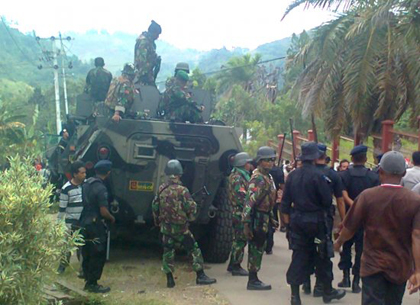
Indonesian forcesIndonesian security forces staking out the Third Papuan People’s Congress in Jayapura earlier this month. Photo: West Papua Media

Pacific Scoop:
Opinion – By Maire Leadbeater

It was not in the headlines, but our neighbourhood has had its own ‘Arab Spring’. The Melanesian people of Indonesian-controlled West Papua, have shown the same determination to pursue non-violent struggle as their counterparts in Egypt and Syria.

A 5000-strong Third Papuan People’s Congress took place over three days in a Jayapura field ringed with menacing armoured riot control vehicles and heavily armed police and soldiers. It was led by Forkorus Yaboisembut, chair of the Papuan Customary Council, who is highlighted on the Indonesian military’s leaked watch list of dangerous “separatists”.

As the Congress came to an end on October 19, Forkorus read a Declaration of Independence first penned in 1961, prior to the Indonesian take-over of the territory.

He then announced that he had been elected to be the “President” of the “Democratic Republic of West Papua”.

As the gathering began to disperse, the military began firing from their assault weapons and launched themselves on the crowd, arresting and beating some 300 people. Forkorus was forcibly arrested along with his “Prime Minister” Edison Waromi and they and three others now face charges of treason.

Dozens were injured, many with gunshot wounds, and up to six people were killed. The first death to be confirmed was that of a law student Daniel Kadepa who was shot in the head as he tried to flee.

Many terrified delegates tried to seek refuge in the nearby Catholic Seminary. Fr Neles Tebay, a prominent advocate for peaceful dialogue, has supplied a detailed account of the violent disruption and brutality displayed as the soldiers invaded the sacrosanct mission complex.

Terrified students
Terrified students were tear-gassed and threatened at gunpoint while one Franciscan brother was taken into custody despite the serious injuries he sustained in the attack.

A menacing security force presence is also ongoing in the remote Timika region, location of Freeport McMoRan mine, where an American multinational makes vast profits from the largest recoverable reserves of gold and copper in the world. About 8000 workers have been on strike since September seeking to lift their wages from the current hourly rate of around NZ $1.80 to $3.60 to parity with the wages paid to Freeport’s workers in other parts of the world.

Petrus Ayamiseba, one of the striking workers, was shot dead by the Indonesian police on October 10, provoking Papuan outrage and an unprecedented level of international union solidarity for the Freeport workers. Since then at least three others have been killed in the area by unknown assailants.

Rather than conciliation, the mine management has resorted to hiring contract workers as scabs.

Freeport McMoRan has had a dream run for more than 40 years. The first contract negotiated with President Suharto gave the mining company virtually free rein as well as generous tax concessions. This was in 1967 when Indonesia did not even have formal control over the territory.

In 1969, Indonesia pulled off a self-determination fraud by conducting a so called “Act of Free Choice” ( known as the “Act of No Choice” to the indigenous Papuans). Just over a thousand Papuan men took part out of a population at the time of nearly one million.

The Freeport mine has always been synonymous with violence and grave human rights abuses, as well as environmental destruction and the abuse of customary land rights. Amungme and Kamoro tribal people have had little recourse but to watch as the mine took over their lands and “decapitated” their sacred mountain.

Gunned down
In the last few years, especially since some Western mine employees were gunned down on the mine access road, the company has come under international scrutiny. However, the Jakarta government is in no hurry to interrupt the flow of taxes, dividends and royalties from Freeport, its biggest taxpayer.

There is an ongoing controversy around the way in which Freeport pays out millions of dollars so that Indonesian military and police forces can provide its security. Direct payments to individual police officers were supposed to have stopped, but the National Police Chief Timur Pradopo revealed in October that these payments of “lunch money” continue.

The security forces have a direct stake in a level of ongoing insecurity, a factor many believe underlies much of the violence in the area.

Following recent events, Indonesia has sent in yet more police and tried to justify the scandalous actions of its security forces as necessary to deal with “separatism”.

Why has New Zealand made no public statement condemning this latest crackdown? Our Government Superannuation fund and other Crown Financial Institutes invest in Freeport McMoRan.

Both government and the Superannuation Fund Board have so far resisted all calls to follow the ethical example of the Norwegian Government Pension Fund which divested from Freeport in 2006.

The New Zealand Minister of Defence recently talked about increasing our defence ties with Indonesia by extending the training we currently offer to Indonesian officers and hosting some “higher level” visits of Indonesian personnel. We also have an NZAID training programme for the mainly migrant West Papua police.

We promote “community policing”, a non-confrontational model that is about as far from current Papuan police practice as it is possible to imagine.

The buzz word is “engagement” – if we talk nicely, the military and police will learn not to open fire on unarmed civilians and Freeport will improve its human rights and environmental standards. Instead we should go with the tide of history, and start listening to West Papuan leaders who want us to support their call for peaceful dialogue

Maire Leadbeater is spokesperson for the Indonesia Human Rights Committee. This article was first published on the New Zealand Herald Online.

West Papua at Boiling Point: Strike at Freeport Mine

Astronaut photo of the Grasberg Mine in Papua ...
Image via Wikipedia

Workers at Freeport McMoran‘s Grasberg mine in West Papua, one of the world’s biggest copper and gold mines, have been on strike since September 15th. Their immediate demand is a large wage increases to bring their salary into line with what the company pays its workers in other countries. The conflict has raged over the past six weeks with unremitting action and brutal repression, bringing the company to its knees at a time when Papua is in turmoil generally.

Several people have already lost their lives around the mine, which has been an ongoing source of tension in West Papua since the 1960s. On Monday 10th October police opened fire on striking miners as they tried to gain access to company premises. One man, Petrus Ayamseba was killed in the incident. Several others were wounded, and one of these, Leo Wandagau, died of his injuries five days later.

There have also been three incidences of shooting along the road that leads to the Freeport mine. Three contract workers were killed in an ambush on Friday 14th October, and then another three men were also killed a week later. Three police officers from the mobile brigade narrowly escaped when their vehicle was shot at on October 26. The perpetrators and their connection with the strike remain unknown. Such ambushes have happened on many occasions in the past in the area. Security forces routinely blame the actions on OPM guerrillas who are fighting for an independent West Papua. However as US-based solidarity group West Papua Action Team explains, “In the past, similar assaults against security and Freeport personnel have been attributed to conflicts among police, military and Freeport security personnel who have long feuded over the division of spoils from extortion practices that target Freeport, as well as conflict over freelance gold-mining efforts by local people.”

The struggle of workers, nevertheless, continues unabated: The strikers have kept up a blockade of the road leading to the mine, with the result that food and medicine supplies have run very low at the mine (although reportedly the local Papuan community near the mine is also suffering from this blockade). The company was also forced to shut production when it discovered that the 60-mile long pipeline carrying gold and copper concentrate from the mine to the port had been sabotaged in several places. Freeport has claimed that it has been able to repair the pipe and resume operations, although on 26th October it had to declare ‘force majure’ meaning that it would not be able to meet its contractual obligations to supply metal concentrates to its customers.

Aside from the shootings mentioned above there have been acts of intimidation from the company. The chief negotiator of the All Indonesia Workers Union (SPSI) which represents the striking workers, Sudiro, was sitting on the verandah of his house when a shot from a silenced gun hit a bowl on a table beside him. He understood this incident as a death threat rather than a direct attempt on his life.

Anger and suspicion in the workers remains high. Duma Tato Sanda, a journalist working for Cahaya Papua, told Papuan newspaper Jubi how he was beaten by the striking workers when he was trying to research a story about an action involving the burning of three Freeport trucks. ‘I said that I was a journalist but nevertheless they beat me and threw stones at me. Luckily, someone came by on a motor-bike otherwise I could have been killed from being beaten by so many people.’ Apparently the workers are reacting to the links which Freeport has made with other journalists, and so see journalists as a threat.

Solidarity actions with the strike have taken place outside of Papua. On the second day of ‘Occupy Jakarta’ protests, the Freeport building in the Indonesian capital was chosen as a focus for the action, and in the US city of Phoenix, activists planned to picket Freeport’s global headquarters on October 28th. In Yogyakarta on the 13th of Octob er and Jakarta on the 26th October there were also demonstrations, but with the demand that the Freeport mine be nationalised. This analysis might fit uneasily with the wishes of many Papuans, who quite clearly identify the Indonesian State as part of the oppression they face, just as much as foreign corporations.

solidarity action in Jakarta

All this is taking place in a moment of intense turmoil for Papuans. At the same time as the actions around Freeport, security forces violently broke up the third Papuan People’s Congress, being held outside Jayapura. With the excuse that the meeting of many thousands of people had decided to call for independence, troops dispersed the crowd using live ammunition. Over the following days six bodies were found in the area. Three-hundred people were arrested, six of which are currently being charged with treason.

Then on the 24th of October, in Mulia in Puncak Jaya two men jumped on the local police chief, Adj. Comr. Dominggus Oktavianus Awes at Mulia airport and used his gun to shoot him dead. The remote Puncak Jaya regency has been the scene of many of the state’s most brutal operations over the past several years, including village burnings, murder, rape and sweeping operations that terrorise the whole community. The Vanuatu-based international spokesperson of the Free Papua Movement (OPM), John Otto Ondawame did not say whether or not this was the work of the OPM, but did make the point that Dominggus had been one of “those who must take responsibility for the series of crimes against humanity in Puncak Jaya.”

Of course the links between the Freeport strike and the wider struggles of the Papuan people for peace and self-determination are not straightforward. But the climate of tension which has put Papua on edge right at the moment surely has its effects on the mineworkers too, as they struggle to make a decent living from this company whose presence in Papua has long been one of the key reasons for the continued militarisation across the whole island, as well as widespread ecological destruction.

Freeport McMoran is a US company headquartered in Phoenix, Arizona, US,although its Grasberg mine in Papua is operated in a joint venture with UK-Australian Rio Tinto, which recieves 40% of the mine’s profits.

http://hidupbiasa.blogspot.com/2011/10/west-papua-at-boiling-point-strike-at.html

URGENT ALERT: Indonesian police plan to break Freeport Workers Strike

From Indonesian Solidarity (Aust)

31st October 2011

MEDIA RELEASE
Indonesian police plan to break Freeport Workers Strike.

According to Mr Albar Sabang, the Secretary of the All Indonesian Workers Union (SPSI), Freeport Indonesia Division, “four panzers, one backhoe and one bulldozer are on the way to mile 27 of the Freeport area in Mimika”. They plan to break the strike by November 1st, when the delegation of ICEM (a member of the CFMEU is part of the ICEM delegation) will meet with the Freeport unionists in Jakarta.

In a letter that was sent to SPSI, the Mimika police commander Deny Edward Siregar states that the SPSI has breached laws such as the Indonesian criminal law, and regulation 13/2003 that regulate the
workers’ conduct. In his letter the police commander says that “the strike has shifted its orientation, and become demonstrations without asking permission from the police and has blocked access to
roads that are vitally important for the national interests”. Further he states that the strikers “have moved from CP north to CP-1, Mile 27 and Gorong-Gorong”. And the strikers “have disturbed public order”. However, the Freeport Workers have followed all the right procedures in their strike while PT Freeport Indonesia has disbursed US$14 million of funds to Indonesian National Police and Military (TNI) to protect Freeport.

Gorong-Gorong is the area where Peter Ayameseba, one of the striking workers, was shot dead by the police in protests that occurred on October 10th.

The police rationale to break the strike, in addition to what the Mimika police commander has said, is that the strikers have pressured Freeport Indonesia, and gained a lot of solidarity support both in Indonesia and overseas. Freeport’s declaration this week of “force majeure” on some concentrate sales from its strike-hit Grasberg mine in Papua was another piece evidence that the strike has been effective.

Freeport Indonesia workers reportedly receive the lowest salaries among all Freeport McMoRan (FM) workers around the world, with wages ranging from US$1.50–$3.00 per hour. Meanwhile SPSI continues negotiating with Freeport Indonesia and demands to have US$7.5 to $33 per hour for workers level 1-3.

On 19th October 2011, the Indonesian military and police attacked the peaceful Papuan People’s Congress and six people were killed, more than 300 were taken into custody, the leaders accused of treason, and many others were beaten with rattan canes and batons by police and soldiers.

Freeport workers can be contacted via Yuly Parorongan as a spokeperson of the Freeport union at +6285254951253 and Frans Okoseray at +6181240492446

_____________________________________________________________________
Indonesian Solidarity is an independent, non-profit organisation that supports human rights, social justice and democracy in Indonesia, and promotes a better understanding in Australia of these issues.

NZ Media ‘blindfolded’ over West Papua crisis, say critics

from our partners at the Pacific Media Centre

Forkorus Yoboisembut … elected West Papuan “president” at the last week’s Papuan People’s Congress and arrested by Indonesian forces. Photo: EngageMedia

Friday, October 28, 2011

Item: 7692

AUCKLAND(Pacific Media Watch): As tensions escalate in the Indonesian-occupied Melanesian region of West Papua, there is growing criticism over the lack of information in the mainstream New Zealand media about the troubled area.

Last week, the third Papuan People’s Congress was held in Abepura, on the outskirts of Jayapura. It was a peaceful rally of thousands of West Papuans who had gathered to celebrate their culture, hold talks and elect their representatives.

When the Morning Star flag was raised and cries of “merdeka” (independence) were heard by the strong Indonesian military presence, gunshots rang out and violencefollowed.

Deaths and mass arrests
The newly-elected “president” Forkorus Yoboisembut, chairman of the Papuan Customary Council (DAP), was arrested along with hundreds of others and reports emerged of up to six deaths.

On Monday, Indonesian police chief Adj. Comr. Dominggus Awes was gunned downon the tarmac of Mulia Airport. The People’s Liberation Army of West Papua or OPM, were accused of being involved but have since denied it.

And on a completely separate event, at least seven people have died over the past few weeks during the controversial strike over low wages at the US-owned Freeport McMoRan mine.

So far, only the public broadcaster, Radio New Zealand International, and independent media outlets such as Pacific Scoop have paid any attention. In the international pages of the main newspapers, Europe and other parts of the world have featured, but nothing about our own region.

NZ ‘not part of Pacific’
Dr Steven Ratuva, senior lecturer in Pacific studies at the University of Auckland, says New Zealand likes to consider itself a Pacific country, but can’t, as its interests lie elsewhere.

“There is nothing in terms of media coverage that gives the impression that New Zealand is part of the Pacific,” he says.

“It’s a dilemma that New Zealand is facing – on one level it claims to be a Pacific country but the New Zealand Herald has only one Pacific reporter, and TVNZ the same.”

Dr Ratuva sources his information from places such as West Papua from blogs as well as “internet sources outside the mainstream media”.

He says the main reason is politics.

“The [Pacific Islands] Forum, at the last meeting didn’t want to touch it. Indonesia is a significant player in the region and has links with Australia and New Zealand,” he says.

“Papua New Guinea doesn’t want to acknowledge it, even though it shares a border with West Papua, due to its fears of Indonesia.”

Dr Teresia Teaiwa, senior lecturer in Pacific studies, at Va’aomanu Pasifika Victoria University of Wellington, says mainstream print and television media leave a lot to be desired.

‘Inanely insular’
“If it’s not a major crisis or related to a major crisis, don’t expect it to be covered,” she says.

“I’ve stopped reading mainstream newspapers because of how inanely insular they are.

“I was surprised at how little coverage the Occupy Wall Street movement got in theDominion Post a couple of weeks ago. If a significant first world movement isn’t getting any serious attention in our newspapers, how can we expect informed and engaged journalism on issues in the Pacific Islands from New Zealand media?”

Dr Heather Devere from the National Centre for Peace and Conflict Studies says New Zealand is inward-looking.

“I do think we are more insular here,” she says.

“I’m not sure that it is so much a concerted effort to ignore rather than a genuine ignorance.”

Journalism education
While others say it is mostly economic pressures on newsrooms, Dr Devere says the issue with media goes back to the education of journalists.

“So many students seem to be attracted to the communication discipline as a chance to be a celebrity rather than an investigative journalist,” she says.

“There is very little content in the training so journalists do not have knowledge about the situations on which they have to report.”

Director of the Pacific Media Centre and journalism educator Dr David Robie is even more critical of the current New Zealand media role in informing the public about events in the region.

He says local media rely too much on international and digital syndications and few journalists dedicated to tailoring international news for a New Zealand perspective.

News judgment ‘parochial’
“There are very few genuine international affairs editors in New Zealand media organisations, specialists in global news who have either done the hard yards themselves as foreign correspondents or have expert background knowledge,” he says.

“So news judgment is often weak and parochial.”

He said it is a shame that New Zealand is shown up by other media organisations abroad.

“It’s extremely embarrassing and it makes a mockery of our claim to be part of the Pacific,” he says. “We really need to up our game.

“When a Middle East-based global news service like Al Jazeera find it important enough to send teams to cover New Caledonia and West Papua, for example, it is an indictment of our own coverage and news values that we fail to match this. I cannot recall the last time that I saw an in-depth TV report in New Zealand on the French Pacific.”

Melanesia loses out
Dr Robie says that most Pacific news published in mainstream New Zealand media is from the Polynesia, while Melanesia and Micronesia are largely ignored.

“It is very rare to see good, in-depth coverage of Melanesian and Micronesian affairs in New Zealand media, with the brave and committed exceptions of Pacific specialists such as Barbara Dreaver on TVNZ,” he says. He also praised Radio NZ International coverage.

“Yet two Melanesian nations are the economic ‘superpowers’ in the region – Papua New Guinea and Fiji. Since the fourth coup in December 2006, there has hardly been any serious journalism about Fiji any more other than extraordinarily biased polemics masquerading as journalism about the regime.

“The country’s censorship law and an inflexible regime don’t make it easy, but far better reporting could still be done in spite of the problems.

“In this context, West Papua barely exists. If even neighbouring Papua New Guinea falls below the radar then there is little hope for West Papua getting fair and informed coverage.”

Australia fares better
In the Australian media, Fairfax’s Sydney Morning Herald has been following the West Papua issue over the last few weeks.

Its coverage has compared with Radio Australia’s Pacific Beat programme. Yet here in New Zealand, no mainstream media has taken it up apart from Radio NZ International.

“I think we are extremely fortunate that there are still a few state-owned broadcasting outfits like RNZI in this country and ABC in Australia that have dedicated Pacific programmes,” says Dr Teaiwa.

“And I’m not sure whether to celebrate or lament this. But often some of the most illuminating stories come from student journalists who have not yet learned to surrender to the wider industry’s demands and values.”

Maire Leadbeater, from the Auckland-based Indonesia Human Rights Committee, and a campaigner for human rights in West Papua, wrote an article in a 2008 edition ofPacific Journalism Review about what she argued was New Zealand’s biggest media blind spot.

If we are unsure that very little has changed in the past three years, perhaps the New ZealandHerald’s approach to West Papua during the Rugby World Cup could clarify the situation:

West Papua‘s moment’

CupShorts took CupShorts jnr to Pt Chevalier playground where we bumped into an off-duty Green Party MP. “Why is the media so obsessed with the World Cup?” she asked. “Big issues are being missed. We just had a delegation here from West Papua and there was no press coverage on them at all.”

A fair point. And one that we’re only too happy to remedy. So, for the record, West Papua is currently part of Indonesia (no IRB ranking). However, if they got independence they might someday hope to rival neighbouring Papua New Guinea (rated 46th in the IRB rankings). Good luck to them.”

PMC

Create a website or blog at WordPress.com

Up ↑