Letters of solidarity flood in their thousands for Filep Karma

by a Special Correspondent for West Papua Media in Abepura

March 19, 2012
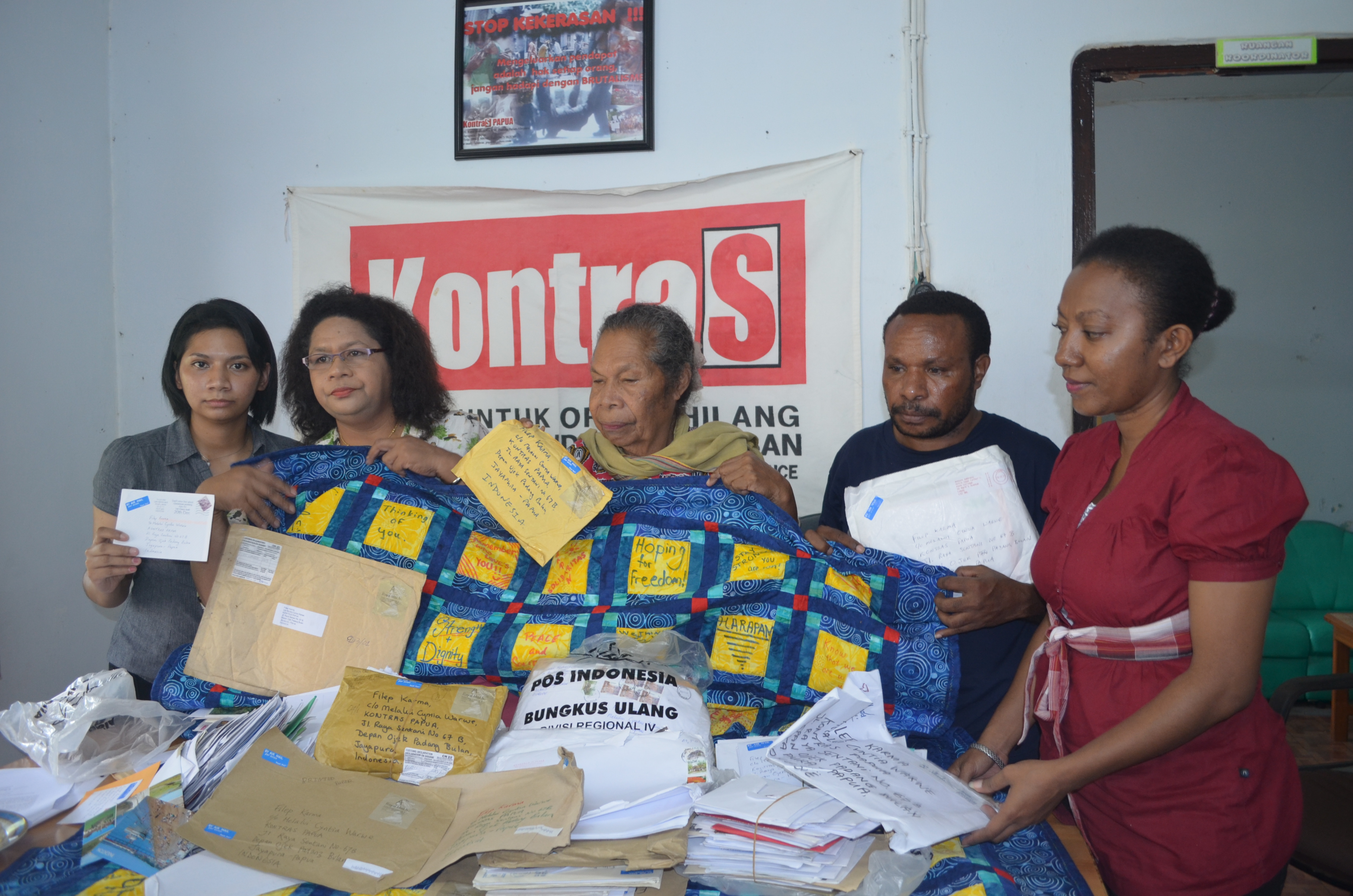
Kontras and Filep Karma's family with some of the nearly 7300 letters sent by international supporters of Karma (Photo: West Papua Media)

Filep Karma, is one of the political prisoners given sentences of 15 years of imprisonment by the government of Indonesia, by raising the Morning Star flag, on December 1, 2004, at Trikora field, Abepura. Ever since a period of 7 years, and 3 months of his prison sentence  have lasted in Abepura prison. During captivity Filep Karma received letters of solidarity sent by the International community through the office of the Commission for missing people and victims of violence in Papua (KontrasPapua).   Nearly 7292 letters of support have been sent in the period of 2011 untill 2012.
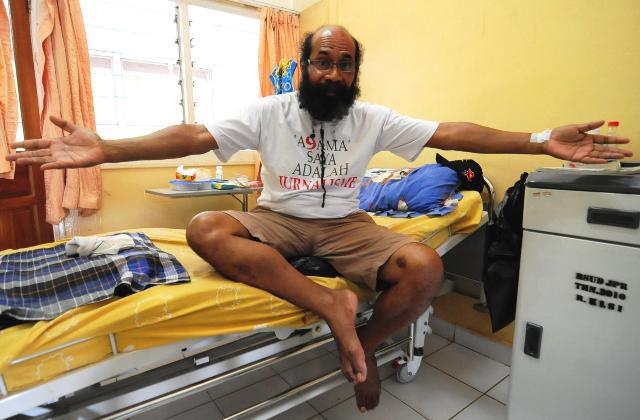
Filep Karma inside the prison hospital (Photo: West Papua Media)

United for the truth (BUK) and Kontras Papua held a Press Conference on March 19, 2012, and immediately submit a letter of support to the family representative of Filep Karma. Andrefina Karma,  Filep Karmas second daughter  said ” International Community support is strong solidarity for the freedom of my father, the people there once a month hold a simple campaign in front of the Indonesian embassy and called for the unconditional release of Filep Karma”, she said.

Letters that came from different parts of the world  proved that there is support for political prisoners in Papua. Olga Hamadi, Director of Kontras Papua says”  the government should not close her eyes  for the injustice suffered by political prisoners in Papua, both in conditions of health and food at the prison, which  received less serious attention”, she said. She also denied the statement by the Minister of Justice and Human Rights Republic of Indonesia during a visit to Papua saying that there are no political prisoners in Papua.

Filep Karma is one of  figures of political prisoners who never made a compromise with the Government of Indonesia. He rejected any form of clemency, amnesty, and abolition that is given by the Government. ” If I receive clemency, that means I ask for forgiveness to the government, but I do not feel guilty at all, I am just making a peaceful protest. Indonesia is a democratic country, am I wrong to fight for the basic rights of indigenous Papuans?

“I will continue to undergo a period of detention up to 15 years in prison, if you want to release me, I ask to be released unconditionaly”, Filep Karma said, as he was undergoing physiotherapy treatment in DOK II general hospital.

westpapuamedia

‘Saying that there are no political prisoners in Papua is a Lie’

Bintang Papua, 7 March 2012Following a statement that has just been made by Amir Syamsuddin, the Minister for Law and Human Rights claiming that there are no political prisoners (tapol/napol) in Papua, various human rights groups as well as Mama Yosepha, the Director of  the Human Rights and Anti-Violence Foundation, and Markus Haluk, a well-known Papuan human rights activist, have responded.

Mama Yosepha and Markus Haluk said: ‘This statement by the Minister for Law and Human Rights shows the extent of the lies being made in public, which came after the dialogue organised by Amnesty International  last November. The Minister said that there were no political prisoners in Papua, only criminal prisoners. This is in line with the racist policies that are used against the Papuan people,’ said Markus Haluk.

Mama Yosepha and Markus Haluk said: ‘We are well aware of the denials and lies continually being spread by the Indonesian government through the Minister for Law and Human Rights. This is happening systematically in relation to the true facts that are known to the Papuan people. Since late 2011, five political prisoners have been on trial, Forkorus and his four colleagues, who are facing the charge of makar – treason – in connection with the declaration made by the Federal Republic of West Papua in October 2011 on Zakheus Square, Jayapura. In addition, from 2008 – 2010, sixteen political prisoners have been in custody in Manokwari while in Fak-Fak there are as many as sixteen prisoners, as well as fifteen in Nabire, four in Mamberamo Raya, one in Biak who is being held in  Abepura prison, and of all these, four are convicted prisoners, plus another six in Timika , which means that from 2008 to the present there have been 67 political prisoners.’

Markus went on to say that there are around ten political prisoners being held in connection with the assault on the ammunition dump in Wamena in 2003 who are now in  custody in Nabire and Biak prisons,while Filep Karma has been in custody since 2004, having been sentenced to fifteen years  and is being held in Abepura Prison, which brings the total since 2008 to seventy-two tapols and napols (tapol refers to detainees, while napol refers to convicted prisoners).

The fact that there are political prisoners in  Papua  was officially acknowledged by the head of  the Papua office of the Ministry of Law and Human Rights, Drs Daniel Biantong in 2010, when he produced a list of 25 persons registered as tapol and napol throughout Papua.

‘The demands for sentencing have varied from eleven months to life imprisonment. This can be broken down as follows: one person for eleven months, two persons for three years, three persons for five years, one person for six years, one person for ten years and one person for fourteen years, as well as three persons who  were sentenced to fifteen years, five who were sentenced to seventeen years, four to twenty years, while two were given life sentences. In all these cases, the prisoners were charged with makar under Article 106 of the Criminal Code,’ he said.

If we go farther back, said Markus,  following the dialogue held on 26 February 1999 during the presidency of B.J.Habibie , all political prisoners who were then being held in Papua were released. However, one year later, in 2000, many Papuan leaders  and ordinary Papuans were arrested and put on trial for makar, and this has been going on up to the present day.

Mama Yosepha,  said: ‘We human rights activists in Papua  have been firmly insisting that there are tapols and napols in Papua, and they are not criminal prisoners. We urge on the Indonesian government to stop spreading lies  and making racist remarks, like talking about murders, arrests and detentions with regard to Papuan leaders and ordinary Papuans here in the Land of Papua. Instead they should release Papuan leaders such as Forkorus Yaboisembut and Edison Waromi as well as the three others with them and lift the makar charges that are being made against all five of them.’

She went on to say: ‘Bearing in mind the statement made by the Minister for Law and Human Rights last  year and then on 5 March 2012, and bearing in mind too that Indonesia is now a Democratic State,what should happen is that the Indonesian government should release all the political prisoners who are now being held throughout Papua  as well as outside Papua.’

She went on to add: ‘We urge the Indonesian government to allow complete access for diplomats, journalists, human rights workers, members of Senates and congresses [around the world] to visit Papua.’

Filep Karma undergoing Medical care at Hospital DOK II

by a special correspondent in Abepura for West Papua Media

March 3, 2012

(Edited and abridged in translation by WPM)

Concerns have been raised again over the health of internationally renowned West Papuan political prisoner Filep Karma, after a series of visits to hospital to treat his worsening health, amid atrocious conditions in the notorious Abepura prison.

Filep Karma is a political prisoner sentenced to 15 years imprisonment by Indonesia after being found guilty of makar (treason) for making a speech calling for independence and raising the banned Morning Star flag on December 1st 2004.

(Gaoled in atrocious conditions and subjected to early routine torture by Indonesian security forces and prison officers, including beatings causing internal injuries, Karma’s health has been declining since 2008, also due to numerous hunger strikes and illness caused by prison conditions in Abepura prison.  Additionally, In response to a petition filed by Freedom Now, the United NationsWorking Group on Arbitrary Detention issued its opinion that the Government of Indonesia is in violation of international law by detaining Filep Karma. Amongst many other international voices, the Working Group called on the Government of Indonesia to immediately release the human rights advocate. – WPM)

He underwent medical checkups at Hospital Dock II, and underwent a colonoscopy by a Dr Arnold, on 17 February 2012, to check his intestines. He underwent the check because up until this point he regularly discharged blood when using his bowels. The results of the check were to be taken on February 21st, 2012. At the same time he also was assessed by a neurologist, Dr. Nelly Rumpaisum, because for the previous few days he felt the pain to the right of his hip when getting down to clean clothes, and now also when standing. When undergoing the examination, Fliep was accompanied by two officers and a doctor from Abepura prison. Filep was to return to the Hospital II, to undergo X-rays of his waist.

At this time, Filep cooked his own food in prison. He used a traditional stove himself, with milk cans and axes, lit with coconut oil. ‘Eating my own cooking is better for my health at the moment, because if I eat food from Abepura Prison, there can sometimes be a lot of seasoning, and this is less suitable for the condition of my body while undergoing medical treatment at the moment’, he said.

On 21 February 2012, according to Dr. Donald Arronggear at the time of the colonoscopy results, ”Filep is affected by inflammation of the intestine next to the anus, so that he must eat foods high in fibre, like fruit and vegetables”, he said. He also received various medicines from the doctor to drink when back in prison. He also did x-rays on the right side of the waist, and the results were to be checked again on 24 February 2012.

Filep Karma will undergo physiotherapy

On several weekends, Filep Karma underwent some medical treatment at the Hospital Dok II. He was accompanied by two prison officers and doctors from Abepura Prison. On 24 February 2012, he received sequence number 2 at the polyclinic at Hospital DOK II. Filep took the x-rays to neurologist, Dr. Nelly Rumapaisum. According to Dr. Nelly ”The right side of Filep’s waist, has narrowed. So, it must to undergo physiotherapy for 12 sessions. Filep can no longer lift heavy equipment and also sports is a high-risk”, said Dr. Nelly.

Filep Karma said that ‘my waist has already been sore for a while, but it felt sore for a few weeks so it had to be checked”. Filep Karma also must use a corset after undergoing physiotherapy (a very uncomfortable apparatus in the sweaty conditions of the prison – WPM) . He will undergo regular physiotherapy and will be back and forth to the DOK II Hospital for ongoing care.

“My desire is also to be an inpatient at DOK II Hospital, while undergoing physiotherapy, because the distance between the Prison Abepura and Jayapura is about 60 minutes, which makes me making a little exhausted on the journey”, Karma said.

See Also : FILEP KARMA REFUSES INDONESIA’S REMISSION Aug 20, 2011 – Video report by Cyntia Warwe

HRW:: Indonesia – Drop Charges Against Papuan Activists

English: Human Rights Watch logo Русский: Лого...

Free Political Prisoners, Amend Treason Law to Uphold Free Speech

JANUARY 29, 2012
  • Police arrest attendees of the Third Papuan People
    Congress in Jayapura, Indonesia‘s Papua province on
     October 19, 2011.  © 2011 Reuters
The Indonesian government should show its commitment to peaceful expression by dropping the charges against these five Papuan activists. It’s appalling that a modern democratic nation like Indonesia continues to lock up people for organizing a demonstration and expressing controversial views.
Elaine Pearson, deputy Asia director

(New York) – The Indonesian government should drop charges against five Papuan activists who are being prosecuted for peacefully expressing their political views, Human Rights Watch said today. On January 30, 2012, the district court in Jayapura, the Papua provincial capital, will begin the treason (makar) trial of five leaders of the Papuan People’s Congress, which the authorities forcibly dispersed last October.

“The Indonesian government should show its commitment to peaceful expression by dropping the charges against these five Papuan activists,” said Elaine Pearson, deputy Asia director at Human Rights Watch. “It’s appalling that a modern democratic nation like Indonesia continues to lock up people for organizing a demonstration and expressing controversial views.”

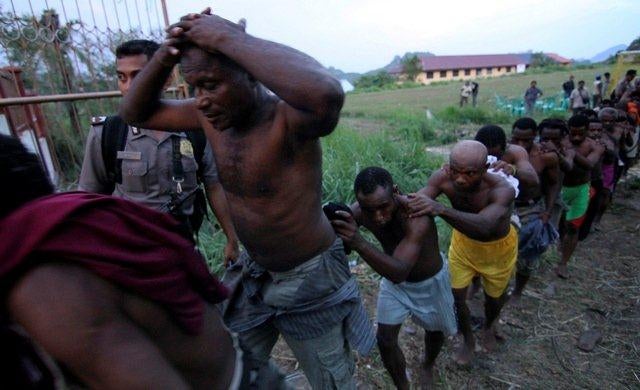
On October 19, 2011, Indonesian security forces, using excessive force, broke up a three-day Papuan People’s Congress gathering in Jayapura, Human Rights Watch said. After one of the leaders read the 1961 Papua Declaration of Independence out loud, police and the army fired warning shots to disperse the approximately 1,000 Papuans gathered for the peaceful demonstration supporting independence for Papua. The security forces then used batons and in some instances firearms against the demonstrators, killing at least three and injuring more than 90 others. Witnesses said that demonstrators had been struck on the head and several suffered gunshot wounds.

Following the incident, eight police officers, including the Jayapura police chief, Imam Setiawan, were given written warnings for committing a disciplinary infraction by not giving priority to the protection of civilians. However, no other action was taken against police or military personnel for possible misuse of force.

Five of the activists– Forkorus Yaboisembut, Edison Waromi, August Makbrowen Senay, Dominikus Sorabut, and Selpius Bobii – were charged with treason under article 106 of the Indonesian Criminal Code and have been held in police detention since October 19. Another Papuan, Gat Wenda, a member of the Penjaga Tanah Papua, orPepta (Papua Land Guard), which provided security at the Congress, will be tried separately on charges of possessing a sharp weapon.

At least 15 Papuans have been convicted of treason for peaceful political activities. They include Filep Karma, a civil servant who has been imprisoned since December 2004. About 60 other people throughout Indonesia, mostly activists from the Moluccas Islands, are also imprisoned on charges related to peaceful acts of free expression. Human Rights Watch renewed its call for the Indonesian government to release all political prisoners and allow human rights organizations and foreign journalists unimpeded access to visit Papua.

The Indonesian Criminal Code should be amended to ensure that no one is prosecuted for treason for exercising their rights to peaceful protest protected under the Indonesian constitution and international law, Human Rights Watch said. The constitution in article 28(e) states, “Every person shall have the right to the freedom of association and expression of opinion.” Article 28(f) provides, “Every person shall have the right to communicate and obtain information for the development of his/her personal life and his/her social environment, and shall have the right to seek, acquire, possess, keep, process, and convey information by using all available channels.” The International Covenant on Civil and Political Rights, which Indonesia ratified in 2006, similarly protects the rights to free expression and peaceful assembly.

Human Rights Watch takes no position on claims to self-determination in Indonesia. Consistent with international law, however, Human Rights Watch supports the right of everyone, including independence supporters, to express their political views peacefully without fear of arrest or other forms of reprisal.

“The Indonesian government should be prosecuting the people responsible for the ugly and unnecessary crackdown that left three Papuans dead, not those who read out a 1961 independence statement,” Pearson said. “Pursuing this trial will only deepen the resentment that many Papuans feel against the government.”

West Papua : Where is our freedom and justice? Trial on Monday

http://hermanwainggai.blogspot.com/2012/01/west-papua-where-is-our-freedom-and.html

Opinion

by Herman Wainggai

On October 16-19, the Third Papuan Congress held historic meetings in Abepura, Jayapura in which the largest representative majority ever of West Papuans voluntarily united and participated as members of the nascent Federated Republic of West Papua within our civil society. However, on October 19th, while nearing the completion of the public declaration of our independence, the Indonesian military became violent and arrested hundreds of nonviolent West Papuans, including President Forkorus Yaboisembut and Prime Minister Edison Waromi of the Federated Republic of West Papua.

Congressional Hearings on West Papua, September 22, 2010 From left : Salmon Yumame, Forkorus Yaboisembut, Eni Faleomavaega, Edison Waromi and Herman Wainggai

Over the years I have worked alongside many activists and political leaders including Filep Karma, Forkorus Yaboisembut, Jacob Rumbiak and others. For instance, Edison Waromi is a colleague of mine who has spent his life as a nonviolent political activist working for West Papua’s freedom. He has made tremendous sacrifices in his personal life including numerous incarcerations within the substandard conditions of Indonesian prisons in Papua.

Edison’s prison history began in 1989 when he was imprisoned for twelve years; In 2001 he was jailed for six months; and in 2002 we were incarcerated together for two years. For Edison this amounts to 14 1/2 years in the past 23 years of his life. Now he is currently serving another 15 year prison sentence resulting from his arrest in October. The convictions for these political incarcerations are typical iterations of subversion; In the meantime he will continue to serve his 15 year sentence with nary a complaint, even with the awareness that his due process will likely be denied.

My hope is that I will see the day when West Papuans are no longer defined by their repression and victimization, but rather by their strength, courage, and tenacity to fight for justice.

Create a website or blog at WordPress.com

Up ↑