JUBI, 9 December 2011
Abridged in translation by TAPOL
The Rajawali Group plans to open up 10,000 hectares in the district of Malind, Paniai for a sugar beet plantation. In preparation for the planting, seeds have already been brought from West Java after undergoing tests.
The manager of the Rajawali Group Abdul Wahab said that the seeds are currently being prepared in readiness for planting. The process should take six months but because of the heat in the past few months, it may take eight months. Some of the seeds have dried up because of the heat.
The planting of sugar beet is planned to begin in 20112 but difficulties have arisen because of the unrealiability of some of the contractors. They are busy at the moment with construction work and road building which may require some adjustments.
Wahab also said that a factory will be built in 2012 and it is hoped that by 2014, the crop will have been harvested and we are able to produce red sugar. ‘This is the target for the company and it must be realised,’ he said.
COMMENT by Tapol
The item just posted about the Rajawali Group’s opening up of 10,000 hectares of land for the production of sugar beet in Malind district of Paniai fails to raise the issue of who holds proprietary rights over the land which the company plans to ‘open up’ for beet.
There is no indication about whether there are people who are now living on the land or whether it is an area where the Malind people hunt or fell trees to build houses or for fuel to cook their everyday meals.
Did Rajawali seek the permission of local communities that live on or use the land that the company plans to use for a beet plantation? Were the local communities who, we may assume, use the land for their homes or livelihoods, ever consulted about the use of the land or offered compensation? What will happen to people who currently live on this land? Will they be evicted or paid compensation for the seizure of their land?
Using the land for the cultivation of beet will require a considerable input of labour. Where will these labourers – and their families – come from? Will this require the influx of labour from outside Papua, thus shifting the demographic composition in favour of migrants from other parts of Indonesia and further intensifying the marginalisation of the Papuan people?
Alex Mahuze is a Malind tribesman and a sago farmer in Merauke. His clan has for generations lived in harmony with nature. The arrival of the Merauke Integrated Food and Energy Estate (MIFEE) program has forced him to earn money through other means, which ironically harms the environment. He lost his lands and his culture is threatened, but Alex fights on.
Re-uploaded by westpapuamedia as courtesy to Papuan Voices Merauke and EngageMedia: EngageMedia cannot share effectively due to software restrictions in embedding iframes across many platforms. This is temporary fix to help get it out further.
video information
produced by Papuan Voices [Merauke}
contact write the producer
produced Sep 15, 2011
distributor Papuan Voices [Merauke}
* Sago, or Metroxylon sagu is a species of palm in the genus Metroxylon. It tolerates a wide variety of soils and may reach 30 meters in height. Several other species of the genus metroxylon, particularly metroxylon salomonense and metroxylon amicarum, are also used as sources of sago through Melanesia and Micronesia. In addition to its use as a food source, the leaves and spathe of the sago palm are used for construction materials and for thatching roofs, and the fibre can be made into rope.
* Merauke Integrated Food and Energy Estate – MIFEE – was announced on 18 February 2010 by the former Bupati of Merauke, J.G Gebze and officially launched on 11 August 2010 by the Minister of Agriculture, Siswono Yodohusodo on behalf of the Indonesian President. The project involves 36 investors, 13 of whom are already operating in the area. MIFEE covers an area of 2.5 million hectares and plans to bring into the area a work force of four million people.
Human rights advocates and those who have studied the record of Freeport McMoran in West Papua were startled to learn that Corporate Responsibility Magazine had named Freeport as the 24th-best corporate citizen in America (click for the full list). More startling still, the company scored well based mainly on a sixth-place ranking in the human rights category.
How is this possible? Well, the survey’s methodology seems to pay no heed to human rights performance. Only human rights rhetoric matters. And in that, Freeport excels. A strong written policy on human rights declares: “Freeport-McMoRan does not tolerate human rights transgressions.” It points to rights risks in West Papua, Peru, and the Democratic Republic of Congo, and adds that PT Freeport Indonesia policy is to “notify the direct commanders of the perpetrators” in cases where human rights allegations are made against Indonesian security forces. Since reputable human rights groups suggest that the top ranks of the security forces are implicated in widespread human rights violations in West Papua, this is hardly striking at the root of the problem.
As local people have pointed out, and researchers have confirmed, Freeport’s performance is a far cry from the written policies. The main trouble is intimate ties to Indonesian security forces.
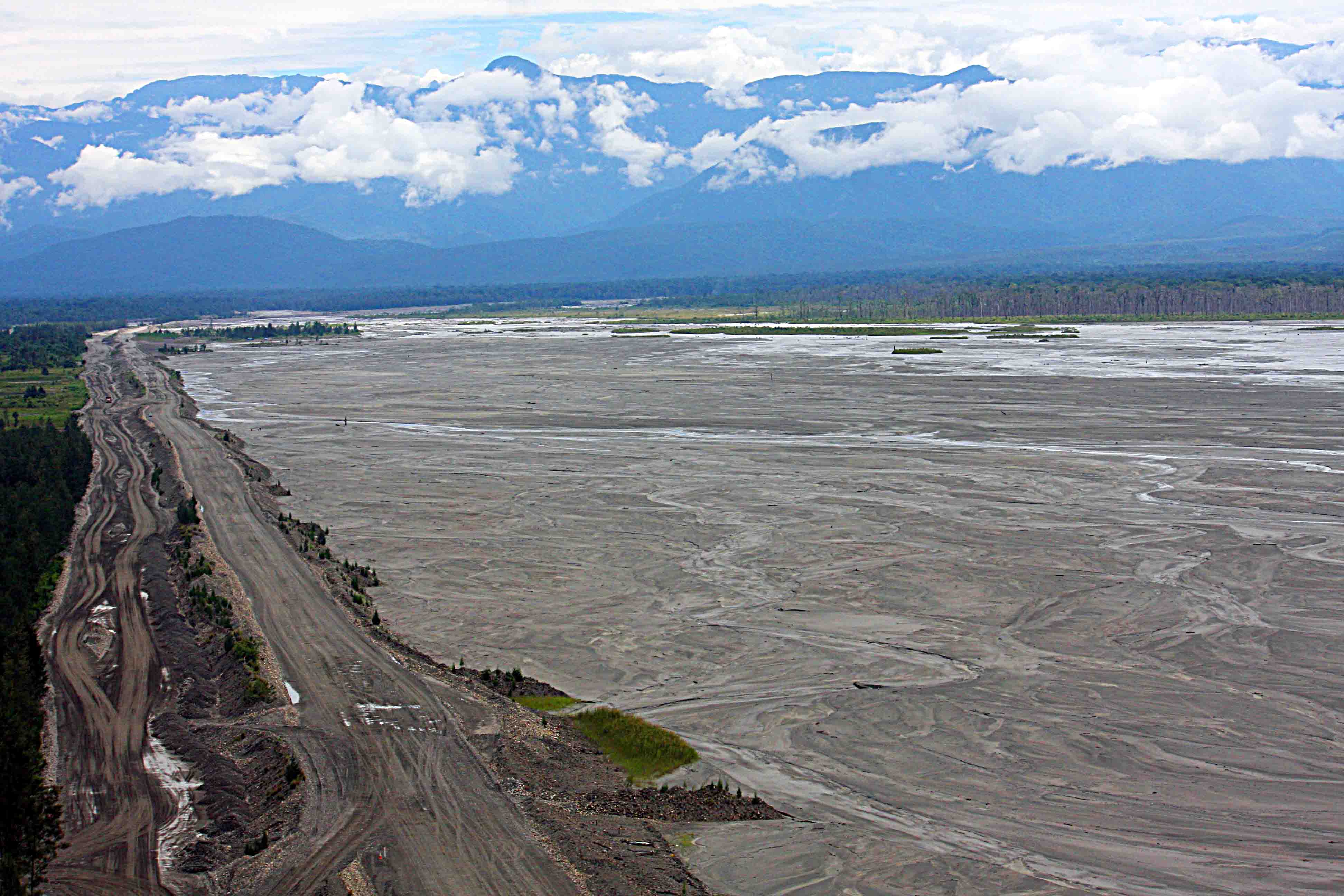
Violence around the mine is used by security forces to target and scapegoat local people. In 2005, the New York Times revealed thatFreeport paid the security forces more than $10 million in 2001 and 2002. Payments are now made “in-kind” rather than in cash. The local Amugme people have long protestedFreeport seizure of their lands. Pictures of Freeport’s Grasberg mine from space (left) show the scale and environmental impact in the mountains that are home to the Amungme.
And lest all of this be hailed as “old news,” the Amungme filed a lawsuit last year sayingFreeport had taken their lands illegally. Meanwhile, the Indonesian army’s presence around Freeport, and the company’s close ties to Indonesian security forces, were reinforced this year. The continuing alliance between Freeport Indonesia and the Indonesian security forces is likely to exacerbate, rather than improve, the human rights situation.
None of these reports are taken in to account in the “100 Best Corporate Citizens List.” All the human rights indicators measure “human rights disclosure” and the sole source, according to the methodology details, comes from “Company public disclosures” – a corporation’s own information about itself.
The methodology, in other words, measures promises, not performance. There are parallels to the debate over whether companies accused of operating sweatshops overseas can be trusted to police themselves, or should accept independent monitoring. Thus the list cites the voluntary “Sullivan principles” first created under the Reagan administration and welcomed by companies resisting demands to divest from apartheid South Africa. AndFreeport boasts of adherence to the Voluntary Principles on Security and Human Rights, launched by the British and American governments in 2000.
The key word here is “voluntary.” As with the mining industry globally and with businesses jumping on the corporate social responsibility (CSR) bandwagon more generally, companies are happy to promise good performance, as long as no one will be looking over their shoulders.
So perhaps it’s no surprise to learn that Corporate Responsibility Magazine is in fact published on behalf of the Corporate Responsibility Officers Association, a body made up of many of the companies being judged, and steered by such firms as Domtar and KPMG.Freeport is listed as a “recent member” of the CROA. It’s advanced in the listings – it was ranked 83rd in 2010.
The problem here isn’t just the “corporate social responsibility” methodology, but the entire concept of “CSR”. It can all too often be used by companies to buy their way out of “corporate social irresponsibility.”
Freeport is no champion of the best values of corporate citizenship: For human rights activists, it’s long been a poster child for corporate irresponsibility. A list of good corporate citizens with Freeport winning laurels demonstrates more than flaws in the study. As George Monbiot has written of climate change credits, the lists offer corporations a new form of medieval European Catholic “indulgences,” forgiveness for any form of offence. Jeff Ballinger recently pointed out on this blog that companies like Nike are wrapping themselves in the CSR garment to burnish their corporate images, despite continuing disregard for many labor rights. Freeport, too, is now having itself measured for a fine CSR wardrobe.
—-
David Webster is an assistant professor of International Studies at the University of Regina inSaskatchewan, Canada. He is a former coordinator with the East Timor Alert Network/Canada.
On his first visit to Merauke to see preparations for MIFEE, the Merauke Integrated Food and Energy Estate, Marie Pangestu, the Minister of Industry and Trade said that the customary rights of the local community should be dealt with first, by issuing certificates, in connection with the MIFEE project that is being developed in the district of Merauke. The land which will be used for planting must be suitable for whatever crops are to be grown there.
The minister was speaking to journalists after flying over the land that will be used for the MIFEE project.
‘I have been closely following the discussions and reports about this projects which have been taking place at the centre. And now, I have come to see things for myself at close range and I have come to the conclusion that the land is very suitable indeed for agricultural production. ‘
He also said that he had received a short account from the Merauke governmental chief about the plans being made for the project, as well as measures for its implementation and land usage. Companies planning to invest can now go ahead to acquire the necessary licences and start planting their crops.
He went on to say that it was now necessary to build the necessary infrastructure, in particular harbours to support the project once it gets underway. For instance, he said, investors who intend to establish palm oil plantations will need harbours of their own.
[COMMENT: The central government will clearly be investing huge sums of money to promote the interests of companies planning to invest in MIFEE. Not at all clear what is meant by issuing certificates to the local communities whose customary rights to the land will be sacrificed as investors are invited to grab their land with little regard for the loss of their livelihoods based on hunting and fishing. No mention either about whether the rightful owners of the land will be granted any compensation for the loss of their land and the destruction of their livelihoods. TAPOL]
JUBI, 25 June 2011
The local branch of the union of energy and mining workers at Freeport-Indonesia announced on Friday 24 June that it had set a
deadline of 4 July for its decision to organise a strike at Freeport.
The intention to take strike action was announced by the chair of the
Freeport branch, Virgo Solossa.
‘We are keeping the door open for the management to recognise our
legitimate demand for talks but if the management makes no response, the
strike will go ahead.’
Since the weekend all the workers on the low-land and high-land company
premises have been wearing black arm bands as a sign of the death of
industrial partnership.which the company has until now praised.
The cause for the strike action is that a number of members of the union
are threatened with dismissal for allegedly being absent from work.
‘This is an act of discrimination and intimidation against our right as
leading members of the union. We have no intention of allowing this to
happen, and give the management until 3 July. If they fail to response,
then any question of industrial partnership will be regarded as
dead.,’said Virgo.
The action will involved the 8,000 workers at the company.




 West Papua Media Alerts
