Police urged to say who shot Miron Wetipo

JUBI: 17 February 2011

A lawyer in Jayapura, Gustaf Kawer, has called on the police to be transparent and explain what happened to Miron Wetipo, who was being held in the Abepura Prison. He was shot dead by the police/TNI and Densus 88 during a sweeping operation and searches being undertaken by BTN Puskopad (an army unit).

‘The police must be transparent and explain publicly what happened to Miron Wetipo. All the more so since Miron was not the person who was behind the shooting in Nafri. The police should tell his family and the general public what happened,’ said Gustaf Kawer. He also said that it was important for the name of the peron responsible for the shooting to be made public so as not to cast suspicion on the whole of the police force.

‘They must have the courage to say who it was in the security forces who shot Wetipo. They cannot ignore this case because it involves a violation of human rights that must be resolved,’ he said.

Miron Wetipo was shot dead by forces of the police/TNI and Densus 88 while they were on sweeping operations and were searching the home in the location of BTN, Puskopad, in the district of Abepura, Jayapura, Papua. He was also thought to be a leader of the OPM and was involved in the shooting that occurred inNafri Kampung on Sunday, 27 November 2010.

[The article includes a photo of a poster saying: ‘Who is it who murdered Miron Wetipo’.

VIDEO: More Indonesian brutality against Civilians in Kapeso, 2009

WARNING: This video contains disturbing images of extreme brutality and will be disturbing to most viewers.  Please complain to the Indonesian security forces if you do not wish to see this.

Indonesian military brutality and torture of West Papuan civilians is revealed in a video released today exclusively by West Papua Media.

The footage shows troops from Indonesia’s elite counter-terrorism unit Detachment 88, who receive Australian and US military training, engaged in a raid in late May 2009 on the Papuan village of Kampung Bagusa, at Kapeso airstrip in Mamberamo regency.

The footage, filmed by a Detachment 88 officer on his mobile phone, shows the immediate aftermath of the raid. The bodies of at least five dead villagers are visible on the ground and there is sporadic gunfire clearly heard.

The incident occurred at the end of a month long occupation of the remote airstrip by an local religious group, and was transformed into a demonstration of widespread pro-independence sentiment by an off-shoot of the TPN or National Liberation Army. Local military and police commanders sent troops to clear the airstrip, including the elite Detachment 88 force. Negotiations between local people and security forces broke down in confused circumstances, and security forces attacked all present. The aftermath of this operation is depicted in the video.

The footage shows Detachment 88 troops urgently taking cover behind desks in a pendopo (traditional ceremonial shelter) whilst under alleged attack. Curiously, whilst troops are allegedly being shot at by unknown shooters off camera, the solider continues to narrate calmly and film proceedings whilst he is standing up, exposed to alleged fire. This does raise the possibility that the entire proceedings are staged for the benefit of the camera.

Disturbing scenes at the end of the footage appear to show two Papuan children tied up and being forced at gunpoint to crawl along the floor by the Indonesian military. The footage continues to show them in apparent pain while the soldiers taunt them.

To date, no satisfactory transparent investigation has occurred of the events surrounding the Kapeso occupation and subsequent shooting of civilians by security forces. West Papua is routinely closed by the Indonesian government to International Media and Human Rights Observers.

Regardless of the circumstances of alleged armed provocations, Indonesian security forces are again displaying excessive force to civilians and non-combatants and in particular to children. Indonesia has ratified the Convention on the Rights of the Child, but has so far refused to ratify the Convention’s Optional Protocol on the involvement of children in armed conflict.

The footage is sure to raise further questions about the activities of the Indonesian military in West Papua, as well the involvement of the Australian military in training and arming those seen in this footage. The video was passed to West Papua Media via a member of the Indonesian security forces who stated that the circulation of this form of ‘trophy footage’ is rampant amongst troops operating in the region.

PLEASE NOTE:  There is a translation error in the subtitles in this footage which is quite critical.  At approximately 00:54 (seconds), where soldiers are pursuing West Papuan people, the dialogue is incorrect.

From a correspondent:
“”jangan dibunuh” is translated as “don’t get killed” but should be “don’t kill them”. It’s common to issue orders in passive register like that. It is followed by “diborgol” ie “handcuff them”. It’s a big difference, since it is suggestive of how often extra-judicial killings do take place – the soldiers on scene have to be reminded to NOT kill the prisoners. “

The video can be viewed at the following link: http://www.youtube.com/watch?v=VD0eFA4scTo
or watching below:

For all media enquiries please contact Nick Chesterfield at West Papua Media on wpmedia_admin@riseup.net or +61409268978

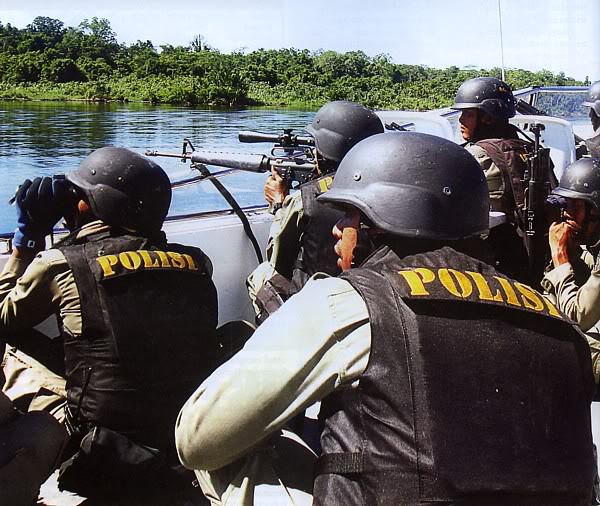
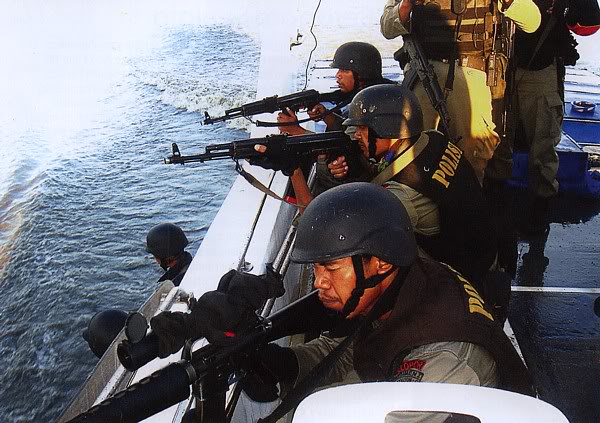
An Indonesian BRIMOB source today (Feb 9) sent West Papua Media these images of personnel from the Pelopor taskforce depicted in the footage above on their way via speedboat to conduct the operation to retake the airfield.  The individual officer in the foreground of the upper image has been identified as the cameraman and narrator of the footage.

West Papua Media apologises for the low-quality of the footage due to it being filmed on mobile phone in low resolution

A higher quality version of the footage is available to media upon application under strict conditions; unfortunately YouTube automatically loses quality during upload.  Please contact West Papua Media for arrangements

Boycott needed after torture trial farce – Greens

Soldiers of the Indonesian Army
Image via Wikipedia

Boycott needed after torture trial farce – Greens

Media Release – Tuesday January 25th, 2011

The Australian Greens have called for the Government to cut all military
ties with Indonesia in response to light jail terms handed down
yesterday to Indonesian soldiers who tortured two Papuan men.

Greens legal affairs spokesperson Senator Scott Ludlam said the conduct
of the Indonesian government and the farcical trial of the three
soldiers involved showed a “total lack of respect for human rights”.

“What we have here is an open and shut case of severe torture, with
video evidence, and the soldiers responsible will spend, at most, 10
months in prison and then continue their careers in the Indonesian army
– they won’t even be discharged. It is a disgrace – an absolute
disgrace,” said Senator Ludlam.

“There is no ambiguity here. A video of the torture shows the soldiers
burn one man’s genitals, suffocate him with a plastic bag and hold a
knife to his throat. One of the victims said he was beaten for two days,
held over a fire and had chillies rubbed into his wounds,” he said.
“First the Indonesian authorities claimed their soldiers were not
responsible, and then charged them with ‘disobeying orders’. It was a
pathetic response from a government that couldn’t care less about the
human rights of the Papuan people.”

Senator Ludlam said the Australian Government must cut military and
para-military ties with Indonesia.

“Why are we helping to train and arm these soldiers? Why do we fund the Indonesian National Police when its Detachment 88, a so-called
counter-terrorism unit, has been linked to a series of human rights
abuses?” said Senator Ludlam. “While human rights abuses, while torture
continues in Papua and Maluku, we can not fund and train the people
responsible.”

Reader reply: Australia and Kopassus

http://securityscholar.wordpress.com/2011/01/14/reader-reply-australia-and-kopassus/

Security Scholar

Reader reply: Australia and Kopassus

14/01/2011
by Natalie Sambhi

Associate editor at Australian Policy Online and Researcher with the Monash Global Terrorism Research Centre at Monash University, Andrew Zammit provides comment to my post on Australia’s options with Kopassus.

Comer’s critique of the Leahy amendment highlights many flaws in its implementation, but his suggested modifications don’t really provide a way forward for dealing with Kopassus. His suggestion that Leahy should include a mechanism to re-legitimise units which have cleaned themselves up and purged human rights-abusers is perfectly sensible. But the problem with Kopassus, made clear in the human rights reports mentioned in the Deutsche Welle article you cited, is not only past violations but continuing ones, albeit on a far lesser scale. So a Leahy amendment with Cromer’s modifications would probably continue to restrict aid to many Kopassus units.

A theme underlying Comer’s piece was that efforts to tackle human rights abuses are more likely to be successful when they are consistent. I’d suggest it follows from that that Australia’s position should be closer to that of the US Congress.

US Congressional efforts to hold the Indonesian military accountable have repeatedly been undermined by those who, I’d argue, should have been supporting them. In the mid 1990s the Clinton administration provided high levels of assistance to the Indonesian military that at very least violated the spirit of the Congressional restrictions. The Bush administration criticised the restrictions publicly and repeatedly, which may have signalled to the Indonesian military that the US was not completely serious about human rights reform. As your post pointed out, Obama also undermined Congressional efforts in 2010. In addition to this, throughout these past two decades Australia provided military assistance to Indonesia with fewer restrictions than the US (excluding the period immediately after the East Timor referendum, when both the US and Australia cut off military aid).

These inconsistencies would have greatly weakened the pressure that the Leahy amendment and other restrictions were intended to apply, and may well be more important than the specific flaws in the Leahy amendment described by Comer.

Current Kopassus commander, Major General Lodewijk Paulus, has stated that he hopes America’s position on assistance to the Indonesian military becomes closer to Australia’s; I hope it’s the other way round.

http://securityscholar.wordpress.com/2011/01/11/australias-options-on-kopassus-and-human-rights/

Australia’s options on Kopassus and human rights

11/01/2011
by Natalie Sambhi

Last week, the Indonesian National Commission on Human Rights (Komnas HAM) released its preliminary report into the alleged torture of Papuans by the Indonesian military (TNI). Quoted in a Deutsche Welle report on 4 January, the head of the commission, Ifdhal Kasim, confirmed that members of TNI had “grossly violated human rights”. The DW piece finished with Phil Robe’s (deputy director of Human Rights Watch’s Asia Division) call for Australia to put pressure on Indonesia to reform TNI’s Army Special Forces, Kopassus, or risk losing credibility as a country that respects human rights. I was curious to know exactly what HRW meant by “pressure”.

In their open letter of 26 October 2010, HRW recommended two lines of action for the Australian Prime Minister: first urge the Indonesian government to undertake further investigations and disciplinary action into allegations of abuse by the military, to adopt legislation to provide civilian criminal court jurisdiction over military personnel responsible for offenses against civilians, and to investigate allegations against Detachment 88; and second tighten up and make public Australia’s vetting procedures for Indonesian security forces.

While there have been perennial calls (ostensibly by HRW but also within the Australian press, most recently here) for Australia to get involved, here I examine how much credence HRW’s recommendations deserve.

The first set of recommended actions­even if they are in keeping with Australia’s foreign policy leanings­is tantamount, from Indonesia’s perspective, to meddling in another country’s affairs; President SBY warned Prime Minister Gillard ahead of her November visit to Jakarta that Australia’s interference in torture cases was not welcome. Later, during her trip, Prime Minister Gillard accepted President SBY’s assurance that a “full and transparent investigation” would take place. In light of the resultant investigations carried out by Komnas HAM, it is highly unlikely that any other tangible and productive outcome would have transpired from more vocal chiding on behalf of Australia.

The second set of HRW recommendations­that is, for Australia to adjust its own rather than Indonesia’s approach to human rights concerns­is far more appropriate. As I have proposed elsewhere, the adoption of a legal standard against which Australia can measure human rights reform within foreign militaries is, albeit complex and ambitious, a pragmatic way of reconciling our foreign policy with our defence engagement. A useful departure point could be the Leahy Amendment to the Foreign Assistance legislation (see s502B and subsequent appropriationslegislation). In short, Leahy prohibits US security assistance to military units where there is credible evidence that they have committed “gross violations of human rights”.

That said, Leahy is no silver bullet, and it is worth examining some of the challenges involved in adopting a similar legalistic approach. Many of the finer points of these challenges are elaborated further in Charles K. Comer’s critique, but here, I will draw out a few.

First, the wording of any test for human rights standards and vetting must be carefully constructed. In the case of Leahy, funding is barred for units rather than individuals where credible evidence demonstrates a gross violation of human rights. In the case of the US and Indonesia, two TNI officers with exemplary records who were denied US funding despite having been born after the violations alleged to have been carried out by their unit occurred (Comer: 63-64). This situation is somewhat mitigated by Australian vetting procedures which seek to minimise contact with individuals who have backgrounds of concern, however there remains a lack of accountability to which standards these backgrounds are compared. The framework provided by Leahy could complement current vetting procedures.

Second, if adopted, Leahy must be applied consistently to all foreign military partners. As Comer notes, “[i]n the case of Indonesia, units, either cohort or composite, receiving training must undergo full vetting to include the history of the unit itself. By comparison, unit vetting in the Philippines consists of vetting only the unit commander or most senior individual in the case of a composite unit.”

Third, Wikileaks cables released in December 2010 revealed that a ban on training (enacted by Leahy) between the US military and Kopassus was lifted due to pressure by Indonesian President SBY (Indonesia denies pressure was applied to lift the ban). Unsurprisingly, this brings to light the ways in which legal protection of human rights standards can be trumped by realpolitik concerns. In the words of Australian Defence Force Academy associate professor Clinton Fernandes, ”[t]he decision to renew links shows contempt not only to the victims of gross human rights violations but to members of the US Congress.” Nonetheless, that Leahy continues to serve as a yardstick of US expectations on human rights remains important, when applied and upheld correctly.

By no means should Australia be merely reactive to the calls by organisations like HRW, however, it is worth continuing to debate options proposed and perhaps draw closer to reconciling a desire to uphold human rights and an imperative to engage with Indonesia’s military.

etan

Indonesian Civil Society: Open letter to SBY Raising Concern and Offering Solution:: One-Year Human Rights Promotion in Papua 2010

OPEN LETTER

Raising Concern and Offer Solution::

One-Year Human Rights Promotion in Papua 2010

To the attention of

President Republic of Indonesia,

Susilo Bambang Yudhoyono

In Jakarta

Dear Mr. President,

We are writing this letter to you to raise our concern over human rights conditions in Papua. We are confirmed that lacking of protection and recognition of Papuans’ rights have led to abusive and violent practice against Papuans. This pratice has persistently cause death to Papuans and left trauma for them and their family. This practice clearly does not reflect the spirit of this country’s constitution to protect whole citizens.

We have recorded that there have been some big issues this year that attract public attention. The issues such as footage violent action against civilians by military in Tinggi Nambut Papua,[1] violence against civilians in Bolakme,[2] ethnic conflict between Papuan highlanders and Yoka people,[3] shooting civilians in Nafri[4], shooting against prisoners in Tanah Hitam,[5] civilians shot dead in Boroway,[6] arrest and detention of Filep Karma and  Buchtar Tabuni[7] and the rally of returning special autonomy. Other cases relating to social, economy and culture which potentially bring negative impact on Papuans and destroy Papuan values such as MIFEE in Merauke,[8] Dagewo case in Paniai[9],  the transfer of local land in Lereh for palm oil plantation, Freeport case,[10] and many illegal logging cases.

Bsaed on our observation and data collected, the problems mentioned above happen because of the following reasons:

First, government still stigmatisize any Papua groups and individual as separatist as they do resistance against government. Government uses ‘stigmatization of separatist” as powerful  strategy to silence Papuans demand and freedom of expression and weaken the critical thinking from Papuans who often criticise the govermnent policy. This strategy is partially successful as it silences resistant movement but in the other side it gives more energy and spirit for more resistance. Also, this unpopular strategy has planted the seeds of hostility and mistrust among Papuans against Indonesia.

Second, Jakarta still plays dominant role in the issue of any policies and their implementations in Papua. Jakarta, as the central power, is still unable to trust any process of development in Papua although Papua has been given special autonomy to manage themselves. MIFEE case, violence against civilians in Bolakme, Tingginambut-Puncak Jaya and Freeport cases are example on how central government still exercise their absolute authority which potentially destroy basic rights of Papua. Central govermnet just interest in investment without considering the basic rights of Papuans and their values

Third, Papua is still considered as conflict area. Therefore, security approach is dominant. Huge number of troops are deployed  every year to Papua to secure the border area and investor’s assets. Ironically, the security approach has caused fear and revive the past trauma. People in the border feel fear when they go to bush and forest to hunting, gardening as they might be arrested as being suspected as members of Papua freedom movement (OPM)/ National Freedom Army (TPN).

Fourth, The massive deployment of troops which is to secure investors’ assest has caused human right violations and fear. The rights of people are neglected and intimidation is done when the locals demand their rights and speak critically.

Fifth, Economic problems are still strongly perceived as the main problems in Papua. Therefore, huge amount of money and investment is needed to build Papua to improve their economy. RESPEK ( strategic plan for rural development) program is one example where the program emphasize infrastructure development rather than human resources development. Moreover, suspection among the locals is rising over the use and management of special autonomy fund used for RESPEK program. Also, no efective supervision has led to corruption

Sixth, the policy issued by govermnet and its implementation actually repair the impact not solve the basic problems which has been persisting so long. It is crucial that any policy has ‘solving-problems’ elements. If not, the problems will never be solved.

Based on the description above, we urge Mr. President to take immediate action by ordering central government and localgovernment to do the following:

First, hold peaceful dialog as an effective means to solve the problems in Papua. The dialog Jakarta-Papua which has been initiated by Papua Peace Network Team needs to be supported. The dialog should involved all elements: government, customary community, religious leaders, academics and civil groups.

Second, stop all stigmatization against Papuans and place them a citizens who have rights to be protected by the state. Constitutions guarantee freedom of expression and this should also be applied to Papuans. Some articles in state criminal law and government regulation No. 77 year 2007 about treason and subversion need to be amended as it limits the freedom of expression

Third, revise or redesign security approach to be human rights-based approach as it will recognise the rights of Papuans and protect Papuans from violent acts. The deployment of troops need to be adjusted to the need of the local area and real threat as to save state budget of defense

Fourth, police should exercise their professionalism in keeping the order and promote human rights. The professionalism is shown by giving protection so people feel secure and peaceful in doing their activities. This is important to bring back trust from the people.

Fifth, push the policy that promote human rights and provide justice to the victims of human rights abuses. Government has to take immediate action to establish human rights court and reconciliation and truth commission in Papua as mandated by special autonomy law

Sixth, central government needs to revise public-service related policy because the existing policy does not provide and touch the basic rights of Papuans. There are three public service issues that needs to taken into consideration: education, health and economy where these three areas are directed to empowernment, affirmative action and protection

Seventh, Policies issued for Papua need to have recognition of human rights elements. This is so because all existing policies basically emphasize on economic and welfare problems.

Eighth, governor, Papua legislative (DPRP) and Papua People’s Assembly (MRP) should build good coordination and reponsive to the problems of human rights abuses in Papua. Lack of initiatives and good will from these institutions show that they actually do not have commitment to promote human rights in Papua and potentially increase mistrust among Papuans.

We write this open letter with the hope that immediate action to be taken to solve the problems in Papua. Thanks

Jayapura, 05 January 2010

Institutions support this open letter

Papua Based Institution

Foker LSM Papua, ALDP, Elsham Papua, SKP-KPC, KPKC Sinode GKI Papua, LBH Jayapura, JAPH-HAM Wamena

Jakarta Based Institution

Imparsial, Kontras Jakarta, HRWG, PRAXIS

CC :

1.  Menkopulhukan RI

2.  Menkokesra RI

3.  Menteri Dalam Negeri RI

4.  Menteri Luar Negeri RI

5.  Menteri Pertahanan RI

6.  Panglima TNI

7.  Kapolri

8.  Jaksa Agung RI

9. Ketua DPR-RI

10. Anggota DPD Provinsi Papua

11.  Gubernur Provinsi Papua

12. Gubernur Provinsi Papua Barat

13. Ketua DPRP

14. Ketua MRP

15. Kedutaan Asing

16. lembaga Internasional

17. Jaringan kerja Papua


[1] This video was initially released by Hongkong Based Human Rights group, AHRC and made public through youtube. In the video, it shows that military tortures civilians suspected as members of Papua free movement group. But in fact, the victim is a reverend. Government then response to the incident immediately by forming fact-finding team. Ministry of politics, law and human rights finally acknowledges in the press release that it is true that military has done such a barbaric act. The perpetrators of the torture were finally on trial and sentenced respectively 5 months and 7 months. This very minimum sentence indicates a failure of states to provide justice to the victim

[2] An ambush against military in Yugam, Bolakme, Jayawijaya district on 1 december 2010. This incident has caused two civilians die

[3]This incident took place on 17 November 2010, 35 houses burned and 3 got injured. The highlanders damage the houses in Yoka as they are angered by a song composed by a Yoka man which insult the highlanders. It is also suspected that third party plays role in fueling the conflict. Local government has facilitated a dialog and they have agreed to cease their hostility. .

[4] Group of unknown men shoot civilians in Nafri, Abepura on 28 November 2010. One was dead and 4 seriously injured. The perpetrators are not identified yet.

[5]Friday on 3 December 2010 around 12.00, 4 prisoners and one detainee escape from prison. Miron Wetipo, one of the prisoners is shot dead when trying to escape. One of the prisoner is finally caught while the other three escape.

[6] Rahmat Faisal, an employee at mobile phone counter,  found dead by Oktafinaus Yerisitow. The victim was suspected being shot around 13.00 on 13 December 2010

[7] Filep Karma and Buchtar Tabuni were detained as they are suspected as the mastermind of riot in the prison after the death of Wiron Wetipo, a man shot dead while trying to escape from prison. Actually, Filep Karma and Buchtar Tabuni just ask head of law and human rights department about the reason why Wetipo was shot dead

[8]Merauke Integrated Food and Energy Estate (MIFEE) is a joint program between local and national government. This program will place Merauke as global agriculture industry. The program is promising which says that in 2030 Indonesia will have additional reserved food such as rice of 1.95 million ton, corn 2.02 ton, and many other food reservation. Also, Merauke will have income of IDR 124.2 million per capita per year in 2030. The program will bring more people from Java to work in the industry. Sadly, the program has taken people’s land.

[9]Illegal mining in Degowo has happened since 2001 where local do the mining without outside intervention. But since 2003, intervention comes and backed up by military and police. As more outsiders come and do the mining, the locals are moved out and can no longer do traditional mining as they used to do. They are even forced to release their land to investors who are interested in the gold mining. Moreover, prostitutes are brought by investors and military to Degowo to entertain the locals.

[10] Freeport case is the longest and massive exploitation of natural resources in Papua. Although there have been many efforts initiated by Freeport to bring back trust of Papua such as giving Cooperate Social Responsibility (CSR) but the problems and mistrust remain

Create a website or blog at WordPress.com

Up ↑