FREE THE PEOPLE? FREE THE MEDIA!
by Nick Chesterfield
A Paper presented at the University of Sydney Centre for Peace and Conflict Studies “Comprehending Papua Conference”, February 22-23, 2011. This paper will form a chapter of the forthcoming book “Comprehending Papua”, to be published in early 2011 by the University of Sydney Centre for Peace and Conflict Studies.
———
It is almost a cliché today that peoples wishing to free themselves from tyranny are turning in huge numbers to citizen journalism both to tell their stories to the outside world, and to put a formidable brake on the out of sight, out of mind mentality that allows state organs to conduct constant abuse with impunity. The rise of citizen media is giving mainstream journalism the kick it needs to remember its core business of giving voice to the voiceless. In West Papua, the Voiceless are slowly discovering they can roar.
Just a few weeks ago an event occurred in Tunisia that was to be the spark for the pan-Arab awakening which has just seen yet another dictator ousted, now in Egypt. After a local trader immolated himself in protest against the Tunisian regime, citizen media succeeded in viralizing the news of this event. “We could protest for two years here, but without videos no one would take any notice of us,” said a relative of the martyred 25-year-old.
For media activists and journalists reporting Papua, this truth is self-evident, and its acceptance hopefully could ignite the spark of uprising in Papua. The opportunities presented by the Pan-Arab (and other) awakenings are not being lost on the young generation in Papua. Social media in Papua is buzzing, unafraid, with vibrant discussions of implications for Papua of the pan-Arabic revolutionary success. The reality is that a spontaneous awakening and mass politicisation of ordinary Papuans is completely inevitable, and it is being ably assisted by switched-on local people developing their capacity to tell the story to the world.
In researching for several stories over the last few months, my sources have told me in no uncertain terms that they are all ready for a trigger to explode the situation. The only thing holding back sustained mass action – revolution even – across occupied Papua is the constant bickering between exile groups, the actions of the collaborator elites, desperate to cling to the illusion that Jakarta is not there just to steal their land and send them to the moon, and for those who will put their own interests ahead of those surviving under occupation.
What is a mystery is how this mass consciousness will survive the elite and exile power games that are evident in most transitional polities throughout recent history (and is certainly present in West Papua today); whether those exiles will hijack the efforts of the young generation or listen to the actual wishes of their people; and if Jakarta can be trusted not to unleash the truly evil and deeply entrenched habitual brutality that is its only constant in becoming the new colonialists; or that they will claim their place amongst the civilised by not slaughtering those who want peace. History is a wise teacher, and its lesson is never trust the evil or greedy to reform of its own accord.
To keep these ugly realities in check, West Papua (and the international community) needs a determined, effective, vibrant and fearless citizen and professional media to deliver real-time accountability both internally and internationally.
Real time advocacy is vital for the international community to act to end Papua’s suffering. Human Rights advocates conduct scientific research into abuses, but because this information does not get out easily, the problems in Papua are only now getting known to the world.
I need to ask you all today an honest question: without the hard work of journalists in Papua and those outside assisting them to get their voice to international media, would Papua even be in people’s consciousness today? So why is the international arena concerned with West Papua falling prey to the disease of factionalism and Big Man syndrome, and not in assisting WestPapuan people to get their stories into the living rooms of the world?
Many loud mouthed exiles claim significant legitimacy, but baulk and splutter when asked to prove it. This has developed a culture of opacity across the exile movement. A strong and diverse citizen based media across Papua can easily counter exile’s game playing and false claims by ensuring credibility and honesty in social movements. It benefits and strengthens social movements too by giving the skills and practice for sharpening their message, and creating a powerful argument for international support for their aims. Strong domestic media also removes international government’s excuses for inaction, by seriously raising the credibility and verification bar.
If the international community is serious about improving the lives of Papuan people, it will help develop the capacity of the West Papuan media to tell the story of what is going on, and press Jakarta hard to allow immediate international media access. After all, with full accountability, what is there to be afraid of?
Largely in response to years of wilful ignorance and self-censorship of the Indonesian created horrors in West Papua by international media, many sectors of Papuan society spontaneously and independently began a dramatic take-up of social media technology, exponentially increasing since 2008. Blogs, social networking and online media outlets are being utilized all over the country, by a young generation of Papuans impatient for real change. Today’s mass Papuan movement is mainly urban, educated, innovative, nonviolence based, and embracing significantly the power of citizen and social media as a key plank of civil resistance strategy.
Very occasionally West Papua does get in the news, but only through the co-ordination between committed journalists and human rights workers working together and ear-bashing news editors.
Due to the ongoing ban by Indonesia on international media and humanitarian organisations having access to Papua, allegations of abuse are notoriously difficult to verify. While this ban remains in place, only the most dedicated journalists make the effort to go in undercover. West Papua Media has been proud to facilitate undercover trips into occupied territory to meet with many West Papuan people prepare to tell their own story. This is getting more difficult by the day so local people are working for a solution.
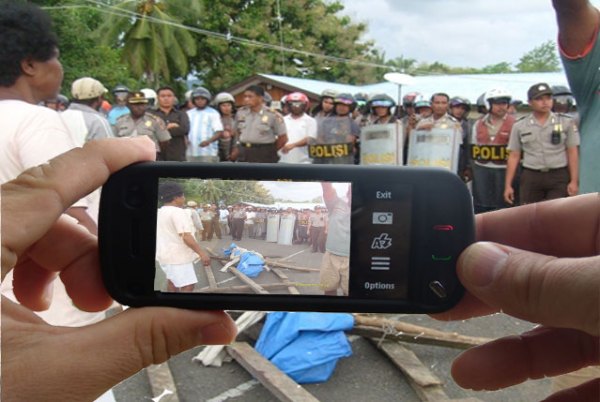
Live images, videos and online activism by Papuan people have already created tremendous momentum in action and awareness of Papua. By creating their own media, and their own narrative, Papuan people are reclaiming self-determination denied for so long.
Reporting in West Papua is a highly risky business. Journalists, Papuan and outsiders alike, are under constant threats for reporting West Papua, with four journalists dying in suspicious circumstance in 2010 alone. Anywhere journalists report fearlessly they are targets, but most journalists in West Papua simply put up with it, they have no other option. What can we do to lessen their risk?
Partly in response to this danger and partly to give local journalists a voice globally, West Papua Media (WPMA) (WestPapuaMedia.Info) was started. It aims to provide a professional service to international media covering West Papua, ensuring high quality, verifiable reporting gets into the international media, directly from the ground, and not from those who seek to distort the truth of daily experience in Papua. By reporting Papuan campaigns to end human rights abuses and bringing these unreported Papuan issues to the front page, we hope to hold the abusers to account. With an ever growing stable of committed and disparate voices from citizen media to professional journalists, West Papua Media is proud and excited to be part of this movement.
Some of our real time work has assisted directly in the prevention of mass acts of violence by the Indonesian security forces, such as our coverage and media advocacy fixing of the July 8-9 Otsus Gagal demos and occupation of the Jayapura DPRP.
Less than ten minutes before the deadline for dispersal of the 2 day rally of over 45,000 people, Indonesian security forces were forced to back down after a BBC report aired, organised by WPMA, which brought international attention the explosively dangerous situation. Extensive international diplomacy occurred in that 15 minutes and, together with the extreme discipline of the mass protest, enabled the protestors to peaceably leave the scene of the protest without violence.
WPMA has worked very hard raising the media profile of West Papua, with significant joint investigations with major media outlets breaking several key stories in 2010. None of this would be possible without deep trust from the people of Papua in reporting their stories. West Papuan citizen media, in conjunction with several colleagues here today, played a key role in alerting the world to deeply heinous cases of abuse.
One was the sourcing, verification and release of the deeply shocking leaked Kostrad torture videos of civilians in Puncak Jaya. The Kiwo incident neatly captures why the Indonesian military cannot be trusted to reform themselves from the inside, and why the role of a robust media is so critical in Papua.
The other was footage of Indonesian BRIMOB police taunting a former political prisoner Yawan Wayeni, having disembowelled him moments before for arguing with them. Both these videos showed the power of citizen media in activating international human rights networks to effectively raise the issue of Papua. Of course, there are many more videos in preparation for release.
A swarm movement cannot have a single media strategy, but media need to understand that it will get media out in its own way too. The media that had wilfully ignored West Papua’s voice for so long really has no right to dictate how information disseminates, and if it wants to get the stories before others, then it just has to move faster. Because it is new media techniques that have already, and will propel Papua onto the front page, to make people choke on their cornflakes.
Likewise, evidence dissemination also needs multiple, failsafe distribution routes: Single dissemination routes can easily be shut down or silenced. West Papuans have tailored their mechanisms to this very effectively; yet this is significantly frustrating outside journalists. According to many in mainstream media, West Papuans can be their own worst enemy when it comes to disseminating information. People on the ground do need to get smarter about media distribution strategies, but the media also must adapt to a social and cultural reality. West Papuan human rights and citizen media are not chaotic: they are maximising the potential audience for their information.
It is important to understand that no one faction or sector in West Papua can claim dominance or leadership of this mass movement. This is not Congress in India and there is no single Gandhi figure. Rather, this is a movement with thousands of Gandhis. The civil movement refuses to be based around a single leadership group, and instead features multitudes of groups and tribes all acting autonomously and independently (where everyone knows their role and works their hardest) but which is nevertheless unified under its collective goals.
Such a swarm structure can occasionally present difficulties for those who cannot think outside traditional top-down strategies for national change, which includes traditional media. Rather than being shut out of dialogue by the game playing of unaccountable elites, this type of structure encourages a longer lasting peace by enabling all actors to have their voices heard. It is also a natural strategy to employ in a nation where it is, for the most part, illegal to congregate in groups.
Other barriers for West Papuan media are much more easily solved with a bit of training, and understanding the enemy (this time the enemy being the unreasonable expectations of media executives far removed from reality).
One issue is the lack of speed with which many West Papuan media activists work, and whilst improving, an event on a day has to be filmed, edited, packaged and disseminated as fast as possible. There are issues of journalistic discipline and professional journalistic practice in new media; safe information gathering, abuse documentation and investigative journalism methodology; information quality assurance; protection of sources, and more.
Effective citizen and professional media training is required to develop awareness of major current and future challenges to safe information dissemination – these are all programs that the West Papua Media network is currently engaged in and it needs help to increase its capacity.
All of this costs money, and requires the international community to understand that the development of indigenous journalism in West Papua is crucial to the protection of human security and peace across the entire Asia-Pacific region. It requires international institutions in media and academia to get out of their cloisters and get muddy, to actually pool resources and help identify new sources of sustainable funding to start training journalists in innovative new media reportage techniques, and to support their work for the global human interest. As I said before, West Papua Media already has training programs ready to go, we just need the funds to make them happen.
In West Papua, as across the world, accountability is always the simplest solution to combatting impunity. An aggressive culture of investigative journalism must be encouraged, and the skills to enable it must be developed, to deliver that accountability, be it in human rights, against military business mafias and corruption, human security, environmental protections, etcetera, and to cover (and protect) the desires of a population to determine their own future, in both the current occupation and in any situation for the future. Both academia and international media must take a strong role in its development, to embed international protections to enable West Papua’s journalists and citizen media to report without fear, hindrance or threat, the stories that are important to West Papuan people and their freedom.
Our hope is that we have a really robust citizen media that can deliver accountability. We want to stop people from being afraid of speaking out, and we want West Papua’s voice to be its weapon, to broadcast its songs for Freedom.
Nick Chesterfield, editor at westpapuamedia.info, is a human security journalist and activist with extensive experience of the Papua issue through refugee protection, human rights, environmental protection, and citizen media work and safety training. He has conducted many field investigations in the West Papuan region since 1999. Together with citizen media and human rights workers from inside Papua, Chesterfield helped set up West Papua Media in 2008, to counter the wilful lack of coverage of West Papua by the international press.

 Has the video showing military torture in Indonesia in October last year created any serious concern for torture in that country? In the video, members of the Indonesian military tortured two indigenous Papuans to obtain information about alleged separatist activities. While some of the perpetrators got a few months of imprisonment for disobeying the orders of their superior, nobody was punished for the torture committed, nor did the victims receive any compensation or medical treatment. The extreme practices shown in the video shocked the public even though numerous cases of torture had been documented by NGOs and the National Human Rights Commission for years.





 West Papua Media Alerts