MRP dualism threatens the existence of the Papuan people

Bintang Papua, 23 June 2011

Pastor Jonga: ‘MRP has now become a mechanism for the government’s splitting tactics.’

The controversy about the setting up of an MRP for West Papua had
continued to rumble on and is likely to last for a long time. There are
people who now claim that having two MRPs will threaten the existence
of the indigenous Papuan people.

This was the theme of a seminar held by the Students Executive Council
(BEM) on Wednesday this week.

The controversy emerged when the governor of West Papua, acting on
behalf of the Minister of the Interior, announced the creation of the
West Papua MRP. The seminar was held at the auditorium of the
Cenderawasih University, and was attended by about a hundred people.The
main speakers were Fadhal Alhamid of the Papuan Customary Council (DAP)
and Pastor Jong Jonga, representing the religious community The
moderator was Laus Rumayon.

Fadhal Alhamid said that the danger posed by MRP dualism was that the
standard set for basic human rights of Papuans living in the province
of West Papua would be different from those set in the province of
Papua. In addition, the creation of the West Papua MRP was to promote
certain vested interests, part of a conspiracy between the governor and
the vice-governor of West Papua. ‘The MRP reached an agreement
regarding cultural and economic unity.But if there are now two MRPs,
there is the danger that this unity will disappear.’

He also said that responsibility for creating the second MRP rests with
the MRP itself. ‘We should raise the question of whether they were the
ones responsible for creating the second MRP.’

He also drew attention to the position of people in the leaderhip of
the Papua MRP and the West Papua MRP. ‘The fact that Ibu Dorkas is the
chairman of the Papua MRP and is also the vice-chairman of the West
Papua MRP has led to a great deal of confusion.

The other speaker, Pastor Jong Jonga, dealt more specifically with his
own experiences with congregations living in the district of Keerom. ‘In
my opinion, special autonomy (OTSUS) has failed to provide protection,
tranquillity and security indigenous because its benefits are only
being enjoyed by people living in the vicinity of the district capital.
‘These were precisely the regions where the percentage of indigenous
Papuans is very low as compared to the percentage of newcomers or
migrants.’ What they were hoping for, he said, was that the MRP which
had been intended as a unifying body would now become a means for
splitting the Papuan people.’

During questions and answers that followed the speeches, the students
focused primarily on OTSUS. Many said that OTSUS had become nothing
more than a mechanism to prolong the sufferings of the Papuan people.
OTSUS has become the long arm of the central government. ‘What was
needed now,’ the one questioner said, ‘was for the DPRP to take action
to disband the West Papua MRP.’ Many in the audience shared these views.

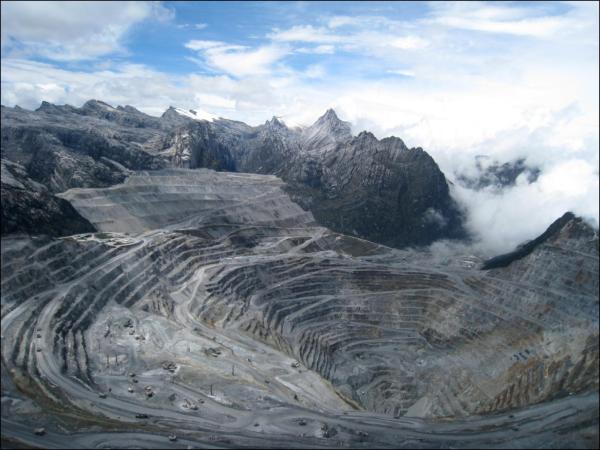
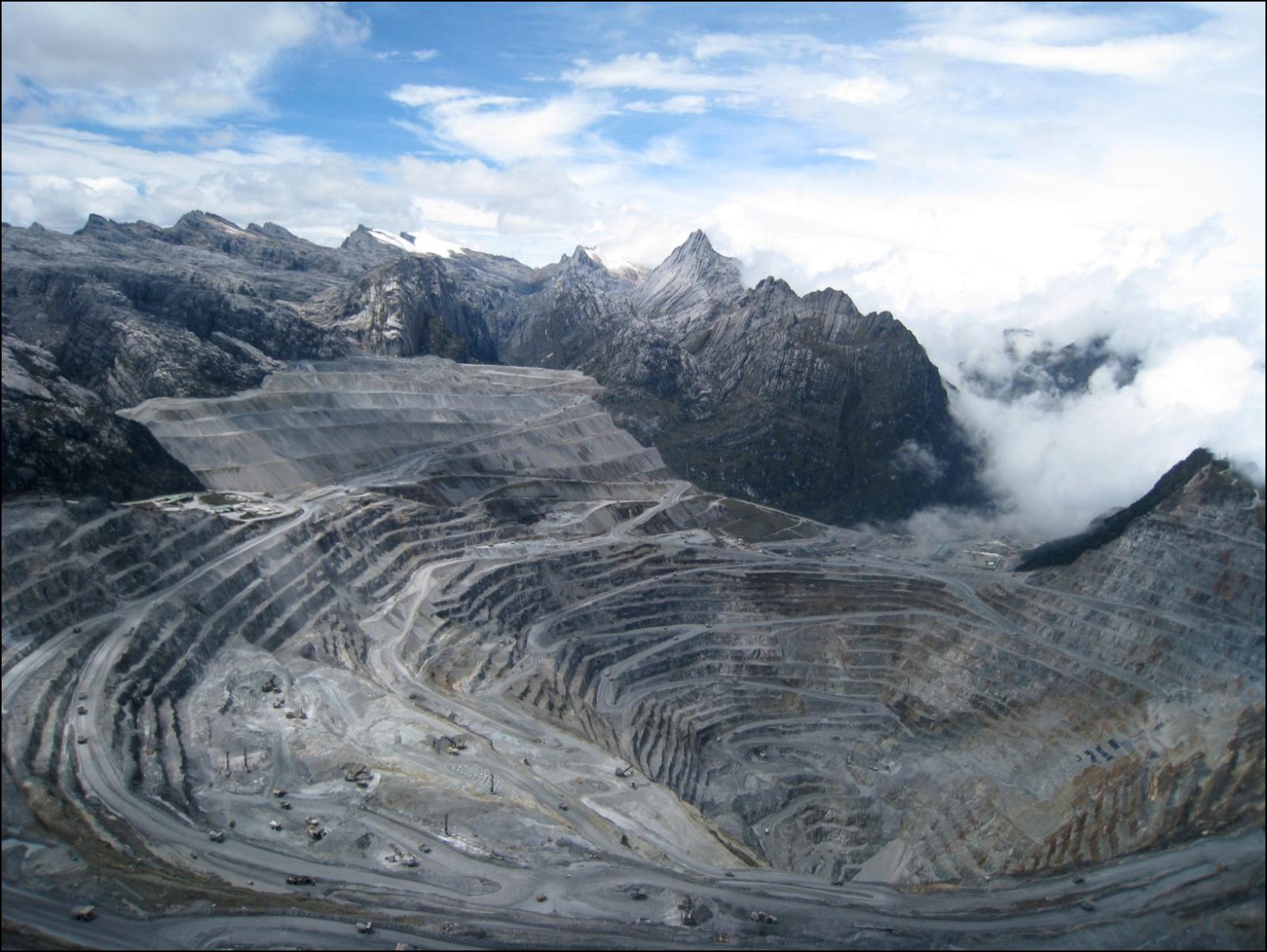
WHAT DO WE KNOW ABOUT HOW MUCH FREEPORT PRODUCES?

JUBI, 22 June, 2011
It is still very difficult for the Mimika district administration to get information about the quantity of gold and copper produced by Freeport-Indonesia and how much is exported via Portsite, Amamapare.
Freeport's Grasberg mine - Earth's biggest hole in the ground

The head  of the mining, energy and minerals department of the Mimika administration, said:

‘We don’t know anything about the quantity of gold, copper and other minerals produced daily by Freeport and this is because  we do not have free access to the company to be able to control the level of production every day.’

He said that the administration did once charge two of its employees to oversee export activity in Amamapare, but after we had given them the task, the two men were unfortunately shifted other posts.’  [Could this have been a deliberate action.]

This is a big problem. Anyone charged with scrutinising exports and imports  would have to be a specialist. They would need to have a special certificate for controlling goods and services for both exports and imports..

All this has an impact on obtaining clarification about the quantity of minerals produced every year. How can this possibly be synchronised with the information received by the authorities in Jakarta? It’s all just a game because the people at the centre get data about gold and copper production which comes directly from the company, PTFI.

The department of mines in Jakarta only gets information from one side. ‘This doesn’t lead to any accuracy. Anyone with bad intentions can easily manipulate the data.  Although lots of stuff is exported, they report a very low figure.’

So the question is: who else but the company can know anything about the quantity of material it produces every year? Only the PTFI.

[COMMENT: This once again highlights the extraordinary powers that the US company has been given to keep a tight control over how much it exploits of Papua’s abundant natural resources, with the  Papuan people not only left in the dark but also left living in poverty while Freeport makes a fortune from its investments in West Papua. TAPOL]

Bomb planted outside Law and Human Rights office, no suspects

Westpapuamedia.info

Local media and witnesses in Abepura, near Jayapura West Papua, have reported the discovery of an explosive device planted on Wednesday evening (local time) outside the offices of the Department of Law and Human Rights (KumHAM) office in Kotaraja.

Armed officers from Brimob Gegana, a specialised motorbike based paramilitary bomb squad, reportedly defused and secured the bomb and made it safe.  No injuries were reported.

The bomb had been lying at the front of the office all day, but no-one had thought to report the suspicious package.  Finally in the evening, the Brimob were called by KumHAM staff members.

According to a report by Bintang Papua, two men were seen leaving the sports bag earlier in the day, and then getting on a motorbike and speeding away.

The Department has frequently come under threat for its mandated work in occasional prosecutions of human rights abuses, and most recently was subject to a series of threatening letters and homemade bombs.

According to an SMS sent to West Papua Media by the Serui Regional Police Chief who was in Jayapura at the time (At police HQ), the bomb “was from the Dutch era”.  He did not elaborate on how a Dutch Era bomb came to be planted outside the KumHAM  building.

Bomb threats are frequently the subject of much speculation in Papua, with incidents usually occuring during times of political upheaval by nonviolence forces.  It is usually believed they are the work of Special Forces or Intelligence agencies keen to discredit the anti-violence movement, despite the fact that the independence movement has publicly disavowed itself of such tactics for many years.

During the 2010 Presidential Elections in Indonesia, many bombs exploded in remote areas of Papua, or at police stations or polling booths, and were never sufficiently investigated by Police.

Magai: ‘Papuan officials are destroying Papua.’

JUBI, 19 June 2011The chairman of Commission A of DPRP. Ruben Magai has warned that the destruction of Papuan resources  is being intensified by the activities of a number of senior officials in the Land of Papua. Some of these officials are ‘playing games’, shielded by a variety of problems which continue to  play havoc with the lives of the  Papuan people. There is no question of these people taking sides with the  weakest people in society. All they are interested in is furthering their own interests.’

‘It is a public secret,’ he said, ‘that Jakarta is continuing to manipulate things, causing the continued destruction of  Papua. There is no space for democracy, the  policies being pursued  have nothing whatsoever to do with promoting the welfare of the Papuan people here.’

Ruben said that Papuan bureaucrats should be fighting to promote the interests of the people, but this is simply not happening. ‘Papuan officials are also contributing to the destruction of Papua,’ he said.

The general view here in Papua is that OTSUS, the special autonomy law, has failed  The government should be opening itself up, making an evaluation of the situation and providing space for these discussions. ‘But nothing of the kind is happening which means that the issue will continue to be raised in demonstrations, in seminars, in media reports and other forums.’

The Papuan people have for many years been raising their voices about the failed implementation of OTSUS, calling for OTSUS to be returned to Jakarta. At the very least, there should be some response. Last Thursday, dozens of people in the Coalition of People United  for Justice (KRPBK) expressed these views.

The Papuan people’s aspirations are regarded by the government as matters of no importance. The DPRP went to Jakarta to raise these issues but to no avail. ‘As representatives of the people, we feel extremely unhappy with this situation. All the efforts we have been making have led nowhere. On one occasion, we submitted  a concept to Commission A of the Indonesian parliament, the DPR,  which was accepted at the time, but there was no follow-up at all. This was a great disappointment,’ he said.

The Land of Papua continues to be turned upside down, with unpopular measures, with acts of violence, with human rights violations which are never resolved, with the abuse of freedom of expression, with the introduction of laws which are unacceptable, as a result of which the rights of civil society are never upheld.

‘This is the reality of the situation in Papua today,’ said Magai.

Churches call for revision of contract with Freeport

Bintang Papua, 8 June 2011The Alliance of Churches in the Land of Papua, PGGP, has called on the government to revise the work contract concluded with the mining company, Freeport.

‘The presence of this foreign company in the district of Mimika has not resulted in any improvements in the conditions of the local people,’ said Wiem Maury, secretary of the PGGP. He said that in addition to this,  the very presence of Freeport in the area has always been a very serious problem for the people.

‘The welfare of the people who are the true owners of the rich natural resource continue to be a matter of great concern. Nor is there any guarantee about security in the area either,’ he added..

He said that the call for a revision of the contract was one of 22  recommendations agreed at the Papuan Transformation Conference that took place from 3-5 June this year.

He said that a representative of the government had attended the conference, along with representatives of all the different Christian denominations that are present in both Papua and West Papua.

The purpose of the conference was to try to reach a common perception  between church leaders and the government on the crucial  issues of empowerment of the community, education and spiritual attitudes.

‘The conference also sought to reach a common position between Papuans with regard to the substance of the special autonomy concerning the issue of taking the side of the local communities, their protectiona and empowerment,’ he said.

Another aim was to reach a common approach between the churches and the government , as the centre as well as in the regions.

According to Victor Abraham Abaidata, the secretary of the organising committee of the conference, a decision was taken to set up a team composed of a representative of the government, representatives of all the churches in Papua as well as a representative of the church at the national level.

‘We have already presented the 22 recommendations to the provincial governments and will soon present them to the central governmentl,’ he said.

Create a website or blog at WordPress.com

Up ↑