1530 21/10/2011 Updates From West Papua

By Newmatilda.com and westpapuamedia.info

CURRENT:
Arrests
Anywhere between 300 and 800 activists arrested, most released
Core group of 5 in custody at least but could be more, all feared tortured:

– Forkorus Yaboisembut – elected as leader of the broad based movement for peace and justice – possibly paralysed witnessed by another detainee
– Edison Waromi – deputy leader
– Argus Krar
– Selfius Bobii
– Dominikus Sorabut

Released
– Abraham Kareni (who’s son lives in Melbourne) with fractured skull

Charges include treason, rebellion, crimes of hatred against the state. These are colonial laws left over from the Dutch era and they carry long sentences — in some cases up to 20 years.

Police violence, dead and wounded
DFAT have confirmed four people are confirmed dead, activists claim six
People identified (all from Petapa or family of:
– Dani Kabepa
– Yakovus Sabonsaba
– Mathias Maidepa
– Martinus Siep
– Tanepi Kobeta
– One additional unidentified member of Petapa, the West Papuan paramilitary guard formed to protect Forkorus Yaboisembut, the man delegates elected as their leader.

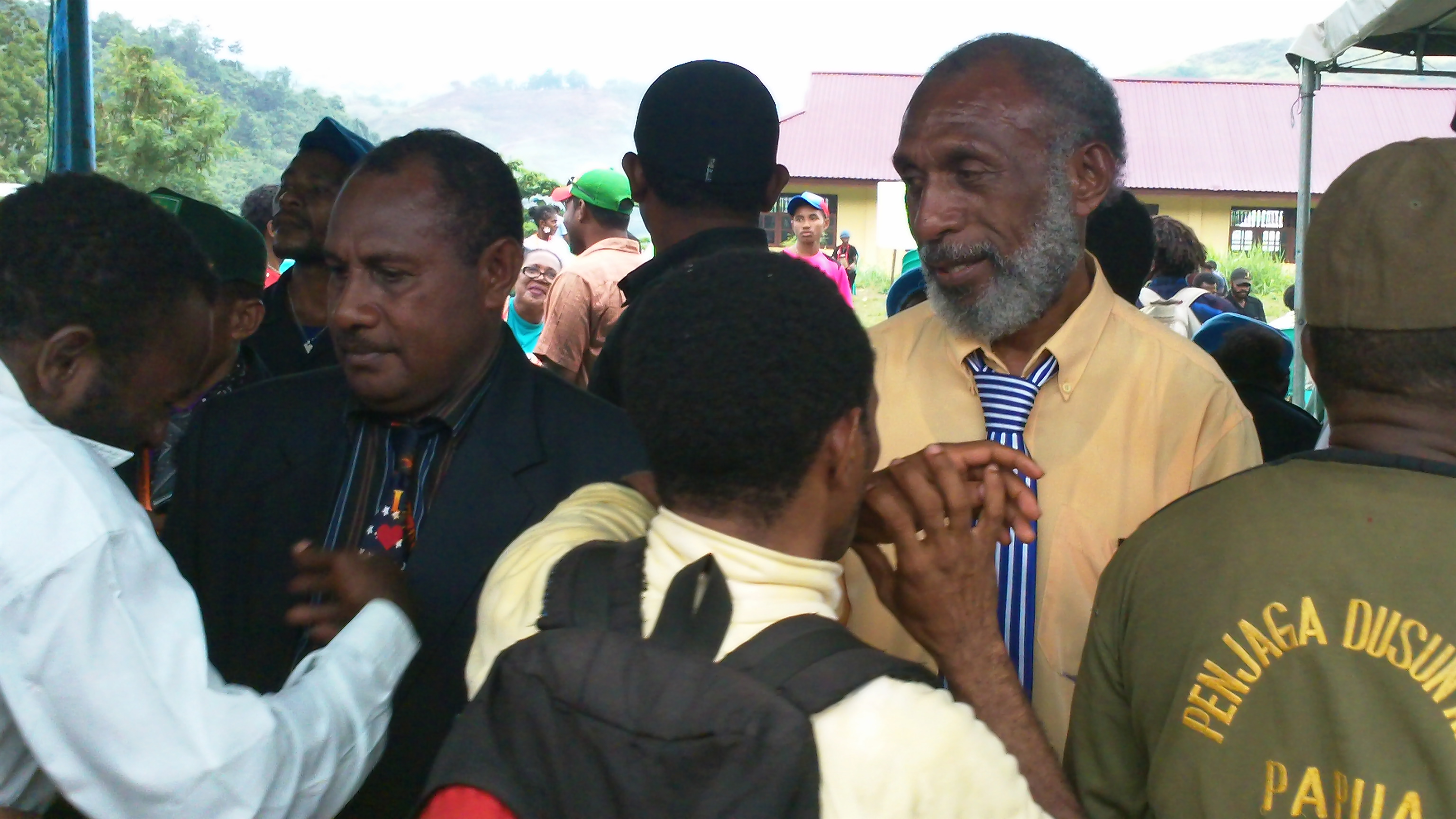
Claims:
– Numerous people have been savagely beaten, many are in hiding for fear of arrest or worse
– Unverified claims people were shot at point-blank range and bundled into armoured personnel carriers and other vehicles.
– Five people at the Dian Harapan Hospital suffering several wounds: ”One is a woman, Ana Ana Adi, 41. She has got wounds at her right thigh. Pilatus Wetipo, 40, was shot in the right leg. Wiler Hobi (22) has some wounds in his head because of being beaten by the weapon, the other two have blistered wounds
– four people in Sabron Yaru wounded

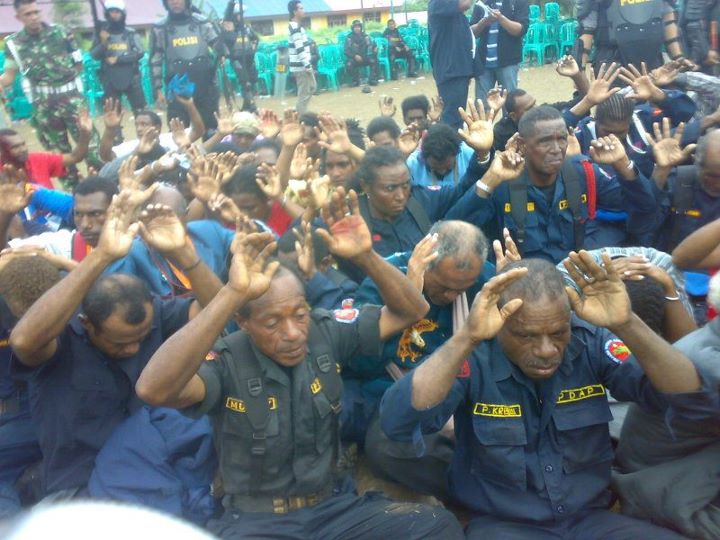
  • Members of the community security force (Petapa) are arrested. Photo: West Papua Media Alerts

Reports of violence by Indonesian troops continue to emerge from West Papua. New Matilda is in contact with local sources. We’re publishing regular updates on the situation here. (Warning: graphic content)

On Thursday, New Matilda published a report on the violence at the Third People’s Congress in West Papua. Indonesia military and police opened fire on participants and took activists and leaders into custody. Reports of fatalities and injuries continue to emerge from Jayapura.

Read Alex Rayfield’s initial report here.

New Matilda is in contact with local sources and will continue to update this page as new information emerges.

UPDATE, Friday 21 October, 10am:
This is a phone interview with journalist Alex Rayfield.

“Ferry Marisan, the director of Elsham — a leading human rights organisation based in the capital, Jayapura — has said that six people are confirmed dead.

“We think that a couple of people were shot as the security forces raided the stage, and some later. There are also lots of people with gunshot wounds, some of whom are in hiding and too scared to get medical assistance.

“We’ve had multiple reports that there were 800 people in jail. Many of those have been released, but a core group is still detained, charged with a range of offences including treason, rebellion, crimes of hatred against the state. These are colonial laws left over from the Dutch era and they carry long sentences — in some cases up to 20 years.

“It’s important for people to know that [Congress] is not a radical fringe movement. It’s made up of mainstream Papuan society: academics, church leaders and senior tribal leaders. In fact the radical fringe stayed away from this event because they think it’s not radical enough. So if the Indonesian government thinks this is a minority view, they are sadly mistaken. It is a mainstream view.

“Meanwhile, we should add for Australian audiences, that the strike continues at the Freeport mine [which is part owned by Anglo-Australian company Rio Tinto]. The two events are intimately connected.”

For more information on the Freeport strikes read New Matilda’s coverage here andhere.

UPDATE Friday 21 October, 4.30PM
These photos were sent by a credible source to West Papua Media Alerts and allegedly show injuries suffered in police custody. They have not been verified by New Matilda.

Photo: West Papua Media Alerts

Photo: West Papua Media Alerts

Photo: West Papua Media Alerts

MORE INFORMATION
Listen to an interview with Elsham’s Ferry Marisan here.

Read Amesty International’s statement on the incident here.

Read an article on Australia’s foreign policy response by Greens spokesperson on West Papua, Richard di Natale, here.

SBS RADIO: Oubreak of violence reported in Papua

By Greg Dyett

interviews with West Papua Media and Asian Human Rights Commission

Download Episode  Duration00:03:33 Download3MB

Papuans attend a protest march in support of self-determination in July, 2010 (Getty Images)

Reports from the Indonesian province of Papua suggest that at least two people died when police and paramilitary troops open fired on crowds attending the Third Papuan People’s Congress.

Up to 20,000 people had reportedly gathered to hear the delegates talk about self-determination.

The violence is reported to have taken place after the Congress declared independence and elected two men as their president and prime minister.

Greg Dyett reports.

Indonesian crackdown on Papuan Congress sparks outrage


Indonesian crackdown on Papuan Congress sparks outrage

A joint statement by TAPOL (UK), the West Papua Advocacy Team (WPAT,
US) and East Timor Action Network (ETAN, US)

On Wednesday, a meeting of thousands of indigenous Papuans in
Jayapura, West Papua, became the scene of a brutal crackdown by
Indonesian security forces. Indonesian troops and police Mobile
Brigades reportedly fired hundreds of shots to disperse the crowd,
pistol-whipped participants and beat them with batons and rattan
canes. They arrested around 300 participants. According to the
Indonesian press, security forces turned violent when Papuan
indigenous leaders, who had gathered to discuss their basic rights,
issued a declaration of independence.

“This appalling display of excessive force has no place in a modern
democracy,” said Lord Avebury, Vice Chair of the UK Parliamentary
Human Rights Group. Avebury called on the Indonesian government to
immediately release detainees and conduct and publish a full
investigation into the incident.

Two people are confirmed dead, with many more injured and five charged
with treason. Among those arrested were Congress organiser Mr Selphius
Bobii, and prominent indigenous leader Mr Forkorus Yaboisembut, head
of the Papuan Customary Council (Dewan Adat Papua). The arrests are a
provocative response to a peaceful gathering, targeting one of West
Papua’s most respected tribal leaders, said the US-based West Papua
Advocacy Team.

The meeting is the third of its kind to take place in West Papuan
history, and was reportedly attended by around 4,000–5,000 people.
While the Congress attracted thousands more to the surrounding area,
many were prevented from gaining entry to the event by security
forces, or were too afraid to enter.

“It is bitterly ironic that when Papuans meet to discuss their basic
rights, Indonesia responds by violating those rights,” said Carmel
Budiardjo, senior campaigner for the UK-based NGO TAPOL. “The daily
discrimination and violations experienced by Papuans are bad enough,
but an attack of this nature on a democratic congress is an absolute
outrage,” she continued.

The use of the infamous ‘makar’ or treason laws to deny the right to
freedom of expression and assembly is an increasing problem in Papua,
suppressing activists and fuelling simmering resentments among the
indigenous population. On Wednesday, US Congressman Mr Eni
Faleomavaega expressed concerns about the arrests, calling for the
immediate release of Mr Forkorus Yaboisembut. The US-based East Timor
Action Network has also condemned the arrests. “The right to gather
and speak out is a fundamental freedom, it doesn’t just disappear
because the government doesn’t like what is being said,” said John M.
Miller, the network’s National Coordinator.

The situation in Jayapura last night was tense amidst fears of
reprisals and further actions by security forces against local
residents and those involved in the Congress. TAPOL, WPAT and ETAN
call on the international community to urge Indonesia to show
restraint, release the detainees, and commit to a peaceful resolution
of the West Papua conflict.

/ Ends

Contacts

UK: Paul Barber, Coordinator, TAPOL, +44-20-8771-2904
paul.barber@tapol.org

US: Ed McWilliams, West Papua Advocacy Team, +1-575-648-2078
edmcw@msn.com

John M. Miller, East Timor Action Network,
+1-917-690-4391 john@etan.org

Photos and video clips

Photos of victims available from TAPOL on request, including victims
suffering gunshot wounds and beatings.

Check West Papua Media Info for breaking news and video clips direct
from West Papua.

Background notes for editors

The Third Papuan People’s Congress

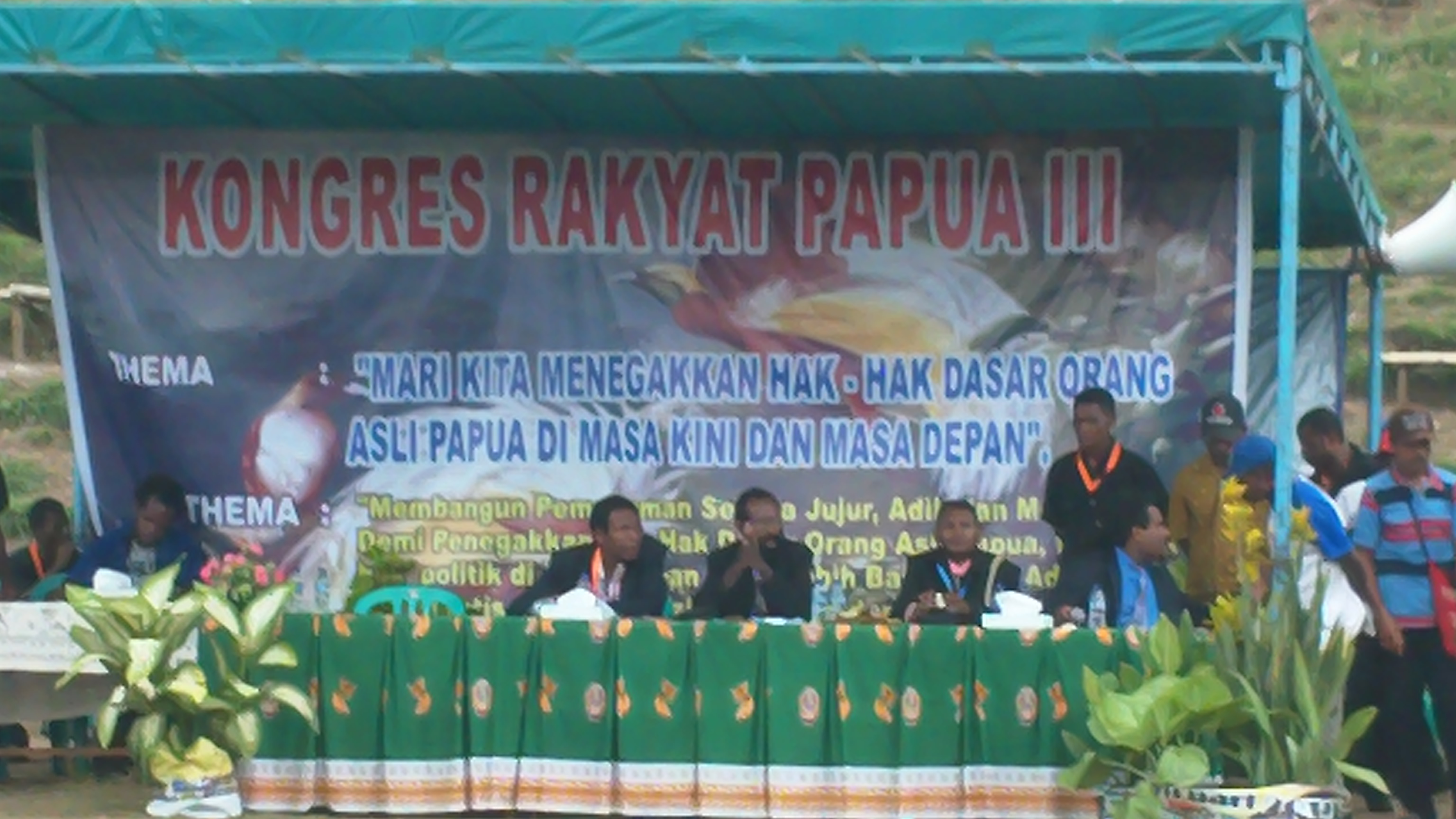
The Congress, themed ‘Affirming the basic rights of the indigenous
Papuan people for the present and the future’ was planned to last for
three days. It opened in Abepura, Jayapura, on 16 October 2011 with
between 4,000 and 5,000 delegates in attendance representing more than
200 tribal groups from across the territory. Over 20,000 more
gathered in the vicinity of the Congress. The organisers were forced
to hold the event in an open field as requests to hold it at a more
suitable venue were rejected.

For the first two days the Congress proceeded peacefully, but the
atmosphere was increasingly tense due to the build-up of over 2,000
members of the security forces in Jayapura. According to local sources
reported by West Papua Media Info, troops encircled the conference
with around 70 vehicles including Army Pansers, a water cannon,
Armoured Personnel Carriers and Barracuda armoured jeeps. On the third
day at the close of the conference, Indonesian troops armed with
automatic weapons, along with units of Brimob, the notorious mobile
brigade of the Indonesian police, reportedly opened fire in an attempt
to disperse the Congress.

History of the Papuan People’s Congress

The First Papuan People’s Congress was held on October 16–19 in 1961,
and issued a manifesto declaring their independence. The Second
Congress held in May–June 2000 issued a resolution which affirmed
their sovereignty as a people and led to the establishment of the
representative body, the Papuan Presidium Council (PDP). Just over a
year later, in November 2001, the PDP chairman, Theys Eluay was
kidnapped by a unit of Indonesia’s Kopassus Special Forces and
assassinated. In a travesty of justice which characterises the problem
of impunity for security forces in Indonesia, the perpetrators were
sentenced to between two and three and a half years.

Elsewhere in Papua: strikes at Freeport

At the same time as the Congress was underway, thousands of Papuan
workers employed by the massive Freeport copper-and-gold mine in West
Papua continued their strike to demand a substantial rise in wages.
The strike, which has hit production at the multibillion dollar
company, which is losing millions, has been met by security force
violence. Since the late 1970s Freeport has been the largest taxpayer
to the Indonesian state, while the majority of Papuans continue to
live in dire poverty: the Papuan provinces remain the poorest in
Indonesia.

West Papua Conflict

One of the world’s longest-running conflicts, the independence
struggle between the Free West Papua Organisation (Organisasi Papua
Merdeka, OPM) and the Indonesian state has been raging for 48 years,
since Indonesia took control of West Papua on 1 May 1963. The conflict
escalated when West Papua was formally incorporated into Indonesia
following the controversial Act of Free Choice in 1969.

Recent context

A period of heightened political activity in the middle of 2011,
including the holding of a Papua Peace Conference in Abepura from 5-7
July and calls for dialogue with the central government, generated
positive signs that tentative progress is being made towards resolving
the Papuan problem, but was followed by a series a violent incidents
and human rights violations. The outcomes of the Peace Conference,
organised by the Jaringan Damai Papua (Papua Peace Network) led by
Father Neles Tebay, provided an aspirational agenda for a peaceful
Papua with a series of ‘Indicators of Papua, Land of Peace.’

Note: The term West Papua covers the whole territory of West Papua,
which in 2003 was divided into two provinces: Papua and West Papua.

Indon Police Hunt Papuan Congress leaders

Metro TV Indonesia footage of the situation at the Congress.

Metrotvnews.com, Abepura: The situation is still tense  in the location of the Papuan Congress-3 in Abepura, Jayapura, on Wednesday(19/10) afternoon.  Police are still hunting the organizers and participants of the congress. Previous clashes between troops and police with congress participants that on its last day, today, decided the establishment of the new nation of Papua with transitional governance structure.

800 arrested, many tortured after troops open fire on Papuan Congress

in partnership with newmatilda.com

STOP PRESS – AT time of publication, confirmed information that another victim, Melkias Kadepa has been found dead in the bushes, in Abepura, according to Matius Murib, the Chairperson of Papuan Human Right Committee in Jayapura.

Troops Open Fire On Papuan Gathering

By Alex Rayfield

arrests in west papua
Participants in the Third Papuan People’s Congress are arrested by Indonesian security forces.

The Indonesian military and police opened fire late yesterday on a gathering of West Papuan leaders. At least one person is believed to have been killed and hundreds have fled the capital

The Indonesian military and police started shooting at around 2:37pm West Papua time, yesterday 19 October. Information about what exactly transpired are still sketchy but at least one person was shot (believed dead), scores have been arrested, hundreds have fled to the hills and jungle surrounding the capital, and the capital is in a state of lockdown.

This slideshow requires JavaScript.

A Papuan priest who was fleeing the shooting contacted New Matilda to report that an army truck passed him carrying Papuan participants who had been present at the Third Papua Congress. According to the witness they were “covered with blood” and had been “beaten and shot”.

The violence erupted at the conclusion of the Third Papuan Congress, a three-day gathering held at the Taboria oval (Zaccheus Field) in Abepura, during which Papuan leaders declared their independence from the Indonesian state.

As many as 20,000 West Papuans met, danced and debated how to achieve their civil and political rights. For three days the atmosphere had been tense. The venue was ringed by Armed Personnel Carriers, military trucks and Barracudas — a type of armed jeep favoured by the paramilitary police. Machine guns were trained on the participants and thousands of soldiers and paramilitary police armed with automatic weapons were present.

Papuan activists feared that the military and police would try to forcibly break up the peaceful gathering. But the Papuans were determined to have the congress.

One activist told New Matilda “maybe we will die but the congress will go on”. Continue it did. The banned “morning star” flag was flown and the banned national anthem was sung. By lunch time on the third day (19 October) Papuan activists, members of the organising committee and well connected church leaders heard that the police and military were going to use force to break up the congress.

By 2pm Jayapura time the Congress was concluding. Forkorus Yaboisembut, the Chair of the influential Customary Papaun Council was elected President and Edison Waromi was elected Prime Minister of the “West Papua Federal State”. The crowd was ecstatic. One senior tribal leader sent New Matilda the following message by SMS: “Kongres has been successful! No reaction from the military. God bless!”

The jubilation was premature.

Immediately after New Matilda received that SMS, Yaboisembut and Waromi read a declaration of independence. The police and military then opened fire and stormed the stage. As Forkorus Yaboisembut was being arrested, his personal bodyguards stepped in to protect him. A witness reports at least one person was then shot. According to an SMSNew Matilda received from Yaboisembut: “hundreds were surrounded, shot, beaten and then arrested”.

Prior to being arrested, Yaboisembut spoke to a journalist from Bintang Papua, a local Jayapura daily. Yaboisembut was reported as saying that the objective of the congress was to discuss the basic rights of the indigenous Papuan people and not to destroy the the republic of Indonesia.

“Although we will be discussing political rights, we respect the Indonesian government because our intention is not to destroy [the republic of Indonesia]. This is a matter of principle,” he said.

“What we are doing is to struggle for the rights of the indigenous Papuan people. This includes our basic right as a nation.”

Yaboisembut knows what he is talking about. He recently wrote a book about international law, self-determination and the right to secession — a right upheld by the international community most recently in South Sudan and before that Kosovo.

Human Rights defenders in West Papua can confirm that in addition to Yaboisembut, Edison Waromi and his wife and child, Selfius Bobi (Chair of the organising committee), Agus Krar, Abraham Kareni, Yudit Kambuaya and Jan Piet Mirino were also arrested.

At the time of writing those arrested were being detained at the local Jayapura police station. Another source reports that Selfius Bobi has not been seen since. Staff fromWest Papua Media Alerts hold grave fears that he is being tortured.

Extreme violence has been used to break up a peaceful gathering.

This was the third time West Papuans have held a congress. The second congress was in 2000. It culminated in the election of the Papuan Presidium Council which collapsed in late 2001 after the Chair, Theys Hiyo Eluay, was assassinated by Kopassus, Indonesia’s Special Forces.

The first Papua Congress was held on 1 December 1961, a day West Papuans commemorate as their national day, and some 18 months before Indonesia occupied West Papua on 1 May, 1963.

Yesterday was the second time the Papuans declared independence from Indonesia. The first was by Seth Rumkorem on July 1 1976 at Markas Viktoria, a guerrilla base on the Papua New Guinea border.

Yaboisembut’s declaration of independence in front of thousands of Papuan people and thousands of heavily armed police is a clear escalation of the struggle for independence. It also illustrates Yaboisembut’s conviction that the struggle needs to be waged through an unarmed popular civilian uprising.

UPDATE 12.35pm:
This information was gathered by West Papua Media Alerts from local contacts. It has not been verified by New Matilda.

Two victims have been named: Martinus Siep was shot dead, and Pilatus Wetipo was shot in the leg and is now in hiding.

Eight truckloads of Congress delegates were taken into police custody. People arrested by the security forces are now missing.

A witness from Wamena has said: “While I was in hiding I saw with my own eyes in front of me nine people who tried to escape up the hill behind the catholic dormitories were shot dead and were taken away by security forces in Panser [armoured vehicle]. Until now I don’t know where they’ve been taken too”.

The security forces have raided Cendrawasi University in pursuit of two delegates from Serui who got shot in the leg and arm. Therefore, all students and delegates in Yawa dormitory have dispersed and are in hiding.

The security forces have also raided dormitories looking for the Congress committee, the Congress leadership and student leaders. Delegates from Biak are reporting that a lot of their representatives are still missing.

Selfius Bobi, who is chair of the Congress organising committee, is missing.

A priest who was hiding in the jungle behind the Congress venue witnessed security forces positioned in the bush shooting down to the venue below, and forces in armoured Panser and police trucks open fire, causing confusion and chaos among participants. He believed security forces had placed themselves behind bushes and were waiting for anyone who escaped up the hill so that they could shoot them and quickly throw them into the vehicles.


UPDATE 1.10PM:
This message was just sent to West Papua Media Alerts by Congress participant Djenggo Nubiri. It has been translated from Indonesian.

“Sister/brother, I’ve just left the police headquarters along with other students who have exams this morning. There are still around 800 detainees in the Jayapura Police Station at the moment. Yeboisembut was injured by the police, he is still being interrogated in a special room. Eduard Pariri, Mrs. Sroer, Kelly Pedai, Abraham Kareni, Nova Sroer, DAUD ABON (Governor of Yapen-Waropen and Mamberamo), Mr. Jacob Sroer and Elieser Awon (ex Free West Papua – OPM – member), Mama Sroer and there are still so many other activists, youths, students, petapa (?), mama-mama (older women), OPMand others. They are still being detained in the Jayapura Police Station’s tennis court since last night. The repressive and violent act by the authority has caused a lot of injuries to the people, some fractured their skulls, broke their legs, while others suffer serious injuries. We had to sign the letter stating we’ve committed criminal acts as they did not allow us to defend ourselves.”

more information as it becomes available. 

Create a website or blog at WordPress.com

Up ↑