Treason trials hand down guilty verdict on Congress leaders: reports

from West Papua Media sources in Jayapura

March 16, 2012

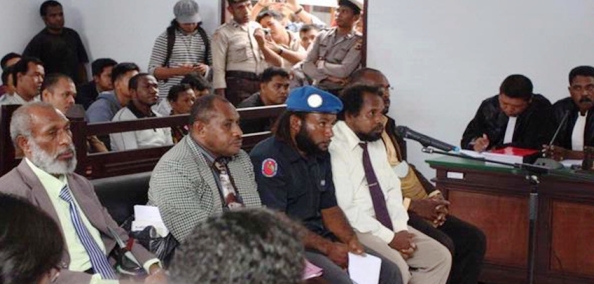
Papuan leaders accused of treason on trial in Jayapura, January 30, 2012

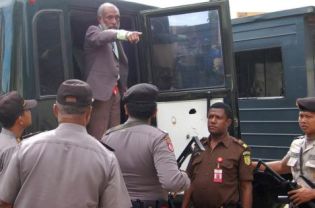
(Jayapura):  Hundreds of security forces are on the streets around Jaypura, West Papua, in a show of force as an Indonesian court found five Congress leaders guilty of Makar (treason), and sentenced the defendants each to three years in prison.

The five defendants, Forkorus Yaboisembut, Edison Waromi, Selfius Bobii, Dominikus Sorabut, and Agus Kraar, were leaders and organisers of the Third Papuan People’s Congress held on October 19 2011, which was brutally broken up by Indonesian security forces after Forkorus  – the Chairman of the Papuan Tribal Council elected as President of the Federated Republic of West Papua – unilaterally reaffirmed West Papua’s independence from Indonesia.

Today’s hearing at the Jayapura Class 1A District Court, the 15th hearing in a trial described by international observers of “descending into farce”, closed after the panel of judges led by Jack Johan Oktavianus declared that the defendants had committed treason under Article 106 of the Indonesian Criminal Code.

During the trial, several Indonesian Brimob paramilitary police officers who opened fire on the Congress gathering, admitted they had no proof that the accused had committed treason before they opened fire on unarmed civilians.

No member of the Indonesian security forces, who during the breakup of Congress were filmed committing acts of brutality and violence on unarmed civilians, were criminally charged and so far have not receive any sanction for the unprovoked attack.

On March 14, another defendant from the Third Papuan Peoples’, Gat Wenda, was also found guilty of makar charges, but was sentence to five months gaol, less time he has already served since his arrest.

Lawyers for the defendants, themselves under threat of prosecution and harassment by Indonesian security forces for their advocacy for the accused, have planned to appeal the decisions, saying “we think this decision is a disaster.”

In SMS messages sent from the legal team to West Papua Media, senior lawyer Olga Hamadi said “we think the judgement from the full bench is out of tune with what actually happened.  We will appeal this to the High Court”.

Gustaf Kawer, another senior member of the legal team, also told West Papua Media via SMS that “the judges considered ambiguous and inconsistent testimony.  (Yet) there is evidence of free expression and democracy that was ruled,” Kawar said, referring to the democratic rights and obligations adhered to by the Congress leaders.

A massive show of military hardware has caused major fear on the streets of Jayapura, with most poeple staying away from demonstrations for fear of an imminent military crackdown.  600 Heavily armed Brimob riot police and 300 Indonesian army soldiers are surrounding the streets around the court, backed up by several water cannon, 13 Barracuda armoured vehicles, and seven Army Panzers (assault vehicles).

Security forces today have, according to local civil resistance sources, used this show of force to actively prevent supporters of the accused to attend court.

The atmosphere has been described as highly tense with Papuan supporters of the convicted men outraged, but terrified, according to SMS messages from sources on the ground.

westpapuamedia

This is a developing situation – please stay tuned.

When there is no guarantee of security of life for the people of Papua

by John Pakage for West Papua Media

Opinion

March 1, 2012

(Edited and abridged in translation by West Papua Media)

Tuesday morning, 21st February, Courtroom 1A in Jayapura was peaceful but tense. Many soldiers were to be seen guarding the streets for a session of the trial of Forkorus Yoboisembut, Edison Gladius Waromi, Agustinus M. Sananay Kraar, Selpius Bobii and Dominikus Sorabut.  They were arrested after the session of the Congress of the People of Papua in Zakeus Pakage Square, Abepura,Jayapura, on the 19th of October 2011.

At the fifth meeting in this case, some witnesses, who were all members of the police, said they had not been direct witnesses and did not know about the public nature of the meeting of the Papua Congress. Seven witnesses out of the eight who were called by the court had attended. These witnesses had only heard from a distance the voice of Forkorus reading the resulting resolution of the Congress.

Forkorus Yoboisembut, Edison Gladius Waromi, Agustinus M. Sananay Kraar, Selpius Bobii and Dominikus Sorabut are all charged with treason, because they had declared the independence of the State of West Papua.

Concerning this case, the legal representative of the accused, Olga Hamadi, told John Pakage from Cermin Papua on Thursday 1st March that the witnesses who are making things difficult for the accused, were not actually at the location of the Congress and their evidence is refuted by those who were.

“Seven witnesses who are all members of the Police gave statements as witnesses; however, we reject them because they did not directly see the meeting. They only heard Pak Forkorus reading a declaration of the result of the Congress via the PA system,”  said Olga.

Hamadi explained that “We saw that the declaration of the results of the Congress which were read by Forkorus were a summary of statements of all the members of the Congress, which were (in turn) a direct statement of the aspirations of the people of Papua.”

Because of this, the accused did not take any action towards secession via this Congress. Thirdly, this Congress is only restoring the country to what it was before the Indonesians annexed it in 1961.

Many of the world’s human rights organisations have already sent letters to the President of the Republic of Indonesia to release Forkorus, Edison Gladius Waromi, Agustinus M. Sananay Kraar, Selpius Bobii and Dominikus Sorabut, because they only gave voice to the problems hindering democracy in Papua, and the human rights violations which would not be tolerated as legal by the government of Indonesia.

The civil human rights organisation based in New York,USA, Human Rights Watch (HRW), says that the establishment of the Congress of the People of Papua is a normal part of the human rights that belong to the people of Papua. They are calling on the government of Indonesiato withdraw the charges against the accused and free the five members of the Congress of the People of Papua immediately.

“The government of Indonesia has to live up to its commitment to peaceful resolution (of the Papua issue) by cancelling these charges against the five activists,”  said the Deputy of HRW for Asia, Elaine Pearson, in a statement cited by AFP on Monday 29th January, 2012.

A similar appeal came from a member of the Congress of the United States, Eni Faleomavaega. Eni said that the TNI and Police were the initiators of the unrest in Papua, especially by the scattering and arrest of members of the Third Congress of the People of Papua (KRP).

Compare this with the stated commitment of the government of Susilo Bambang Yuhdoyono, that it will deal with the problems in West Papua in a “peaceful way, with justice, and with dignity”.

While this legal case is ongoing, international support is growing in strength for the aspirations of Papua to be given the opportunity to express themselves. This support is seen by the government of Indonesia as foreign intervention in the internal affairs of Indonesia’s province of Papua.

It is no secret that the international public already knows of the meeting of the International Group of Parliamentarians for West Papua (IPWP) in Australia on February 29. This support for Papua is gathering in Australia from many of the nations of the Pacific.

On 22 September 2010, a member of the American Congress, Eni Faleomavaega, became familiar with the problems in Papua, and heard (In a special session of the  U.S. House Committee on Foreign Affairs) about the human rights violations which are perpetrated in Papua by the Indonesian government.

Several experts testified at the Committee Hearings and examined a selection of the problems of democracy in Papua, and the violations of human rights.  These included Pieter Drooglever (Institute of Netherlands History), Henkie Rumbewas (a Papuan independence activist), and Sophie Richardson, PhD (Human Rights Watch).

This international opposition has made the government of Indonesia very cautious about the growing support for Papua from many nations outside Papua. Indonesia is afraid that there is a chance that the forces of the US in Darwin, Australia, which will number around 2500 US Marines, will be used to intervene to help liberate Papua.

The head of  Committee 1 of the DPR, Ahmad Muzani, said that the superpower has a close relationship with the personnel in Darwin. He says that the US forces are tied up with the problems in Papua because they have hidden interests in the territory.

To be sure, as technology develops in the world there are fewer incidents  happening in the jungles of Papua that remain unknown.  Since 1969, when the Indonesian government first banned foreign journalists from covering news on the ground in Papua, there have been many cases of foreign journalists being deported back to their home countries from Papua. It’s not clear why Indonesia is so afraid of what’s happening in Papua.

International attention on Papua is also increasing because Papua is a great source of natural resources. Many countries and companies would like to invest in Papua, like Freeport McMoran, an American company which provides huge amounts of  foreign exchange to Indonesia. Freeport enables the Indonesian government to operate in the way it does. This fact would be made very clear if Freeport was forced to close and withdraw all its investment (as some Indonesian and most Papuan figures are calling for). That truly would be a great disaster for -Indonesia – in fact, Indonesia could be broken up by such an outcome.

However, for the last few months Freeport has only just been able to continue operations. The business has reported that its profits are only US6.4 billion, or about Rp57.6 trillion  for the last year, a fall of US1.5 billion from the year before.

“This result is not good, because it shows a fall-off in our operations, at the Grasberg mine in Indonesia,” said the CEO of Freeport, Richard Adkerson, as reported on the BBC on Saturday 21 January this year.

It can be seen that for some months now there has been a loss of business, which is growing all the time, because the management of Freeport has stopped operations of the automated extraction of gold.  The mining of copper at Grasberg has also been reduced.

(These stoppages were initially caused by Freeports’s wholesale rejection of its workers demands for work safety guarantees and living wage increases, from US$1.50 per hour to US$14 per hour.  Freeport workers conducted a five month long strike forcing Freeport to declare force majeure on its supplies and projections. West Papua Media)

These stoppages have affected the share price of PT Freeport Indonesia on the Indonesian stock market (BEI), and also the share price of (parent company) Freeport-McMoran in America. So of course there is a loss by America which is growing. There will also be further significant losses if there is a general economic slowdown, both in Indonesia and in other countries.

At the present time,Freeporthas not been operating since Thursday March 1, and Freeport has stopped operations for the next six months. (It is amidst) these circumstances that America is still donating fighting planes such as the F16 and Hercules to the Indonesian military.

The US Defence Minister, Leon Panetta, has been trying to set up a bilateral meeting with Indonesian Defence Minister Purnomo Yusgiantoro to establish a summit of the Defence ministers ofSouth East AsiainBalifor some time now. The US Defence Secretary also had a meeting with President Yudhoyono at the Ayodya Hotel in Bali.

However, the promised US delivery of 24 F-16 fighter planes and Apache helicopters has not as yet been finalised. Further action is needed in this process, as the planes have not yet arrived in Indonesia. Military observer Rizal Darmaputera views the stepping up of defence cooperation between the US and Indonesia as “one means of implementing America’s geopolitical strategy on the Asia-Pacific rim to balance the growing strength of China.”

The (geo)strategic position of Indonesia is a necessary link in the alliance of the US with various Asia-Pacific countries which tie in with its close connection with Japan and Australia.

So America gives this donation of war planes to Indonesia, knowing that they will be used to ensure that the Papua problem be handled internally by Indonesia to maintain the “unity of the Republic of Indonesia”.

Therefore the promise (by SYB) of basic human rights for Papua demanded by Forkorus and friends will not keep them out of jail as now. Jakarta must evaluate its treatment of the people of Papua as part of the human race, and who deserve rights and respect just as other people in the world deserve; and not to treat them (in the manner) as did AKP Rido Purba, an Indonesian Police officer in Papua who spat in the faces of Forkorus and friends at the time of their arrest.

Up to this time we have yet to see justice and the admission of basic human rights to Papuans; so (the next hearing of treason trial on) March 2 will be a very important stage in the case against Forkorus and friends by the Indonesian justice system in Jayapura.

At this point, “the trial of Forkorus and company will resume,” said  Olga Hamadi, Director of Kontras.

# John Pakage is an independent journalist based in West Papua and a regular contributor to WPM.

24 Feb Update on Forkorus trial: Testimony from witness

Bintang  Papua, 24 February 2012 

One of the witnesses to appear in the trial, Eliezer Awom told the court that the declaration of establishment of the Federal Republic of West  Papua had come about as a result of pressure from the Papuan people, as had been expressed during the Third Papuan Congress which was held in October last year.

Eliezer Awom was the only one of nine witnesses who were due to testify at the hearing. The other witnesses did not turn up.

Awom reminded the court that the Third Papuan Congress had been attended by around four thousand people.

The witness described the decision that was taken at the conclusion of the Congress and the subsequent arrest of Forkorus, along with a number of other people, including the witness himself. He insisted that the Congress was a manifestation of the wishes of the Papuan people and said that the Congress which had taken place and had been given official permission to take place. He said that the Congress had agreed to the establishment of the Federal Republic of West Papua and had elected Forkorus Yaboisembut as the President of the Federal Republic, along with Edison Waromi as its prime minister.

He described how Forkorus made his statement very public through loudspeakers and that two hours later, the security forces had started shooting the participants  in order to force them to disperse. He described the banners that had been unfurled at the Congress and insisted that they were simply restoring the Federal Republic of West Papua, and that West Papua belongs to the West Papua people.

Around 400 people were taken into custody at the time, many of whom were subjected to maltreatment such as kicks and punches by the security forces.

Forkorus and the other four Papuans who are on trial with him confirmed that what the witness said in court was true.

He said that the declaration should be sent to the United Nations in order for the Federal Republic of West Papua to obtain formal recognition from the international community.

As with previous hearings, security forces were out in force around the courthouse.

Indonesian police conduct armed sweep of treason defendants in their cells

from WestPapuaMedia sources in Jayapura

Monday February 20, 2012

Extraordinary scenes occurred at Abepura prison in West Papua on Saturday night when heavily armed police stormed the cells of non-violent Papuan leaders currently on trial for treason.

The unusual and heavy handed security sweep was carried out between 9-10 pm on Sunday night and involved 3 truckloads of armed Dalmas anti-riot paramilitary police; 2 truckloads of Brimob police, and a detachment of the fully armed prison anti-riot officers.

Forokorus Yaboisembut (Jakarta Globe)

The cells of a number of West Papuan political prisoners were turned over in the sweep, and all prisoners possessions were removed, including pens, paper, files, books, letters, plates, drinking glasses, cutlery knives, guitars, and music tapes, including lawyer-client privileged communications and defence notes.  Mobile phones were not found however, according to sources at the prison.

It is believed the targets were  five leaders of the Third Papuan People’s Congress that peacefully declared independence from Indonesia on October 19, 2010, sparking a brutal and bloody crackdown by Indonesian occupation forces.

Forkorus Yobeisembut, and Edison Waromi, the President and Prime Minister respectively of the Federated Republic of West Papua, together with Selpius Bobbi, Dominikus Sorabut, and Agus Kraar are all on trial for treason charges.  The hearing on Friday had to be suspended after the prisoners refused to return into the courtroom due to concerns of the conduct of witness cross-examinations.  The trial was adjourned to February 21.

Reliable sources close to the accused Congress leaders have told West Papua Media that the raids relate to rumours circulating that the five defendants will be broken apart and moved to separate prisons away from Papua. These rumours have been propagated by unknown parties, however regular prison transfers are a common tactic by the Indonesian state on Papuan political prisoners.  The Indonesian Attorney-General and the Prosecutors office have repeatedly stated publicly that the trial and prisoners would be moved from Papua if any unrest occurs, but there is significant local Papuan resistance to such a move.

Local observers also have suggested that the bizarre raids had occurred after police objected to the defendants conduct in court and sought to reassert the “authority of state” by behaving unpredictably.

According to a series of urgent text messages sent to various advocates, the head of the prison at Abepura opened up the political prisoners section to normal criminals allowing them to mix freely.  This is often a tactic utilised by prison authorities to effect violence on prisoners without prison guards having to commit the abuse personally.  The political prisoners source told West Papua Media that in a disturbingly strange move, the prison chief then invited the political prisoners to sit without resistance with in a room together with hardened murderers, robbers and rapists, many of whom are from other parts of Indonesia.

Prison authorities did not reply to any requests for clarification from West Papua Media about the events at Abepura.

Statement from 5 Makar accused at KP3 treason trial

STATEMENT BY FIVE PAPUANS WHO WENT ON TRIAL IN JAYAPURA ON 30 JANUARY 2011[This hand-written statement is signed by the five Papuans who went on trial in Jayapura on 30 January 2012, and is translated in full by
Carmel Budiardjo, TAPOL]

Fully understanding and conscious of our basic human rights as Papuans of the negroid race, part of the Melanesian race who live in the land of the country of West Papua, inheritors from our ancestors, we herewith firmly declare  that WE FIRMLY REJECT THE TREASON TRIAL AND OTHER SUCH TRIALS that has been mounted against the five of us, and we speak on behalf our colleagues and the entire nation of the Papuan people of the Nation of West Papua.

We call for an understanding of this declaration, a declaration of independence, in accordance with the principles of PUBLIC INTERNATIONAL LAW, a law which should be lawfully accepted. And in this case, this declaration will bring us substantial  happiness if it gains the recognition of the international community.

In order to gain substantial and dignified recognition from the international community, we have requested our international team of lawyers to  notify and register  our legal status along with the question of the annexation of the TERRITORY OF THE STATE OF WEST PAPUA at the International Court, with the Secretary-General  of the United Nations, Amnesty International and all member states of the United Nations, as well as other competent authorities.

We herewith categorically state that we are not prepared to make any statements or answer any questions that are based on the laws and accusations of treason by  the Unitary State of the Republic of Indonesia, during the current trial for treason. It is very clear indeed that this is a matter between two nations and two states, that is to say, between the Papuan nation and the Indonesian nation, between the Federal State of West Papua  and the Unitary State of the Republic of Indonesia.

The following are the reasons for our rejection of the trial for treason or any such trial:

[NB: The copy of the statement which we have received jumps at this point from page 2 to page 4 which suggests that the copy we have is incomplete.]

1.    Our struggle and the struggle of those who have gone before us and the nation of West Papua  and all members of the Papuan people up to the present day is a struggle for the restoration of independence and sovereignty of the Papuan Nation as one of our most basic political rights.

2.    Bearing in mind that the Unitary State of the Republic of Indonesia annexed and continues to annex, the people and nation of the Papuan people since the TRIKORA command which was proclaimed by the former president of Indonesia, President Sukarno on 19 December 1961 in the city of Jogyakarta and which was followed up by  the Indonesian military, from 1962 to the present day, by a variety of measures aimed at preserving the annexation.

3.    Our struggle is not aimed as damaging or destroying any country in the world.

4.    We do not intend to damage or destroy the Unitary State of the Republic of Indonesia.

5.    We feel that our dignity has been defiled, that our basic political  rights have been violated in our country, West Papua, which we inherited from our ancestors.

6.    No one, for whatever reason, has the right to make accusations against us or to convict us in a treason trial or any such trial. This is because we have become the subjects of our own laws  as citizens of the nation and state of the Federal Republic of West Papua.

7.    Based on the values of basic human rights, of democracy and the following universal laws:

a. The  first article in the Preamble to the1945 Constitution  of the Republic of Indonesia.
b. Article15 of the Universal Declaration of Human Rights of the United Nations adopted on 10 December, 1948.
c. Article 1, para 1 of the Covenant on Civil and Political Rights adopted as UN Resolution 2200 (xxi) which has been in force since 23 March 1976,.
d. The Declaration on Granting of Independence to Colonial Countries and Peoples in UN Resolution 1514 (xv) on 14 December 1960.
e. The basic principles of decolonisation , namely possidetis juris and the legal succession of the state to the colonial territories  of the  Dutch East Indies (Dutch Papua) since 19 October 1961.
f. ILO Convention No. 169, 1989 on the Rights of Indigenous and Tribal People.
g. The UN Declaration on the basic rights of indigenous peoples of 13 September 2007.
h. The Papuan Independence Manifesto of 19 October 1961 adopted by the Papuan National Committee.
i.  Stipulations adopted by the Grand Congress (MUBES) of the Papuan people in 2000.
j. The Eleven Recommendations of the Second  Papuan Peoples’ Congress and Indigenous Papuan People  in 2010.
k. The decisions of the Second Papuan Peoples Congress in 2000.
l.  The decisions of the Third Papuan Peoples Congress of 2011.

8.    The Statement by the Indigenous Papuan People and the Papuan people is a truth based on analytical and practical categories. The analytical category means that the indigenous P apuan people are the Papuan nation, a negroid race of the Melanesian race, located in the South Pacific. Whereas the practical category is a political statement which was enunciated in the Manifesto of Papuan Independence of the Papuan National Committee on 19 October 1961 in Hollandia, the State of West Papua.

9.     We democratically restored the independence and sovereignty of the Papuan people on 19 October 2011, at the Third Papuan Peoples  Congress with the establishment of the Federal Republic of West Papua  which was announced by the DECLARATION OF THE PAPUAN NATION IN THE STATE OF WEST PAPUA.

10.    The government of the Republic of Indonesia and the governments of all other members of the United Nations, should without discrimination recognise and respect the democratic processes of the Papuan people at the Third Papuan Peoples Congress on 19 October 2011 in the form of the Declaration of the West Papuan Nation and State.

11.     The application of the treason law against the Papuan people must be categorised as a violation of the basic and legal political rights of the Papuan nation.

We hereby call on to the Honourable Judges in this forum to annul the trial held in order to accuse us of TREASON and make similar charges against us. The solution to the independence of the Papuan nation which is our most basic political right must be sought by means of international mechanisms between the Federal Republic of West Papua and the Unitary State of the Republic of Indonesia, mediated by the United Nations.

In order to regulate the transfer  of sovereign powers from the Unitary State of the Republic of Indonesia to the Federal Republic of West Papua, we intend to initiate a new phase of cooperation  based on the principles of democracy,  justice, peace, mutual respect and dignity. As is customary between independent and sovereign nations and states on Planet Earth.

Herewith our statement of REJECTION OF THE TRIAL BEING HELD TO ACCUSE  US OF TREASON AND SIMILAR CHARGES.

Jayapura, 30 January 2012

Signed:

1. Forkorus Yaboisembut, President of the Federal State of West Papua.
2. Edison G. Waromi, SH, Prime Minister of the Federal State of West Papua.
3. Agust M. Sananai Kraar, SIP,human rights activist/staff
4. Selpius Bobii, activist/staff
5. Dominikus Subarat, activist/staff

Create a website or blog at WordPress.com

Up ↑