MRP dualism threatens the existence of the Papuan people

Bintang Papua, 23 June 2011

Pastor Jonga: ‘MRP has now become a mechanism for the government’s splitting tactics.’

The controversy about the setting up of an MRP for West Papua had
continued to rumble on and is likely to last for a long time. There are
people who now claim that having two MRPs will threaten the existence
of the indigenous Papuan people.

This was the theme of a seminar held by the Students Executive Council
(BEM) on Wednesday this week.

The controversy emerged when the governor of West Papua, acting on
behalf of the Minister of the Interior, announced the creation of the
West Papua MRP. The seminar was held at the auditorium of the
Cenderawasih University, and was attended by about a hundred people.The
main speakers were Fadhal Alhamid of the Papuan Customary Council (DAP)
and Pastor Jong Jonga, representing the religious community The
moderator was Laus Rumayon.

Fadhal Alhamid said that the danger posed by MRP dualism was that the
standard set for basic human rights of Papuans living in the province
of West Papua would be different from those set in the province of
Papua. In addition, the creation of the West Papua MRP was to promote
certain vested interests, part of a conspiracy between the governor and
the vice-governor of West Papua. ‘The MRP reached an agreement
regarding cultural and economic unity.But if there are now two MRPs,
there is the danger that this unity will disappear.’

He also said that responsibility for creating the second MRP rests with
the MRP itself. ‘We should raise the question of whether they were the
ones responsible for creating the second MRP.’

He also drew attention to the position of people in the leaderhip of
the Papua MRP and the West Papua MRP. ‘The fact that Ibu Dorkas is the
chairman of the Papua MRP and is also the vice-chairman of the West
Papua MRP has led to a great deal of confusion.

The other speaker, Pastor Jong Jonga, dealt more specifically with his
own experiences with congregations living in the district of Keerom. ‘In
my opinion, special autonomy (OTSUS) has failed to provide protection,
tranquillity and security indigenous because its benefits are only
being enjoyed by people living in the vicinity of the district capital.
‘These were precisely the regions where the percentage of indigenous
Papuans is very low as compared to the percentage of newcomers or
migrants.’ What they were hoping for, he said, was that the MRP which
had been intended as a unifying body would now become a means for
splitting the Papuan people.’

During questions and answers that followed the speeches, the students
focused primarily on OTSUS. Many said that OTSUS had become nothing
more than a mechanism to prolong the sufferings of the Papuan people.
OTSUS has become the long arm of the central government. ‘What was
needed now,’ the one questioner said, ‘was for the DPRP to take action
to disband the West Papua MRP.’ Many in the audience shared these views.

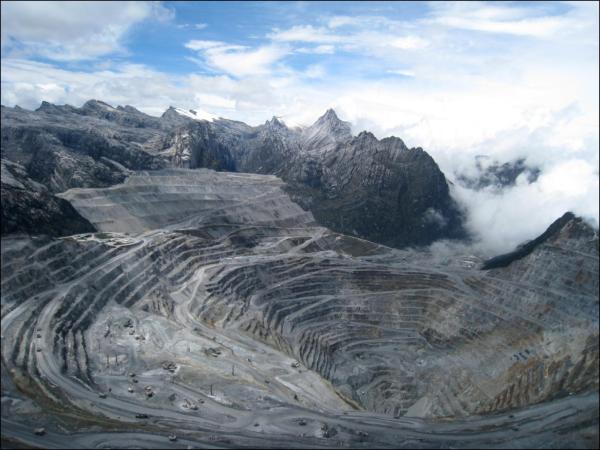
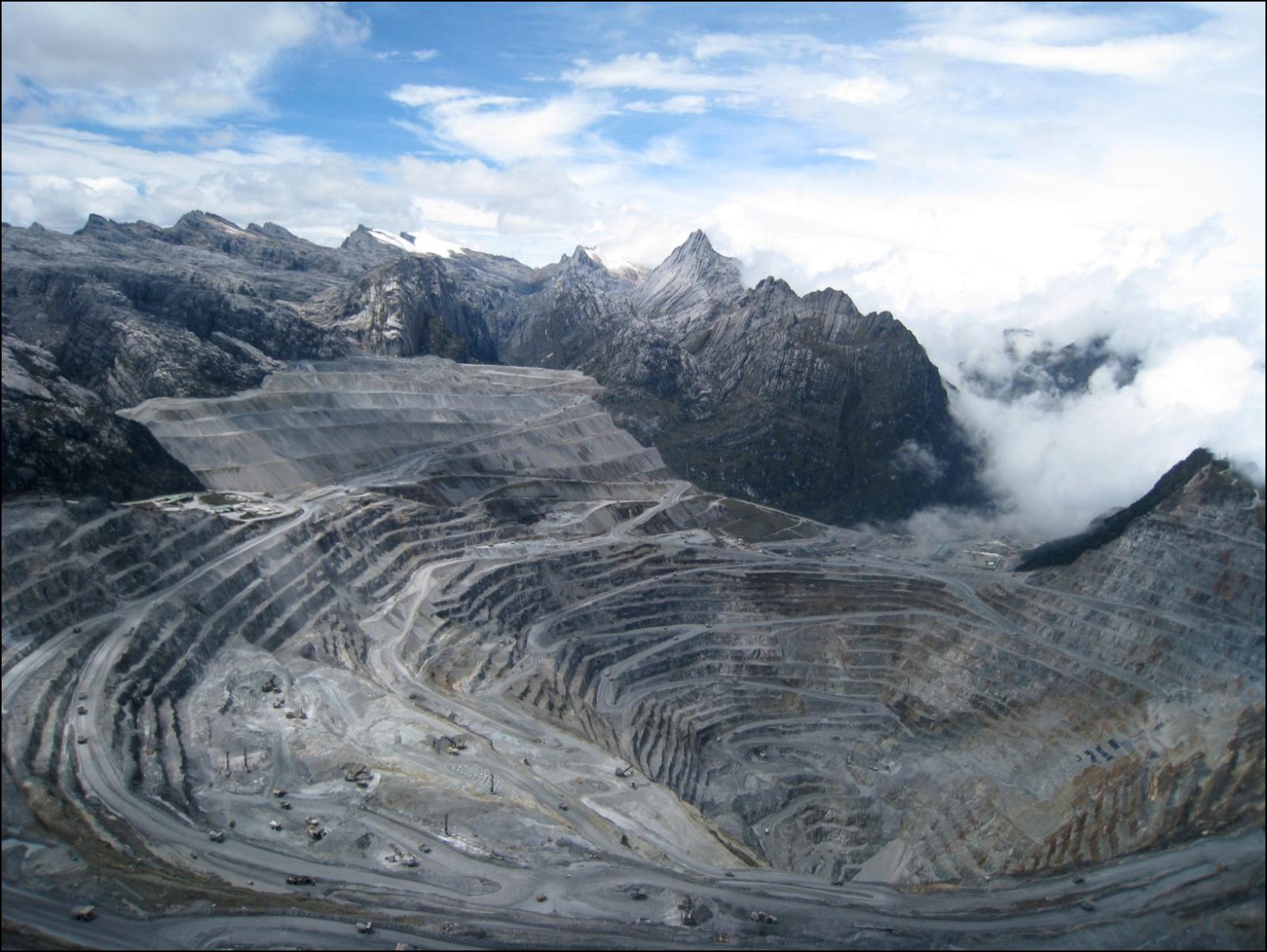
WHAT DO WE KNOW ABOUT HOW MUCH FREEPORT PRODUCES?

JUBI, 22 June, 2011
It is still very difficult for the Mimika district administration to get information about the quantity of gold and copper produced by Freeport-Indonesia and how much is exported via Portsite, Amamapare.
Freeport's Grasberg mine - Earth's biggest hole in the ground

The head  of the mining, energy and minerals department of the Mimika administration, said:

‘We don’t know anything about the quantity of gold, copper and other minerals produced daily by Freeport and this is because  we do not have free access to the company to be able to control the level of production every day.’

He said that the administration did once charge two of its employees to oversee export activity in Amamapare, but after we had given them the task, the two men were unfortunately shifted other posts.’  [Could this have been a deliberate action.]

This is a big problem. Anyone charged with scrutinising exports and imports  would have to be a specialist. They would need to have a special certificate for controlling goods and services for both exports and imports..

All this has an impact on obtaining clarification about the quantity of minerals produced every year. How can this possibly be synchronised with the information received by the authorities in Jakarta? It’s all just a game because the people at the centre get data about gold and copper production which comes directly from the company, PTFI.

The department of mines in Jakarta only gets information from one side. ‘This doesn’t lead to any accuracy. Anyone with bad intentions can easily manipulate the data.  Although lots of stuff is exported, they report a very low figure.’

So the question is: who else but the company can know anything about the quantity of material it produces every year? Only the PTFI.

[COMMENT: This once again highlights the extraordinary powers that the US company has been given to keep a tight control over how much it exploits of Papua’s abundant natural resources, with the  Papuan people not only left in the dark but also left living in poverty while Freeport makes a fortune from its investments in West Papua. TAPOL]

Magai: ‘Papuan officials are destroying Papua.’

JUBI, 19 June 2011The chairman of Commission A of DPRP. Ruben Magai has warned that the destruction of Papuan resources  is being intensified by the activities of a number of senior officials in the Land of Papua. Some of these officials are ‘playing games’, shielded by a variety of problems which continue to  play havoc with the lives of the  Papuan people. There is no question of these people taking sides with the  weakest people in society. All they are interested in is furthering their own interests.’

‘It is a public secret,’ he said, ‘that Jakarta is continuing to manipulate things, causing the continued destruction of  Papua. There is no space for democracy, the  policies being pursued  have nothing whatsoever to do with promoting the welfare of the Papuan people here.’

Ruben said that Papuan bureaucrats should be fighting to promote the interests of the people, but this is simply not happening. ‘Papuan officials are also contributing to the destruction of Papua,’ he said.

The general view here in Papua is that OTSUS, the special autonomy law, has failed  The government should be opening itself up, making an evaluation of the situation and providing space for these discussions. ‘But nothing of the kind is happening which means that the issue will continue to be raised in demonstrations, in seminars, in media reports and other forums.’

The Papuan people have for many years been raising their voices about the failed implementation of OTSUS, calling for OTSUS to be returned to Jakarta. At the very least, there should be some response. Last Thursday, dozens of people in the Coalition of People United  for Justice (KRPBK) expressed these views.

The Papuan people’s aspirations are regarded by the government as matters of no importance. The DPRP went to Jakarta to raise these issues but to no avail. ‘As representatives of the people, we feel extremely unhappy with this situation. All the efforts we have been making have led nowhere. On one occasion, we submitted  a concept to Commission A of the Indonesian parliament, the DPR,  which was accepted at the time, but there was no follow-up at all. This was a great disappointment,’ he said.

The Land of Papua continues to be turned upside down, with unpopular measures, with acts of violence, with human rights violations which are never resolved, with the abuse of freedom of expression, with the introduction of laws which are unacceptable, as a result of which the rights of civil society are never upheld.

‘This is the reality of the situation in Papua today,’ said Magai.

Seven more Papuans facing charges of makar

According to two reports in the tabloid, JUBI on 16 June 2011, there are seven Papuans currently on trial on charges of makar – subversion. In all these cases, the allegations relate to their participation in an event to commemorate the anniversary of the independence of the West Melanesian Republic on 14 December 2010 and their holding aloft the 14-star flag of the West Melanesian Republic. [This is not the Morning Star flag – the kejora – which is also frequently unfurled at peaceful demonstrations in Papua and has landed numerous Papuans in prison over many years.]

The first report relates to the trial of five students of UNIPA – State University of Papua. The five students are Jhon Raweyai, Yance Sekenyap, Penehas Sorongan, Alex Duwiri and Jhon Wilson Wader, whose ordeal in court has now entered its second hearing.

At this hearing, the defendants and their team of lawyers were given the opportunity to submit their demurrers challenging the court’s right to proceed with the trial. Their lawyer Simon Riziard Banundi said that he had submitted two demurrers as the five students were being tried in two groups.

The trial of the two other Papuans on charges of subversion was unable to proceed because three expert witnesses who had been called by the prosecution had failed to appear as promised. These two men, Melkianus Bleskadit and Dance Yenu are also being defended by Simon Riziard Banundi. Banundi sought clarification at the hearing about whether indeed the witnesses had been summoned as the prosecutors had failed to present copies of the summons sent to them. One of the witnesses was said to be ill while no explanation was given about the absence of the other two.

Open Letter – FREE YOUTH ACTIVISTS AND RESPECT HUMAN RIGHTS OF THE PEOPLE OF WEST PAPUA

A Open Letter


To the Government of Indonesia, Indonesian Youth Activists, Indonesian Human Rights Defenders and Organisations, and the People of West Papua. 

RE: FREE YOUTH ACTIVISTS AND RESPECT HUMAN RIGHTS OF THE PEOPLE OF WEST PAPUA

A collection Youth/Human Rights Organisations and Advocates based in Fiji (and across Oceania) are concerned with the continued suppression of witnesses and the media regarding the imprisonment and secret court proceedings surrounding the arrest of 5 youth activists arrested on December 17th 2010 for raising the West Papua Liberation Flag.

Five youth activists Jhon Wenda, George Rawiay, Benha Supanga, Alex Duwe, and Iyance have been charged under Article 106 and 110 of the Indonesian Criminal Code.

Some 200 people took part in a peaceful ceremony outside Manokwari in December 2010, during which the Morning Star flag, a symbol of Papuan independence, was raised in commemoration of the declaration of Papuan independence in 1962.  When the flag was raised, Indonesian Military advanced on the crowd, firing shots and beating people with batons.

We have been advised by colleagues within the West Papua Liberation Movement that the health of these 5 youth activist and safety after been detained since December 2010 is of serious concern. They also noted the media censorship on the case and how many witnesses are afraid to testify because of further repression. We have also been told that a heighten sense of fear has been fueled by the continued presence of a 1000 plus military presence in the province of Manokwari that were ordered into the area.

Human Rights and the protection of activists or defenders of these rights must be respected if we are to allow peace to exist in West Papua. Indonesia as a State signatory to the Universal Declaration of Human Rights and many other Human Rights Instruments should see its role in the protection and advancement of Human Rights, Media Freedom, Civil and Political Rights of all peoples they claim to govern.

Indonesia was re-elected this year into the UN Human Rights Council for the period 2011-2014, which is an inter-governmental body within the UN system made up of 47 States responsible for strengthening the promotion and protection of human rights around the globe. Indonesia’s own human rights record has recently been brought to the forefront and we remind State parties of their obligations to ensure citizens are treated with dignity regardless of ethnicity, age or political opinion.

We urge the Indonesian President and Government of Indonesia, Indonesian Human Rights Organisations and all stakeholders  to intervene and ensure the release of the 5 youth activists and to make a public commitment that there will be no further arrests of individuals purely for the peaceful exercise of their right to freedom of expression, opinion, belief or association.  Specifically, we seek to ensure that laws concerning “rebellion” (Articles 106 and 110 of the Indonesian Criminal Code) are not used against people who have engagedonly in peaceful activities.

As we do not seek to advocate a particular position on the political status ofWest Papua, We believe the right to freedom of expression includes the right to peacefully advocate referenda, independence or other political solutions under a free media.  These rights must be upheld and respected.

Signed 


Peter Waqavonovono

Young Peoples Concerned Network

Suva, Fiji


Sharon Bhagwan-Rolls

FemlinkPacific

Suva, Fiji 


Filomena Tuivanualevu

Youth Coalition Fiji

(Former Ms Fiji) 

Suva, Fiji

Merewalesi Nailatikau

Youth Assembly of the Fiji Islands

(Former Ms South Pacific/Fiji) 


Veena Singh Bryar

FemlinkPacific

Suva, Fiji 


Melei MeleiTuvalu National Youth Council


Samuela Vadei

Western Youth United

Lautoka, Fiji


Felicity Dronavanua

Change Makers Youth Club

Savusavu, Fiji


Siosiua Po’oi Pohiva

 Friendly Islands Human Rights and Democracy Movement Inc

Nukualofa, Tonga 


John Tabeo

Rabi Youth Club

Rabi, Fiji  


Reginald Prasad

DAWG Youth Club

Labasa, Fiji


O A’U ( Oceania Audacities United)

Long Beach, California

‘Amelia Niumeitolu


Kris Prasad

Drodrolagi Movement

Suva, Fiji


Peni Moore

Womens Action for Change

Suva, Fiji


Seona Smiles

Writer

Suva, Fiji


Ester Grace

Soccer Initiatives for Girls

Ba, Fiji


Discombobulated Bubu

Democracy Advocate – Libertarian,

Fiji


Samuel Bird

Malaita Youth Club

Solomon Islands


Dennis Mekai

Vanuaku Youth Club

Santo, Vanuatu


Frank Lagi

Komas Bahai Youth

Honiara, Solomon Islands 


Sepesa Sigatokacake Rasili

Men Fiji

Suva, Fiji


Noelene Nabulivou

Fiji/Australia

Create a website or blog at WordPress.com

Up ↑