Jayapura: A number of acts of violence have occurred in Papua, but none of these incidents have been investigated. which creates the impression that the Indonesian government it simply not interested, while these incidents have only intensified the independence aspirations of the Papua people.’Violent incidents have occurred and Papuans continue to be killed but nothing is being done to bring those responsible to justice. This shows that these acts of violence must have been committed by the State and are quite systematic, according to the Rev Benny Giay, chairman of Synod the Kingmi Church in Papua.
Besides all these shooting incidents against Papuans, the Indonesian government has done nothing to recognise the social, economic and cultural rights of the Papuan people.’The government pays no attention to these matters and simply takes the security approach,’ he said.
All this only intensifies Papuan aspirations for independence.
The chairman of the Alliance of Baptist Churches in Papua, Rev. Socratez Sofyan Yoman expressed the same opinion, and said that nothing has been done to find and arrest those responsible. ‘This State violence has been going on for a long time which is deeply undermining respect for the dignity of the Papuan people. The result is that the government has been unble to develop any sense of nationalism among Papuan people as part of Indonesia. ‘All it has done,’ he said, ‘is to have reinforced the Papuans own nationalism as Papuan people. The Papuan people have no confidence in the Indonesian government and all they want is independence.This is clearly evident from the many incidents when thousands of Morning Star flag were flown everywhere throughout West Papua on 1 May which is commemorated by Papuan people as the day of Indonesia’s annexation of West Papua,’ he said.
He also drew attention to the shooting of Papuan people on that day. ‘The Indonesian government continues to perpetrate these crimes and kill Papuan people,’ he said.
He said that the only way to solve the problem is to immediately hold dialogue between the Papuan people and the government of Indonesia, mediated by a third party. ‘This is the only solution of all the problems in Papua.’
Human rights activists in Papua, including Maius Murib the former deputy chairman of he Papuan branch of Komnas HAM, Matius Mirib have spoken about the demonstrations on 1 May. He said that in the demonstrations n 1 May, there were run by three different groups. Those who demonstrated at the grave of Theys Eluay said that they were just indigenous Papuans and were not organised by the KNPB – the National Committee of West Papua. Thirnteen people were arrested for flying the Morning Star flag.
The demonstration which took place in Jayapura was organised by the KNPB. ‘Many flags were flown in demos organised by the KNPB in Manokwari, Biak, Merauke and Serui. ‘When they were standing in front of the koramil -military – headquarters, one of the students, Terjoli Waea who resides in a student hostel was shot dead in a truck. An autopsy was done at the hospital and then his body as taken back to the Tolikara Hostel.
At ten o’clock that night, Selpius Bobii was forcibly taken to the police command offic in Abepura The police have said that the Morning Star must not be flown but the fact is that many flags were flown. ‘The shooting in front of koramil must be explained and it cannot be said that this was done by an unknown person. This was not somewhere deep in the forst but in the cente of the city at 7 o’clock in the evening.
Harrowing accounts of terror and intimidation are emerging from villagers and human rights workers in the remote Paniai district in West Papua overnight, as a massive Indonesian military assault against National Liberation Army guerrillas continues.
Local human rights and church sources are reporting that ordinary villagers are being subjected to significant human rights abuses by a combined Indonesian police and military force, and have called for immediate international intervention in West Papua to stop the violence.
Over four full strength combat battalions of Indonesian army (TNI) Kostrad commandos from Battalion 753, Brimob paramilitary police, and elite counter-terrorism troops from Detachment 88 – all units armed, trained, and supplied by the Australian Government – were deployed in an offensive to surround the headquarters of the Paniai Free Papua National Liberation Army (TPN-OPM), under the command of General Jhon Yogi.
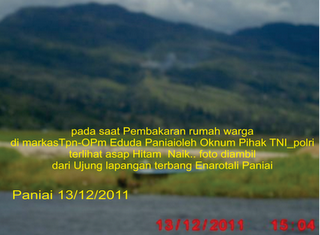
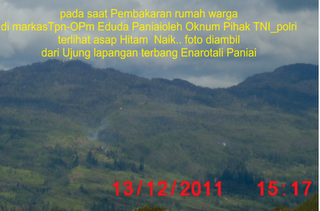
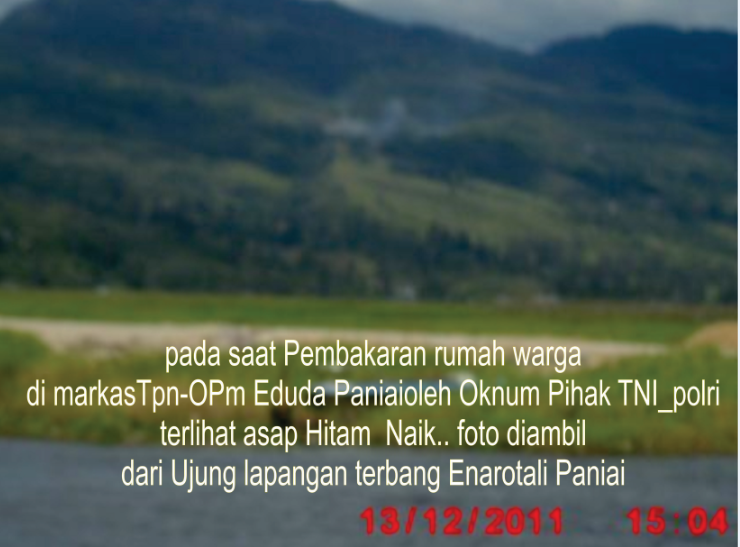
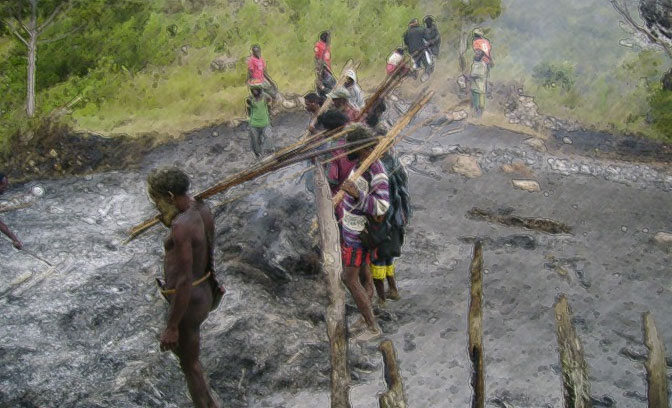
TPN/OPM headquarters Markas Eduda burning after TNI attack, 13/12/2011, Paniai, PapuaPaniai villages burning after TNI attack, 13/12/2011, Paniai, PapuaTPN/OPM headquarters Markas Eduda burning after TNI attack, 13/12/2011, Paniai, Papua
Punitive village burnings and raids are continuing in remote villages around the TPN/OPM headquarters of Markas Eduda. At the time of writing, seventy-five houses, six schools, and about 25 other buildings have been recorded as burnt down in a total of 27 villages by Indonesian security forces.
Eighteen people are now confirmed dead – fifteen from gunshot wounds, and three refugees who allegedly succumbed to starvation in the so-called care centres under the control of security forces. The victims’ names from the attack in Eduda are:
Dead:
Tapupai Gobay (30) was shot in the chest.
Tawe Bunai Awe (30) head crushed*.
Uwi Gobay (35) was shot in the abdomen.
Wate Nawipa (25) was shot in the back.
Martinus Gobay (29) head crushed*.
Owdei Yeimo (35) was shot in the back.
Ruben Gobay (25) was shot in the abdomen.
Paul Gobay (42) was shot in the abdomen.
Bernadus Yogi (23) was shot in the chest.
Demianus Yogi (15) was shot in the back.
Simon Kogoya (40) was shot in the abdomen.
Simon Yogi (30) was shot in the head.
Luke Kudiai (25) was shot in the chest.
Alfius Magai (20) head crushed*
Note: those with “head crushed” allegedly sustained these fatal injuries through severe beatings with rifle butts and “boot stamping”, according to sources
Wounded:
Paschal Kudiai (15) hit by a bullet in the head.
Martinus Kudiai (30) was shot in the hand.
David Mote (40) was shot in the thigh.
Amandus Kudiai (43) was shot in the arm.
Yohan Yogi (21) was shot in the leg.
Mon Yogi (20) was shot in the back.
Credible reports have also confirmed that two civilian “company” helicopters were provided to Security forces, and were allegedly used to drop live grenades and chemical dispersal weapons onto villages surrounding Eduda, and strafe villages with sniper and machine-gun fire on December 13, 14, and 15. Several independent witnesses have claimed to West Papua Media, and reported elsewhere across social media, that the helicopters are well known in the area for local non-military operations.
"Company" Helicopter alleged by local sources to be used in Indonesia security force offensive in Paniai. Source claims photo taken on Dec 13 aas helicopter was circling group. This photo is not independently verified, however analysis shows the image is consistent with independent witness descriptions, and the terrain and weather conditions are consistent with other photos supplied. (West Papua Media source)
Witnesses interviewed by local human rights workers have claimed that at 0800 local time on December 13, the Company helicopter launched CS gas salvos into the village of Markas Eduda, the TPN headquarters, to flush out villagers and guerrillas. According to a separate account sent to West Papua Media by TPN/OPM sources, the helicopters landed troops and occupied Eduda for most of the day, with guerrillas taking to forests in retreat. In retaliation, TPN/OPM fighters shot at the helicopters, unsuccessfully, and several hours of intense fighting ensued which was suspended when Free Papua fighters witnessed many village houses and schools being simultaneously burnt in the surrounding area. According to the TPN/OPM source, villages were set on fire around Eduda and gunshots were heard for the rest of the day and through the night. Free Papua fighters have retreated to the forest and are awaiting orders for their next moves, according to the source.
Villagers from across Paniai are continuing to be displaced by the operations, forced to flee en masse into areas around Enaratoli, on the opposite side of Lake Paniai. As reported on December 14 by West Papua Media, over 131 villages have been abandoned causing at least 10800 Paniai villagers to flee the military operations.
Church sources have further reported that refugees seeking shelter in the Enaratoli area are enduring worsening conditions without any relief. Armed Indonesian security forces have established a police supervised secure “Care Centre” at Uwatawogi Hall in Enaratoli, and have crammed into it 1715 people from Kopabutu and Dagouto villages. According to local activists in reports to West Papua Media, local residents are being threatened with arrest and beatings if they try to provide detainees with adequate humanitarian relief. Police are also preventing people held at the hall from leaving for food or sanitation needs, according to sources. At the time of writing, three people have died at the “care Centre” since December 9 from Diarrhoea. They are :
OTOLINCEA DEGEI age 2 years , died 8:20pm, 9/12/11;
YULIMINA GOBAI Age 4, died 3pm, 14/12/2011;
ANNA DEGEI Age 47, died 1030pm, 14/12/2011.
No food, sanitation or medical aid has been made available by any government agency to give relief to this large number of internally displaced people.
Over 9000 refugees are either hiding in the forest or seeking shelter with their own extended families in the region area. Those with their families are considered safe, however their needs and conditions are difficult to monitor and assess given their isolation
Local teachers have also been in contact with West Papua Media’s stringers. Since 27 November 2011, teaching and learning activities have been suspended indefinitely in all village schools surrounding Markas Eduda. Schools such as SD YPPK in Badao Dei, Yimouto, and Obayauweta villages have been suspended, as has Primary, Junior High, “shop” (trade school) and Elementary Instruction in the towns of Dagouto, and Uwani. The students of these schools have been evacuated with their parents.
A teacher in junior YPPGI Uwani said while repression was occurring in the villages that: “For while we have closed the schools, because school children are frightened and fled with their parents. In addition, we as teachers do not feel safe to make teaching and learning activities. All the teachers have fled Paniai district, and to Nabire. “
On December 15, the army / police battalions have returned to the villages of Uwamani, Dei and Obaipugaida to prepare a major attack for a new phase of the campaign. It is believed strongly by local activists that the “company” helicopter will still be used in addition to Unconfirmed reports have been received by West Papua Mediathat the Indonesian arsenal against civilians in Paniai includes one Mil Mi-24 SuperHind gunship, one of two usually stationed near Jayapura.
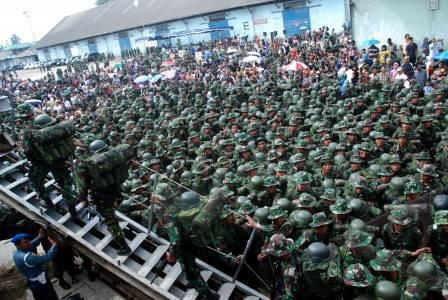
650 Kostrad troops from Battalion 142 being deployed from Palembang to Paniai in Papua, boarding their troop ship on December 9, 2011
West Papua National Committee (KNPB) activists in Paniai reported on December 15 that after the assaults on villages, the Indonesian military forces are now arresting, intimidating and carrying out interrogation on all residents across the districts of Toko, Kopabaida and Uwamani. According the KNPB, Indonesian police have arrested scores of children and adults, and are conducting brutal and physical interrogations and questioning from 11.00 am until the end of the day
The offensive was ongoing throughout December 15, with Indonesian security forces opening fire in many locations around Eduda. Overnight, from 0200 to 0600, heavy gunfire erupted across the Degeuwo River valley. Human rights sources in villages and also with refugees conveyed reports that people were being shot at by snipers if they were moving anywhere after dark, even to collect, food, water, or to secure pigs. It is not known how many people were killed during the night, but local source are expecting the toll to rise.
According to a report provided tonight by a local pilot, Indonesian security forces shot eleven times into houses in the village of Gekoo, where mourners were gathering for a the funeral of a local man who died from illness. Villagers alleged that some bullets even landed in their cooking fires, exploding their food pots.
Witnesses reported a series of helicopter raids from 11am on December 15, with helicopters being used to machine-gun the villages of Obaiyepa and Uwaman. Human rights workers have been unable to access these areas to see if any casualties were sustained.
Unidentified village burnt down 13, dec 2011, near Eduda, Paniai
Helicopters landed at Eduda ceremony ground 11 times from 11:00 to 13:00 hours, and residents suspect logistics, ammunition and additional forces were being deployed.
The area around Paniai has been long subject to conflict and heavy Indonesian military offensives against civilians, however in recent months the Indonesian police have taken charge of punitive operations against West Papuans harbouring pro-independence sympathies. The conflict has recently escalated over land rights and the control of local gold mining operations, with Brimob deeply involved in both joint venture security, and direct involvement in gold businesses and associated activities. The Australian gold mining company Paniai Gold is also operating in the Degeuwo River region.
Indonesian soldiers in Paniai, December 2011
Civilians in the foothills are in panic and reliving the trauma of past operations, according to the report from a local pilot. “They are concerned emotions again will open in Wegeuto of the 1982 war Memoria Passionis (memory of suffering) and again when the Army conducted ongoing military operations (DOM – Daerah Operasi Militer) from 1989-1993 across the Badauwo area, near Eduda, ” the source said via email. He explained that during the last DOM period the army accused and stigmatised civilians as being members of the TPN-OPM, and subsequently tortured thousands of villagers. Human rights sources at the time documented villagers being waterboarded / tortured for 24 hours; residents’ houses burned, raped girls and married women, extrajudicial killings, burning off fingers, moustaches and beards, pulling fingernails and quartering villagers with armoured vehicles. Troops also conducted burning and destroying food gardens, killing livestock and pets, and fouling water supplies.
Residents are concerned that the current angry and emotional behaviour by the TNI-police toward TPN / OPM will be vented on civilians living on the slope of the hamlet Wegeuto especially, directly adjacent to Markas Eduda. In a message delivered to West Papua Media local villagers have pleaded for International Advocacy to get Military and Police immediately withdrawn from Eduda and Paniai in general.
Much trauma is being felt by civilians across Paniai as a result of the offensive. Independent journalist Sonny Dogopia, from Papuan Voices , interviewed local villagers by telephone on December 14. Magda Tekege, a housewife from Deiyai District, said civil society is very scared and depressed. ” Here also TNI / Police beat us and put us under surveillance, and are one full alert status, ” she explained. Deiyai Magda called the situation unusual , “this is probably due to invasion by TNI / police in Paniai, therefore Deiyai also suffer the effects.”
Reports from Tuesday described the exercises that the Australian trained, funded and armed Brimob Gegana unit, upon arriving in Enaratoli proceeded to take over the streets immediately, causing normal town life to be immediately disrupted as local people emptied the streets to hide.
On December 6, Human rights, church sources and local activists had independently claimed that 542 people have been forcibly evacuated by troops from the Special Gegana Brimob “Counter” terrorist police unit. The villages of Dagouto and Kopabatu and surrounding hamlets in the Dagoutu Paniai district were evicted after the Gegana unit decided it wanted to expand a new headquarters facility to deploy in the offensive against Jhon Yogi, the local leader of the armed guerrilla unit of the National Liberation Army (TPN-OPM).
The Gegana unit, a specialised elite anti-terrorist unit of the Indonesian police has been deployed heavily across Papua to crackdown on pro-independence activists engaged in non-violent resistance, as well as to eliminate the armed struggle groups. Gegana is one of several elite Indonesian police units that receives arms, funding, and training from the Australian Government, and was blamed on December 3 for burning down a church and school in Wandenggobak, in the highland regency of Puncak Jaya.
As this article was going to press, an update was received from a trusted human rights worker in Paniai. “At 2300 in the evening, Brimob Coconut Battalion 2 burned down buildings of Paniai Districts’ tourism assets, located in Bukit Dupia, in the same location as the Regent’s residence. This evening in Paniai the situation is very tense”. TPN fighters reportedly have returned fire on the attack and heavy fighting is still occurring,
The situation is ongoing and developing and West Papua Media will continue to closely monitor events.
Please urgently help us continue this work. @westpapuamedia ia working tirelessly to end impunity in Papua with effective journalism. But we need your help – PLEASE DONATE NOW wp.me/P1aPlR-116
Freeport’s James Moffett has said ‘there is no alternative’ to the company’s reliance on the Indonesian military [EPA]
Investing in conflict-affected and high-risk areas is a growing concern for responsible businesses and investors. Companies based in developed countries often operate in lesser-developed foreign markets, where governance standards are lax, corruption is high and business practices are poor.
These pieces focus on one specific Anglo-Australian company and their American partner that jointly operate a mine in West Papua, one of the poorest provinces of Indonesia. The risks for the company include the potential to contribute to environmental and social damage in a foreign market. The risks for investors include financing a company that does not get its risk management right.
This is the third chapter of a four-part essay that examines how the Norwegian Pension Fund came to blacklist the mining giant Rio Tinto. The first part can be found here, and the second part can be found here.
In February 1995, Anglo-Australian mining giant Rio Tinto announced three deals that secured access into Grasberg, a massive gold and copper mine in the Indonesian province of West Papua.
First, Rio Tinto agreed to invest $500m of new capital in Arizona-based mining corporation Freeport for a 12 per cent stake in the US business. Second, Rio Tinto agreed to finance a $184m expansion of the Grasberg mine. In return, it received 40 per cent of post-1995 production revenue that exceeded certain output targets and, from 2021, a 40 per cent stake in all production. Finally, Rio Tinto would receive 40 per cent of all production from new excavations elsewhere within West Papua.
Rio Tinto was effectively doing business with Indonesian dictator Suharto, too.
In response, Freeport told shareholders that Rio Tinto would “contribute substantial operating and management expertise” through proportional representation on the board – as well as on various Grasberg operating and technical committees, from which the “policies established by the [board] will be implemented and operation will be conducted”.
Speaking of the “exceptional potential” of the deal, Rio Tinto’s then chief executive, Robert Wilson, agreed that“given [Rio Tinto’s] experience in other major open-pit copper ore bodies such as Bingham Canyon, Palabora and Escondida, we anticipate considerable mutual benefit”.
Rio Tinto obviously liked how Freeport-Indonesia did business, especially at Grasberg.
By October 1995, an independent US government agency had cancelled Freeport’s international political risk insurance. The insurer, the Overseas Private Investment Corporation (OPIC), specifically cited the Grasberg mine operation as contravening the Foreign Assistance Act of 1961, which required that “overseas investment projects do not pose unreasonable or major environmental hazards or cause the degradation of tropical forests”. Freeport was the first policyholder to be terminated by the OPIC for ethical violations, despite President Suharto and Freeport director Henry Kissinger heavily lobbying the US government to reinstate the policy. Following OPIC’s decision, the company did not disclose the environmental performance of the mine again until 2003 – it no longer had to.
For a brief time in 2000 and 2001, a particularly sympathetic Indonesian environment minister, Sonny Keraf, pursued numerous avenues to impose penalties and fines on Grasberg, including an unsuccessful attempt to invoke the criminal section of the 1997 Environmental Law to cease Freeport-Indonesia’s riverine method of tailings disposal, by which the corporation fed the mine’s waste product into nearby rivers. Under pressure for his pursuit of the part-Indonesian-owned Freeport, Keraf was replaced following the 2001 election.
As Suharto’s reign came to an end, an increasing number of West Papuans also began to campaign against the environmental and social impact of Grasberg. Papuan leaders brought the matter before the US Federal District Court in April 1996 and before the Subcommittee on International Operations and Human Rights of the US House of Representatives in May 1999. Many more attempts, including one to address shareholders at Rio Tinto’s 1998 annual general meeting in London, were foiled by Indonesian authorities.
Building on restrictions introduced in 1991, the US government banned arms transfers to Indonesia for widespread human rights violations in East Timor in 1999. Consequently, Freeport’s payments to the Indonesian military and security forces were more closely scrutinised. The Wall Street Journal found that, between 1991 and 1997, Freeport guaranteed more than $500m in loans so that Suharto’s family and allies could purchase a stake in the mine – a great portion of which was written off by Freeport in 2003.
An outspoken Australian academic, Lesley McCulloch, also found that the 1996 Timika riots adjacent to the Grasberg mine led to a spike in monetary demands by the Indonesian military, resulting in the funding of a $35m army base. Freeport and Rio Tinto refused to disclose details of the payments.
A history of violence
Then in August 2002, two US teachers and an Indonesian employee of Freeport-Indonesia were murdered at the Grasberg mine complex. Following one rebel’s admission that he was a business partner of the Indonesian military, several New York City pension (superannuation) funds formally requested that Freeport disclose the nature of its Indonesian “security” payments. The shareholders were concerned that such payments violated the Foreign Corrupt Practices Act.
Although Freeport was not required to put the proposal to shareholders, the company did begin to disclose its security-related payments. Filings with the US Securities and Exchange Commission since 2001 have confirmed annual payments reaching an average $5m each year for government-provided security of the Grasberg complex and its staff – and fluctuating annual costs reaching $12m for unarmed, in-house security costs. A spokesman for the company later told the Jakarta Post that these payments had been taking place since the 1970s.
Sporadic accounts began to surface – in the Sydney Morning Herald, Jakarta Post, and New York Times – quoting internal sources that confirmed that the Indonesian had masterminded the killings to extort monies from the Grasberg operators. “Not surprisingly, the Indonesian military has exonerated itself,” US Congressmen Joel Hefley and Tom Tancredo said in June 2003. “American investigative teams, including the FBI, have not been able to complete their investigations mainly due to the Indonesian military’s refusal to co-operate and tampering of evidence.”
Freeport remained steadfastly opposed to later demands by New York City pension fund investors to cease all payments to the Indonesians until they complied with official US investigations into the August 2002 murders. At the 2004 annual general meeting, president and chief executive Richard Adkerson advised shareholders: “The management and Board believe that the stockholder proposal mischaracterises the company’s relationships with Indonesian security institutions and suggests actions that would undermine the company’s relationship with the Indonesian government and the security of the company’s operations.”
Despite the ongoing human rights and corruption concerns in West Papua – including a report by the World Bank and a letter by US senators to then UN Secretary General Kofi Annan calling for the appointment of a special representative to Indonesia – after a vote by shareholders, the resolution was not passed.
On March 23, 2004, Rio Tinto announced it had sold its 11.9 per cent shareholding in Freeport. Rio Tinto made a $518m profit. Citing no environmental or social reasons, Rio Tinto’s then-chief executive Leigh Clifford reassured shareholders that “the sale of [Freeport] does not affect the terms of the joint venture nor the management of the Grasberg mine” and that through “our significant direct interest in Grasberg, we will continue to benefit from our relationship with Freeport”.
Rio Tinto remained committed to the mining of Grasberg and would continue overseeing its management through various operating and technical committees.
Sensational claims that illegal payments to individual soldiers, units, and policemen had been routinely made to secure the Grasberg complex and its staff came to light in 2005. A report by Global Witness revealed that an additional $10m had been paid directly to individual military and police commanders between 1998 and 2004. This included $247,000 between May 2001 and March 2003 to General Mahidin Simbolon, former head of the 1999 East Timor massacre, and monthly payments throughout 2003 to the police Mobile Brigade – a group cited by the US State Department as having “continued to commit numerous serious human rights violations, including extrajudicial killings, torture, rape, and arbitrary detention”.
With the US arms trade embargo still in place, Rio Tinto had reassured the market that payments to the Indonesian military were “legally required and legitimate” only months before the news broke. Now Rio Tinto and Freeport-Indonesia came under even greater public pressure. At Rio Tinto’s next shareholder meeting, after several West Papuans refugees made statements to the board on Grasberg, shareholder activist Stephen Mayne suggested that “the most appropriate thing for Rio Tinto to do would be to exit”. After confirming that Rio Tinto’s contractual obligations would permit such a move, then-chairman Sir Rod Eddington informed shareholders that they “make a considerable effort to ensure that the best that Rio Tinto can offer to Freeport in the management of that venture is available to them”.
An Indonesian ministerial decree in 2007 demanded that the security of “vital national objects” – such as Grasberg – be handed over to the police within six months. Evidence obtained by world news service AFP suggests this is not happening. In a filing to the US Securities and Exchange Commission, Freeport disclosed additional direct payments of “less than” $1.6m in 2008 to 1,850 soldiers, despite the fact that 447 policemen make up the official number of personnel responsible for security at the Grasberg complex.
Unrepentant
The company’s 2008 Sustainable Development report confirms that Freeport-Indonesia makes contributions to “security institutions (including both police and military)”. Alarmingly, according to Amnesty International, as recently as 2008 there have been fundamental human rights violations such as the “torture, excessive use of force and unlawful killings by police and security forces” – reports that have subsequently been confirmed by the UN Special Representative of the Secretary General on Human Rights Defenders and the United Nations Committee against Torture.
“There is no alternative to our reliance on the Indonesian military and police,” Freeport chairman James Moffett said to the New York Times in 2005. “The need for this security, the support provided for such security, and the procedures governing such support, as well as decisions regarding our relationships with the Indonesian government and its security institutions, are ordinary business activities.”
Part 4 to follow next week.
This is an extract of a chapter from the book, Evolutions in Sustainable Investing: Strategies, Funds and Thought Leadership, to be published by Wiley in December 2011.
NAJ Taylor is a PhD candidate in the School of Political Science and International Studies at the University of Queensland, and casual lecturer in the Faculty of Law and Management at La Trobe University.
Bintang Papua, 6 September 2011The executive committee of the Synod of the KINGMI Church in the Land of Papua has responded to the threat issued by the police force in Paniai that failure to hand back two firearms by the end of Wednesday, 7 September would mean that the police will launch hunt and search operations against the TPN/OPM led by John Yogi.
According to the KINGMI Church, these search operations against John Yogi who is alleged to have seized the weapons, could result in possibly hundreds or even thousands of casualties of innocent people among the civilian population, said Dr Benny Giay.
The deputy chairman of the Papuan branch of the National Human Rights Commission, Matius Murib, also had a meeting with Ruben Magai, the chairman of commission A of the DPRP about the issue.
Dr Benny Giay of the KINGMI Church called on Commission A of the DPRP to provide the opportunity for local leaders and churches to hold discussions with John Yogi and his comrades. The reason for doing so was that, according to reports from local communities in Paniai, everyday life in Paniai has been paralysed and many local inhabitants have fled their villages in a state of trauma, havng heard about the forthcoming operations against the TPN/OPM. ‘We call upon Commission A and the chief of police to do everything possible to prevent casualties among the civilian population,’ he said.
Meanwhile, the Rev. Albert Kesya, said that plans to launch search operations against the TPN/OPM had been made public at a time when the congregation were involved in Spiritual Camping in Madi Kampung, Enaro,sub-district of Paniai. on 26 July. which is not far from the location where the headquarters of the TPN/OPM is believed to be based. Even so, Brimob forces in Panai had attacked and seized many things, including thousands of bullets (the figure given in the article is 40,000), Rp 50 million, twelve hand phones, ten bows and arrows, and a Yamaha motorbike.
Deputy chairman of the National Human Rights Commission in Papua, Matius Murib, said the government and the security forces need to pay attention to three things. There can be no justification for anyone among the authorities or the population to use violence and cause casualties among the population. ‘Such actions,’ he said, ‘were rejected by human rights organisations around the world, bearing in mind that Indonesia has ratified covenants against the use of violence. and the loss of lives. Secondly, the local population needs to hold negotiations with the TPN/OPM. Whatever the situation, people like John Yogi and his group can be expected to listen and to understand.’
‘There is no need to set a deadline for the launching of operations. Weapons belonging to the state should be in the hands of the state. There can be no justification for launching search operations against the TNP/OPM. There are weapons in the hands of many groups. And there are many weapons in the hands of people who are not authorised to hold weapons.’
‘People cannot be allowed to do things that will result in victims falling among the civilian population.’ He said that some people can be expected to use weapons as a bargaining point to achieve certain objectives, but trying to force people to return weapons will never solve the problems.’
Ruben Magai, chairman of Commission A of the DPRP in Papua, called on the chief of police in Papua to use social means, not military means, because the latter will only traumatise the people and make them very afraid.
JAKARTA — It is a seemingly unending conflict in a part of the world famous for both its awesome remoteness and the incredible wealth on and beneath the ground.
For half a century, Indonesian troops and police officers have fought a shadowy and sporadic war in the vast forests and highlands of Papua, as the western end of New Guinea is known, after taking control of the former Dutch colony in the 1960s. It is a long-running conflict that is poorly understood by even those involved.
On one level, the fight is between security forces and ragtag groups of indigenous separatists, armed with guns, spears and arrows.
Sometimes, it is alleged, it is factions of the security forces fighting among themselves, drawn into competition over the ill-gotten spoils of a region of vast natural resources, including some of the world’s richest mines. Often, official references to those doing the killing go no further than “unknown persons,” leaving their identity — agents provocateurs, business rivals or guerrillas — the stuff of conspiracy theories.
But after an outburst of violence in recent months that has killed dozens, Indonesia is coming under renewed calls to solve a conflict, replete with economic misery and human rights abuses, that has tainted the country’s image as an emerging democratic giant.
A report this week by the International Crisis Group, an independent research organization, is the latest in a series of calls by civil society groups for a renewed dialogue between Papuans, who are ethnically distinct from other Indonesians and many of whom favor independence, and officials in Jakarta, who see the region as an inviolable part of Indonesia.
At issue are special autonomy arrangements put in place a decade ago by the administration of former President Megawati Sukarnoputri to head off renewed calls for independence following the 1998 fall of the Suharto dictatorship. Suharto ruled Papua with an iron fist while making billions for Jakarta from its natural wealth.
Special autonomy devolved some power to Papuans and saw the creation of local governments and the pumping of huge sums of money back into the region. The government also, controversially, split Papua into two separate provinces, Papua and West Papua.
But the report argues that special autonomy has so far failed to solve the roots of the conflict. Deep poverty persists, as does chronic corruption.
Non-Papuan migrants from other parts of Indonesia dominate the economy.
And, importantly, there remains a sense among Papuans that Indonesian security forces remain a law unto themselves, killing and torturing with near impunity.
“The government of President Yudhoyono, on Papua as on everything else, has been glacially slow to develop a policy that would be different from the default response of throwing cash at the problem and hoping it will go away,” the report by the crisis group said.
While democratic Indonesia has made huge strides in solving bloody wars of separatism and intercommunal conflict in provinces like Aceh and Maluku, Papua has stood out as a weeping sore.
Recent violence exposes the complexity of the conflict. The past two months have seen a rash of attacks in the highland district of Puncak Jaya, one of the poorest and remotest areas of Indonesia and a hot spot for a local insurgency led by a faction of the separatist Free Papua Movement, or TPN-OPM.
This month, a helicopter carrying a shot and dying soldier was hit by rebel bullets in the region and, last week, a motorcycle taxi driver was shot and killed in the district capital by “unknown persons,” said Lt. Col. Alex Korwa, the local police chief.
Over the hills, in Puncak, another district created as part of the government’s special autonomy plan, fighting between indigenous clans over control of the local government left 17 dead in late July.
This month, five people, including two soldiers, were killed in separate incidents near Jayapura, the capital of Papua Province. A series of other gunfights and stabbings have continued throughout Papua over this period.
The authorities have, mostly, pointed the finger at the TPN-OPM for the deadliest of the Jayapura attacks, an ambush in which four people were killed. But Papuan independence campaigners assert that elements of the security forces, or their clients, are behind many such attacks.
“These attacks I think have been carried out either by militias, or the military themselves, as violence to create an atmosphere of fear,” said Benny Giay, a pastor in the Gospel Tabernacle Church. The commander of military forces in Papua, Maj. Gen. Erfi Triassunu, said the attack near Jayapura was “purely the TPN-OPM.”
Mr. Giay also alleged that a Papuan farmer, Das Komba, was abducted and killed by soldiers near the border with Papua New Guinea on Friday, but the police and military have so far not commented on the case.
Cases in which members of the security forces received light sentences for the torture and murder of civilians have caused outrage in recent months, but the crisis group argues in its report that the fact such trials exist at all is a step forward.
With Papua thousands of kilometers from Jakarta, and tightly sealed from foreign journalists and many rights groups, it is difficult to confirm independently claims and counterclaims about much of the violence. For those on the ground, too, many attacks remain mysterious.
“How can we trust the police or the military if there are no perpetrators, if no one gets caught?” asked Latifah Anum Siregar, the director of the Democracy Alliance for Papua, a human rights group.
“Police will send out 200, 300 people on a sweep, but they won’t get anyone.”
One senior police officer who has had command roles in Papua’s hot spots said that even he was often uncertain who exactly was behind attacks — rebels or rogue soldiers. “We weren’t sure,” said the officer, who declined to be named because of the sensitivity of the subject. “Every time we got a glance of the shooter, they always disappeared really quickly into the jungle.”
Realizing the drawbacks of special autonomy, the government of President Susilo Bambang Yudhoyono has pledged to put together a temporary body, called the Unit for the Acceleration of Development in Papua and West Papua, to seek solutions to corruption, poverty and rights abuses in the region, but its formation has been delayed.
“There’s a lot of mistrust by the people in Papua, both towards the government in Jakarta and their own regional governments,” said Dewi Fortuna Anwar, a political science professor at the Indonesian Institute of Sciences who is involved in setting up the body.
But building trust may take more than building schools. Many Papuans remain fiercely committed to independence, arguing that the process by which Indonesia achieved sovereignty over Papua in 1969 — a vote by 1,025 Papuan elders handpicked by the Indonesian authorities — was flawed.
Indonesia is similarly inflexible. Simply unfurling the region’s Morning Star independence flag can be considered subversion, a crime punishable by up to 20 years or life in prison. About two dozen people are in jail or awaiting trial in Papua on subversion charges, according to Human Rights Watch.
Amid violence earlier this month, thousands of people protested in Papuan towns and cities to demand a referendum on independence. The political affairs minister, Djoko Suyanto, was firm in his response. “Papua is a part of the unitary republic of Indonesia,” he said. “That is what we must maintain.”





 West Papua Media Alerts