I write with the support of the people of West Papua, New Guinea, pro-democracy activists around the world and defenders of the rights of West Papuans, to say that the global support for democracy and freedom, and the end of 50 years of military colonization by Indonesia for will be exercised firmly and peacefully.
Peaceful demonstrations are planned for January 17, 2013 at the Embassy of Indonesia in Washington DC, Los Angeles, as well as in Manokwari, West Papua, Yapen Waropen, Papua, and Australia and the Solomon Islands to demand freedom for West Papuan political prisoners.
Today, people around the world are watching the peaceful demonstration in West Papua, where most are people are ready to take to the streets with music, dancing, and their demand that Indonesia free West Papua political prisoners.
Over the years, peaceful demonstrators in West Papua have been terrorized, imprisoned and killed by Indonesian military police. Edison Waromi, one of West Papua’s human rights defenders, has been imprisoned for more than 14 years, and we were imprisoned together for two of those years. West Papuan activists Edison Kendi and Yan Maniamboy currently are threatened with 20 years in prison for organizing a nonviolent rally in support of the United Nations’ InternationalDay of the World’s Indigenous People in New York in August 2012.
We demand that Indonesia immediately and unconditionally free all West Papuan political prisoners and end its military occupation of West Papua. We also request that the UN Special Rapporteur, who is scheduled to be in Indonesia in January, visit West Papua and meet with imprisoned political leaders of the Federated Republic of West Papua, such as President Forkorus Yaboisembut, Prime Minister Edison Waromi, and others.
Herman Wainggai
Former political prisoner and visiting scholar at George Mason University
Statue of Yos Sudarso erected to celebrate the theft of West Papua into Indonesia (Photo credit: Wikipedia)
December 21, 2012
from West Papua Media Stringers and AMP in Jogjakarta
Hundreds of Papuan students belonging to the Papuan Students Alliance (AMP) staged a silent protest on Wednesday (19/12) commemorating the 51st anniversary of Trikora, the campaign that enabled the military invasion of West Papua by Indonesian forces.
The mass action began with a long march from the Papuan student hostel ‘Kamasan 1’ to the centre of town in front of the Post Office, at 11.00, West Indonesian time [WIB]. The students carried and wore messages about their protest as local media followed events from the sidelines, despite heavy rain.
One of the protest co-ordinators, Phaul Hegemur, said that on 19 December 1961, then Indonesian president Soekarno proclaimed TRIKORA (Tri Komando Rakyat, or the Triple People’s Command) in the North Alun-Alun [town square], intended to stymie the formation of the independent state of West Papua that had been declared on 1 December 1961 whilst under Netherlands administration.
Following that, Soekarno as Commander of the forces for the ‘Liberation of West Irian’ [now Papua] issued Presidential Decree. 1 of 1962, which ordered the Mandala Commander, Major General Soeharto, to conduct a military operation to seize the territory of West Papua as a region of Indonesia, said Phaul.
This slideshow requires JavaScript.
“So there followed several waves of Military Operations: among others by air, were Operation Banten Kedaton, Operation Garuda, Operation Serigala, Operation Kancil, Operation Naga, Operation Rajawali, Operation Lumbung, Operation Jatayu. Operations by sea included Operation Show of Force, Operation Cakra, and Operation Lumba-Lumba,” Hegemur said.
Hegemur explained that it was also the beginning of the phase of exploitation through Operation Jayawijaya and Special Operations [Opsus]. “Through this, West Papua was occupied, and it’s suspected that many many Papuans were massacred at that time. And up to the present, the military-police forces are the most powerful state apparatus that Indonesia uses to crush the resistance of the Papuan people wanting full independence.”
Human Rights violations against the Papuan people continue to occur due to the brutality of the Indonesian military.
The silent protest made 7 demands:
That the Indonesian government and its allies immediately recognize the Independence of West Papua on December 1, 1961,
That we vehemently oppose the results of International Law (the New York Agreement and the Rome Agreement), and make the UN immediately responsible to reverse the unilateral surrendering of West Papua to the Republic of Indonesia, based on the people’s decision of 1969 [Pepera] which led to the United Nations General Assembly Resolution No. 2504 (XXIV) condemning Pepera as undemocratic and unrepresentative.
That we strongly reject the demeaning offerings of the colonial Indonesian government (Special Autonomy, UP4B, National Dialogue, Peace Talks) through the limbs of PAPINDO in West Papua,
That those who have seriously transgressed Human Rights be immediately brought to justice through the mechanism of the International Criminal Court based in The Hague, The Netherlands; that both organic and non-organic military should be pulled out and the violence against the people of West Papua cease forthwith,
On behalf of the West Papuan people from Sorong to Merauke, we firmly PROTEST the TRIKORA declaration that trashes the value of humanity in Papua,
We demand that West Papua be open to International Journalists and International Human Rights Workers,
Finally that a REFERENDUM of the Papuan people be held soon.
The Malind indigenous people from Domande and Kaiburse villages are continuing to raise complaints and accusations against two subsidiaries of the Rajawali Group, PT Karyabumi Papua and PT Cenderawasih Jaya Mandiri, which are currently developing sugarcane plantations in Malind and Kurik districts, Merauke, West Papua.
The company has already been operating in Domande village since 2011, and has built a road and cut down the forest to develop their plantation and factory infrastructure.
“At the beginning, the company promised they would recruit local people as their labour force, but that turned out to be untrue. Many of the workers came from outside the village, which left local people feeling let down”, said Hubertus, a young person from Domande.
The company had made a list of ten promises which the people of Domande had agreed to, sweet-sounding promises about building facilities and infrastructure and recruiting local labour. But then when the people would demand their rights, the company would often refuse to meet those promises.
Tired of waiting for the company to give compensation for the trees they had already felled, villagers and holders of traditional land rights blockaded the road in November 2012. The company managed to reach an agreement with local community leaders that they would meet their demands and pay compensation for the trees at the beginning of December 2012, but there have still been no signs that the company will meet the obligations which it agreed to.
“The company just decieves us all the time”, said Hubertus, irritated.
In Kaiburze village, the head of the LMA (Lembaga Masyarakat Adat = Customary People’s Organisation), Ursus B. Samkakai, has sent letters to the government and the company, making clear that they did not consider as legitimate any permits or agreements with investors made without the knowledge or agreement of the local people and the LMA.
Paulus Samkakai, LMA’s secretary in Kaiburse, related how villagers from Kaiburse, together with the Malind LMA at the Merauke Regency level, have asked the Papua branch of the National Human Rights Commission to issue a letter of recommendation to the local government and the Rajawali company. They want them to conduct a meeting to discuss compensation and the opinion of the Domande people who reject investment plans in the Kaiburse area.
The Kaiburze people reject the company because they no longer have access to much land. Most of their customary land is now taken over by transmigrant villages, covering a area of 40,000 hectares.
The problem is that government and transmigrants, who have arrived from outside the area, often take over, use or sell this customary land, without the permission of the Kaiburse villagers or clans who hold the rights to that land. That includes giving it to the companies.
The people hope that through its policy and support the local government will protect the Malind people’s customary rights.
ELSHAM PAPUA
Lembaga Studi dan Advokasi Hak Asasi Manusia
(Institute for Human Ri ghts Study and Advocacy of Papua)
Reverting to the DOM era: Papua back to being a Zone of Military Operations
There was a significant increase in the intensity of the conflicts and violence in Papua between August 2011 and December 2012. ELSHAM Papua reported on several incidents that had resulted in serious casualties and although the growing severity of the incidents was disturbing, these did not prompt the Government to react. These events include the overwhelming offensive called “Operasi Aman Matoa I 2011”, terror actions and shootings by unidentified perpetrators (OTK), cases of internal displacements, as well as cases of extrajudicial killing of civilians by the police.
“Operasi Aman Matoa I 2011” is the designation for an armed crime prevention operation that was set up in the areas of Puncak Jaya and Paniai. This operation was under direct command of the Chief of Police, and was run by the Operations Task Force (Satgas Ops) through police telegram letter No. STR/687/VIII/2011 dated 27 August 2011.
The Operations Task Force for Operasi Aman Matoa I 2011 was led by Drs. Leo Bona Lubis, the Commissioner of Police. During the execution of Operasi Aman Matoa I 2011 in the Paniai Regency, a number of grave human rights violations were perpetrated, which include:
(a) the taking of the lives of two civilians, Salmon Yogi (20) and Yustinus Agapa (30) who died as a direct result of the armed conflict,
(b) the inflicting of injuries to at least four civilians: Yulian Kudiai (22), Melkias Yeimo (35), Yohanis Yogi (25) and Paskalis Kudiai (21), who became victim as a result of the armed conflict,
(c) great material loss due to the armed conflict in Eduda District which includes 78 houses that were burnt by the Operations Task Force; educational activities at 8 elementary school (SD) and 2 Junior High School (SMP) that had to be halted; religious and worship services could no longer be ensured in eight Catholic churches, seven Kingmi churches and four GKII churches; hundreds of machetes, knives, saws, hammers, bows and arrows were confiscated;
(d) villagers no longer felt secure in their own homes and they fled. As many as 37 people perished while in displacement: 13 toddlers, 5 children, 17 adults and 2 elders;
(e) communities from the Districts of Komopa, Keneugida, Bibida, East Paniai and Kebo have endured material loss due to their displacement. The villagers were forbidden from going to their gardens by the members of the Operations Task Force. As a result, this primary source of livelihood for the communities was left neglected and unattended. Prior to the evacuation, 1581 heads of livestock were forcibly slaughtered, including as many as 478 pigs, 3 cows, 11 goats, 132 rabbits, 381 ducks, and 576 chickens. After returning to their homes and villages, the residents experienced severe food shortage. Members of the Operations Task Force had also damaged the fences built by the residents, as they used those as firewood.
Violent acts committed by the security forces, both the military and the police, are still common and they are in flagrant violation of a number of international humanitarian standards and principles. Some of the cases that we note are as follows:
a. The heavy-handed assault carried out by the police against Persipura fans at Mandala Stadium on 13 May 2012, which led to 18 people suffering from respiratory problems due to tear gas that had been fired indiscriminately and six others being detained arbitrarily.
b. The shooting of four people in Degeuwo by the police on 15 May 2012, by which one person was killed and the other three were seriously wounded.
c. The assault against civilians in Honai Lama Wamena on 6 June 2012, by members of the Indonesian army (TNI) Battalion 756 Wimane Sili, which resulted in one person dead and 14 others seriously injured.
d. The arbitrary arrest and torture by the police of 10 people in the town of Serui, as they were commemorating the International Day for Indigenous People on 9 August 2012.
e. The forced disbanding by the police of a KNPB-led demonstration that was about to start in front of the campus of the State University of Papua in Manokwari on 23 October 2012. A total of 15 people were detained by the police, nine of them were tortured, and 2 others suffered gunshot wounds.
Summary executions by the police of pro-democracy activists who are active within the West Papua National Committee (KNPB) continue to occur. The extrajudicial shooting of Mako Tabuni (34), First Chairman of the KNPB on 14 June 2012, is clear evidence of acts of police brutality against civilians. A similar killing occurred in Wamena on 16 December 2012, when the police shot dead Hubertus Mabel (30), militant KNPB Chairman for the Baliem region.
Other violent acts such as terror acts and shootings by unknown assailants increased, both in 2011 and 2012. From 5 July to 6 September 2011, there were 28 shooting incidents where 13 people were killed and at least 32 people were wounded. Meanwhile, throughout 2012, there were 45 attacks by unknown assailants, killing 34 people, injuring 35 people and causing severe trauma to 2 people.
One of the worrisome events that received very little attention from the Government was the crisis which lasted from July to November 2012 in the Keerom where villagers fled their homes as they no longer felt secure because of activities conducted by the security forces. A joint effort between ELSHAM Papua and the Keerom Catholic Church enabled the return to their homes of 38 internally displaced people (IDPs) who had fled into the jungle.
Various cases of violence and human rights violations that occurred in Papua totally escaped the attention of the central Government and that of local Papuans. Conditions such as these indicate that the status of Papua as an autonomous region has turned into a status of “Special Operations Region”, similar to what was experienced in the decades between 1970 and 2000 when Papua was designated as a Military Operations Area (DOM). Legal impunity for the perpetrators of the violence becomes flagrantly visible as the perpetrators of such violence are practically never brought to justice, nor do they receive fitting sentences.
Prohibiting international humanitarian organizations, international journalists and foreign researchers from accessing the Papuan region inevitably gives way to the increasing acts of violence by security forces in that region. Elite units, such as Anti-Terror Special Detachment 88, are conducting activities that are contrary to their mandate as they themselves are the ones creating terror against activists of the pro-democracy movement in Papua.
Bearing in mind the socio-political conditions faced by Papuans today, ELSHAM Papua is calling for:
1. the Indonesian Government, to open access to international humanitarian agencies, international journalists and foreign researchers to the region so they can freely visit and monitor the human rights situation in Papua;
2. the police of the Republic of Indonesia, to immediately reveal to the public the identity of those responsible for the numerous attacks and mysterious shootings that have occurred lately in Papua;
3. the Indonesian Government and groups opposing the Government, to choose dialogue as a way to end the conflict and the ongoing violence in Papua;
4. the military and the police, to uphold and respect the universal principles of human rights that have been ratified by the Government of the Republic of Indonesia.
Indonesian Special Forces officers have redoubled their efforts to hunt down non-violent womens’ and environmental rights activist Fanny Kogoya, after a failed attempt to capture her and Papuan student activists from the West Papua National Committee at a university dormitory on Tuesday night.
Fanny Kogoya was also elected the head of the Papua desk for the Indonesian branch of Friends of the Earth (WAHLI) on June 13, the day before her close friend Mako Tabuni, former KNPB leader,was extrajudicially executed by Detachment 88 troops in Jayapura.
Kogoya, also a women’s rights defender from the grassroots Papuan women’s network TIKI, has been been placed on a Papua wide wanted persons list (Daftar Pencarian Orang or DPO) by the Australian-trained and funded Detachment 88 anti-terror investigators. This is despite Kogoya having resigned from pro-independence activities, according to established credible sources in Jayapura. Kogoya is also accused by police of having knowledge of the whereabouts of activists from the pro-independence civil resistance group, West Papua National Committee (KNPB).
KNPB activists are in hiding after being ruthlessly hunted by security forces, in order to break the back of the civil resistance movement against Indonesian brutality in occupied West Papua. This harassment campaign has gained significant pace ahead of planned Papua-wide mobilisations against Indonesian colonial violence on October 23 – rallies widely expected to be subject to major Indonesian state violence.
The latest crackdown has seen brutal intelligence gathering techniques employed by security forces, including officers identified by witnesses as being from Detachment 88, arbitrarily targeting for beatings, kidnappings, arrests and torture on students and civilians from the highland tribes of Yakuhimo and Dani people – seen by many observers as the backbone of the KNPB effort to use civil power to defeat Indonesian state violence.
Confirmed reports from human rights activists in Jayapura have described heavily armed plain clothes officers – believed by witnesses to be members of either Kopassus or Detachment 88 – violently threatening highland students and civilians in a bid to hunt down members and associates of the KNPB.
Raids on student accommodation around Abepura and Jayapura have intensified ahead of a planned mass mobilisation across Papua on October 23rd by KNPB, which is calling for an end to these illustrated acts of Indonesian state violence – a move seen as makar (subversion) by the new Papua Police chief Tito Karnavian , the former head of the Australian- funded Detachment 88.
Attempts to contact Karnavian or his Papua Police spokespeople for comment for this article have been so far rebuffed and unsuccessful.
Additionally, witnesses and survivors have described a chronology of what is being described as a “fishing operation” by Indonesian intelligence officers. Attempts to capture Fanny Kogoya had been ongoing for several days, with police Avanzas permanently stationed outside houses and haunts of both Kogoya and her extended family and friends.
According to a detailed and disturbing testimony provided by Yakuhimo man and citizen media worker Simson Yohame to independent human rights monitors in Jayapura, the officers have heavily monitored highland students in the greater Jayapura area in a bid to isolate KNPB activists from their base.
Yohame, a friend of Kogoya, was himself kidnapped and tortured by suspected Detachment 88 officers on October 9 after accidentally leaving his motorbike helmet at a Javanese restaurant in Waena, near Abepura. He had been tailed for several days by intelligence officers, who suspected his friendship with Fanny would lead them to their quarry.
Upon leaving the restaurant, he was set upon by plain clothes police intelligence agents, whom he believed to be Detachment 88 officers. They bundled him in to the back of a black police Avanza car, whilst soldiers who were stationed outside the Yakuhimo regencies student dormitory at Waena stood guard. An intelligence officer from Makassar hit him repeatedly with a butt of a pistol, and other officers punched him systematically in the chest using a silat (traditional Javanese martial arts favoured by Kopassus) technique that can easily cause cardiac arrest.
He described being taken in a six car high speed convoy, initially to the back of an unknown facility close to the Jayapura police headquarters, before being subjected to psychological torture on a drive around the greater Jayapura area, and was hypnotized to disorientation. Yohame described the brutal interrogations where he was threatened with knives, swords and cocked and loaded firearms by Detachment 88, according to his testimony. Interrogators also subjected him to psyops by playing loud torture music and sound on headphones they held on his head, while they were sticking knives and pistols into his body.
Giving fascinating if chilling insight, Yohame has detailed the processes that Intel attempted to use to turn him to spy on his friend Fanny. He refused eventually, but not before documenting the techniques utilized.
After the torture, the Detachment 88 officers allegedly moved onto “Stage 3” as Yohame described it, a combination of the classic good cop / bad cop routine. “They (intel) began to ask me the core question: ‘Do you know Fanny Kogoya? This picture is FK, FK stay close to you. You do not deny it. If you deny we will kill you.’”
“I asked why are you looking for FK? Intel said to me that ‘because the cases of murder that Mako Tabuni was doing involved FK. FK participated in designing all events Mako and comrades were doing’. Yohame reported the police as saying.
The police continued: ‘FK loves the money Mako and his friends had over the years. FK is the girlfriend of Danny Wenda. Wenda is now the number 1 Papua Police DPO’,” the interrogators said.
The interrogators then changed tactics, offering a payment. “In addition, if you (SY) can inform on where FK is, we will pay you (SY) Rp 10 million for initial operations,”. They demanded the locations of Danny Wenda, the Chairman of KNPB, Victor Yeimo, Tinus Yohame, Buktar Tabuni, Victor Yeimo, Assa Asso, and also fellow Yakuhimo clansmen allegedly involved in KNPB, alternatively offering payment, and threatening to kill him if he denied knowledge of their whereabouts. Yohame was then trained in demonstration and civil resistance disruption and sabotage techniques, and fieldwork techniques employed by intelligence informants.
Yohame described how his tasking had traumatised him greatly, and he refused internally to carry out the actions. After his release having agreed to be an Indonesian agent, he was secretly informing Fanny Kogoya about the massive operation in effect to capture her and warning her to move outside the town to avoid arrest or disappearance.
Fanny Kogoya, who like other civil society activists on the DPO list is constantly moving from house to house, has so far eluded capture due to the diligence of the now underground non-violent independence movement in Papua.
—
For the whole night of October 12, a Cenderawasih University (UNCEN) dormitory in Waena was under siege by a large group of plain clothes armed and masked security forces, who surrounded the dormitories. During the night, the police overran the dormitories in their search for Fanny Kogoya, according to witnesses.
Three students who living at the UNCEN hostel – UL (32), IK (36), and PK (22) – said they had been beaten and terrorized by the police. “Police pry the door and entered. They say ‘we find the DPO who live here,'” the students explained in the human rights report. “They say the name of FK and Danny Wenda (DW).”
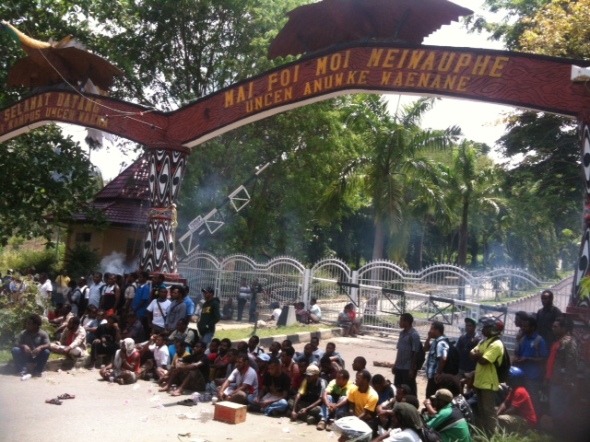
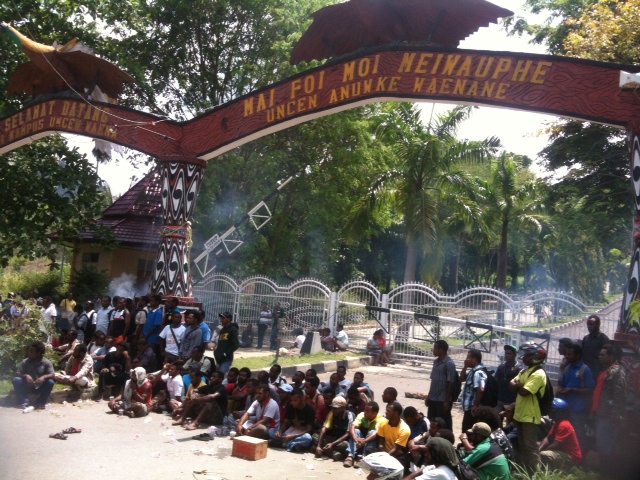
The Yakuhimo students at the dormitory were angered by the event, but held a peace blockade outside the gates of the Uncen campus in Waena, independent sources at the campus told West Papua Media. No reports were received of any forced dispersal, however tension is high and all West Papuan students are in fear that that they could be arrested or disappeared at any moment, according to human rights sources.
Yakuhimo students and supporters blockade outside Uncen Waena after the Detachment 88 raids, October 12 (West Papua Media)
These actions came after a campaign of arrests from late September of at least eight people in the highland town of Wamena after police targeted homes and offices of KNPB members, accusing them of involvement in bombings and terrorism, despite KNPB being committed to non-violent civil resistance tactics.
In a statement, UK based human rights group Tapol said that “The targeting of KNPB activists appears to have intensified after the killing of the KNPB leader Mako Tabuni, on 14 June 2012. Officers of Indonesia’s counter-terrorism unit, Special Detachment 88 (Densus 88), funded and trained by Australia, the US and the UK, are thought to have been involved in the killing of Mako Tabuni and the arrest of the KNPB members in Wamena.”
Tapol has called for Indonesian authorities to “end the campaign of terror, intimidation and violence against human rights defenders and political activists, particularly members of KNPB,” and to guarantee the safety of Fanny Kogoya, Viktor Yeimo, and others who have been targeted.
Tapol has also called on Jakarta to “end the deployment of Densus 88 to Papua, investigate all allegations of human rights violations by Densus 88 officers and other security forces personnel and bring those responsible to justice.”
Whilst tension remains high during the crackdown, KNPB activists have also warned their members not to be taken in by SMS messages that are being spread by intelligence personnel attempting to incite violence and horizontal conflict. Activists have circulated a list of mobile numbers that are responsible, and are urging all recipients to document any numbers that continue to spread these messages.
Many people have reported to West Papua Media of an upsurge in Special Forces activity, even around those who are not active on Papuan independence issues. There has been a significant increase on the presence of intelligence officers on the street. Selfius Bobii, the former Front Pepera leader serving out a three sentence at Abepura prison on a treason conviction for his role in the 3rd Papuan People’s Congress of October 2011, still maintains close and effective communications with a network of activists throughout Papua.
In an SMS sent to West Papua Media, Bobii described how the TNI “have stooped to making themselves out to be civilians, to carry out undercover operations in order muffle the independence aspirations.”
“Some are posing as Bakso (Beef offal noodles) Sellers on roadsides, some are posing as motorbike repair people and so on,” Bobii said.
Bobii described the following factual account: On 11 Oct at 2303 hours in Nabire, Yance Agapa was heading home and was given a lift by an ojek (motorbike taxi) rider to the front of the Indonesian Air Force Quarters in front of the ‘Glory’ internet cafe. When they arrived at Malompo he gave the driver Rp20000 (approx. AUD$2) who hurriedly put it into the pocket of the black jacket he was wearing. Then a pistol fell out of his jacket. Yance startled in fright to which the driver responded “Brother don’t be frightened because I’m from Ambon but my mother is from Sentani. I’ll tell you straight, I’m a member of DENSUS 88 sent from Central to get the government program happening. So let our people from the community know to be careful using hire motorbikes. ”
West Papua Media has independently verified this account.
KNPB activists, most living underground currently, have expressed significant fears for their safety and survival from the crackdown. Yohame begged in his testimony, “the condition of our current times is so dire, (we need) all my friends and the international support groups to be able to monitor our current situation. Virtually all KNPB activists are threatened at this time. “
It is unclear whether these intensified crackdown tactics will work on those close to DPO suspects to give up not just Fanny Kogoya, but other non-violent activists who are simply attempting to raise their universal human rights of self-determination and freedom of expression.
Certainly these hunting parties have confirmed one thing: that Australian trained counter-terrorism troops are without any doubt being used to suppress peaceful political activity, outside their legal mandate of counter-terrorism. This should be deeply concerning for Australia in its quest for advocating internationally the Rule of Law – and at the moment that it has just taken up a position on the UN Security Council it might prove to be an inconvenient turning of a blind eye.





 West Papua Media Alerts