Baptist leader calls for unconditional release of Forkorus

Bintang Papua
11 December 2012
The Indonesian government has been urged to free all political prisoners in Papua, including Forkorus Yaboisembut and Filep Karma. On the occasion of World Human Rights Day,  the human rights defender Socrates Sofyan Yoman spoke about the activities throughout 2012 of organisations such Polri (the police force), the TNI (the Indonesian military) and vicious armed civilian groups. He said 90  incidents of violence had been committed by these groups in all parts of Papua during the year so far.’As we celebrate Human Rights Day,’ he said, ‘we defenders  of human rights urge the Indonesian government to take the following actions:

‘Firstly, in accordance with its constitutional responsibility to safeguard its citizens, the government should acknowledge that the way it treats prisoners, convicts and the citizens in general is brutal, inhumane and demeaning. This includes the way it treats Papuan civil society and Papuan political prisoners. Such activities  should be prohibited, along with all practices that violate the law. Torture must be clearly identified  and criminalised. This would be seen as a concrete sign of Indonesia’s commitment to the International Covnention Against Torture which it officially ratified  by enactment of Law 5/1998

Secondly, the government should agree to adopt a policy that recognises Papuan citizens as victims. In those cases where legal processes have been resorted to, rehabilitation not imprisonment should be the method  chosen. The government should also adopt measures to  inform the general public about the many civilian victims in Papua.

His next point was to ensure that whenever the law on treason is used in a court of law, this should be non-discriminatory and concrete action should be taken to put an end to all criminal activities by the security forces, including judges, public prosecutors and all those people who are in charge of the prisons.

Furthermore,  the rights of all Papuan political prisoners must be safeguarded, including ending all illegal detentions. In cases where confessions were made under duress and without the presence of legal counsel, they should not be accepted as evidence in a court.of law.

The government should create mechanisms for people to be able to initiate charges. Such mechanisms should be available everywhere and in all places of detention and imprisonment.And in cases where charges are brought by detainees, this must be followed through by independent investigations by law-enforcement institutions as well as the National Human Rights Commission.

His next point  was to urge the National Human Rights Commision, the National Commission to End Violence Against Women and the Ombudsman  of the Indonesian Republic, to establish a mechanism  for a fully independent National Protection Unit to visit all places of detention, especially places of detention where persons charged with treason (/makar/) or other political prisoners  are being held as part of the state’s responsibility to act in accordance with the Anti-Violence Optional Convention.

The seventh point was to press the Indonesian government to enter in peaceful dialogue on the problem of Papua, mediated by a third party, one of the aims of which would to end torture and other forms of violence throughout the Land of Papua.

The eighth point was to press the Indonesian government to invite  the UN Special Rapporteur against Torture and Arbitrary Detentions to visit Papua.

The ninth point was to press the Indonesian government  to allow foreign journalists to visit Papua.

The tenth point was that the Indonesian government should accept responsibility for incidents of gross violations of human rights such as the incident in Abepura on 7 December 2000, the Wasior 2001 incident, the Wamena  2003 inicident and other incidents that have already been investigated by the  National Human Rights Commission, and to ensure that  the results of these investigations  are considered at the human rights court and dealt with in accordance with the principles of justice.

With regard to the role of the churches in Papua, it should be acknowledged that their main mission  has been paralysed by the state and governmental system in Indonesia.

Moreover, its prophetic voice is hardly ever heard in Papua, particularly since Papua was integrated into the Indonesian republic by military means and this the integration was preceded by the bloody events surrounding the Act of Free Choice, which continue to the present day.

‘The churches have forgotten or refused to recognise that Christianity arrived in Papua three centuries ago, on 5 February 1855.’

These thoughts were expressed by Socrates Sofyan Yoman during his opening address of the Congress of the Alliance of Baptist Churches in Papua at the Baptist Church in Wamena in October 2012.

He pointed out that his church  has supported the Papuan people with education, religious belief, healthcare and in the economic sphere, and has helped to improve access to the most remote areas by establishing small airfields which cater for small aircraft, with alll the risks this involves.

The church’s  missionaries live in close proximity with the Papuan people and help to foster the dignity of the Papuan people.in sharp contrast to what Indonesia has done since Papua’s integration, when it became a colonial power, a fact that is rarely criticised by the churches.

As a church leader, Yoman said that he not only studies the Bible but also learns from the history of Papua.  He has learned a great deal from this history, in particular the many untruths that have been told.  It is the role of the churches to insist on correcting these untruths, he said

Until now the churches talk about  ‘peace and well being’ but God’s people are continually  stigmatised as treasonous and accused of being part of the OPM.

As a church leader, he rejects all these allegations  and believes that Christians  must reflect of God’s will, as is stated in Genesis 1:26.  For all these reasons, he said in conclusion:

‘I will continue to speak out and will do everything I possibly can to share in the sufferings of God’s people. There is no future for Papua if it continue to remain a part of Indonesia. Papuans cannot live normal lives The churches must speak out about this and integrate themselves with those people whose very identity has been destroyed. It must speak out about  justice, equality  and the freedom  of all humankind regardless of race, ethnicity, culture or religion.

[Translated by TAPOL]


Yusak Pakage: ‘I was arrested for being a former tapol.’

by OKTOVIANUS POGAU of SuaraPapua.com
5 December 2012Jayapura: ‘I was arrested because of my having once been held as a political prisoner (tapol),’ said Yusak Pakage, a Papuan activist. who said that the charge against him was a frame-up, alleging that he was dangerous just because he was carrying a knife.

He made this statement to suarapapua.com on 4 December, following a hearing at the Class 1A district court in Jayapura  He said that as soon as he was arrested on 27 July this year, he was taken to a police command post and questioned about his behaviour towards a court official, Sefnat Fonataba.

‘Soon after, Fonataba came to the police station and told the police there that there was no problem with me and apologised to me for what he had done.’  The policeman asked Pakage to write a statement  saying that there was no problem between him and the policeman which is what he did.

When he was about to sign the statement, the chief of police in Abepura came along and said that he had other instructions about how to handle this case.

‘Shortly afterwards, I was taken to the police station where I was interrogated for quite a long time about the knife. I said that it was a very cheap knife, the kind of knife that you can find in any traditional market in Jayapura. It is just something I carry about with me for my everyday needs. I didn’t buy it in order to do something criminal, as the security people seemed to think.’

‘ I have never  heard anything about needing a special permit to carry an ordinary knife.The law in Indonesia is very confusing and I don’t know about any rule governing the carrying of a knife.  The chief of police said that he didn’t know who I was and wanted the case to be handled in the usual way.’ But according to Pakage, the police officer knows very well who he is and that he had previously been held as a tapol. ‘He was lying,’ said Pakage.’He just wanted it to be known that I had formerly been held as a tapol, when I was arrested along with Filep Karma in 2004 for carrying the  Morning Star flag.’

‘I frequently make statements about the human rights situation in Papua and take a leading part in many demonstrations, so of course he knows very well who I am.’

Pakage also said that during his interrogation, all his personal belongings were taken away, even including his ballpoint, and none of these things  have been returned to him.

On 19 August, he was transferred to the prison in Abepura and he is now waiting for his case to be completed and to hear the verdict of the judge.

Pakage used this occasion to warn his activist friends to be very careful and keep control of their feelings when they are doing anything to struggle for the rights of the Papuan people.

‘I tell them not to get too emotional and to learn from my own experiences which show that I can be arrested for something very trivial.’

Siman Pattiradjawane, the lawyer who is defending Pakage told reporters that the verdict in the case will be announced on 11th December.

Wewak PNG turns out in numbers to support West Papua

from West Papua Media sources in Wewak, Papua New Guinea

December 11, 2012

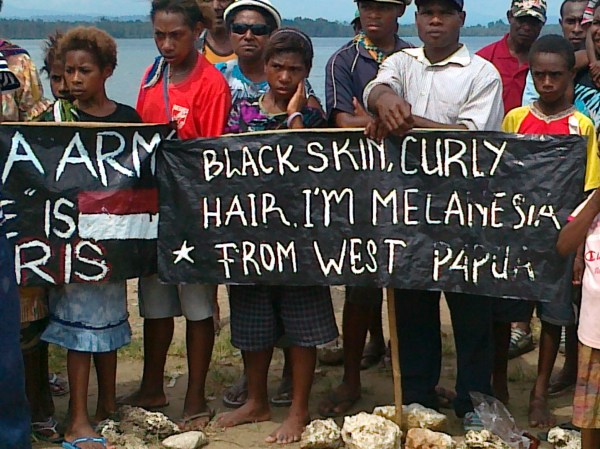
Over one thousand civil society members from Wewak, East Sepik Province in Papua New Guinea, turned out on December 10 to support their wantoks across the border in a large and vibrant demonstration that brought the provincial capital to a standstill, local stringers from West Papua Media report.

The rally and festival, called to bring attention to human rights situation in neighbouring West Papua on International Human Rights Day, saw PNG government officials, security forces, church leaders and ordinary people march together calling on the PNG government to do more to stand up to Indonesia on the issue of West Papua, and for the sovereign rights of West Papua to be respected.

This slideshow requires JavaScript.

At around 9:00am the marchers gathered at Mongian Compound, about 500 metres from Wewak town market.  A long-march started with less than hundred people but the numbers grew throughout the day.  As the marchers approached Wewak town area around 10:00am,Wewak local time, the number had grown to one thousand people.  The positive environment and support from the authorities and civil society motivated long-march organisers to do four laps around Wewak Town until midday.

One West Papuan observer told West Papua Media via phone conversation that the spontaneous support from the public was “amazing and unreal”.  As further quoted “a lot of ordinary people and women who sell their food at Wewak town market left their goods and joined the march. They even donated money, food, drinks and various garden food to us (West Papuan asylum seekers).”

At around, 12:30pm, the streets of Wewak was covered with sea of people who called for basic human rights to be protected, but importantly echoing the aspirations of the sovereign right of West Papuan people, according to participants

The long-march finished at the new Police Station near Wewak Town Market, where various speakers addressed the crowd.  Amongst the speakers were, Miss Sophie Mangai, President of Wewak Women’s Council, who led the long-march calling on those gathered to “lets all support our brothers and sisters from West Papua for their struggle for independence.”

“West Papuans are our brothers and sisters; we are one people; one ancestor; and one Melanesia in the Pacific. So we must drive out Indonesia from the land of West Papua,” said Miss Mangai.

Other Speakers included: Florence Parinjo (Wewak Women Council), Abraham Kareni, Jusuf Kambuaya and Daniel Waromi (West Papuan expatriates living in Wewak) and followed by other West Papuan asylum seekers.

PNG Media including NBC also covered the rally, interviewing many West Papuan and PNG people present.

According to rally organisers, the rally was fully endorsed by Sakien Sakawar (Police Border Commander), Mr. Francis Kemaken (Coordinator of Diocese of Caritas PNG/Oceania, and Patron of the Federated Republic of West Papua Branch-ESP Wewak PNG), 3. Miss Sophie Mangai (President of East Sepik Council of Women), and Jusuf Kambuaya (General Secretary, Federated Republic of West Papua Branch Office Wewak).

Informal festivities continued into the night, according to local sources.

West Papua Media


Indonesian government to act on Papuan political prisoners

via Tapol
5 Dec 2012
Indonesian government to act on Papuan political prisoners
By: KBR68H, translated by TAPOL

Names of 23 Papuan political prisoners submitted to Komnas HAM

3 December 2001

Solidarity for Humanitarian and Human Rights Violations has submitted information regarding 23 political prisoners to Komnas HAM (the National Human Rights Commission).

Earlier, Komnas HAM planned to set up a team to resolve the cases of political detainees and convicted political prisoners in Papua. The spokesman for SKP Papua, Mathius Murib, said that information regarding the prisoners, including their arrest, the time they have spent in custody and their conditions in prison was submitted. He said that in many cases, there was no legal basis for their being charged for treason and that their imprisonment was in violation of their human rights

“We have supplied data relating to a number of prisoners being held in prisons in Papua. Detailing how many prisoners there are and for how many years they have been held. Altogether, we have submitted such information regarding 23 political prisoners. We greatly appreciate this support and the action.”

Earlier on, Komnas HAM planned to set up a team to resolve the cases of political detainees and convicted political prisoners in Papua. The purpose was to review the status of those being held in prison. This would include considering a reduction in the length of their sentences.

To read the article in Indonesian on the KBR68H website, click here.

Komnas HAM is seeking Clemency for Papuan Political Prisoners

4 December 2012

Komnas HAM, the National Human Rights Commission intends to struggle to ensure that all political detainees and convicted political prisoners in Papua are granted clemency or a reduction in sentence.

The chairman of Monitoring and Investigating Human Rights Violations, Natalius Pigai, said that Komnas HAM plans to set up a special team next January to identify the cases of political detainees and convicted political prisoners in Papua, together with the Ministry of Law and Human Rights.

“This special team will also be entrusted with the task of granting clemency or reduction of sentences for political detainees and convicted political prisoners in Papua. We will be undertaking this in collaboration with the Ministry of Law and Human Rights,” said Natalius.

He went on to say that this special team would do everything possible to improve the general environment and facilities in all the prisons in Papua. This will include ensuring that every tapol/napol receives whatever healthcare is required.

To read the article in Indonesian on the KBR68H website, click here.

Law and Human Rights Ministry to check status of around 20 Papuan political prisoners

4 December 2012

The Ministry of Law and Human Rights plans to check the status of around twenty political prisoners in Papua. This decision follows their intention to resolve the cases of political detainees and convicted political prisoners.

A spokesman of the Ministry of Law and Human Rights, Martua Batubara, said that those who are serving sentences will be given remissions (a reduction of sentence) in accordance with the law.

As for the Komnas HAM, it can only make recommendations.

“We intend to check in the prisons as well as to check with the Ministry of Law and Human Rights to find out which prisoners are serving sentences and which are prisoners whose cases are still being processed. We don’t know which prisoners they are talking about (gap with question mark perhaps indicating something that is illegible) or whether it is true that Komnas HAM  only has the authority to investigate and then make recommendations to the authorities in charge of the prisoners.”

Previously, Solidarity for Humanitarian and Human Rights Violations in Papua submitted information about 23 political prisoners to Komnas HAM. This was done to complete the information available to Komnas HAM, following a plan to set up a team to resolve the cases of political detainees and convicted political prisoners in Papua. The purpose is for there to be a review of the status of all those who are currently being held in detention. This would also include seeking a reduction in the sentences now being served by all those who are currently being held in prison in Papua.

To read the article in Indonesian on the KBR68H website, click here.

Police shooting of escaped political prisoner sparks Manokwari riots

Tabloid Jubi

December 5, 2012

Condition of Manokwari town tense

The town of Manokwari in West Papua is in uproar (On Wedenesday, December 5). It is reported that crowds have run amok and have been carrying out acts of arson.

A (WPM edit: source believe to be police officer) source for tabloidjubi.com in Manokwari states the riot was triggered as the result of the shooting by police officers  of a DPO (Detainee on the political Daftar Pencarian Orang or Wanted persons list)) by the initials TA, who escaped from Prison. on Tuesday.https://i0.wp.com/tabloidjubi.com/wp-content/uploads/2012/12/Manokwari.-ist.jpg

(West Papua Media has confirmed with independent sources in Manokwari that the dead political detainee was named Timotius Napirem Ap – a relative of executed West Papuan songman and nationalist Arnold Ap).

“So last night (Tuesday 4/12) police members chased a DPO prisoner of the initials TA. (police) Members fired warning shots, however the person in question (the escapee)  resisted because he carried a homemade weapon, “ reported the source of Tabloidjubi.com, Wednesday 5/12/12.

According to the source, because the prisoner’s resistance endangered the police, they were forced to shoot him. “However I don’t know precisely where he was shot. But after he was shot he was able to run to the Manokwari District General Hospital (RSUD)’’ he explained.

However he continued,  it appears that because of loss of blood, the prisoner’s life could not be saved. “Even though he was taken to the RSUD, his life could not be saved. This was what triggered the anger of a number of the people. They then lit fires at various points in the town of Manokwari, including the Prison Guard Post perhaps which is in the centre of Manokwari was burned . Up to this moment the situation in Manokwari remains tense,” explained  the  (police) source to Tabloidjubi.com.

Another Tabloidjubi.com source  in Manokwari mentioned that the prisoner had been shot in the feet, neck and back, by the police officers. The prisoner died and was taken secretly by security offers to the morgue in Wirsi last night, 4/12 around 12.00 pm WIT. (West Indonesian time).

“The prisoner was shot in the coastal area of Maripi by the police, without committing any crime. The police chased this person because he escaped using a motor cycle. But because of the chase the police and  intelligence cordoned off and encircled Timotius Ap, which resulted in the prisoner being shot’’ said the Tabloidjubi.com source via his mobile phone.

Meanwhile the Public Relations Officer for the Police District of Papua AKBP I Gede Sumerta Jaya, said that his office was still waiting  for information from Manokwari. “I have not yet received field data. I too am still waiting for data. Shortly, if there is accurate data then I can provide information.” I Gede briefly responded.  (Jubi/Arjuna)

Create a website or blog at WordPress.com

Up ↑