Diamond’s observations, made in his recent book The World until Yesterday, that West Papuans are ‘warlike’ and that the state and development are forces for good need to be chucked in the academic dustbin. They don’t stack up against the evidence and in the case of West Papua help perpetuate ideas that are used to justify the ongoing Indonesian occupation.
Take his claim that Indigenous Papuans like those from the Dani nation are warlike, locked in perpetual combat with their neighbours, and bereft of role models, structures or processes that help pull them out of cycles of violent retribution. In reality Dani leaders like Benny Wenda, Sofyan Yoman, Dominikus Surabut, and Fanny Kogoya are at the forefront of a nationwide nonviolent rebellion against Indonesian occupation. This is not a recent phenomenon. Papuans from Biak, for instance, were engaging in acts of peaceful defiance as early as 1910, twenty years before Gandhi launched his salt satyagraha against British rule. They defied bans against traditional singing and dancing, organised collective tax resistance and initiated labour strikes in protest of Dutch colonialism. Alliances like KNPB, the West Papua National Committee also continue determined nonviolent resistance even as the Indonesian military tries to wipe them out, killing 22 KNPB activists in 2012 alone.
As for not cooperating across tribal boundaries, people like Dominikus Surabut, currently imprisoned by the Indonesian state for peacefully declaring independence from Indonesia, are part of a Pan-Papuan tribal confederacy, the Dewan Adat Papua (DAP) and the Federal Republic of West Papua. If you visit the DAP leader and FRWP president elect, Forkorus’s Yaboisembut’s home on the coast, you will see a Dani gate gracing the front entrance. While Papuans from different highland and island tribes will greet you and make you feel welcome you won’t be able to meet Mr Yaboisembut because like Mr Surabut he is also in jail for leading a nonviolent insurrection.
But you won’t find any of this in The World until Yesterday. Diamond fails to mention the occupation and fails to mention the fact that the West Papuan struggle for freedom is the largest nonviolent movement in the Pacific. We are not just talking about a handful of activists, but tens of thousands of Papuans who have gone on strike, occupied parliament, set up parallel government structures and are using the latest digital technology to demolish the Indonesian government’s refusal to give the international media free reign to report on what is happening.
Diamond’s other suggestion that the twin forces of industrialization and states are helping bringing development and peace to societies once isolated and trapped in a perpetual cycle of inter-tribal war has been labeled by Survival International, an indigenous human rights organisation, as “dangerous nonsense”. In West Papua large scale development like the giant Freeport/Rio Tinto gold and copper mine has displaced the local landowners the Amungme and Kamoro. Far from bringing development the company’s theft of land and resources has impoverished them. Freeport’s policy of paying the Indonesian military and police to provide security has led to a mounting death toll that numbers in at least the hundreds. Demands for independent forensic human rights investigations are repeatedly ignored by the Indonesian government and Freeport. Despite this Papuans from groups like Tongoi Papua, an independent Papuan labour union of Freeport mine workers who in 2006 won a 100% wage increase though collective nonviolent action, are working together, across tribal boundaries, to press for the freedom to organise and greater rights.
As for the Indonesian government bringing peace to West Papua; that is laughable. The Indonesian government has occupied West Papua since 1963. They maintain their rule through brutal force, ably assisted I might add, by foreign governments like Australia, the U.S and others. Rev. Sofyan Yoman from the Baptist Church, and other Papuans, call it “slow-motion genocide”. But again, don’t expect to read that in Diamond’s book.
Diamond’s observations about our collective past are often insightful but in the case of West Papua his ossified ideas about warlike Papuans and his praise of the state and development are at best, highly contested.
Edmund McWilliams is a retired U.S. Foreign Service Officer who served as the Political Counselor at the U.S. Embassy in Jakarta 1996-1999. He received the American Foreign Service Association’s Christian Herter Award for creative dissent by a senior foreign service official. He is a member of the West Papua Advocacy Team and a consultant with the East Timor and Indonesia Action Network (ETAN).
In a December 5, 2012 lecture at Stanford University’s International Policy Studies program ( revised January 22, 2013), the respected Southeast Asia analyst Sidney Jones discussed the Indonesian government’s unwillingness, thus far, to categorize the Papuan “ethno-nationalists/separatists” as “terrorists.” Jones identifies these Papuan “ethno-nationalists” and “separatists” as the armed Papuan opposition, Operasi Papua Merdeka (OPM) and what she describes as “an extremist faction of KNPB, the West Papua National Committee, a militant pro-independence organization.” Jones cites various incidents of violence in West Papua that she claims were committed by these “ethno-nationalists and separatists.”
The authors of violence in the Indonesian archipelago, especially violence with complex motives, are never so clear cut as her lecture implies. This is especially true of West Papua where police-military rivalries over access to resources and sources of extortion monies is well known.
Her analysis focuses on the different approaches employed against the West Papuan “ethno-nationalists/separatists” and against Islamic militants (“jihadists”) by prosecutors and the security forces (police, military and Detachment 88). Jones contends that “the discrepancy between the way the two groups are treated by the legal system is untenable.” She considers two alternatives: One would be to employ anti-terrorism law in West Papua, and the other would entail moving away from the use of anti-terror law against “jihadists.” She argues extensively against the latter approach of “pulling back from the use of the anti-terror law.”
Jones contends that pressure for use of the anti-terror law against “ethno-nationalists/separatists” is growing among Islamic observers. In particular, she cites Harits Abu Ulya, director of the Community of Ideological Islamic Analysts (CIIA): “If the government is consistent, then it should acknowledge that attacks motivated by ethno-nationalism and separatism be considered terrorism because they are carried out by an organization with a political vision that uses terrorism to influence the security environment and challenge(s) the sovereignty of the state. Why aren’t we seeing forces being sent en masse to cleanse Papua of separatism?”
Jones’ argument warrants a more detailed critique than space here allows, but even a brief review reveals a number of problems.
Jones summarily credits recent violent acts in West Papua to the “ethno-nationalists and separatists.” This is surprising insofar as Jones is a highly regarded observer of the Indonesian political scene with a deep human rights background. She knows, or should know, that the authors of violence in the Indonesian archipelago — especially violence with complex motives — are never so clear cut as her lecture implies. This is especially true of West Papua where police-military rivalries over access to resources and sources of extortion monies is well known. Jones should know also that military, police and intelligence agencies, have long played the role of provocateur, orchestrating acts of violence which advance agendas that are invariably obscure.
Jones cites what she claims is recent “ethno-nationalist” pressure on the giant Freeport McMoRan mining operation. She ignores the reality that such pressure in the past has frequently been orchestrated by the military, specifically the Indonesian Special Forces (Kopassus). To be fair, Jones alludes to this complexity but largely dismisses it. Her analysis similarly ignores the reality that the Indonesian state has long blocked international monitoring of such security force skullduggery and manipulation of the security environment in West Papua by restricting travel by international journalists, human rights researchers and others to and within the region.
Jones also fails to acknowledge the reality, widely noted in international and local human rights circles, that the Indonesian government has long sought to smear peaceful dissent in West Papua as “separatist.” Jakarta, through the aegis of a corrupt court system and often criminal state security forces, has repeatedly employed the “separatist” label to arrest and prosecute or detain peaceful political dissenters, such as those who display the Papuan morning star flag. Courts regularly resort to charges of treason that date to the Dutch colonial era and widely used by the Suharto dictatorship to intimidate dissidents. Jones’ call for Indonesia to define “separatism” as “terrorism” would deepen Jakarta’s targeting of peaceful dissent and the intimidation of Papuans generally. Use of the anti-terror law would enable the police to detain “separatist” suspects, including those engaging in peaceful protest, for a week rather than 48 hours. The law also empowers the police to employ electronic surveillance. Ongoing efforts would strengthen the anti-terror law to give the police even broader powers to limit the freedom of speech and assembly.
The argument to employ the “terrorist” label against “ethno-nationalist and separatist” groups and individuals in West Papua could have direct legal implications for international solidarity movements.
Jones claim that the West Papua Nationalist Committee (KNPB) is a “extremist,” is without substantiation. Criminal activity by some alleged members of the KNPB is generally not well corroborated and usually reflects efforts by the State to undermine the organization. The KNPB, and many other Papuan organizations and individuals are indeed ever more strongly pressing for Papuan rights, importantly including the long-denied Papuan right to self determination. But these efforts are largely nonviolent.
In recent years, this struggle has found growing support within the international community. Employing the “terrorist” label against “ethno-nationalist and separatist” groups and individuals in West Papua could have direct legal implications for international solidarity movements. In the U.S., groups or individuals who advocate on behalf of groups designated by the U.S. government as “terrorists” are subject to criminal prosecution. Given the close relations among governments, including those of the U.S. and Australia and Indonesia’s security forces, Indonesian government labeling dissidents in West Papua as “terrorist” could have dire implications for the solidarity network. How long would it be before the U.S. and other governments themselves begin to label various Papuan groups and individuals as ‘”terrorist.” U.S. and other international groups acting in solidarity with Papuans seeking to attain their rights could be criminally targeted and charged.
In sum, the Jones analysis is hobbled by the very term “terrorism” which is so poorly defined international law and procedure as to threaten and intimidate even those groups and individuals engaged in peaceful dissent.
In a final note, Sidney Jones, who was the Asia Director for Human Rights Watch from 1989 to 2002, should at a minimum explicitly reject the call by Harits Abu Ulya that she cites in her lecture for the Indonesian government “to cleanse Papua of separatism.” Such rhetoric gives license to the kind of atrocities already visited on the people of the Indonesian archipelago, including Timor-Leste, for far too long.
It is likely that most US citizens who consider themselves informed about global events are aware of the genocides in Rwanda, Bosnia and East Timor, yet it’s likely that few people in the US are aware of the ongoing genocide in West Papua, New Guinea.
In Rwanda, genocide resulted in an estimated 500,000 deaths in a 3-month period; in Bosnia, genocide resulted in an estimated 200,000 deaths in a 3-year period. In East Timor, there were more than 103,000 deaths in a 3-year period; and, in West Papua, New Guinea, there are conservative estimates of 100,000 Melanesian Papuans killed, and 300,000 displaced or missing over a 47-year period. Remarkable is the disparity of time between the Rwanda, Bosnia and East Timor genocides, ranging from 3 months to 3 years, contrasted with the ongoing 50-year genocide of indigenous West Papuans. In the aftermath of the Rwandan 3-month slaughter of 500,000 people, the carnage was blatant, the atrocities flagrant.
In view of the continuing carnage wrought in West Papua by the Indonesian military during the past 50 years, we must wonder why most people in the Western world are oblivious to the indigenous Melanesians’ plight, and what factors are contributing to the protraction of such abuse.
Indonesia’s colonization and military occupation of Dutch-owned West Papua was achieved, and continues, with the blessing of the governments of the United Kingdom, Australia and the United States, and facilitated by the operation of the world’s largest copper and gold mine owned by Freeport-McMoRan Copper and Gold Inc., a US corporation.
In addition, for more than 50 years, some of the world’s largest transnational mining corporations have been exploiting West Papua’s oil and minerals, including Union Oil, Amoco, Agip, Conoco, Phillips, Esso, Texaco, Mobil, Shell, Petromer Trend Exploration, Atlantic Richfield, Sun Oil and Freeport (USA); Oppenheimer (South Africa); Total SA (France); Ingold (Canada); Marathon Oil, Bird’s Head Peninsula (UK); Dominion Mining, Aneka Tambang, BHP, Cudgen RZ, and most critically, Rio Tinto (formerly RTZ-CRA) (Australia/UK).
The exploitation of natural resources by extractive industries results in catastrophic harms to human and environmental health and indigenous societies. Typically, mainstream global media, most of which are in thrall to corporate interests, look the other way when such military/corporate injustices are perpetrated upon indigenous populations.
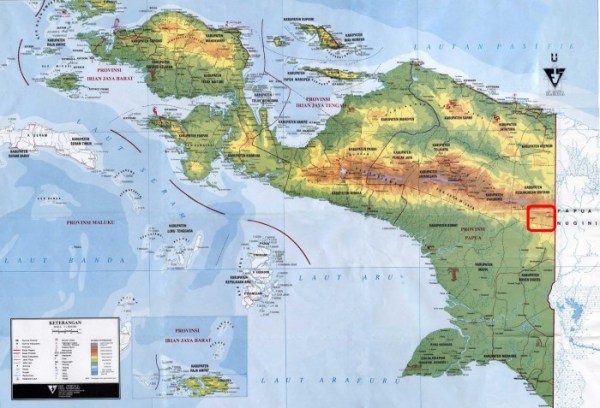
New Guinea is the second largest island on earth, and one of 20,000-30,000 archipelagos in the South Pacific. The island is divided vertically, with independent Papua New Guinea occupying the eastern section and West Papua, now an unwilling province of Indonesia, occupying the western side. There are more than 250 tribes, more than 270 distinct languages and thousands of different pidgin dialects.
In addition to copper and gold, abundant natural resources include natural gas, oil, timber and fish. These resources profit corporate interests and the Indonesian government without compensation to the Melanesian population, who live in poverty.
In 1969, the Act of Free Choice consultation was held in West Papua to ascertain whether the indigenous Melanesian population preferred to remain a province within the nascent nation of Indonesia or become their own independent nation. The consultation was fraudulent, and free participation by the indigenous people was nil. Only 1025 West Papuans, representing a population of one million, were picked ( by the government of Indonesia ) to vote and it was not implemented in accordance with international law of the New York Agreement on August 15, 1962 – One Man One Vote. It was a whitewash. Nobody gave a thought to the fact that a million people had their fundamental rights trampled ( CV Narasimhan, Deputy Secretary – General of the United Nations 1961 – 1978 ). Thus, the voiceless West Papuans became a province of Indonesia and the victims of 50 years of oppression.
The people of this forgotten land have struggled for freedom for 50 years under brutal Indonesian occupation. The people of the different tribes are raped, tortured and slaughtered, and their natural environment continues to be degraded. In their efforts to resist this injustice, their leaders have been arrested, tortured and threatened with death. For this reason, many now live in exile, where they continue to be involved in education and activism with the goal of enlisting the international community to join their efforts to achieve justice and freedom.
The Universal Declaration of Human Rights affirms the rights of all people to freedom of opinion and expression, and the right to peaceful assembly and association. Indonesia is a signatory to the International Covenant on Civil and Political Rights (ICCPR), which guarantees the right to freedom of expression and peaceful assembly, and Indonesia’s constitution also declares those rights. However, Indonesia’s continued arrest and incarceration of nonviolent political activists since the 1980s, and the October 19, 2011 arrests of more than 300 civilians during the Third National Congress, including Edison Waromi and Forkorus Yaboisembut, Prime Minister and President, respectively, will not deter Melanesians from their nonviolent struggle to secure self-determination within a democratic framework, and are recognized, respected and supported by the international community.
For this reason, many peaceful demonstrations took place around the world on
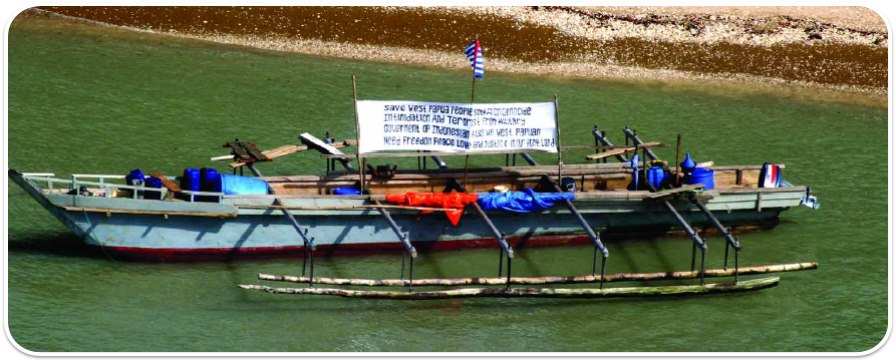
The boat that brought 43 West Papuan Asylum seekers to Australia, putting Papua back on the front page and touching off a diplomatic storm . Photo Damien Baker, Mapoon, Queensland, Australia January 17th, 2006
January 17, 2013. The Demonstrations commemorated the escape to freedom by 43 West Papuan refugees on January 17, 2006, when, after paddling across open ocean for four days and surviving a violent storm, they beached their traditional canoe in Australia and found asylum. Myself – Herman Wainggai – am one of those 43.
The Free West Papua Political Prisoners Team in Washington DC is a group of academics and human-rights activists who are willing to stand up for justice and work toward a free West Papua that is independent from military and corporate colonization.
Photo : Free West Papua Political Prisoners Campaign Team, Washington DC, USA
Human Rights Watch reports that Indonesia has incarcerated nearly 100 activists from Maluku and Papua for peacefully voicing their patriotism and political views. As one of those former political prisoners forced into exile, I am now a visiting scholar at George Mason University, after being imprisoned for more than two years after daring to raise the West Papuan flag. My uncle, Dr. Thom Wainggai, died while imprisoned for the same demonstration of patriotism.
Free West Papua Campaign in Los Angeles, California
“I want to commend Moana Nui for organizing this demonstration on behalf of the people of West Papua to give voice to their fight for freedom and self-determination. We call on the leaders of all governments to stop supporting human rights abuses, murder, genocide and the military occupation of West Papua. To our brothers and sisters in West Papua: Continue to fight for what you know is right, for your freedom, your culture, for humanity. Know that, in this fight, you are not alone.” Harold Green. http://mnaa-ca.org/jan-17-2013-west-papua-action/
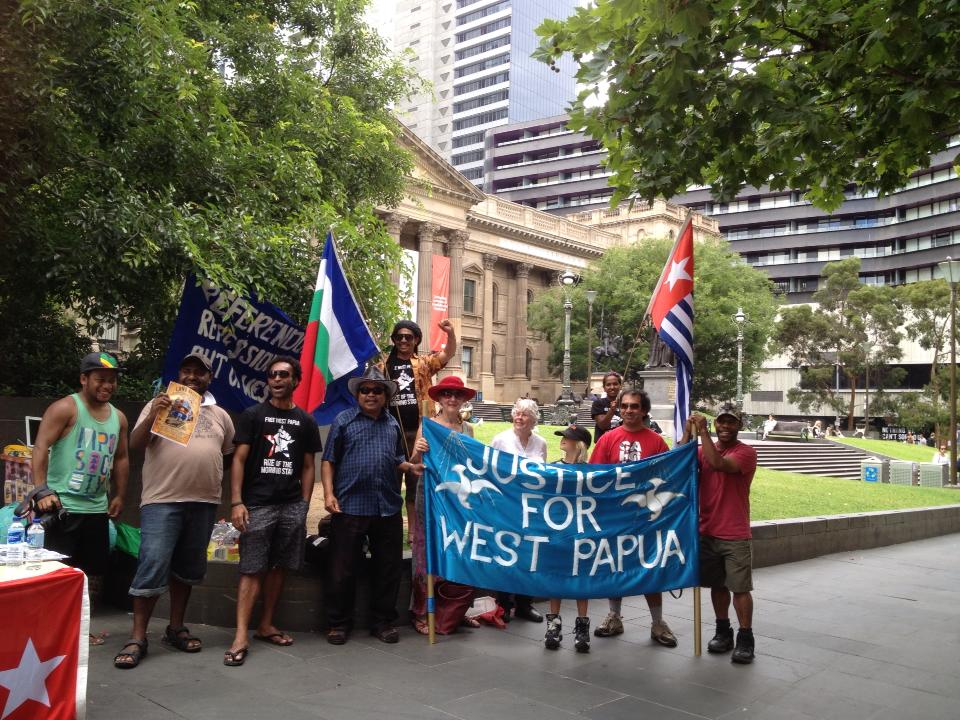
Free West Papua Campaign in Melbourne
Foreign Affairs Minister of the Federated Republic of West Papua, Jacob Rumbiak, said international activists are demanding that Indonesia remove its military personnel, and that president Yudhoyono must issue orders to stop the slaughter of West Papua National Committee (KNPB) members.
“Six activists were arrested and tortured in Serui yesterday for handing out pamphlets about today’s rally, including Patris Rosumbre (Vice Governor, Saireri State, Federated Republic of West Papua) and Menase Karubaba,” he said. Rosumbre has since escaped, but the whereabouts of Karubaba are not known, and there is deep concern for his safety.
Photo Free West Papua Campaign Melbourne, Australia January 17th, 2013
The Federated Republic of West Papua has called for negotiations with the Indonesian government under the auspices of the United Nations since 2011, and, Rumbiak claims, “Indonesia is losing credibility with its international donors in failing to respond to our invitation.”
Free West Papua Campaign in the Solomon Islands
In a statement from Honiara, Chairman of Solomon Islands for West Papua, Rexy Roses, highlighted that more than 50 years of tyranny and
Photo Rexy Roses, Solomon Islands for West Papua, 17th January 2013
immeasurable human rights abuses suffered by the indigenous people of West Papua at the hands of the occupying Indonesian military forces is more than too much to bear, and it is now time for dialogue and negotiations to end the violence in West Papua and to allow a peaceful referendum. This year will be a challenging one, and we will ensure that the cries of the indigenous Melanesian people of West Papua be heard in every corner of the Pacific and beyond.
Since the recent peaceful demonstration in Yapen Island and Manokwari, I have been told that the military agents are increasing their violent activity in West Papua and in many other places around West Papua. It is not difficult to imagine the impact that tens of thousands of Indonesian troops have on the daily lives of the West Papuan people. This new action by the Indonesian military raises the question: Why would Indonesia send so many troops to West Papua? Is this to intimidate the West Papuan people, to deny us our freedom of speech and prevent us from peacefully gathering in the land of our ancestors to debate and challenge the domination of our land and freedom? This recent West Papua Media report clearly states that the Indonesian government does not provide for the protection of human rights in West Papua.
For West Papuans, daily life is a nightmare, full of pain, suffering, torture, rape and bloodshed. There is no freedom to speak or act freely. The systematic oppression, terror, intimidation, kidnapping, incarceration, poisoning and murder of indigenous Melanesians in West Papua has not changed since I fled the country in 2006. It’s time to support the West Papuan people in their struggle for human rights and political independence.
Herman Wainggai is a West Papuan civil resistance activist based in Washington DC USA, and former political prisoner. He lectures in strategic non-violence and civil resistance and is a visiting scholar at George Mason University, Washington.
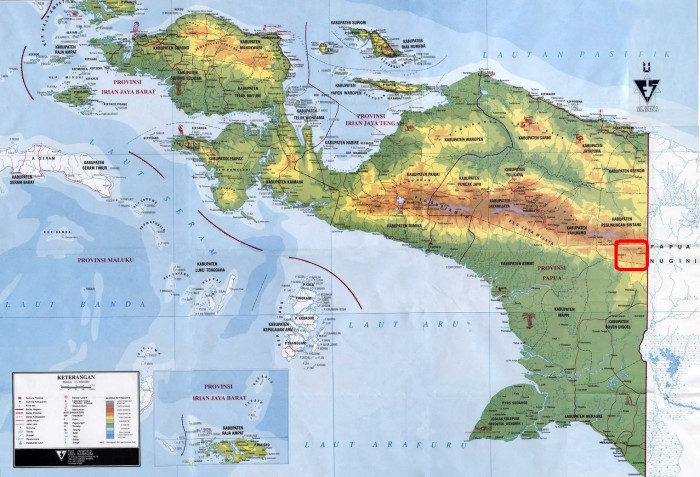
A January 19 demonstration of over 500 people asserting Papuan rights to freedom of expression defied a police ban on gatherings in the remote town of Oksibil, in the Pegunungan Bintang (Star Mountains) Regency, close to the Papua New Guinea border. Challenging police to arrest over 500 people, the protest also announced a boycott of provincial gubernatorial elections being held in the regency until January 29.
Credible local sources reported to West Papua Media that local Papuan people had been frustrated with ongoing restrictions on independent Papuan political expression, and were asserting their human rights to free expression despite the risk of arrest.
“(We are here) to express the community’s opinion through a statement from the indigenous community of Papua, in regards to the matter of the blocking of the planned visit by the U.N Special Rapporteur on the Promotion and Protection of the Right of Freedom of Expression and Opinion, Mr Frank La Rue, to Indonesia from 14-26 January 2012 which relates to the the decisions of the Human Rights Committee 107 and 108 at the U.N Session in Geneva,” a spokesperson for the local rights group West Papuan Interest Association told West Papua Media via email.
The sources also reported that the gathering was angered by the Regency police chief’s ban on public free expression, and so withdrew their consent and participation to the notoriously corrupt and divisive Indonesian imposed provincial gubernatorial election process.
The WPIA spokesperson told West Papua Media on Saturday afternoon via SMS that a large (but unspecified number) of police were physically blocking the demonstration from occurring, despite the rights to Freedom of Expression being guaranteed in both Indonesian law and also Special Autonomy legislation.
“The WPIA had sent a letter to the Head of Police in Pegunungan Bintang regarding the matter of the above peaceful gathering and advising them it would be carried out at Oksing-sing (in Pegunungan Bintang) on 23 January 2013, and that the group would remain in one location, nor would not disturb the proper order of public affairs or public activities, and would not be breaking any rules,” said the WPIA spokesperson.
“However the Head of Police in Pegunungan Bintang gave a letter in response saying they would not authorise the gathering,” said the spokesperson.
According to witnesses though, the gathered people were determined to go ahead with the planned action. Speakers said that if the action was prevented from occurring, the entire crowd of over 500 people would go immediately with the WPIA Organiser to the Pegunungan Bintang Police Headquarters.
“They would demand that the Police detain every one of them in the prison until 29 January 2013 after the general Election for the Provincial Governor, and then release them after that,” the WPIA spokesperson told West Papua Media.
Police reportedly backed down after this, though West Papua Media has not as yet been able to independently verify this.
Oksibil historically only has sporadic public events of political free expression, and remote area expressions of political dissent have usually been met with brutality. For the police to not forcefully disperse a gathering is exceptionally uncommon.
The demonstration self-dispersed without reported incident, and no reports have been received as yet about any reprisal actions from police.
Well over 1000 people engaged in a colourful and vibrant demonstration calling for West Papuan independence on Manokwari on January 17, despite Indonesian police banning the march and the display of the Morning Star Papuan Independence flag.
Amid worries of a security crackdown and violence from Indonesian security forces, organisers of the rally reported a generally peaceful event, with participants well-disciplined against reacting over severe intimidation tactics, preferring instead to use music, drumming and free expression to get their message across.
Organised by activists from the former Federated Republic of West Papua, the Manokwari protest saw several groups of singers, dancers and drummers converged at the Sanggeng sports stadium, marching 7 kilometres to the church at Elim Kwawi over four hours. They were shadowed at all times by at least police to secure the action is over 200 police personnel, 2 truckloads of soldiers, 8 armed motorcyclists, and an extra truckload of elite Dalmas Riot Police (a unit that includes personnel from the Detachment 88 anti-terror group funded by Australia).
To the shouts of “Merdeka!” (Freedom!), and accompanied by 4 groups of drummers and 2 flute bands, over 100 banned Morning Star flags were flown during the march, held high by mama-mama, youth, children and students. Sources at the march reported to West Papua Media that spirits were high amongst participants due to the music and dancing.
This slideshow requires JavaScript.
Speaking from Washington DC, Herman Wainggai, FRWP’s representative to the United Nations, said in a statement that “Over the years, peaceful demonstrators in West Papua have been terrorized, imprisoned and killed by Indonesian military police. Edison Waromi, one of West Papua’s human rights defenders, has been imprisoned for more than 14 years, and we were imprisoned together for two of those years. West Papuan activists Edison Kendi and Yan Maniamboy currently are threatened with 20 years in prison for organizing a nonviolent rally in support of the United Nations’ InternationalDay of the World’s Indigenous People in New York in August 2012.”
Wainggai repeated the demand “that Indonesia immediately and unconditionally free all West Papuan political prisoners and end its military occupation of West Papua. We also request that the UN Special Rapporteur, who is scheduled to be in Indonesia in January, visit West Papua and meet with imprisoned political leaders of the Federated Republic of West Papua, such as President Forkorus Yaboisembut, Prime Minister Edison Waromi, and others.”
International solidarity actions were held outside the Indonesian Embassy to the United States in Washington DC, and also in the Solomon Islands, and Melbourne, Australia.
Rexy Roses, from the new Solomon Islands for West Papua solidarity group, called upon the Indonesian government to immediately release West Papua and Malukan political prisoners, and to respect their rights to free expression.
“More than 50 years of tyranny and immeasurable human rights abuses suffered by the Indigenous people of West Papua at the hands of the occupying Indonesian Military forces is more than too much to bear, it is time now time for dialogue and negotiations to end violence in West Papua and to allow for a peaceful referendum. This year 2013 is going to be a very challenging year and we will make sure that the cries of the indigenous Melanesian people of West Papua be heard in every corners of Melanesia, the Pacific and beyond, it is time for change, together lets stand for the change we want to see in West Papua and Maluku, ” Rexy stated.
Police attempt to provoke trouble
Organisers of the rally had notified Indonesian Police of their rally but the Chief of Police in Manokwari forbade the rally from going ahead, contrary to the rights of peaceful expression guaranteed to West Papuan people under the now discredited (but still active) Special Autonomy legislation of 2001. However, according to reports from witnesses and our stringers, police stood by and allowed participants to gather, instead focussing their attention on the seizure of Morning Star Flags.
Upon an attempt to formally raise the Morning Star on flagpoles, police moved in and attempted to seize flags, however organisers led by West Papua National Authority Executive Governor of Region II Manokwari Markus Yenu negotiated with police, who allowed the mass to continue after receiving assurances that no flag raising would occur again. However, outside Biryosi petrol station, police seized flags from a young man, escalating into a tense situation due to the hostility between individual police officers and the youth.
According to West Papua Media’s stringer at the protest, ” the journey became increasingly tense as Police officers began intimidation by beginning to walk ahead (faster) than the rear of the masses,” whilst in riot gear, using a common riot police tactic of dispersal.
“The Massa (collective group) felt that a scenario was being created by Indonesian police to disrupting the peaceful demonstration and provoke violence. This situation occurred precisely around Copal Sanggeng Manokwari. However our koorlap (Koordinator Lapangan or field coordinator) were able to ensure massa discipline and not be provoked by friction generated by these police officers,” one field coordinator, who cannot be named, told West Papua Media.
The Rally dispersed peacefully around 3.30 pm local time after speeches by West Papua National Authority, Federated Republic of West Papua, and other activists, followed by prayers, with no reports of further intimidation of participants from security forces.
In Yapen meanwhile, security force intimidation and the arrest of seven activists on January 16 in Mantembu village by an Indonesian Army (TNI) unit, prevented the planned demonstration from taking place in Serui town. Reports received by West Papua Media from human rights sources early in the day described a tense atmosphere with several hundred heavily armed police and army patrolling key protest gathering point. Unconfirmed reports claimed that a joint police and army unit blockaded roads outside Mantembu village and threatened violence on any potential protest participants.





 West Papua Media Alerts