Nurses in Papua take their complaints to governor.. and to the ALDP

Bintang Papua, 19 February 2011
Abridged in translation by TAPOL

Nurses working at the Dok II General Hospital have taken part in a
demonstration at the governor’s office, complaining that their rights
have been ignored.

‘We are working to the utmost and often doing things that doctors should
be doing in addition to our own duties. In addition to applying
catheters and giving infusions, we do laboratory work and look after
and wash the patients, as well as handling things that doctors should be
doing.’

Leni Ebe is one of more than one hundred nurses working at Dok II in
Jayapura.who are critical of the management of the hospital which they
describe as being appalling. After having made complaints to the
director of the hospital (to no avail), they took their complaints to
the governor of the province.

She spoke in particular about the incentive fee that had been promised
by the government but had not yet been paid.

Nurses in all the hospitals in Abepura as well as elsewhere in Papua are
doing their utmost, she said. ‘We were promised the incentive fee in
2009 and were eventually paid Rp 30,000 [around £2.00], which we got
only after pressing very hard for it.’

Since the enactment of the Special Autonomy law (in 2001), Papua has
been allocated substantial sums of money yet internal management
problems have led to a failure to solve problems in the hospitals,
including the failure to pay the incentive fee, which is being paid to
administrative staff. This led to the hospital personnel deciding to
take their problem to the governor.

Leni Ebe said that it had been agreed that specialist doctors and
dentists would get Rp 10 million (a month), phamacists would get Rp5
million and other medical personnel would get Rp 3m, while other staff
including nurses would get only Rp1m. ‘We have to handle so much of the
work, including that usually done by doctors. Is this is all we are
worth? It is far too little, especially for those of us who have
families to feed.’

A decision by the governor allocating the money for the whole of 2010
had not been followed through, as a result of which the nurses decided
to take their problem to the ALDP this week. Anum Siregar, director of
the ALDP, said that the failure to implement the decision was a clear
indication of the lack of any seriousness on the part of the government
to solve the problem and could lead to similar cases occurring elsewhere.
Human rights situation raised with US diplomat visiting Papua

Bintang Papua, 16 February 2011

HUMAN RIGHTS SITUATION REPORTED TO US DIPLOMAT

Biak: The traditional Papuan community in Biak reported the current
social and political situation in Papua to the first secretary for
political affairs at the US embassy, Melanie Higgins, when she visited
the office of DAP (Dewan Adat Papua) in Biak. Their representatives drew attention in particular to the human rights situation and the
deteriorating welfare since the enactment of the Special Autonomy Law (OTSUS) which had led to the failure of OTSUS.

The issue that came to the fore was that for the Papuan people the
solution was merdeka – independence. ‘This poured forth from the hearts of the indigenous people during their meeting with the US diplomat on Wednesday. They said that this would be the best solution for the accumulation of problems in Papua,’ said Yan Pieter Yarangga, chairman of DAP in Biak-Supiori, following his meeting with Higgins.

He said that the visit by Melanie Higgins was consistence with the US
decision to evaluate OTSUS in Papua. She was able to hear how OTSUS had been implemented in the ten years since its enactment.

Besides talking about the failure of OTSUS, they raised some specific
cases, such as the beating of a civilian by a member of the security
forces (TNI) over a land dispute regarding land being held by the Air
Force.

They also talked about such matters as history, the development process and the growing number of poor Papuans. Women who were present spoke about the growing number of HIV/AIDS victims in Biak and everywhere in Papua.

‘We talked about many serious problems which were an indication of
genocide. ‘But we very much regret the fact that according to the US
there is no genocide in Papua,’ said the chairman of the local DAP.

He said that the indigenous people of Papua nevertheless warmly
appreciated the visit by Melanie Higgins and the present position of the US, and understood their US support for NKRI (Unitary State of the
Republic of Indonesia.).

‘But they should realise that we will not retreat and will continue to
struggle until we reach a solution for the political status for the
people of Papua and hope that Melanie Higgins will pass on the views of the indigenous Papuan people to the US government, in so that they would be passed on to the central government in Jakarta for them to take steps in favour of a comprehensive solution of the Papuan problem.’

‘Actually, there were many problems to raise with her but time was
short, so we came to the conclusion that we should raise a number of
basic indicators about problems of a very substantial nature.’

WOMEN SAY: DEPUTY GOVERNOR MUST KEEP HIS PROMISE

WOMEN SAY: DEPUTY GOVERNOR MUST KEEP HIS PROMISE

Bintang Papua, 8 February 2011

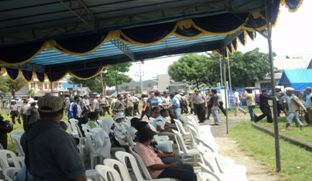
Hundreds of women traders (known as mama-mama) visited the office of the governor of the Papua province to demand that the deputy governor, Alex Hesegem keep the promise he made to give them assistance in the form of capital. The women stayed in the hall of the governor’s office, demanding to meet the deputy governor. After waiting for two hours, they were eventually able to meet him.

He said he was happy to enter into dialogue with the women but things became tense when they persisting in demanding that he keep his promise. He responded by saying that this would certainly be done, I can do it tomorrow.’

But he asked he women to draw up a list of their names because another official insisted that anyone receiving half a million rupiahs would have to pay a fee of five thousand rupiahs. This is reportedly the reasons why the capital has not yet been provided. Some women said that they had no objection to paying this fee.

‘This problem has been going on for two years, and we have been going back and forth to the governor’s office, but all the time they keep telling us to go somewhere else.’

She said that she hoped that after supplying the list of women, the
matter will be resolved because they were worn out, going back and forth about this.

The issue dates back to 2007 when the deputy governor held an open
house. When the mama-mama went there to meet the officials, they
requested help in the form of half a million rupiahs for each one of
them yet to this very day, they have not received anything.

[COMMENT: This just shows the problems Papuan people continue to
encounter in order to secure for themselves a role in engaging in trade
and business in Papua. TAPOL]

Flag raisers to go on trial in Manokwari

JUBI, 11 February 2011

Flag raisers to go on trial in Manokwari

Two Papuans are due to go on trial in Manokwari for raising the 14-star flag. The two men are Melkinus Bleskadit and Dance Bleskadit who, along with five others, raised flags on 14 December 2010. The documents regarding the two men were handed over by the police to the attorney’s office.

A lawyer acting for the two men, Yan Christian Warinussy, said that this is the second stage in the judicial process, following interrogation and bringing together other evidence.

‘The two men are now awaiting action on their case by the prosecutors who will present the charges against them,’ he said. He said that the two men were likely to be charged for treason – makar – and the lawyer hoped that the trial proceedings would commence as soon as possible.

Four others involved in the flag raising are Jhon Wena, 21, George
Rawiay, 20, Benha Supangha, 20, and Alex Duwen, 22. [The name of the fifth person was not mentioned .] The ages of the two men due to be formally charged were not given.

The seven men were arrested as they were commemorating the anniversary of the independence declaration of the West Melanesian Republic on 14 December 2010.

The five men are being held in police custody and are still undergoing
interrogation by the police.

Bintang Papua: DPRP member calls for end to separatist stigma

Bintang Papua, 9 February 2011

[Abridged in translation by TAPOL]

STOP SILENCING PAPUANS WITH THE SEPARATIST STIGMA

The chairman of Commission A of the provincial legislative assembly, the DPRP, Ruben Magai, has called on the police chief to stop using political stigmatisation when conducting operations in Papua. Such statements, he said, result in scaring the indigenous Papuan people and trying to silence them.

These remarks followed a recent statement by a police officer [lower down, it is clear that the statement was made by the police chief] alleging that the OPM is present in the region of Degeuwo, on the border between Paniai and Nabire,. where security disturbances have recently occurred.

Regardless of whether the police have firm evidence, such statements are a form of character assassination, in a region that is known to have abundant natural resources where investors would be keen to invest, with the backing of the security apparatus.

‘This kind of thing is very bad and should be corrected,’ he said. ‘It is as if all the security disturbances are the work of separatists and have nothing to do with injustice. When the term separatism is used in Papua, it is clearly directed against the Papuans who live in the area.’

He warned of a high-level conspiracy by people in authority. All this makes the indigenous Papuans harbour feelings of hostility towards those who make such baseless statements. The term NKRI (Unitary State of the Republic of Indonesia) should not be the exclusive property of people in officialdom. People throughout the territory , including those living in the interior, should be able to speak loud and clear about the NKRI.

But at a time when the state is engaged in a number of questionable activities, including acts of violence against the population in the interior as well as making all kinds of baseless accusations, such things can only spread a feeling of insecurity and anxiety for isolated communities in the interior who know very little about what is going on. ‘What they do know is that they are suffering from injustice as well as the consequences of development which have destroyed their natural resources.’

They are living without any guarantees for security in their old age, which is something that should be taken into consideration, he said.

The age-long problems will remain unresolved as long as the security forces pursue the approach of violence and intimidation, he said.


The Alliance of Intellectuals is also disappointed by the chief of police

Similar views have been expressed by the Alliance of Intellectuals of Suku Wolani Moni, who regret the statement made by the chief of police to the effect that the OPM has a base in Degeuwo.

An Alliance deputy chairmen, Tobias Bagubau, said that a week ago the chief of police promised that they would put an end to illegal logging in Degeuwo. ‘As a representative of the Wolani Moni people, I regret the police chief’s statement to the effect that the OPM is based in Degeuwo whereas in fact there are no OPM members in Degeuwo.’

He said that he thinks the police chief is playing a new game of distracting attention from all the unresolved problems. ‘Please stop making such allegations about the OPM in Degeuwo. What we want is for the problem of illegal mining to be halted,’ he said.

He said that he can’t stop wondering why the police chief is always making such statements which can only lead to widespread feelings of dissatisfaction and result in insecurity for the state.

‘If the OPM is indeed here, they should be arrested. After all, there are plenty of members of the security forces based here,’ he said.

Create a website or blog at WordPress.com

Up ↑
