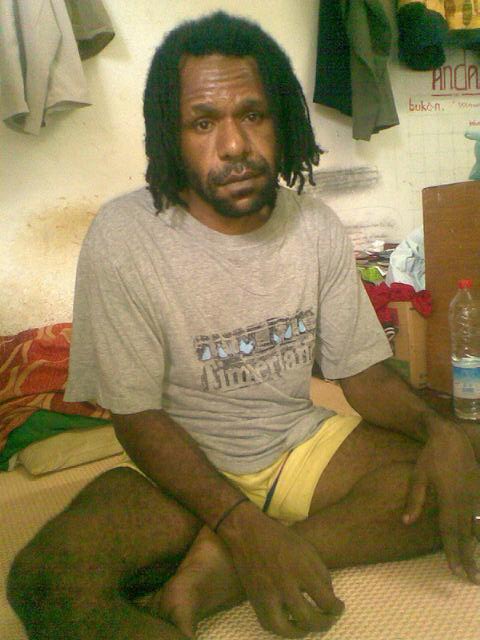
Three political prisoners are ill

JUBI, 26 January 2012Three political  prisoners from Papua , who were arrested for their alleged involvement in the case of the assault on the ammunitions dump of Kodim 1702, Wamena on 4 April 2003, are now ill. Their names are: Enos Lokobai, Jefrai Murib and Numbunggan Telenggen.

Wirya, the co-ordinator of the NGO Foker in Biak Numbir, said  that Enos Lokobal and his colleagues have been suffering from lumbago  and have been taken to hospital for treatment but they are still in pain.

According to Wirya, Jafrai Murib went to hospital to be treated for malaria. [Several types of malaria are mentioned here.] As a result of his condition, he has become very pale. Apok Lakobal has been ill since November last year. His right side is paralysed and he is unable  to move; the doctor at the hospital said that he has had a stroke.

After the ammunitions dump was attacked, Enos Lakobal was sentenced to fifteen years, while Jafrai Murib and Numbangga  were given life sentences.

[This has been abridged in translation owing to our inability to identify some of the illnesses mentioned in the article. TAPOL]

3 Papuan prisoners in need of medical treatment for stroke

Papuan prisoners in Biak Jail
Papuan prisoners in their cell in Biak prison: Numbungga Telengen (black clothes), Jefrai Murib (sleeping) and Apot Lokobal (wearing glasses). Jafrai Murib is thought to have suffered a stroke on 19 December 2011 which has caused paralysis. He can no longer stand.


I am often in and out of prisons to deal with political prisoners, so I know many detainees and their families and lawyers. Last week, I received a message from somebody representing three Papuan prisoners in Biak prison. He said that prisoner Jefrai Murib is thought to have suffered a stroke on the morning of 19 December 2011. He’s paralysed. He can’t walk. When he walks he does so with the aid of his friends. The left side of his body, his left leg and his left arm have lost all sensation.

Jefrai Murib

Murib has had a check-up in Biak General Hospital, where the doctor referred him to Jayapura hospital.  Biak hospital is not as well equipped as Jayapura hospital. Murib is in a cell together with Numbungga Telengen and  Apotnagolik Enos Lokobal.  They were arrested in April 2003 following a raid on a Wamena weapons store. Murib and Telenggen got a life sentence, Lokobal was sentenced to 20 years in jail.

Lokobal also suffers from the same symptoms; the right side of his body has lost all sensation. He has also been seen twice at Biak hospital, on 12 November and 23 November. Lokobal is also suspected of having suffered a stroke. Unlike Jafrai Murib, by last week Apot Lokobal was able to walk again, although his steps are weak and faltering, and he has to be carried when taken to hospital. Lokobal needs more specialised medication. The Indonesian state is responsible for providing healthcare to prisoners. I hope that the health condition of these two prisoners will be taken seriously by the Penitentiary Director General.

In accordance with the doctor’s recommendations, Jefrai Murib should be moved to Abepura jail in Jayapura, and needs to receive medical attention at the Dok Dua Hospital in Jayapura.

Warinussy on the politics behind the recent conflicts in Papua

Bintang Papua, 14 September 2011Manokwari: Yan Christian Warinussy, a Papuan human rights lawyer and executive direction of LP3BH, believes that the road leading toward dialogue between Papua and Indonesia has become clearer in the past few months.

The recent escalation of violence in various parts of the Land of Papua. such as Jayapura, Biak, Nabire and Manokwari as well as the Central Highlands will not dampen the aspirations of the indigenous Papuan people, that which were proclaimed in the Papuan Peace Declaration drawn up at the Papuan Peace Conference held by the Papuan Peace Network (Jaringan Damai Papua) on 5-6 July this year in Jayapura.’From the record of conflicts that have occurred in the Land of Papua up to the present day, I have been able as a human rights activist to reach a better understanding of the specific characteristics and background of the reasons for the various violent conflicts that have occurred in the Land of Papua recently. Moreover, we now know who the persons who having been plotting these incidents are, along with their political purposes. All this has helped us to understand the motivation behind these strange incidents which has made it possible for us to draw conclusions about who it is who is behind all these criminal incidents,’ said Warinussy.

Each of these incidents has occurred without leaving any trace of who was involved. This impression has been further strengthened by the fact that the police force throughout the land of Papua have been unable to identify who was behind each incident. It is also apparent that  the police have been unable to discover any significant evidence to reveal the perpetrators of these incidents.

In fact, he went on to say, each of these incidents have occurred without anything left behind that might help to identify the perpetrators. This would suggest that the criminal perpetrators are part of  a special unit that have undergone intensive training  and have been trained even to commit murders without leaving a single trace and in this way make it difficult for the police to conduct any criminal investigations. These crimes  have resulted in the Papuan people feeling more afraid to take actions in conformity with their rights to freedom of expression and freedom of opinion.

The intention appears to be to show to the central and local governments and to the international community that the security situation in West Papua is not safe because of the presence of the TPN/OPM. Yet, we have heard nothing at all from the TPN/OPM about who they think are behind these recent incidents. This has been aimed at thwarting the deeply felt aspirations of the indigenous people for dialogue with the Indonesian government.

Vested interests in the Land of Papua have for years pursued a strategy  within the context of development and general governance aimed at causing frictions  between those vested interests. This is something that needs to be discussed openly between all those involved, including the indigenous Papuan people, in order to find a peaceful solution and realise the aspirations for a Papuan land of peace as quickly as possible.

Human rights situation raised with US diplomat visiting Papua

Bintang Papua, 16 February 2011

HUMAN RIGHTS SITUATION REPORTED TO US DIPLOMAT

Biak: The traditional Papuan community in Biak reported the current
social and political situation in Papua to the first secretary for
political affairs at the US embassy, Melanie Higgins, when she visited
the office of DAP (Dewan Adat Papua) in Biak. Their representatives drew attention in particular to the human rights situation and the
deteriorating welfare since the enactment of the Special Autonomy Law (OTSUS) which had led to the failure of OTSUS.

The issue that came to the fore was that for the Papuan people the
solution was merdeka – independence. ‘This poured forth from the hearts of the indigenous people during their meeting with the US diplomat on Wednesday. They said that this would be the best solution for the accumulation of problems in Papua,’ said Yan Pieter Yarangga, chairman of DAP in Biak-Supiori, following his meeting with Higgins.

He said that the visit by Melanie Higgins was consistence with the US
decision to evaluate OTSUS in Papua. She was able to hear how OTSUS had been implemented in the ten years since its enactment.

Besides talking about the failure of OTSUS, they raised some specific
cases, such as the beating of a civilian by a member of the security
forces (TNI) over a land dispute regarding land being held by the Air
Force.

They also talked about such matters as history, the development process and the growing number of poor Papuans. Women who were present spoke about the growing number of HIV/AIDS victims in Biak and everywhere in Papua.

‘We talked about many serious problems which were an indication of
genocide. ‘But we very much regret the fact that according to the US
there is no genocide in Papua,’ said the chairman of the local DAP.

He said that the indigenous people of Papua nevertheless warmly
appreciated the visit by Melanie Higgins and the present position of the US, and understood their US support for NKRI (Unitary State of the
Republic of Indonesia.).

‘But they should realise that we will not retreat and will continue to
struggle until we reach a solution for the political status for the
people of Papua and hope that Melanie Higgins will pass on the views of the indigenous Papuan people to the US government, in so that they would be passed on to the central government in Jakarta for them to take steps in favour of a comprehensive solution of the Papuan problem.’

‘Actually, there were many problems to raise with her but time was
short, so we came to the conclusion that we should raise a number of
basic indicators about problems of a very substantial nature.’

Create a website or blog at WordPress.com

Up ↑