A West Papuan leader-in-exile fears Indonesian security forces will violently suppress the 50th anniversary celebrations of the independence movement’s flag … the Morning Star.
Thousands of police, military and special forces are reportedly massing in the two provinces just north of Australia, ahead of Papuan rallies planned for Thursday.
On Monday, Indonesian police said no officers would face charges over last month’s crackdown on the Papuan People’s Congress.
The crackdown left three Papuans dead and there are claims dozens were tortured.
Stefan Armbruster spoke with London-based West Papuan leader Benny Wenda, for whose arrest Indonesia this week issued an Interpol Red Notice.
The rally organised by the National Committee for West Papua (KNPB) on August 2 2011 was led by Mako Tabuni from KNPB. The protesters were on the streets the whole day. There were more than 10,000 people, from Sentani, Jayapura as well as students from Abepura. The peaceful rally was organised to support the seminar by International Lawyer for West Papua (ILWP), initiated by Benny Wenda in London, the UK, which looked into the history of the 1969’s People’s Act of Free Choice (PEPERA).
Jayapura: Although no official report has yet been received about the
results of the International Laywers for West Papua conference in Oxford
on 2 August with regard to challenging the 1969 Act of Free Choice
(pepera) at the International Court of Justice, Imparsial-Jakarta says
that a challenge can only be successful if it is made by a state, not
by an organisation like ILWP.
Poengki Indarti, the executive director of Imparsial, an organisation
that frequently draws attention to the activities of the Indonesian
military in West Papua as well as to the human rights situation there,
said that the ILWP is not a state and furthermore, pepera was
legitimised by the United Nations while virtually all countries
recognise that West Papua is part of NKRI, the Unitary State of the
Republic of Indonesia.
She said that what Benny Wenda is trying to do via the ILWP and the
IPWP is to win as much support as possible from countries around the
world which show an interest in West Papua’s secession from Indonesia.
However, this is very difficult indeed because all countries with the
exception of Vanuatu support the incorporation of West Papua into
Indonesia. ‘What they are trying to do is get the support of some
hopefully sympathetic states. I dont think people should overact to the
decisions adopted by the ILWP conference,’ she said.
However, Yan Christian Warinussy, executive director of Papua-based
human rights NGO, LP3BH, said that any challenge with regard to ‘legal
standing’ would depend on the interpretation of the judge before whom
the case is brought. He said: ‘As regards any efforts to challenge
pepera that may be made by the ILWP, anyone and in particular the Papuan people could submit a challenge because it relates to their
rights as Papuans . If in the opinion of the judge before whom the case
is brought, an organisation such as the ILWP has been granted the
necessary powers by the Papuan people, the case can of course be
accepted.’ He went on to say that it would be much more strategic for
the challenge to be made first of all at the national level because
Indonesia has its own legal system and it is not certain that a
decision would be adopted by the International Court in a case
connected with a sovereign state like Indonesia.
‘Therefore, I would press for the challenge to be made within the
Indonesian legal system which could be done by the Papuan Customary
Council (Dewan Adat Papua) or another organisation that has been granted
the necessary powers,’ said Warinussy who received the John Humphrey
human rights award in 2005.
The Imparsial director-general said that she thinks that all
stakeholders in Papua should focus primarily on peaceful endeavours and
dialogue to find a ‘middle way’. If everyone sticks to their own
opinion, the ones whose interests are damaged are the Papuan people who
do not have a very good understanding of political affairs. (sic).
Meanwhile, she drew attention to the long drawn out Papuan problem with
many actions being taken about the unsatisfactory implementation of
OTSUS (the special autonomy law), many acts of violence that have
resulted in civilian lives being lost, as well as actions calling for
independence, all of which point to the lack any serious attention from
the central and provincial governments. She said that the Indonesian
government is half-hearted about Papua and seems to want conditions in
Papua to stay the same as they are now. ‘We all hope to see the
government pay serious attention to Papua.’ She said it seems as though
the government just wants to keep the conflict in Papua going. It shows
no interest in enacting regulations or laws and seems to be acting at
cross purposes, with the government frequently pursuing the repressive
approach while the military have said that that they have made drastic
changes in the way they handle Papua. However, people feel that the
situation is no different from what it was in the past.
‘In the many cases of violence, it is the task of the police to
investigate who was responsible but nothing concrete has happened, while
Papuans are asking whether it was the real OPM or a fictional OPM that
certain state institutions are keeping alive. Everyone is looking to
the government to explain things because as yet the Papuan question
has not been resolved whereas the government is not serious about
solving it.
A case in point is what Benny Wenda is doing in the UK. Although Poengky
Indarti has checked the Interpol list of fugitives and saw that he is a
fugitive registered with Interpol, he is nevertheless free to seek
support overseas while no action is taken against him either by the
Indonesian government or the Indonesian police. The government is
deliberately keeping the Papuan problem hanging in the air, from the
polemics about the failure of OTSUS, to the breaches of security and the
shooting incidents as well as the calls for independence that have
caused much anxiety among the civilian population, whereas the
government still doesnt regard Papua as a problem that is in need of
solution.
This week marks the 48th anniversary of the West Papuan struggle for independence from Indonesia. Thousands have taken to the streets and international lawyers are making a strong case for West Papuan self-rule.
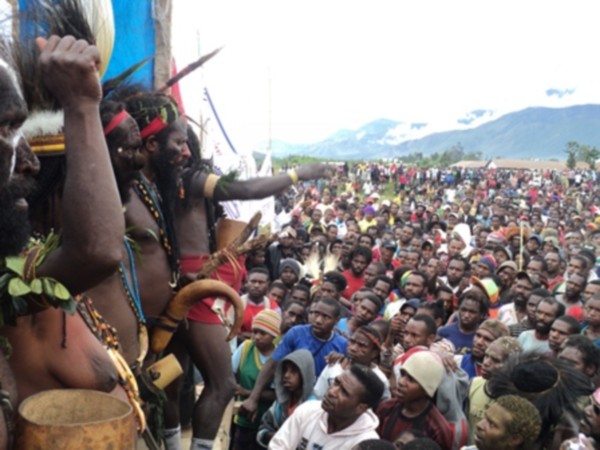
Thousands have demonstrated on the streets of West Papua in recent weeks demanding independence. Free West Papua Campaign
Thousands have demonstrated on the streets of West Papua in recent weeks demanding independence. Free West Papua Campaign
It is a grief-stricken path that has been followed for generations. It stretches from when the Dutch colonized the region in the 19th century and cruelly continued when control was handed to Indonesia by a United Nations Temporary Executive Authority in 1963. And this week the journey towards independence has led thousands of West Papuans onto the streets to demand the international community acknowledge their right to be free.
‘West Papuans will never recognize their homeland as being part of Indonesia and we have a fundamental right to self-determination under international law,’ says Benny Wenda, a West Papua independence leader living in exile in Britain. ‘West Papuans have marched peacefully this week and have shown again that they can meet violence with peace to achieve this [aim], no matter how much [Indonesia] tries to intimidate us.’
‘A blind eye has been most cynically turned by the international community towards the situation of the people in West Papua’
Protesters and human rights campaigners are regularly harassed and arrested in West Papua and, according to Amnesty International, reports of torture whilst in detention and other human rights violations are commonplace. But with momentum building for the cause, the police have been reluctant to intervene in the recent protests.
‘The demonstrations were so big this time they know if they act violently towards the protesters it would be noticed internationally,’ says Wenda. ‘We have been trying for 48 years now and, just like the Middle East, we need people power to change the world – but we also need people from around the world to notice.’
One of the biggest obstacles that the Free West Papua campaign faces is a lack of interest, let alone support, from the outside world.
Forgotten conflict
‘West Papua is a forgotten conflict,’ says Charles Foster, spokesperson for International Lawyers for West Papua. ‘A blind eye has been most cynically turned by the international community towards the situation of the people there.’
As part of efforts to raise the profile of the region, a conference was held in Oxford this week by the Free West Papua campaign. International lawyers and activists spoke at the event to highlight the case for an independent West Papua under international law.
Benny Wenda and fellow West Papuans sing their national anthem at a conference in Oxford. Nick Harvey
‘In legal terms, the region has a clear right to self-determination,’ says Foster. ‘If you look at the New York Agreement [a treaty signed in 1962 by the Netherlands and Indonesia regarding the political status of West Papua, then known as West New Guinea] the United Nations was given trustee status over the region which was supposed to lead to self-determination in 1969. Indonesia has never disputed the fact it put its name to this agreement; therefore it implicitly acknowledges that it was bound by it.’
But the New York Agreement was followed in 1969 by the ironically titled Act of Free Choice, a vote by a tiny section of the population of West Papua, hand-picked by the Indonesian military, on whether the region should become independent or remain part of Indonesia. Although it has since been widely recognized that the process was a sham, calls for a revote have consistently been ignored.
‘There is no serious legal scholar anywhere in the world who thinks the Act of Free Choice was a genuine expression of the free will of the West Papuan people,’ says Foster. ‘When Indonesians talk about this they try to steer clear of what actually happened on the ground in 1969. They’re not stupid, they realize how embarrassing it is.’
As long as the international inertia continues, the situation for West Papuans continues to worsen
Yet even if the New York Agreement is somehow forgotten and the circumstances surrounding the Act of Free Choice somehow ignored, international law still falls heavily on the side of the West Papuans. In 1960 the UN General assembly passed a crucial agreement, the Declaration of Granting Independence to Colonial Countries and Peoples, which states: ‘All peoples have the right to self-determination; by virtue of that right they freely determine their political status and freely pursue their economic, social and cultural development.’
This firm legal ground has yet to translate into any meaningful concessions to the West Papuan people. And as long as the international inertia continues, the situation for West Papuans continues to worsen.
Clemens Runawery is an exiled independence activist who has been unable to return to his country for more than 40 years.
‘The longer we stay part of Indonesia the more our status will suffer, both physically and demographically,’ he says. ‘Back in 1961 the vast majority of the people in West Papua were West Papuan, with only a minority from other places. Today this situation has been completely reversed. How much time do we really have left?’
 00:03:54
  2MB
2MB
 07:05
07:05




 West Papua Media Alerts