West Papua: the road to freedom?

Benny Wenda at the IPWP launch
Image via Wikipedia
Published on August 4, 2011 by Nick Harvey  in
New Internationalist
http://www.newint.org/features/web-exclusive/2011/08/04/west-papua-protests-independence/

West Papua: the road to freedom

Web exclusive

This week marks the 48th anniversary of the West Papuan struggle for independence from Indonesia. Thousands have taken to the streets and international lawyers are making a strong case for West Papuan self-rule.
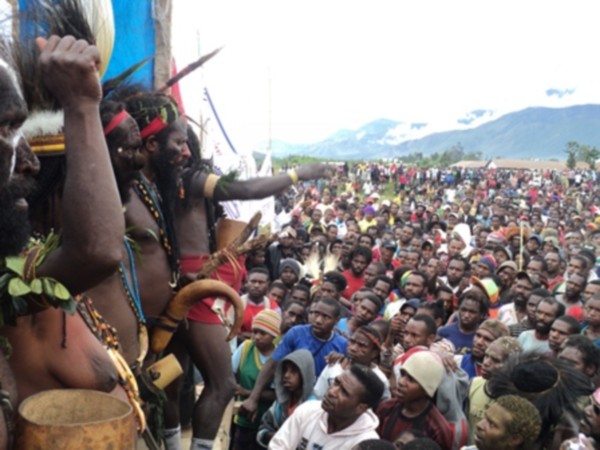
Thousands have demonstrated on the streets of West Papua in recent weeks demanding independence. Free West Papua Campaign

It is a grief-stricken path that has been followed for generations. It stretches from when the Dutch colonized the region in the 19th century and cruelly continued when control was handed to Indonesia by a United Nations Temporary Executive Authority in 1963. And this week the journey towards independence has led thousands of West Papuans onto the streets to demand the international community acknowledge their right to be free.

‘West Papuans will never recognize their homeland as being part of Indonesia and we have a fundamental right to self-determination under international law,’ says Benny Wenda, a West Papua independence leader living in exile in Britain. ‘West Papuans have marched peacefully this week and have shown again that they can meet violence with peace to achieve this [aim], no matter how much [Indonesia] tries to intimidate us.’

‘A blind eye has been most cynically turned by the international community towards the situation of the people in West Papua’

Protesters and human rights campaigners are regularly harassed and arrested in West Papua and, according to Amnesty International, reports of torture whilst in detention and other human rights violations are commonplace. But with momentum building for the cause, the police have been reluctant to intervene in the recent protests.

‘The demonstrations were so big this time they know if they act violently towards the protesters it would be noticed internationally,’ says Wenda. ‘We have been trying for 48 years now and, just like the Middle East, we need people power to change the world – but we also need people from around the world to notice.’

One of the biggest obstacles that the Free West Papua campaign faces is a lack of interest, let alone support, from the outside world.

Forgotten conflict

‘West Papua is a forgotten conflict,’ says Charles Foster, spokesperson for International Lawyers for West Papua. ‘A blind eye has been most cynically turned by the international community towards the situation of the people there.’

As part of efforts to raise the profile of the region, a conference was held in Oxford this week by the Free West Papua campaign. International lawyers and activists spoke at the event to highlight the case for an independent West Papua under international law.

Nick
Harvey
Benny Wenda and fellow West Papuans sing their national anthem at a conference in Oxford. Nick Harvey

‘In legal terms, the region has a clear right to self-determination,’ says Foster. ‘If you look at the New York Agreement [a treaty signed in 1962 by the Netherlands and Indonesia regarding the political status of West Papua, then known as West New Guinea] the United Nations was given trustee status over the region which was supposed to lead to self-determination in 1969. Indonesia has never disputed the fact it put its name to this agreement; therefore it implicitly acknowledges that it was bound by it.’

But the New York Agreement was followed in 1969 by the ironically titled Act of Free Choice, a vote by a tiny section of the population of West Papua, hand-picked by the Indonesian military, on whether the region should become independent or remain part of Indonesia. Although it has since been widely recognized that the process was a sham, calls for a revote have consistently been ignored.

‘There is no serious legal scholar anywhere in the world who thinks the Act of Free Choice was a genuine expression of the free will of the West Papuan people,’ says Foster. ‘When Indonesians talk about this they try to steer clear of what actually happened on the ground in 1969. They’re not stupid, they realize how embarrassing it is.’

As long as the international inertia continues, the situation for West Papuans continues to worsen

Yet even if the New York Agreement is somehow forgotten and the circumstances surrounding the Act of Free Choice somehow ignored, international law still falls heavily on the side of the West Papuans. In 1960 the UN General assembly passed a crucial agreement, the Declaration of Granting Independence to Colonial Countries and Peoples, which states: ‘All peoples have the right to self-determination; by virtue of that right they freely determine their political status and freely pursue their economic, social and cultural development.’

This firm legal ground has yet to translate into any meaningful concessions to the West Papuan people. And as long as the international inertia continues, the situation for West Papuans continues to worsen.

Clemens Runawery is an exiled independence activist who has been unable to return to his country for more than 40 years.

‘The longer we stay part of Indonesia the more our status will suffer, both physically and demographically,’ he says. ‘Back in 1961 the vast majority of the people in West Papua were West Papuan, with only a minority from other places. Today this situation has been completely reversed. How much time do we really have left?’

Amnesty: URGENT ACTION FEARS FOR SAFETY of Human rights defender Yones Douw

AI has released an Urgent Action Update for Yones Douw. (5 August 2011)
The original Urgent Action concerning Yones was Issued on the 17 June 2011and is below the present one.


————————————

http://www.amnesty.org/en/library/asset/ASA21/023/2011/en/95040490-098a-445d-81e2-20f94150781e/asa210232011en.html

DOCUMENT – INDONESIA: FURTHER INFORMATION: FEARS FOR SAFETY OF INDONESIAN RIGHTS ACTIVIST

FU UA: 188/11 Index: ASA 21/023/2011 Indonesia Date: 5 August 2011

URGENT ACTION

fears for safety of indonesian rights activist

Human rights defender Yones Douw has received medical treatment after he was beaten by military officers on 15 June. However, he continues to fear for his safety and the safety of his family after he received information that he is under surveillance by members of the Indonesian security forces.

On 1 July Yones Douw travelled to Jayapura, Papua province in Indonesia, to seek medical assistance for the injuries he sustained while monitoring a demonstration on 15 June. X-rays revealed a blood clot in his head and a fracture to his hand. He is still receiving medical treatment for these injuries and continues to feel pain at the back of his head and in his hand. He also suffers from frequent headaches.
While he was travelling to Jayapura for treatment, Yones Douw received information that a senior police officer in Nabire had contacted police intelligence officers in the district by SMS asking “Has Yones left Nabire, please check and keep a close eye on him”. On 15 July he was informed by a credible source that the Nabire District Police Station had ordered officers to monitor Yones Douw’s movements in Nabire. Since then Yones Douw has seen strangers waiting in the vicinity of his house and heard motorcyclists revving their engines as they pass by. Human rights groups have raised concerns in the past about individuals and groups being hired to intimidate human rights defenders, minority groups and others. Yones Douw fears for his safety, and the safety of his family.

Yones Douw was beaten while monitoring a demonstration calling for accountability for the stabbing and killing of Papuan Derek Adii on 14 May, reportedly by military officers. To Amnesty International’s knowledge there has been no investigation into the death of Derek Adii.
Please continue to write in English, Indonesian or your own language:
Urge the authorities to take immediate action to ensure the safety of Yones Douw, in accordance with his wishes;
Call for an immediate, effective and impartial investigation into the unnecessary and excessive use of force used against Yones Douw, with the results made public and those responsible brought to justice in fair trials;
Call on the authorities to initiate an independent investigation into the possible unlawful killing of Derek Adii, and ensure that, should the allegations be verified, those responsible be brought to justice in fair trials and the victims receive reparations;
Call on the authorities to ensure that all members of the police and military are made aware of the legitimate role of human rights defenders and their responsibility to protect them, as set out in the UN Declaration on Human Rights Defenders.
P LEASE SEND APPEALS BEFORE 16 SEPTEMBER 2011 TO :
Minister of Justice and Human Rights
Patrialis Akbar
Ministry of Justice and Human Rights
Jl. H.R. Rasuna Said Kav No. 4-5
Kuningan, Jakarta Selatan 12950
Indonesia
Fax: +62 21 525 3095
Salutation: Dear Minister
Papua Police Chief
Inspector General Bekto Suprapto
Papua Regional Head of Police (Kapolda)
Jl. Samratulangi No. 8 Jayapura,
Papua, Indonesia
Fax: +62 967 533763
Salutation: Dear Kapolda
And copies to:
Chairperson National Human Rights Commission (Komnas HAM)
Ifdhal Kasim
Jl Latuharhary
No.4 Menteng Jakarta Pusat
10310, Indonesia
Fax: +62 21 39 25 227
Also send copies to diplomatic representatives accredited to your country.
Please check with your section office if sending appeals after the above date. This is the first update of UA 188/11. Further information: www.amnesty.org/en/library/info/ASA21/014/2011/en
———————————————————————————————————————————-

DOCUMENT – INDONESIA: PAPUAN ACTIVIST AT RISK FOLLOWING BEATING

UA: 188/11 Index: ASA 21/014/2011 Indonesia Date: 17 June 2011 Date: 17 June 2011
URGENT ACTION

PAPUAN ACTIVIST AT RISK FOLLOWING BEATING
Yones Douw , a human rights activist in the Indonesian province of Papua , was beaten by military officers on 15 June and has been denied medical treatment . He fears for his health and safety , as he has previously been detained and assaulted as a result of his human rights activities.
A protest took place at the 1705 District Military Command (Kodim) base in Nabire, Papua province, on the morning of 15 June, to call for accountability for the stabbing and killing of Papuan Derek Adii on 14 May 2011, reportedly by military officers from the 1705 District Military Command. At about 9am on 15 June, Yones Douw, a 42-year-old human rights activist, heard that a protest, which included family members of Derek Adii, was about to take place, and he went to the base to monitor it. Thirty minutes after he arrived, a group of protesters turned up in three trucks, broke into the front entrance of the base and started to shatter the windows and throw objects. Yones Douw immediately rushed into the base to calm the protesters.

In response, the military fired shots into the air and started hitting the protesters. Yones Douw was struck on the head with pieces of wood many times. He also sustained injuries on his shoulder and wrists from the beatings. As he was beaten he heard the military threaten to shoot the protesters saying “these animals should be taught a lesson”. A military officer also hit the father of Derek Adii, Damas Adii, with a piece of wood. After the beatings, Yones Douw travelled to the Siriwini hospital for treatment and to obtain a medical report, but was told by medical staff that he required a letter from the police before they could treat him. He then decided to go home and is still suffering from the injuries. He fears for his health and safety.
Yones Douw is a respected human rights activist in Papua and has been documenting human rights violations by the police and military over the last decade.


PLEASE WRITE IMMEDIATELY in Indonesia n , English or your own language:
Urging the authorities to take immediate action to ensure the safety of Yones Douw, in accordance with his wishes, and ensure his immediate access to medical care;
Calling for an immediate, effective and impartial investigation into the beatings and the threats against Yones Douw, with the results made public and those responsible brought to justice in fair trials;
Calling on the authorities to initiate an independent investigation into the possible unlawful killing of Derek Adii, and ensure that, should the allegations be verified, those responsible be brought to justice in fair trials and the victims receive reparations; and
Calling on the authorities to ensure that all members of the police and military are made aware of the legitimate role of human rights defenders and their responsibility to protect them, as set out in the UN Declaration on Human Rights Defenders.
PLEASE SEND APPEALS BEFORE 29 JULY 2011 TO :
Minister of Justice and Human Rights
Patrialis Akbar
Ministry of Justice and Human Rights
Jl. H.R. Rasuna Said Kav No. 4-5
Kuningan, Jakarta Selatan 12950
Indonesia
Fax: +62 21 525 3095
Salutation: Dear Minister
Chairperson National Human Rights Commission (Komnas HAM)
Ifdhal Kasim
Jl Latuharhary
No.4 Menteng Jakarta Pusat
10310, Indonesia
Fax: +62 21 39 25 227
Salutation: Dear Ifdhal Kasim
Papua Police Chief
Inspektur Jenderal Bekto Suprapto
Papua Regional Head of Police (Kapolda)
Jl. Samratulangi No. 8 Jayapura,
Papua, Indonesia
Fax: +62 967 533763
Salutation: Dear Kapolda
Also send copies to diplomatic representatives accredited to your country. Please check with your section office if sending appeals after the above date.
URGENT ACTION
PAPUAN ACTIVIST AT RISK FOLLOWING BEATING

ADDITIONAL INFORMATION

In January 2009, police officers kicked and punched Yones Douw during his arrest, after he attempted to intervene to stop clashes between police and demonstrators in Nabire. He and seven other demonstrators were denied access to the outside world and he was deprived of food and drinking water during his one day detention.
In recent years, there have been a number of cases of intimidation and attacks against human rights defenders and journalists in Indonesia, and human rights defenders are regularly intimidated and harassed in Papua. International human rights observers, non-governmental organizations and journalists are severely restricted in their work there.
Amnesty International continues to receive credible reports of human rights violations by the security forces in Indonesia, including torture and other ill-treatment and the unnecessary and excessive use of force. There are often no independent investigations into allegations of human rights violations, and those responsible are rarely brought to account before an independent court. In January 2011 three soldiers who had been filmed kicking and abusing Papuans were sentenced by a Military Court to between eight and 10 months’ imprisonment for disobeying orders. The fact that the victims were not able to testify because of the lack of adequate safety guarantees raised serious concerns about the trial process. Amnesty International believes that the civilian courts are much more likely to ensure both prosecutions for crimes involving human rights violations and protection for witnesses than the military system, which is unlikely to be impartial and independent.
While Amnesty International acknowledges the difficulties faced by security forces in Indonesia, especially when confronted with violence, the power to use force given to security forces is restricted by relevant international human rights law and standards, the basis of which is the right to life. The Indonesian authorities must ensure prompt, independent and impartial investigations into all credible allegations of human rights violations by the security forces. Those found responsible, including persons with command responsibility, should be prosecuted in proceedings which meet international standards of fairness, and victims provided with reparations.
UA: 188/11 Index: ASA 21/014/2011 Issue Date: 17 June 2011

Amnesty:URGENT ACTION PAPUAN ACTIVIST AT RISK FOLLOWING BEATING

UA: 188/11 Index: ASA 21/014/2011 Indonesia Date: 17 June 2011

URGENT ACTION

PAPUAN ACTIVIST AT RISK FOLLOWING BEATING

Yones Douw, a human rights activist in the Indonesian province of Papua, was beaten by military officers on 15 June and has been denied medical treatment. He fears for his health and safety, as he has previously been detained and assaulted as a result of his human rights activities.

A protest took place at the 1705 District Military Command (Kodim) base in Nabire, Papua province, on the morning of 15 June, to call for accountability for the stabbing and killing of Papuan Derek Adii on 14 May 2011, reportedly by military officers from the 1705 District Military Command. At about 9am on 15 June, Yones Douw , a 42-year-old human rights activist, heard that a protest, which included family members of Derek Adii, was about to take place, and he went to the base to monitor it. Thirty minutes after he arrived, a group of protesters turned up in three trucks, broke into the front entrance of the base and started to shatter the windows and throw objects. Yones Douw immediately rushed into the base to calm the protesters.

In response, the military fired shots into the air and started hitting the protesters. Yones Douw was struck on the head with pieces of wood many times. He also sustained injuries on his shoulder and wrists from the beatings. As he was beaten he heard the military threaten to shoot the protesters saying “these animals should be taught a lesson”. A military officer also hit the father of Derek Adii, Damas Adii, with a piece of wood. After the beatings, Yones Douw travelled to the Siriwini hospital for treatment and to obtain a medical report, but was told by medical staff that he required a letter from the police before they could treat him. He then decided to go home and is still suffering from the injuries. He fears for his health and safety.

Yones Douw is a respected human rights activist in Papua and has been documenting human rights violations by the police and military over the last decade.

PLEASE WRITE IMMEDIATELY in Indonesian, English or your own language:

– Urging the authorities to take immediate action to ensure the safety of Yones Douw, in accordance with his wishes, and ensure his immediate access to medical care;

– Calling for an immediate, effective and impartial investigation into the beatings and the threats against Yones Douw, with the results made public and those responsible brought to justice in fair trials;

– Calling on the authorities to initiate an independent investigation into the possible unlawful killing of Derek Adii, and ensure that, should the allegations be verified, those responsible be brought to justice in fair trials and the victims receive reparations; and

– Calling on the authorities to ensure that all members of the police and military are made aware of the legitimate role of human rights defenders and their responsibility to protect them, as set out in the UN Declaration on Human Rights Defenders.

PLEASE SEND APPEALS BEFORE 29 JULY 2011 TO:

Minister of Justice and Human Right s

Patrialis Akbar

Ministry of Justice and Human Rights

Jl. H.R. Rasuna Said Kav No. 4-5

Kuningan, Jakarta Selatan 12950

Indonesia

Fax: +62 21 525 3095

Salutation: Dear Minister

Chairperson National Human Rights Commission (Komnas HAM)

Ifdhal Kasim

Jl Latuharhary

No.4 Menteng Jakarta Pusat

10310, Indonesia

Fax: +62 21 39 25 227

Salutation: Dear Ifdhal Kasim

Papua Police Chief

Inspektur Jenderal Bekto Suprapto

Papua Regional Head of Police (Kapolda)

Jl. Samratulangi No. 8 Jayapura,

Papua, Indonesia

Fax: +62 967 533763

Salutation: Dear Kapolda

Also send copies to diplomatic representatives accredited to your country. Please check with your section office if sending appeals after the above date.

Additional Information

In January 2009, police officers kicked and punched Yones Douw during his arrest, after he attempted to intervene to stop clashes between police and demonstrators in Nabire. He and seven other demonstrators were denied access to the outside world and he was deprived of food and drinking water during his one day detention.

In recent years, there have been a number of cases of intimidation and attacks against human rights defenders and journalists in Indonesia, and human rights defenders are regularly intimidated and harassed in Papua. International human rights observers, non-governmental organizations and journalists are severely restricted in their work there.

Amnesty International continues to receive credible reports of human rights violations by the security forces in Indonesia, including torture and other ill-treatment and the unnecessary and excessive use of force. There are often no independent investigations into allegations of human rights violations, and those responsible are rarely brought to account before an independent court. In January 2011 three soldiers who had been filmed kicking and abusing Papuans were sentenced by a Military Court to between eight and 10 months’ imprisonment for disobeying orders. The fact that the victims were not able to testify because of the lack of adequate safety guarantees raised serious concerns about the trial process. Amnesty International believes that the civilian courts are much more likely to ensure both prosecutions for crimes involving human rights violations and protection for witnesses than the military system, which is unlikely to be impartial and independent.

While Amnesty International acknowledges the difficulties faced by security forces in Indonesia, especially when confronted with violence, the power to use force given to security forces is restricted by relevant international human rights law and standards, the basis of which is the right to life. The Indonesian authorities must ensure prompt, independent and impartial investigations into all credible allegations of human rights violations by the security forces. Those found responsible, including persons with command responsibility, should be prosecuted in proceedings which meet international standards of fairness, and victims provided with reparations.

UA: 188/11 Index: ASA 21/014/2011 Issue Date: 17 June 2011

Open Letter – FREE YOUTH ACTIVISTS AND RESPECT HUMAN RIGHTS OF THE PEOPLE OF WEST PAPUA

A Open Letter


To the Government of Indonesia, Indonesian Youth Activists, Indonesian Human Rights Defenders and Organisations, and the People of West Papua. 

RE: FREE YOUTH ACTIVISTS AND RESPECT HUMAN RIGHTS OF THE PEOPLE OF WEST PAPUA

A collection Youth/Human Rights Organisations and Advocates based in Fiji (and across Oceania) are concerned with the continued suppression of witnesses and the media regarding the imprisonment and secret court proceedings surrounding the arrest of 5 youth activists arrested on December 17th 2010 for raising the West Papua Liberation Flag.

Five youth activists Jhon Wenda, George Rawiay, Benha Supanga, Alex Duwe, and Iyance have been charged under Article 106 and 110 of the Indonesian Criminal Code.

Some 200 people took part in a peaceful ceremony outside Manokwari in December 2010, during which the Morning Star flag, a symbol of Papuan independence, was raised in commemoration of the declaration of Papuan independence in 1962.  When the flag was raised, Indonesian Military advanced on the crowd, firing shots and beating people with batons.

We have been advised by colleagues within the West Papua Liberation Movement that the health of these 5 youth activist and safety after been detained since December 2010 is of serious concern. They also noted the media censorship on the case and how many witnesses are afraid to testify because of further repression. We have also been told that a heighten sense of fear has been fueled by the continued presence of a 1000 plus military presence in the province of Manokwari that were ordered into the area.

Human Rights and the protection of activists or defenders of these rights must be respected if we are to allow peace to exist in West Papua. Indonesia as a State signatory to the Universal Declaration of Human Rights and many other Human Rights Instruments should see its role in the protection and advancement of Human Rights, Media Freedom, Civil and Political Rights of all peoples they claim to govern.

Indonesia was re-elected this year into the UN Human Rights Council for the period 2011-2014, which is an inter-governmental body within the UN system made up of 47 States responsible for strengthening the promotion and protection of human rights around the globe. Indonesia’s own human rights record has recently been brought to the forefront and we remind State parties of their obligations to ensure citizens are treated with dignity regardless of ethnicity, age or political opinion.

We urge the Indonesian President and Government of Indonesia, Indonesian Human Rights Organisations and all stakeholders  to intervene and ensure the release of the 5 youth activists and to make a public commitment that there will be no further arrests of individuals purely for the peaceful exercise of their right to freedom of expression, opinion, belief or association.  Specifically, we seek to ensure that laws concerning “rebellion” (Articles 106 and 110 of the Indonesian Criminal Code) are not used against people who have engagedonly in peaceful activities.

As we do not seek to advocate a particular position on the political status ofWest Papua, We believe the right to freedom of expression includes the right to peacefully advocate referenda, independence or other political solutions under a free media.  These rights must be upheld and respected.

Signed 


Peter Waqavonovono

Young Peoples Concerned Network

Suva, Fiji


Sharon Bhagwan-Rolls

FemlinkPacific

Suva, Fiji 


Filomena Tuivanualevu

Youth Coalition Fiji

(Former Ms Fiji) 

Suva, Fiji

Merewalesi Nailatikau

Youth Assembly of the Fiji Islands

(Former Ms South Pacific/Fiji) 


Veena Singh Bryar

FemlinkPacific

Suva, Fiji 


Melei MeleiTuvalu National Youth Council


Samuela Vadei

Western Youth United

Lautoka, Fiji


Felicity Dronavanua

Change Makers Youth Club

Savusavu, Fiji


Siosiua Po’oi Pohiva

 Friendly Islands Human Rights and Democracy Movement Inc

Nukualofa, Tonga 


John Tabeo

Rabi Youth Club

Rabi, Fiji  


Reginald Prasad

DAWG Youth Club

Labasa, Fiji


O A’U ( Oceania Audacities United)

Long Beach, California

‘Amelia Niumeitolu


Kris Prasad

Drodrolagi Movement

Suva, Fiji


Peni Moore

Womens Action for Change

Suva, Fiji


Seona Smiles

Writer

Suva, Fiji


Ester Grace

Soccer Initiatives for Girls

Ba, Fiji


Discombobulated Bubu

Democracy Advocate – Libertarian,

Fiji


Samuel Bird

Malaita Youth Club

Solomon Islands


Dennis Mekai

Vanuaku Youth Club

Santo, Vanuatu


Frank Lagi

Komas Bahai Youth

Honiara, Solomon Islands 


Sepesa Sigatokacake Rasili

Men Fiji

Suva, Fiji


Noelene Nabulivou

Fiji/Australia

Human rights NGOs in Papua may seek international action about violations in Papua

Bintang Papua, 14 June 2011
Jayapura: On the occasion of the tenth anniversary of the Wasior
incident, which was described by Komnas HAM – the National Human Rights
Commission – as a gross violation of basic human rights, two leading
human rights organisations in West Papua, BUK – United for Truth – and
KontraS-Papua – Commission for the Disappeared and the Victims of
Violence, held a press conference in Jayapura.

They said that there has been a failure to show any serious concern
about the violation of basic human rights in Papua. In view of this,
they said that they now intend to bring these cases up before an
international mechanism. ‘There has as yet been no international move
to take action on these cases, but we intend to raise these issues by
waging a campaign in the hope that this will bring pressure to bear on
the Indonesian government to resolve these cases,’ said Selpius Bobii,
the BUK co-ordinator. who was accompanied as the press conference by
the co-ordinator of KontraS-Papua, Olga Hamadi.

He also said that they would make formal approaches by letter to a
number of government institutions as well as NGOs.

‘Immediately after this press conference, we will be sending letters to
Komnas HAM, to the attorney-general’s office, to Amnesty International ,
to the media in Papua as well as to NGOs in Germany and elsewhere.’

The organisations felt that such action was now called for as a way of
exerting pressure so as to ensure that these cases are recognised as
gross human rights violations and are brought before a court of law.

‘It seems that it is necessary to bring pressure to bear on the various
NGOs and on the government to persuade them to be more serious about
resolving a number of human rights cases in Papua,’ they said.

According to data that has been collected by BUK, these cases resulted
in the deaths of six people at the time of the incidents, while seven
others died subsequently as a result being subjected to torture. Seven
people are reported to have disappeared, while no fewer than 305 others
were subjected to sweeping operations known as ‘Tuntas Matoa’.

‘There has also been discrimination against the families of the victims
because their parents have been branded as separatists. This is apparent
from the way that /respect /funds have been distributed, bearing in mind
the fact that the families have been treated differently than others in
the community.’

With regard to the human rights violations that have been perpetrated in
Papua at the hands of members of the Indonesian army (TNI) and the
Indonesian police (POLRI), in all these cases, it has been virtually
impossible to bring them before a court of law. ‘In the case of those
incidents that were actually taken to court, nothing was done to side
with the victims; the perpetrators were protected with the argument that
whatever had been done was in the interest of the security of the state.
An example of this was the Abepura case where those who were found
guilty are no longer behind bars.

The Wasior incident occurred on 13 June 2001. It was triggered when a
person demanded compensation for the theft of his traditional land
rights but this failed to solicit any response. On the contrary, the
people concerned were accused of disrupting security and were arrested,
tortured, and in many cases killed or made to disappear.

‘Cases that have been identified by Komnas HAM as gross violations of
human rights have reached a stalemate.after disputes between Komnas HAM
and the attorney-general’s office, with the latter using formalistic
excuses.

They went on to say that the Wasior case as well as the Wamena case (the
fatal shooting of Opinus Tabuni in August 2010) had been acknowledged by
Komnas HAM as gross violations of human rights but it had been virtually
impossible to deal with such cases because the administrations of the
provinces of Papua and West Papua which came into being following the
special autonomy law (OTSUS) had also failed to respond.

In view of all this, the representative of BUK made the following demands:

1. The president of Indonesia should immediately resolve the Wasior and
Wamena cases and in doing so recognise the fact that Papuans are
citizens of the Unitary Republic of Indonesia, NKRI which means that
their standing and dignity within the state is in keeping with the
values of the Papuan people as citizens of Indonesia.

2. The attorney-general’s office should end its machinations with regard
to the Wasior and Wamena cases and co-ordinate with other state
institutions so as stop their activities which have resulted in
reinforcing the cycle of impunity.

3. The administration of the province of Papua, along with the DPRP,
Komnas HAM-Papua and the MRP (Majelis Rakyat Papua ) should act together
as quickly as possible to ensure that the Wasior and Wamena incidents
are brought before a human rights court in the Land of Papua.

4. A Papuan Human Rights court should be set up immediately.

5. If the government fails to deal seriously with the Wasior and Wamena
cases, we as representives of all the victims of human rights
violations in the Land of Papua will bring these matters before an
international court of law.

Create a website or blog at WordPress.com

Up ↑
