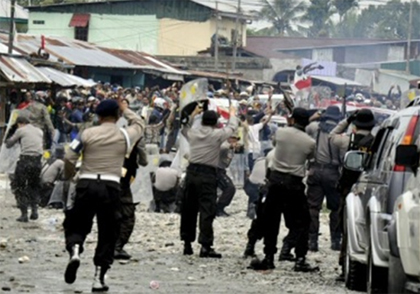
(JG) 51 Tortured by Indonesian Security Forces in Papua Violence: Elsham

51 Tortured by Indonesian Security Forces in Papua Violence: Elsham
Farouk Arnaz & Ronna Nirmala | November 29, 2011

The National Police said on Monday that it handed out punishments to a total of 17 officers for last month’s deadly crackdown on the Third Papuan People’s Congress but refrained from firing or demoting any of their own.

Ethics tribunals were held for members of the Mobile Police (Brimob) and the Jayapura Police believed to have been responsible for the incident, according to a National Police spokesman, Insp. Gen. Saud Usman Nasution.

Two Brimob officers were reprimanded, while two low-ranking enlisted officers were sentenced to 14 days detainment in a special cell.

In Jayapura, the capital of Papua, the chief of police at the time of the violence, Adj. Sr. Comr. Imam Setiawan, and seven of his subordinates received reprimands, while five enlisted officers were sentenced to seven days of detainment.

“They failed to follow proper police procedures in carrying out their security duties,” Saud said of those punished. “[Their actions were] excessive.”

No officer, however, was dismissed from the force or demoted for a violent incident that left at least three congress participants dead.

Sau d said the none of the officers would be charged with murder or face any other criminal charges. Police investigators, he said, put the victims’ times of death after the officers had left the scene.

He said one of the congress participants, Daniel Kadepa, had died from a stab wound, while the other two victims, Max Saseyo and Jacob Samansabra, could not be autopsied because they had already been buried by their families.

Separately on Monday, the Institute for Human Rights Study and Advocacy (Elsham) and the Communion of Churches in Papua (PGGP) said at least 51 people had been tortured by members of the military and police during and after the congress.

Congress participants told the groups they had been beaten and kicked repeatedly by security forces both at the congress site and while being transported to police headquarters. Some participants said they were beaten at the police station.

There were also reports of verbal abuse, the groups said.

One person said a policeman hit him in the head with the butt of an assault rifle. Another said he was shot in the buttock and thigh.

Also, a nearby monastery was looted and vandalized by security forces, the groups said.

The Rev. Wellem Maury of the PGGP said the National Commission on Human Rights (Komnas HAM) needed to take over the case and form a fact-finding team to investigate allegations of human rights abuses, torture and excessive use of force.

“Komnas HAM must also announce its findings to the Coordinating Ministry for Politics, Legal and Security Affairs so there is an open and fair trial,” he said.

International human rights groups like Amnesty International and Human Rights Watch, he added, must also be given access to those still being detained for treason, particularly Forkorus Yaboisembut, who was named president of an independent Papuan republic at the congress.

In a report released on Nov. 4, Komnas HAM alleged that the crackdown violated a raft of basic human rights and called on police to conduct a thorough investigation. It also said the central government should accelerate a dialogue with the Papuan people and do more for development in the province

Amnesty: ‘Slap on the wrist’ for police violence in Papua is accountability failure

These written warnings are a slap on the wrist. They do not provide accountability for the deaths of three people, or for the use of excessive and unnecessary force against a peaceful gathering.

Sam Zarifi, Amnesty International’s Director for the Asia-Pacific
Wed, 23/11/2011


The fact that eight Indonesian police officers involved in a violent crackdown on a peaceful gathering that left three dead have only been given written warnings, is a failure of human rights accountability, Amnesty International said today.The warnings were given after an internal disciplinary hearing on 22 November found that the officers violated the police Disciplinary Code.On the afternoon of 19 October 2011, police and military units violently dispersed peaceful participants of the Third Papuan People’s Congress, a nationalist gathering being held in Abepura, Papua province.

The bodies of Demianus Daniel, Yakobus Samonsabara, and Max Asa Yeuw were later found near the Congress area.

“These written warnings are a slap on the wrist.  They do not provide accountability for the deaths of three people, nor for the use of excessive and unnecessary force against a peaceful gathering,” said Sam Zarifi, Amnesty International’s Asia-Pacific Director.

Some 300 participants were arbitrarily arrested and ill-treated at the end of the Congress. Most were released the following day but six have been charged and are currently awaiting trial.

Amnesty International has called on the authorities to act on the findings of the Indonesian National Human Rights Commission (Komnas HAM) that rights violations were committed by security forces, and to prosecute those responsible.

“Even though the Indonesian authorities have a responsibility to prosecute human rights violators, this is yet another example of how in Indonesia, human rights crimes committed by police officers never reach civilian courts, but are dealt with through inhouse disciplinary hearings,” said Sam Zarifi.

“Internal disciplinary procedures are for dealing with minor offences, not serious human rights violations.”

Amnesty International also urges the Indonesian authorities to set up an independent police complaints mechanism to deal with human rights violations by police officers.

Current bodies such as the National Police Commission or the National Human Rights Commission do not have the powers to deal effectively with complaints about police abuses, nor to provide reparations to victims.

A Komnas HAM investigation team found a range of human rights violations were allegedly committed by the Indonesian security forces on 19 October, including opening fire on the peaceful Papuan gathering and beating and kicking participants.

It was reported on 7 November that the President’s office had rejected the Komnas HAM findings, stating that the police were still handling the case.

On 22 November, an internal police disciplinary hearing in Jayapura, Papua found the former Jayapura Police Chief Iman Setiawan guilty of violating the Disciplinary Code for “his inability to co-ordinate police officers under his command”.

Seven police officers from Jayapura City were also found guilty of violating the code for not “protecting and servicing the community with the best of their ability” and “degrading the honour and dignity of the state and the police”. They were all each given a written warning.

The disciplinary hearings for the seven police officers were reportedly held behind closed doors.

——————–

AI – Government must act on Komnas HAM’s findings of human rights violations at Papuan Congress

AMNESTY INTERNATIONAL  PUBLIC STATEMENT

8 November 2011

The Indonesian government must immediately act on the Indonesian National Human Rights Commission’s (Komnas HAM) findings that human rights violations were committed by Indonesian security forces at the Third Papuan Peoples’ Congress on 19 October 2011.

The Komnas HAM investigation team found a range of human rights violations allegedly committed by the Indonesian security forces, including opening fire on participants of the peaceful gathering and beating and kicking them. The Commission, which made its findings public on 4 November 2011, has called on the Indonesian National Police chief to investigate these human rights violations.

It was reported on 7 November that the President’s office had rejected the findings of Komnas HAM, stating that the police were still handling the case.

The Indonesian authorities must initiate an independent, thorough and effective investigation into the Commission’s findings. If the investigations find that the security forces committed unlawful killings or torture or other ill-treatment, then those responsible, including persons with command responsibility, must be prosecuted in proceedings which meet international standards of fairness, and victims provided with reparations.

The failure to bring perpetrators of these violations to justice in fair trials will reinforce the perception that the security forces in Papua operate above the law and fuel the ongoing climate of mistrust towards the security forces there.

On the afternoon of 19 October 2011, police and military units violently dispersed participants of the Third Papuan People’s Congress, a peaceful gathering held in Abepura, Papua province. The bodies of Demianus Daniel, Yakobus Samonsabara, and Max Asa Yeuw were found near the Congress area. An estimated 300 participants were arbitrarily arrested at the end of the Congress. Most were released the following day but six have been charged. Five people were charged for “rebellion” and “incitement” under Articles 106, 110 and 160 of the Criminal Code, while one was charged for “possession of weapons” under Emergency Law No. 12/1951.

According to Komnas HAM, the three people who were found dead had gunshot wounds on their bodies. The Commission was not able to confirm whether they were killed by the police or military, and have called for police forensics investigators to examine the bullets. Komnas HAM also found that at least 96 participants had been shot, kicked or beaten by police officers.

Komnas HAM further reported that security forces had raided a Catholic monastery and seminary. They shot at the building and broke the windows when the monks refused to hand over alleged separatists to the police. Many Papuans are now afraid to leave their homes because of the continued security checks and raids. The Commission also raised concerns that security forces had confiscated mobile phones, laptop computers, printers, cameras, cars, motorcycles and millions of rupiah in cash, and called for these items to be returned to the owners.

The Commission stated, contrary to statements by the Indonesian authorities that the Congress was illegal, that the Indonesian Minister of Law, Politics and Security had in fact directed the Director General of Regional Autonomy at the Home Affairs Ministry, to attend the Congress and give the opening speech.

The Commission made a series of recommendations including calling on President Susilo Bambang Yudhoyono to accelerate the dialogue with the Papuan people and to evaluate the deployment of a large security presence in the area.

The Komnas HAM investigation indicates that security forces appear to have violated the rights to life and to freedom from torture and other ill-treatment, both of which are non-derogable under the International Covenant for Civil and Political Rights (ICCPR), to which Indonesia is a state party.

By using unnecessary and excessive force and firearms against the participants, the Indonesian security forces have also violated the Convention against Torture and Other Cruel, Inhuman or Degrading Treatment or Punishment, which Indonesia has also ratified. Moreover, the right of all people in Indonesia to be free from torture and other ill-treatment is guaranteed in the Indonesian Constitution and the 1999 Law on Human Rights.

The actions of the security forces also appear to contravene the UN Basic Principles on the Use of Force and Firearms by Law Enforcement Officials which provide, among other things, that force should be used only as a last resort, in proportion to the threat posed, and should be designed to minimize damage or injury.

Kontras condemns police shooting of Freeport workers

Kontras, the Commission for the Disappeared and Victims of Violence has condemned the shooting of Freeport workers who were seeking negotiations with the management of the company. Since the commencement of the strike on 15 September there has been no sign that the management is seeking to provide the space for dialogue which could accommodate the interests of the two sides.

During an action on 10 October, the workers protested against the company for recruiting new workers to replace those now on strike. We have received information that some eight thousand workers  were involved in this action. They marched from the secretariat of the SBSI, the trade union, to the culverts, a distance of about 500 metres along a road that was six metres wide. A short distance away, hundreds of policemen were standing on guard.

The police tried to disperse the workers action as they were seeking to meet the management of the company.. Having failed to meet the management, the workers burned some vehicles believed to belong to the company. The police then opened fire on the workers: Petrus Ayamiseba  who works in catering at the company  was shot in the waist and died. Six others were wounded, Leo Wandagau, Alius Komba, Melkius Rumbiak, Yunus Nguliduan, Philiton Kogoya and Ahmad. Some of the policemen were also injured.

We regard the shooting and violence as an act of intervention and intimidation against industrial relations as guaranteed in Law13/2003 on Labour Affairs. The government, in this case the Department of Labour and Transmigration, should be playing a role to guarantee the basic rights of the workers as stipulated in that law, in particular with regard to legal procedures in article 137.

Furthermore, it is clearly stated that no one shall interfere with strike actions undertaken by the workers. (article 143) and workers on strike may not be replaced by other workers in any form whatsoever (article 144).

The presence and acts of violence by hundreds of police have damaged the efforts of the workers  to seek negotiations with the namagement. The police have clearly sided with Freeport  by undertaking  patrols and protection of the company and have been receiving monthly contributions (see letter from head of operations no b/918/IV/2011). The function of the police should  be to protect the people,

The shooting and acts of violence have also violated a number of regulations. Internally, the police should implement the regulations of the police  Furthermore the police have also violated a number of other laws such as the Human Rights Law of 1999 and Law 12/2005 on Ratification of the Covenant on Civil and Political Rights.

Kontras therefore calls on the police:

1. To conduct a thorough investigation into the shooting and acts of violence that occurred on 10 October,

2. To pursue legal procedures  that are impartial, credible, accountable and transparent with regard  to the shooting and acts of violence.

3. Should take steps to ensure that the police maintain their independence in all industrial relations disputes so as to ensure that they do not trigger acts of violence and other breaches of the law.

Jakarta, 10 October 2011

[Translated by TAPOL]

Indonesian security forces open fire on West Papuan striking miners – kill one

from our partners at Pacific Media Centre

http://pacific.scoop.co.nz/2011/10/indonesian-security-forces-open-fire-on-west-papuan-striking-miners-%E2%80%93-kill-one/

October 11, 2011
Papua mineIndonesian security forces face striking miners at Grasberg copper mine in West Papua. Photo: AP

Pacific Scoop:
Report – By Karen Abplanalp and PMC news desk

Indonesian security forces have shot and killed at least one protester and  wounded eight others when they opened fire on striking workers at Freeport-McMoRan’s gold and copper mine in West Papua, union officials said.

Union leader Manuel Maniambo said thousands of striking workers were trying to prevent replacement workers from heading by bus to the mine.

Blocked by security forces, some protesters began throwing rocks.  Three food delivery trucks were burnt, according to an Agence France-Presse reporter at the scene.

The security forces began firing shots and at least one man was killed, one more unconfirmed dead, one man critically injured and at least 8 men wounded.

The dead man has been identified as 30-year-old Petrus Ayemsekaba.

Indonesian security forces said six of their men were also hurt during the demonstration.

Around 9000 workers from the Grasberg mine in West Papua began the strike on September 15, demanding that their current minimum wage of less than NZ$2.50 an hour be raised to globally competitive levels.

Lowest wages
Union representatives say that Freeport’s workers, who are mostly indigenous West Papuans, receive the lowest wages of any Freeport mining facility in the world.

Concerns for the miners safety has been mounting recently as reports of intimidation of union officials were reported.

Union spokesperson Juli Parrongan said: “Our personal safety going on strike is under pressure of the PT Freeport Indonesia management.”

Union officials have been complaining that PTFreeport, (the Indonesian unit of US-owned mining firm Freeport McMoran Copper & Gold Inc.) management has been breaking Indonesian laws regarding fair strike actions since the strike began.

The union has said the striking miners have been intimidated into going back to work and to signing contracts.

Workers in Indonesia have been granted the right to strike, and under Indonesian law, they are able to do this free from intimidation.

Reinforcements sent
In preparation for the strike, military and police reinforcements were sent to Timika, the closest town to the mine.

The Papua Police dispatched an extra 114 police Mobile Brigade (Brimob) personnel to Timika with an additional 100 Brimob personnel from Jakarta to join 850 personnel from the Indonesian military (TNI)-police joint task force.

AFP quoted police spokesman Wachyono as saying:  “So far, five policemen suffered head injuries and another had his leg  injured from being pelted with stones by workers. They have been taken  to hospital.”

Police fired warning shots into the air after the striking workers  pelted them with stones, Wachyono said, in scenes witnessed by an AFP  reporter at the site.

The Indonesian military and the Indonesian police are now under the international spotlight in the hope that its track record of human rights abuses in West Papua are not repeated during the current miners strike.

As chair of ASEAN Indonesia, with its goal to make ASEAN a people-centered community, it has a good incentive to be seen as a democratic country, free of human rights abuses.

Karen Abplanalp is an Auckland photographer and also an AUT University postgraduate student on the Asia-Pacific Journalism course.


Create a website or blog at WordPress.com

Up ↑