KNPB: Action Appeals to DEMAND REFERENDUM IN WEST PAPUA

CRITICAL MEDIA ALERT

Action Appeals to DEMAND REFERENDUM IN WEST PAPUA

The West Papua National Committee [KNPB] will re-organize the people of West Papua to demand the UN to review the Act of Free Choice (Pepera) of 1969 and to held a referendum in West Papua as a solution to solve this political conflict in West Papua.

In its appeal, KNPB through vice chairman, Mako Tabuni as action coordinator appeals to the West Papuan people to understand and realize that the root problem of West Papua is the UN PEPERA 1969 which was not done through the standards and principles of international law, nor democratic, and very betrayed political rights of the people of West Papua.

Therefore, said Mako Tabuni, KNPB as the media expect the solidarity of the people of West Papua through prayer support, materials and attendance at a peace rally that will be held on Monday, May 2, 2011.

Buchtar Tabuni, Chairman ofr KNPB who is still languishing in jail through the papers stated that West Papua problem have to settle through democratic means which convey the demands through peaceful non-violent action, so he hopes that all the people of West Papua to involve as a form of commitment to end the suffering of the people of West Papua.

This rally will be followed in various areas throughout West Papua. In this action, masses is not allowed to carry sharp tools, alcohol, drugs, and the Morning Star flag. This action will be decorated with ornaments culture, graffiti from Papuan identity and demands in the form of Billboard, brochure and leaflets.

According to Victor Yeimo as the International Spokesperson for KNPB, this action will be done to encourage Indonesia and the international community to take immediate peaceful resolution of the issue of West Papua through international law, so that UN could held a referendum in West Papua. This process should be encouraged by the solidarity of the entire people of Indonesia and the international community who appreciate and care about and for human rights, justice and for the peace of the world.

For more info contact us at: papuaemergency@fpcn-global.org | +6282198854369

PAPUAN CHURCHES: DECLARATION REGARDING FAILURE OF THE INDONESIAN GOVERNMENT IN GOVERNING AND DEVELOPING THE INDIGENOUS PEOPLES OF PAPUA

REGARDING FAILURE OF THE INDONESIAN GOVERNMENT IN
GOVERNING AND DEVELOPING THE INDIGENOUS PEOPLES OF
PAPUA

THEOLOGICAL DECLARATION OF CHURCHES IN PAPUA
Today on January 26th, 2011 we, Leaders of churches in the Land of Papua, along with Christian congregations, gather to declare our stance and position with regard to the state of government and its development policies pursued in the Land of Papua since annexation of Papua by the Unitary Republic of Indonesia, specifically with the introduction of the Law No. 21/2001 regarding the Special Autonomy for Papua.

As Churches, we are deeply concerned over the condition of our peoples, especially the indigenous Papuans, owners of this land, whose fate has been cornered to uncertainty amid development policies staged by the Indonesian Government in the Land of Papua. Such development policy is more characterized by physical structures/infrastructural development and to promote the interests of Indonesia in the Land of Papua.

The implementation of Special Autonomy for Papua has been inconsistent and inconsequent is a strong indication of insincerity of the Indonesian Government which led Papuans to view that OTSUS has FAILED. MRP, as a manifestation of the Special Autonomy with its members hastily selected and further exacerbated with the government’s ignorance of Ii point recommendations produced by the grand meeting of MRP (Papuan Peoples’ Assembly) itself, is therefore considered as an insult to the people of Papua, as people created in the image of God. The Churches also question the letter issued recently by the Minister of Home Affairs No, 188.341/1 l0/SJ regarding clarification pertaining to Special Regulation for Papua Province dated 13 January 2011 which further annihilate the right and existence of indigenous Papuans in their own motherland.

We see such situation as Kairos, a momentum for Churches to speak and express our stance and deep concerns in the form of the following Theological Declaration.

First, we are convinced that these processes repeat the same old process of annexation of Papua into Indonesia which is legally and culturally a flaw. The process of the Act of Free Choice (Pepera) in 1969 has been the root of problem on democracy and legality for the people of Papua. Ever since its integration into Indonesia, Papua has become a troubled territory under the authority of the Indonesian government.

Second, Papuans have undergone a ‘Silence history of suffering’ or memmoria passsionis leading to Genocide. The discourse of genocide has long been voiced by so many observers who are deeply concerned over the very existence of Papuans. The term genocide perhaps does not meet the criteria set forth by the UN, or other nations, or by Indonesia. But from our own view as victims, genocide is indeed taking place through the conditioning staged by Jakarta in the forms of ideology and development policies that are against the indigenous Papuans. Transmigration policy and unrelenting military operations are, in our view well-planned programs to eventually annihilate indigenous Papuans. Papuans are positioned as “the other” and as such warrant surveillance, control, and civilization. Papuans are not equal citizens of Indonesia. Some observers in Jakarta view this as an internal colonialism or disguised slavery against Papuans.

Third, we, churches of Papua acknowledge our own failures and sins for being silent for too long over demonic and destructive nature of the development policy and modernization on indigenous Papuans, which according to observers in Jakarta as internal colonialism and disguised slavery. Papuan churches have misarticulated the Scripture which states: “the government is the Lord’s representative on earth, worthy of respect.” Up until now, this has caused us incapable of playing our prophetic role.

Fourth, to respond to the challenges faced by Papuans, we, the churches are determined to return to our roots, to our Christian traditions, namely to the Scripture and church history. Thus, we view the sufferings of our Papuan people from the biblical perspective (Matthew 16:3b) “signs of times” and see it as theological and missiological challenges. This implies that the Lord is sending us, Papuan churches to His people who are traversing a dark history of suffering and oppression. It is therefore, as churches in Papua we want to hear to regularly raise questions and communicate with the Lord “what do you have in mind with regard to the behavior of those who indulge in disguised slavery against our people? Do you agree and applaud them?”

Fifth, consequently we want to view this critical position of churches in Papua in expressing the grievances of Papuans in the land of Papua is an integral part of our calling to spread the good News commanded by the Holy Scripture. The Scripture and church history are our basis for action. In this mission, the church is sent to shepherd the Lord’s people, keep the image of the Lord to be free from abuse (John 10:11; 21:12, 16, 19). As shepherds, we are obliged to listen to the voices of our sheep (congregation); in this light we raise our voice because “our life boat is drowning; the candle of our people is being put off in the name of development and territorial sovereignty.”

Sixth, with regard to development policy and current government administration, we hereby declare: (a) that the Indonesian government has FAILED to promote the welfare of indigenous Papuans especially since the Special Autonomy was passed. Therefore we urge the government to immediately halt the whole process of election of members of the MRP (Papuan People’s Assembly) taking place currently and respond to the 11 point recommendation made by the MRP grand meeting; (b) and as a solution, we urge the Indonesian government to open itself and hold a dialogue with indigenous Papuans to be mediated by a neutral third party; (c) we are appalled by the attitude exhibited by indigenous Papuan state officers who are ignorant of the rights of their own people.

Seventh, we urge our Papuan communities to stand up, to work on your own salvation, and express the truth before the present tyrant state authorities, who is on a rampage of internal colonialism, ethnic cleansing (genocide), and disguised slavery against your own Nation.

Eight, to our Papuan communities, in Indonesia, and anywhere else, do pray for us in solidarity to make us stand firm in embracing today’s challenges in Papua that are full of pain and tears.

End of this declaration.

Leaders of Churches in Papua

Signed
Elly D. Doirebo M.Si
Deputy Chairperson of Synod of Evangelical Christian Church of Papua

Rev. Dr. Benny Giay
Chairperson of Synod of Papuan Christian Church

Rev. Socrates Sofyan Yoman MA
Chairperson of Fellowship Papuan Baptist Churches


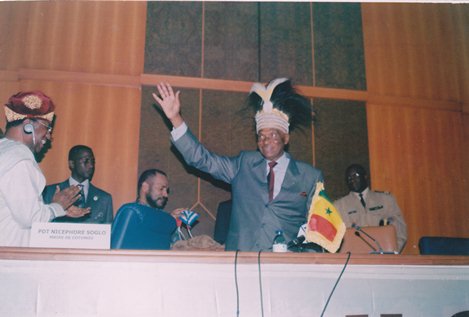
President of Senegal – “West Papua is now an issue for all black Africans”

The President of Senegal, Abdoulaye Wade,  has become the first African leader to publicly back West Papua‘s bid for independence, stating that ‘West Papua is now an issue for all black Africans’.

His comments came last week during a conference in Senegal’s capital Dakar, attended by Benny Wenda, a West Papua independence leader who was granted political asylum by the British Government in 2003.

Benny Wenda addressed the audience, telling them about the situation in West Papua and his own struggle to bring independence to his homeland.
Following his address he presented the President with a Papuan headdress, and was warmly embraced by him. The President then addressed the audience, urging all African nations to take attention to the West Papua issue and do whatever they can to help.

Senegal is a country south of the Sénégal River in western Africa with a population of over 15 million. The current President was re-elected to power in 2007.

Vanuatu's sellout to Indonesia disappoints West Papua at PIF

Opinion

August 17, 2010

Peter Woods

The conclusion of the Pacific Islands Forum has left a great sense of disappointment. There was every reason to think that Vanuatu would be the prominent voice in the forum for the West Papuan demand for a seat at the table. As recent as June 19 the Vanuatu Parliament passed a motion to bring the matter of West Papua to the UN this year.

All the public reports leading up to the forum, and the private assurances to the lobbying being done by the Vanuatu Free West Papua Association even up to the Prime Minister, gave every indication that West Papua  would be high on the agenda, and even that the representative West Papua delegates would at least be given observer status.

In his opening speech, incoming forum chairman Vanuatu Prime Minister Edward Nipake Natapei, said: ‘‘We need to be talking much more about how we can bring hope to the Pacific citizens who are struggling to find employment; who are without political freedom . . .’’

What happened? Nothing. Silence. No delegate raised any matter publicly concerning West Papua. All the talk was that politically, the matter of Fiji dominated, and that this shut down any further debate about West Papua. Three questions arise from this: Is this the real reason why West Papua was not promoted? If not what was the reason? Does this failure mean that Vanuatu’s sponsorship is now a lost cause for the West Papuan independence movement?

The real reason West Papua became the elephant in the room at the forum is that Natapei is obviously under great pressure from foreign powers — especially Australia, Papua New Guinea and Indonesia. Australia continues to advocate the territorial integrity of the Indonesian republic and the necessity of Special Autonomy working for West Papua. Australia is also the major development donor for the country, and that must come with some loyalty tag.

PNG, together with Solomon Islands, supports Fiji, contrary to Vanuatu who is taking the Australian/New Zealand stance. Indonesia, for its part, is increasingly muscling into the Pacific – it just supplied Vanuatu with new uniforms for its police force, and increased its presence from the usual six to 48 members at the most recent forum. These came in two waves, on August 1 and August 5, the last delegation including a West Papuan, Dr Felix Wainggai, an adviser to Indonesian President Susilo Bambang  Yudhoyono on development on East Indonesia.

This probably proved too much fire-power for the Vanuatu PM, who afterwards on radio claimed that his silence on West Papua was due to procedural matters to do with the Melanesian Spearhead Group.

Another angle on Vanuatu’s silence may have to do with the internal or external manifestations of the West Papuan independence groups themselves. A delegate to the PIF told Jacob Rumbiak, foreign affairs spokesman for the West Papuan National Authority (WPNA) and myself that the perception from inside the Vanuatu Foreign Office is that the West Papuan independence movement is still divided.

The reality on the ground, however, is that there is a growing consensus from among the majority of activist groups, and more importantly between the Presidium and the WPNA — the transitional government increasingly recognised across West Papua as a credible political next-step to the current frameworks within West Papua.

The ire has been raised, however, of the pro-West Papua council of chiefs and various members of the coalition. They see this as a cave-in and Natapei and his government may not last.

All may not be lost then regarding Vanuatu’s advocacy role for its Melanesian fellow countrymen in West Papua. PIF 2010 may prove a Pyrhhic victory for the countries leaning on Vanuatu. The groundswell of opposition is rising within Vanuatu.  This will either galvanise the Natapei government or replace it with a coalition really dedicated to proceed on the West Papuan issue. Vanuatu’s reluctant neighbours could indeed end up with a little mouse that is roaring in the Pacific.

Peter Woods spent five years in West Papua from 1978 to 1983.

West Papua political prisoner Filep Karma warns of the danger that new US-Indonesia ties present in secret interview for Al-Jazeera

From Al-Jazeera

Around 200 people raised the Morning Star flag in Indonesia’s Papua province in December 2004, in a symbolic move to mark the Papuan independence campaign that has been pursued since 1962.

Filep Karma was arrested at that ceremony and jailed 15 years for flying the outlawed Papua flag.

And he warns, in a secretly recorded interview with Al Jazeera, that the decision to renew military co-operation between the US and Indonesia could have dangerous consequences for the Papuan people.

Watch the interview here
http://english.aljazeera.net/video/asia-pacific/2010/07/201073124515884622.html

Create a website or blog at WordPress.com

Up ↑