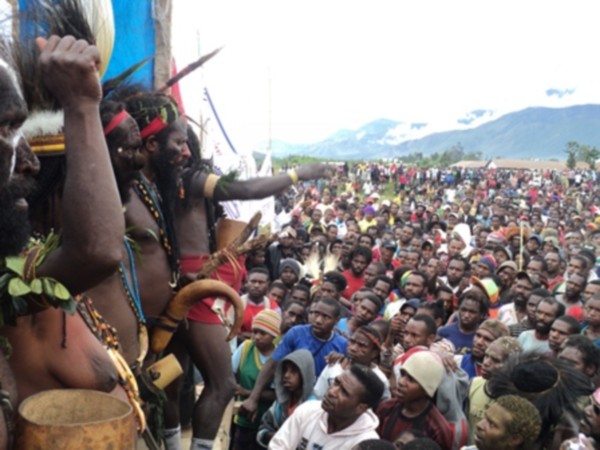
Strike pressures PT Freeport Indonesia into serious negotiations

Alex Rayfield and Claudia King11 August 201

Indigenous Papuans are waging a four-decade long nonviolent struggle for independence from Indonesia. At the heart of Papuan grievances lies Freeport, the world’s largest gold and copper mine, owned and operated by US based company Freeport McMoRan and their Indonesian subsidiary PT Freeport Indonesia.

Perched on the western rim of the Melanesian Pacific, adjacent to independent Papua New Guinea is West Papua. Here, in a land so diverse that you can stand on a tropical glacier 15,000 feet high and peer down on the equator, indigenous Papuans are waging a four-decade long nonviolent struggle for independence from Indonesia. At the heart of Papuan grievances lies Freeport, the world’s largest gold and copper mine, owned and operated by US based company Freeport McMoRan and their Indonesian subsidiary PT Freeport Indonesia.

Recently trouble at the mine flared up again, as around 12,000 Indonesian and Papuan Mine workers and contractors went on strike, joined by local indigenous leaders. Walking off a job has never been so hard, Yan Ampnir told us. When he decided to join the mine workers’ strike in the remote Indonesian province of Papua, it was not a simple case of heading out the gate and driving home to his family. It involved a gruelling 40-mile trek down a roller-coaster road that plunges 8,400 feet down from the vertiginous cloud-cloaked mountain walls of Tembagapura, the remote mine base camp, to the sprawling swamp lowlands of Timika.


SPSI collection. Freeport Mine.

Tembagapura is a company town. The only people who live there are mine workers. After long shifts in the Grasberg open pit or in the underground mine, workers are bussed on four-wheel drive trucks back to Timika or the US lookalike suburb of Kuala Kencana, replete with shopping malls, manicured lawns and street lights, all carved out of the middle of the jungle. So, when the company refused to bus the workers outside the Indonesian military– guarded mine area, Ampnir and his compatriots picked up their bags and started walking.

Seventeen hours later the first group arrived in Timika; tired, wet, cold and hungry. Eight days later the strike ended. In the process some 12,000 mine workers (of a total workforce of 23,000) halted production at the world’s largest gold and copper mine, inflicting a loss of USD$95,000 per day on US-based Freeport McMoRan, Indonesian subsidiary PT Freeport Indonesia and their Anglo Australian partner, Rio Tinto.

After a quick search on the Internet, Albar Sabang, the local union branch secretary, hands us an excel spreadsheet. On it is a list of pay scales. Sabang is a mechanic who fixes heavy machinery like bulldozers and excavators. He has worked for PT Freeport Indonesia since 1994 and earns $3.00 per hour. He is one of the highest paid local employees out of a group PTFI calls “non-staff”. Others earn as little as $1.80 per hour, a wage that rose 98% after a similar workers strike in April 2007.

Sudiro (his only name) is a softly spoken tall Javanese man, unassuming in person. He is the local SPSI (Seluruh Pekerja Serikat Indondesia – or All Indonesian Workers Union) chair of the Freeport Mine Workers Union, an affiliate with the national SPSI network. Recently sacked by PT Freeport Indonesia for organising workers, he only just got his job back. “Of all the Freeport mines”, Sudiro tells us, “PT Freeport Indonesia is the most profitable. It has the lowest production costs. But workers are paid the lowest salaries. We are even paid less than Freeport mine workers in Mongolia and the Democratic Republic of Congo. That’s not right.”

A history of local grievances 

Freeport is emblematic of much that is wrong in West Papua.

The company’s Contract of Work was signed in 1967, two years before the Act of Free Choice was concluded, a referendum that was supposed to give the indigenous West Papuans a chance to say whether they wanted to be independent or part of Indonesia. In fact, there was no vote. Instead, 1,022 West Papuans, less than 0.01% of the population, were corralled into camps and told to “vote” for integration with Indonesia or have “their tongues cut out”. But it was not just the Indonesian government that consented to democratic fraud writ large; the US, Australian and European governments were also not prepared to contest the election or risk stability in the region for what one US Embassy source at the time called a handful of “Stone-Age illiterate tribal groups”.


SPSI collection.Strike Leaving Tembagapura.

The biggest prize of all was Freeport. Suharto declared the company a national asset and instructed the military to guard the mine, which led to a long history of human rights violations, including un-investigated mass killings, theft of Papuan land and massive environmental degradation, all of which has led to ongoing violent and nonviolent resistance.

This was the era before the notion of “free, prior, and informed consent” became best practice for extractive industries. According to local indigenous landowners, they still feel that they have not been consulted or their rights respected.

As the Amungme people’s sacred mountain is consumed, tailings are dumped in the Ajkwa River at the rate of 200,000 tons a day. The result: over 30,000 hectares of rainforest have been wiped out and huge levee banks built to stop Timika from being smothered by sludge waste. In the process, Freeport became a lightning rod for all Papuan grievances.

Although the company tried to respond to local indigenous West Papuan grievances by hiring Papuan staff and redirecting 1% of the profits to support members of the local seven tribes, new problems continue to be added on top of old, unresolved issues. The local tribes (a number of whom work in the mine) and Freeport mine workers from elsewhere bring in massive profits for the company. They work under extreme conditions at high altitude but feel like they have little stake in the company and few worker benefits.

“We are not valued as human beings. We are treated as an instrument of the company. Our goal is to get to a position where we are treated as human” says Sudiro.

According to miners interviewed in July 2011, many workers are forced to take out bank loans to pay for basic needs and to support their families. After retirement, some must seek alternative types of income. Yet when workers attempt to raise these issues with Freeport management, they have received warning letters from them in return.

“It seems like the company sees us as the troublemakers. But,” says Sudiro, referring to workers’ contributions to gold and copper production, “we are the solution-makers.”

SPSI finds its teeth 

SPSI PT Freeport Indonesia is one local branch of the national labour union federation of Indonesia. The organization has represented PTFI mine workers in 16 Collective Labor Agreements (CLA) dating back to 1977. But until recently it functioned as little more than a rubber stamp for company policies.

Freeport has a history of suppressing workers’ rights and union organizing. Under Suharto, independent labour organising was prohibited. Those that tried were often killed or spent years in jail. But over the past decade, as political space has slowly opened up, Sudiro and other workers have been quietly organizing. But because of the closed-off nature of West Papua, they have done so through exchanges on the Internet, educating themselves on best practice and lessons learned from unions in other parts of the world. “We particularly admired the quiet, peaceful way Japanese workers raised their grievances,” said Sudiro.


SPSI collection. Strike Congregate at Tembagapura.

SPSI PT Freeport Indonesia’s mission and objectives are limited to workers’ rights and their tactics are exclusively nonviolent. But they continue to be associated with violence and separatism. “We use a peaceful way. We don’t want to get into the political arena, this is not our area. We just want to struggle for our rights, and to have the same rights as workers elsewhere.”

Campaigns to educate fellow mine workers about their rights and the role of unions in protecting workers seem to be paying off. Reflecting on worker participation in the recent strike, Sudiro said, “The workers finally opened their eyes and minds to the situation. The company cannot stop this. We have woken up. We will never go back to how we were treated before the strike.”

Nevertheless, SPSI Freeport members continue to face threats and intimidation from the company. When two of the union members travelled to Jayapura to seek advice from Papuan leaders, they were followed by Indonesian security forces who have long been paid by Freeport to guard the mine.

“The company does not like us organizing for workers’ rights, but we are not doing anything wrong. The strike is an action that is guaranteed by the law. Indonesia is a member of the ILO and the ILO is very clear. We have the right to form a union and we have done so according to Indonesian law” says Sudiro.

Article 104 (1) of Indonesian National Law Number 13, 2003 explicitly states: “Every worker/ labourer has the right to form and become a member of a trade/ labour union.”

The decision to strike 

The company has utilized a range of “dirty” tactics to avoid dealing with SPSI demands over wages and conditions. One of the most galling for mineworkers was the creation of a ‘new’ union aimed at pushing out SPSI’s union. The new union was created in response to SPSI Freeport mineworkers’ agitation around wages and conditions.

At the same time the company declared the SPSI Freeport Mine Workers Union – an organisation that has grown from a low of 4,000 to 8,200 members – illegal, and promptly fired six of the leadership including Sudiro himself. The only problem was this ‘union’ had no members. Its board was appointed by Nur Hadiah, a lawyer based in Jayapura, in violation of SPSI regulations. “It was a completely fake union” said Sudiro.

The reaction from the workers? An overwhelming decision from all of the 254 union representatives to strike and nearly 100% participation from SPSI Freeport union members. “We were up against a wall. We had no other choice,” Sudiro said.

But the strike was not just about wages. “We wanted the company to recognise the union, the right to freely organise, and to reinstate the six SPSI Union leaders who were dismissed by Freeport for conducting union business” said Sudiro.


SPSI collection. A female striker
After more than a week of strikes and continuous demonstrations, on the evening of July 11 PT Freeport Indonesia gave in to SPSI’s

demands. They reinstated the union leaders without any deduction in salary, agreed to pay the wages of all striking workers for the duration of the strike, agreed to recognise SPSI Freeport Mine Workers Union as the sole legal representative of Freeport mine workers and also agreed to enter into Collective Labor Agreement negotiations. Those negotiations opened Wednesday July 20 at the Freeport-owned Hotel Rimba Papua in Timika. They are still continuing and according to Company sources are not expected to finish until 19 August. Both workers and management are remaining tight-lipped about their progress.

The seven tribes

The current  (seventeenth) Collective Labor Agreement negotiations are different. They are not only about wages and conditions. They also concern the company’s relationship with local landowners, the Amungme and Kamoro, as well as five other major highland tribes – the Dani, Moni, Damal, Mee/Ekari and Nduga.

Amungme tribal elder Hengky Uamang speaks to us at one of the SPSI union leaders’ rented duplex house in the back lanes of Timika. His voice is quiet and one of his compatriots translates from Amungme into Indonesian so that we can understand what he is saying. His message is simple and profound.

“My heart is broken. It is as if we are not human beings but a piece of gold to be consumed. I am gold but I get no benefit.” Tears slowly roll down his face.

Others in the crowded living room become angry. “Does Moffet (the US Chair of Freeport McMoRan) have no shame?” Jecky Amisim rhetorically asks. “Does he not fear God? Don’t you people in America know that if you come to someone’s place and want to take something, you have to ask first?”

The seven tribal leaders nod in agreement. Sudiro tells us: “If these negotiations fail, we will see it as a death of democracy.”

“If Moffett and Armando Mahler (the president of PT Freeport Indonesia) can’t help us, if the wealth of these mountains do not bring a benefit to us the local tribes, the workers and the people of Papua,” says Mr. Amisim, “then it is better we just kick this company out.”

The strike may be over,  but as union and management begin month-long negotiations over their biannual Collective Labour Agreement, the company continues to face the possibility of continued disruption from disgruntled workers and restive landowners seeking significant changes after years of opposition to Freeport mining.

“This article was originally published in the independent online magazine www.opendemocracy.net

About the authors
Alex Rayfield is a freelance journalist based in Timika
Claudia King is a freelance journalist reporting from Timika


Imparsial: Only a state can challenge the Act of Free Choice

Benny Wenda at the IPWP launch
Image via Wikipedia

>Bintang Papua, 10 August 2011
[A very lengthy report, abridged in translation by TAPOL]

Only a state can challenge the Act of Free Choice

Jayapura: Although no official report has yet been received about the
results of the International Laywers for West Papua conference in Oxford
on 2 August with regard to challenging the 1969 Act of Free Choice
(pepera) at the International Court of Justice, Imparsial-Jakarta says
that a challenge can only be successful if it is made by a state, not
by an organisation like ILWP.

Poengki Indarti, the executive director of Imparsial, an organisation
that frequently draws attention to the activities of the Indonesian
military in West Papua as well as to the human rights situation there,
said that the ILWP is not a state and furthermore, pepera was
legitimised by the United Nations while virtually all countries
recognise that West Papua is part of NKRI, the Unitary State of the
Republic of Indonesia.

She said that what Benny Wenda is trying to do via the ILWP and the
IPWP is to win as much support as possible from countries around the
world which show an interest in West Papua’s secession from Indonesia.
However, this is very difficult indeed because all countries with the
exception of Vanuatu support the incorporation of West Papua into
Indonesia. ‘What they are trying to do is get the support of some
hopefully sympathetic states. I dont think people should overact to the
decisions adopted by the ILWP conference,’ she said.

However, Yan Christian Warinussy, executive director of Papua-based
human rights NGO, LP3BH, said that any challenge with regard to ‘legal
standing’ would depend on the interpretation of the judge before whom
the case is brought. He said: ‘As regards any efforts to challenge
pepera that may be made by the ILWP, anyone and in particular the
Papuan people could submit a challenge because it relates to their
rights as Papuans . If in the opinion of the judge before whom the case
is brought, an organisation such as the ILWP has been granted the
necessary powers by the Papuan people, the case can of course be
accepted.’ He went on to say that it would be much more strategic for
the challenge to be made first of all at the national level because
Indonesia has its own legal system and it is not certain that a
decision would be adopted by the International Court in a case
connected with a sovereign state like Indonesia.

‘Therefore, I would press for the challenge to be made within the
Indonesian legal system which could be done by the Papuan Customary
Council (Dewan Adat Papua) or another organisation that has been granted
the necessary powers,’ said Warinussy who received the John Humphrey
human rights award in 2005.

The Imparsial director-general said that she thinks that all
stakeholders in Papua should focus primarily on peaceful endeavours and
dialogue to find a ‘middle way’. If everyone sticks to their own
opinion, the ones whose interests are damaged are the Papuan people who
do not have a very good understanding of political affairs. (sic).
Meanwhile, she drew attention to the long drawn out Papuan problem with
many actions being taken about the unsatisfactory implementation of
OTSUS (the special autonomy law), many acts of violence that have
resulted in civilian lives being lost, as well as actions calling for
independence, all of which point to the lack any serious attention from
the central and provincial governments. She said that the Indonesian
government is half-hearted about Papua and seems to want conditions in
Papua to stay the same as they are now. ‘We all hope to see the
government pay serious attention to Papua.’ She said it seems as though
the government just wants to keep the conflict in Papua going. It shows
no interest in enacting regulations or laws and seems to be acting at
cross purposes, with the government frequently pursuing the repressive
approach while the military have said that that they have made drastic
changes in the way they handle Papua. However, people feel that the
situation is no different from what it was in the past.

‘In the many cases of violence, it is the task of the police to
investigate who was responsible but nothing concrete has happened, while
Papuans are asking whether it was the real OPM or a fictional OPM that
certain state institutions are keeping alive. Everyone is looking to
the government to explain things because as yet the Papuan question
has not been resolved whereas the government is not serious about
solving it.

A case in point is what Benny Wenda is doing in the UK. Although Poengky
Indarti has checked the Interpol list of fugitives and saw that he is a
fugitive registered with Interpol, he is nevertheless free to seek
support overseas while no action is taken against him either by the
Indonesian government or the Indonesian police. The government is
deliberately keeping the Papuan problem hanging in the air, from the
polemics about the failure of OTSUS, to the breaches of security and the
shooting incidents as well as the calls for independence that have
caused much anxiety among the civilian population, whereas the
government still doesnt regard Papua as a problem that is in need of
solution.

The legal road for West Papua: a dead-end?

The legal road for West Papua: a dead-end?


Jason MacLeod[1] and Brian Martin[2]


Legal actions might assist the West Papuan struggle for freedom, but this approach is extremely difficult and entails significant risks. Using the courts plays to the opponents’ strengths: it may not do much to erode Indonesian rule in West Papua, and risks reinforcing it. Priority needs to be put on nonviolent strategies involving large numbers of ordinary people, particularly inside West Papua.

Risks of a legal strategy

Firstly, using legal channels requires considerable money and resources and thus restricts involvement by ordinary people. Even with high profile pro-bono support, any legal case will be extremely expensive. Although West Papua is rich in natural resources, the movement is short on cash. The Indonesian government will do all it can to delay and derail the case going to court, both in Indonesia and internationally. If the case does make its way to the courts, the Indonesian government will spare no expense in fighting it. Legal battles are not won solely by money, but it definitely helps. In court, the movement will be fighting an opponent with more money and resources.

Secondly, a legal strategy favours the powerful. In terms of access to people of influence on the world stage, the Indonesian government has more power than the movement. Government power is not the only kind of power operating, but it is worth factoring the Indonesian government’s considerable international influence into an assessment of whether to pursue legal actions or how such a strategy might be strengthened.

Thirdly, there are technical legal issues. There is a risk that the case might never be heard simply because the court accepts objections such as that the plaintiffs are mischievous and or the court does not have jurisdiction. Even if the case does get to an international court there is no guarantee the challenge will be successful. A failure to win the case, even on technical grounds, could undermine the cause for self-determination by giving a legal stamp of approval to the Act of Free Choice.

Fourthly, even if the case is successful, there is no guarantee of any subsequent political change. This is the lesson from many other struggles relying on courts and official bodies.

Consider the United Nations. There have been numerous resolutions by the UN General Assembly and Human Rights Commission condemning the Indonesian government’s invasion of East Timor and the subsequent human rights violations committed under the occupation. All were ignored by the Indonesian government, some for decades.

In the 1990s, the International Court of Justice was asked to rule on the legality of nuclear weapons under international law. The court gave an opinion, some parts of which supported the goals of anti-nuclear campaigners. However, no government with nuclear weapons took any substantial action, such as moving to disarm, in response to the court opinions.

The situation is similar in West Papua. The Indonesian government’s occupation is clearly illegal, as Saltford[3] and Drooglever[4] have shown convincingly. The Indonesian Government will be unlikely to give up its rule of West Papua just because an international court rules the occupation illegal.

Finally, a legal strategy could act as a dampener on dissent inside West Papua. It could reinforce the belief that Papuans themselves don’t have to actively struggle for their own liberation, because powerful outsiders will save them.

Courts are examples of “official channels” – and they do not work well when dealing with powerful perpetrators, such as governments. People often believe that official channels provide justice, yet they heavily favour those with more money and power. Official channels are usually very slow, can be expensive, and restrict opportunities for non-experts to participate. Issues are taken out of the public domain and moved it to more restrictive arenas, such as courts, that are usually less sympathetic. Even when official channels come up with good recommendations, governments often do not act on them.[5]

The case of West Papua is essentially about power politics and vested economic interests. Therefore, winning in the court of public opinion (in other words building a powerful social movement) and raising the political and economic costs of the Indonesian government’s continued occupation will be more decisive than a legal victory. However, the two strategies could be complementary.


Strengthening a legal case through building a people’s movement

In the past 25 years, international boundaries have been dramatically redrawn and numerous countries have become independent. On 9 July 2011, South Sudan became the world’s newest state. Before that Kosovo and East Timor became independent. During the late 1980s and early 1990s several republics of the former Soviet Union also became independent. The overwhelming majority – with the exception of Romania – did so through nonviolent means. Some, like Estonia, Latvia and Lithuania, won national liberation even though half their population was made up of Russian immigrants. What was decisive about all these movements was that they undermined the occupiers’ legitimacy and disrupted their rule. That outcome can be achieved through violent or nonviolent action.

By nonviolent action we mean sustained, unarmed and extra-parliamentary collective action in the pursuit of political and social goals. Nonviolent action has been used in dozens of countries. Also called people power or civil resistance, nonviolent campaigns have ousted dictators, resisted coups and been effective in challenging racism, exploitation and other injustices.[6]

The history of the international movement against nuclear weapons shows that governments have been most constrained when protest is vigorous. When protest has waned, military races have accelerated.[7]

Recent research into  self-determination struggles waged between 1900 and 2006 shows that struggles for independence or national liberation and territory are very difficult to win, even more difficult than removing a dictator like Suharto or Mubarak. Chenoweth and Stephan compared whether armed or nonviolent struggle was more likely to produce self-determination outcomes (like independence). They found that violent and nonviolent struggles had roughly equal chances of succeeding – about 25%.[8]

With equal odds of success, nonviolent struggle is definitely more desirable: it causes less loss of life, allows for greater participation of ordinary people, and lays the basis for a free and open society after independence. In contrast armed struggle results in higher casualties, less participation and a greater likelihood of post-independence repression. Mixing armed and nonviolent struggle tends to contaminate the gains won by nonviolent struggle.

So what helps these movements succeed? Specifically, what might improve the prospects of the West Papuan freedom movement? Here are some possibilities that could be part of a nonviolent struggle.

  1. Make the violence of the Indonesian government and the nonviolent resistance of the Papuans visible to transnational networks that mobilise on behalf of Papuans.
  2. Expose the failure of governance in West Papua by withdrawing support for, or co-opting, state institutions like the Majelis Rakyat Papua (MRP), Dewan Perwakilan Rakyat Papua (DPRP – the two Provincial parliaments in Papua Province and Papua Barat Province), local parliaments (DPRD – Dewan Perwakilan Rakyat Daerah) and the civil service.
  3. Use nonviolent sanctions to impose economic and reputational costs on transnational corporations in West Papua.
  4. Take the struggle to mainstream Indonesia and the societies of the Indonesian government’s elite allies, for example Australian and British governments and corporations.
  5. Coordinate with transnational activist networks to alter the Indonesian government’s willingness to maintain the occupation and to affect its capability to do so.

When it comes to challenging the Indonesian government’s legitimacy in West Papua, it is also vitally important that local Papuan and transnational solidarity movements continue to expose not only the historical denial of self-determination but also the ongoing failure of governance. This includes collecting and publicising the testimonies of surviving participants in the Act of Free Choice, participating in strikes, boycotts, noncooperation with Special Autonomy, establishing autonomous cultural, religious, economic and political institutions and other forms of mass based nonviolent challenges to Indonesian rule. Student and youth groups in particular have taken many initiatives; other groups can become more active, including churches, members of the MRP, members of the Papuan civil service, teachers, health workers, Papuan workers in resource extractive industries – and people like those gathered here today.

A legal strategy has the potential to strengthen the case that Indonesian rule in West Papua is totally illegitimate, but only if, at the same time, Papuans themselves are actively refusing to cooperate with, and nonviolently disrupting, Indonesian rule in West Papua. Faced with an adverse legal opinion, but without sustained and widespread protest, the Indonesian government will simply and legitimately point out that Papuans are participating in elections, that local Papuan politicians are in the positions of Governor and Bupati, that the MRP, provincial and local parliaments represent Papuan interests, and that there is a large Papuan civil service running the country.

A legal strategy without a powerful people’s movement is like a bird of paradise with only one wing. It looks appealing but it won’t fly.


[1] Solidarity activist, civil resistance educator and doctoral candidate at the School of Politics and International Studies at the University of Queensland.

[2] Professor of Social Sciences, University of Wollongong, Australia, http://www.bmartin.cc/.

[4] Pieter Drooglever, An Act of Free Choice: Decolonisation and the Right to Self-Determination in West Papua, Oxford: Oneworld Publications (2009)

[5] Brian Martin, Justice Ignited: The Dynamics of Backfire, Lanham, MD: Rowman & Littlefield (2007); “Backfire materials,” http://www.bmartin.cc/pubs/backfire.html.

[6] Kurt Schock, Unarmed Insurrections: People Power in Nondemocracies, Minneapolis: University of Minnesota Press (2005); Gene Sharp, The Politics of Nonviolent Action, Boston: Porter Sargent (1973); Adam Roberts and Timothy Garton-Ash, Civil Resistance and Power Politics: The Experiment of Nonviolent Action from Gandhi to the Present, Oxford: Oxford University Press (2009).

[7] Lawrence S. Wittner, The Struggle against the Bomb (3 volumes), Stanford, CA: Stanford University Press, 1993–2003).

[8] Erica Chenoweth and Maria Stephan, Why Civil Resistance Works: The Strategic Logic of Nonviolent Conflict, New York, NY: Columbia University Press (2011).

Indonesia food security project threatens Papuan way of life – activists

http://www.trust.org/alertnet/news/indonesia-food-security-project-threatens-papuan-way-of-life-activists

Source: Alertnet // Thin Lei Win

05 Aug 2011 14:07

NOTE: West Papua Media proudly provided fixing services for Reuters AlertNet for this article and further investigations.  

A member of the Koroway tribe walks up a ladder to his house at a forest nearMerauke city in Indonesia’s Papua province in this May 18, 2010 handout photo. REUTERS/Suntono-Indonesia statistic agency/Handout

By Thin Lei Win

BANGKOK (AlertNet) – Indigenous Papuans are at risk of further marginalisation and the forests and ecosystems on which they rely face destruction due to an ambitious food security project by the Indonesian government, activists say.

Under MIFEE (Merauke Integrated Food and Energy Estate) plans, 1.63 million hectares of forest which forms the basis of life for some 200,000 indigenous people in the Merauke area would be used to grow rice, palm oil, soya bean and corn among other crops.

Indonesia is seen as a key player in the fight against climate change and is under intense international pressure to curb its rapid deforestation rate and destruction of carbon-rich peatlands.

Activists accuse the authorities of not sufficiently consulting the Malind Anim people about the project, which they say pose a double threat to local Papuans. Not only would they lose their customary lands, but they would also face an influx of migrants from the rest of Indonesia — further marginalising communities that feel disenfranchised by what they say is the government’s exploitation of natural resources at their expense.

“If this project goes ahead, it means we will lose everything – we will lose our land, our culture, our livelihood, our food,” Rosa Moiwend, a Papuan activist whose family still lives in Merauke, told AlertNet.

The transition from forest to farm and plantation land would have a “tremendous” impact on natural ecosystems, Carlo Nainggolan from Indonesian rights group Sawit Watch, said.

“Indigenous people who have made use of natural forests to meet necessities of life will experience a dramatically decreased quality of life and well-being,” he said.

Department of Agriculture officials did not respond to a request for comment.

STRAINED TIES

Papua, two provinces on the west half of New Guinea island, has long suffered strained ties with Indonesia which took over the area from Dutch colonial rule in 1963. And this week, thousands of indigenous Papuans them marched on the parliament in the capital of Papua, demanding a referendum on independence from the archipelago.

Despite being home to a mine with the world’s largest gold and recoverable copper reserves, Papua is one of the least developed regions in Indonesia. According to the United Nations, 40 percent of Papuans live below the poverty line of $1.25 a day, compared to the national average of 18 percent.

Both the central and regional governments have hailed MIFEE as the answer not only to Indonesia’s growing concerns about food shortages but as a source of exports.

The project is expected to produce close to 2 million tonnes of rice, almost 1 million tonnes of corn, 2.5 million tonnes of sugar and close to 1 million tonnes of crude palm oil, according to local media reports.

However, activists point out that the staple food for Papuans is sago, a starch derived from sago palm, not rice. And they say there has been discontent in some areas where compensation from companies clearing and managing the land was deemed insufficient.

Despite a recent government pledge to resolve land tenure conflicts and protect the rights of people in forest-based communities, activists say most locals remain in the dark about the project.

“People from the village, when asked about MIFEE project replied, ‘MIFEE is a car that frequently crosses the road that reads MIFEE (on the body of the car)’,” Sawit Watch’s Nainggolan said.

LOSING A WAY OF LIVING

The massive scale of the project and nature of the indigenous people’s skills – many make a living hunting and gathering rather than farming – means a huge workforce is likely to be imported from outside Papua, activists say.

Sawit Watch estimate that some 5 million workers were needed to work the land, or four labourers per hectare. Yet, based on the 2009 census, the number of people native to Merauke was 195,577, Nainggolan said.

The low levels of education, knowledge and Indonesian language skills also mean indigenous Papuans are likely to be only involved in MIFEE as low-skilled labourers despite the loss of their land and livelihoods, he said.

Moiwend summed up the anger felt by activists.

“If the Indonesian government says that we are a part of them, that we are their brothers and sisters like they say, why do they do this project?,” she said. “They don’t want us to live in our own land. They want to kill us with this project.”

West Papua: the road to freedom?

Benny Wenda at the IPWP launch
Image via Wikipedia
Published on August 4, 2011 by Nick Harvey  in
New Internationalist
http://www.newint.org/features/web-exclusive/2011/08/04/west-papua-protests-independence/

West Papua: the road to freedom

Web exclusive

This week marks the 48th anniversary of the West Papuan struggle for independence from Indonesia. Thousands have taken to the streets and international lawyers are making a strong case for West Papuan self-rule.

Thousands have demonstrated on the streets of West Papua in recent weeks demanding independence. Free West Papua Campaign

It is a grief-stricken path that has been followed for generations. It stretches from when the Dutch colonized the region in the 19th century and cruelly continued when control was handed to Indonesia by a United Nations Temporary Executive Authority in 1963. And this week the journey towards independence has led thousands of West Papuans onto the streets to demand the international community acknowledge their right to be free.

‘West Papuans will never recognize their homeland as being part of Indonesia and we have a fundamental right to self-determination under international law,’ says Benny Wenda, a West Papua independence leader living in exile in Britain. ‘West Papuans have marched peacefully this week and have shown again that they can meet violence with peace to achieve this [aim], no matter how much [Indonesia] tries to intimidate us.’

‘A blind eye has been most cynically turned by the international community towards the situation of the people in West Papua’

Protesters and human rights campaigners are regularly harassed and arrested in West Papua and, according to Amnesty International, reports of torture whilst in detention and other human rights violations are commonplace. But with momentum building for the cause, the police have been reluctant to intervene in the recent protests.

‘The demonstrations were so big this time they know if they act violently towards the protesters it would be noticed internationally,’ says Wenda. ‘We have been trying for 48 years now and, just like the Middle East, we need people power to change the world – but we also need people from around the world to notice.’

One of the biggest obstacles that the Free West Papua campaign faces is a lack of interest, let alone support, from the outside world.

Forgotten conflict

‘West Papua is a forgotten conflict,’ says Charles Foster, spokesperson for International Lawyers for West Papua. ‘A blind eye has been most cynically turned by the international community towards the situation of the people there.’

As part of efforts to raise the profile of the region, a conference was held in Oxford this week by the Free West Papua campaign. International lawyers and activists spoke at the event to highlight the case for an independent West Papua under international law.

Nick
Harvey
Benny Wenda and fellow West Papuans sing their national anthem at a conference in Oxford. Nick Harvey

‘In legal terms, the region has a clear right to self-determination,’ says Foster. ‘If you look at the New York Agreement [a treaty signed in 1962 by the Netherlands and Indonesia regarding the political status of West Papua, then known as West New Guinea] the United Nations was given trustee status over the region which was supposed to lead to self-determination in 1969. Indonesia has never disputed the fact it put its name to this agreement; therefore it implicitly acknowledges that it was bound by it.’

But the New York Agreement was followed in 1969 by the ironically titled Act of Free Choice, a vote by a tiny section of the population of West Papua, hand-picked by the Indonesian military, on whether the region should become independent or remain part of Indonesia. Although it has since been widely recognized that the process was a sham, calls for a revote have consistently been ignored.

‘There is no serious legal scholar anywhere in the world who thinks the Act of Free Choice was a genuine expression of the free will of the West Papuan people,’ says Foster. ‘When Indonesians talk about this they try to steer clear of what actually happened on the ground in 1969. They’re not stupid, they realize how embarrassing it is.’

As long as the international inertia continues, the situation for West Papuans continues to worsen

Yet even if the New York Agreement is somehow forgotten and the circumstances surrounding the Act of Free Choice somehow ignored, international law still falls heavily on the side of the West Papuans. In 1960 the UN General assembly passed a crucial agreement, the Declaration of Granting Independence to Colonial Countries and Peoples, which states: ‘All peoples have the right to self-determination; by virtue of that right they freely determine their political status and freely pursue their economic, social and cultural development.’

This firm legal ground has yet to translate into any meaningful concessions to the West Papuan people. And as long as the international inertia continues, the situation for West Papuans continues to worsen.

Clemens Runawery is an exiled independence activist who has been unable to return to his country for more than 40 years.

‘The longer we stay part of Indonesia the more our status will suffer, both physically and demographically,’ he says. ‘Back in 1961 the vast majority of the people in West Papua were West Papuan, with only a minority from other places. Today this situation has been completely reversed. How much time do we really have left?’

Create a website or blog at WordPress.com

Up ↑