Indonesian security forces conduct violent sweeps, detain scores ahead of mass demos in Jayapura for May 1

West Papua Media

May 1 2013

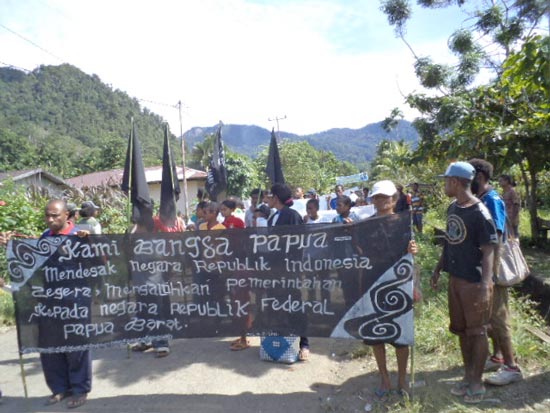
Indonesian police and army units have conducted heavily armed security sweeps across Jayapura ahead of mass demonstrations to commemorate the 50th Anniversary of Indonesia’s annexation of West Papua.

Thousands of members of civil society organisations are today converging on Jayapura, West Papua, to hold the demonstrations, however, reports from West Papua Media stringers on the ground in Jayapura have documented a series of brutal raids to prevent public participation in the planned rallies.

Led by a coalition of pro-independence networks including activists from the National Federated Republic of West Papua (NFRPB) and the West Papua National Committee (KNPB), the demonstrations are intended to “show a peaceful expression of continued and universal opposition to Indonesia’s colonial violence against indigenous West Papuans,” and continue to call for self-determination for Papua’s people, a basic human right now denied by Indonesia with the May 1 50-year anniversary of Papua’s annexation, according to organisers from the NFRPB.

Organisers have also called for rolling and widespread strikes, particularly amongst Papuan members of the Indonesian civil service, and for Papuan university and high school student to join the rallies and use May 1 as a “public holiday for West Papuan people’s future”.

The raids began at 0300 (3am local time) on April 30, after the new Papuan Governor Lukas Enembe endorsed a decision by Chief of the (Indonesian) Papua Police, the Australian-trained former head of the notorious counter-terror unit Detachment 88, Inspector General Tito Karnavian, to criminalise all public gatherings for May 1.  Karnavian made significant public statements in both Indonesian and Papuan press saying that he will not tolerate dissent to be publicly expressed today, despite this ban being a breach of the of freedoms of expression and association guaranteed under the Indonesian Constitution.

Police have announced to Jayapura residents and rally organisers, that if demonstrations occur, Police will first attempt to use persuasion to disperse the approach of rally participants, and if rally participants ignored persuasion, then they would use force and “destroy” any gatherings.

Organisers have reported that on top of the extra thousand heavily armed police announced by Karnavian, hundreds of heavily armed plain clothes special forces police and soldiers have arrived in the city, with most moving around on motorbikes.  In addition, hundreds of soldiers from the Indonesian Army (TNI) were yesterday witnessed riding on motorbikes whilst in full battle kit in a clear show of force and intimidation against Papuan civilians.

Several student dormitories housing rally delegates from various centres across Papua were raided by heavily armed police on April 30, allegedly including Australian-trained members of the counter-terror Detachment 88 attached to the Jayapura ResKrim (Criminal Investigation Branch), as part of a sweep to capture key organiser and West Papua National Authority Manokwari Governor Markus Yenu.  In one raid, police from ResKrim detained for 15 hours an elderly former political prisoner named Alfred Kapisa (72), beat, interrogated and subjected him to violence, because according to human rights sources, he was found with a rally flyer on his kitchen table and was suspected of being involved as an organiser.

A raid on the Manokwari student dormitory at 1442 local time, where Yenu was present with the Manokwari rally delegations, ended with police left empty-handed after the students told the police that the delegation were the student’s official guests.

After Yenu and the Manokwari delegation moved to the Mamberamo dormitory, the Abepura police chief allegedly pressured the Chairman of the GKI (Indonesian Christian Church) Synod Alberth Yocku to issue an eviction demand for delegates to vacate the dormitories, managed by the GKI.   A platoon and several carloads of heavily armed Police then arrived in the courtyard of the dormitories, and gave the delegates an hour to vacate, upon threat of arrest.  The GKI had often come under criticism from Papuan civil society, churches and even Papuan politicians in the Indonesian parliament as being no more than a puppet of Jakarta.

Meanwhile, Indonesian civil society organisation National Papua Solidarity (NAPAS) has condemned the Papuan police decision to ban public dissent, saying in a statement that the ban “represents a reactive, paranoid and discriminative approach of the Indonesian government that limits the exercise of the civil and political rights of Papuans.”

“Furthermore, the decision would undermine the existing processes and initiatives to find a peaceful solution for Papua conflicts,” NAPAS coordinator Zely Ariane said in the statement.

“The ban to commemorate the 50th anniversary event illustrates the Indonesian government position that aims to monopolies the interpretation of Papuan history for the sake of the state, not for Papuans,” Ariane said.

“When both the Governor of Papua and the Chief of Police of Papua deliberately ban any activities of Papuans to commemorate this historic moment, history repeats itself. Papuan’s rights of free speech of free speech and freedom of movement and of assembly were not protected and guaranteed then and now. Therefore, we question both the local authorities in Papua and the national authorities of Indonesia whether they treat Papuans as citizens or just inhabitants,” said Ariane.

Credible sources in Jayapura have reported to West Papua Media that members of the military and police are very wary of KNPB involvement in the 50 year anniversary demonstrations, after these sources spoke with Kopassus officers posing as ojek (motorbike taxi) drivers.  Indonesian security forces have long blamed KNPB members for major acts of violence including “unknown persons” (OTK) shootings, though no credible evidence has ever been proven.

However, organisers have reported to West Papua Media that consolidation and planning meetings for today’s commemorations were held between all participant components of Papuan civil resistance, and successfully developed an understanding for joint action, highlighting the goals of Negotiations, Referendum and Recognition as three points of an agreed campaign pathway agenda.  Additionally, all components have reaffirmed their commitment to peaceful actions and non-violence as a strategy for all civil resistance mobilisation.

Activists are pressing on with their plans to hold rallies and commemorate today’s anniversary.  Whilst activists are expecting a violent police response, they are prepared with a diversity of civil resistance and non-violence tactics to maximise the strategic backfire on Indonesian security forces.

Reports from the ground in Jayapura have detailed fears of a major escalation in repression by security forces.  Currently over a thousand police have illegally set up a camp on the Papuan land that is the gravesite of Indonesian assassinated Papuan independence hero Theys Eluay.  Human rights sources have expressed concern that this military occupation of one of Papua’s most important sacred site for self-determination and freedom expression is a deliberate provocation by the military to create outrage and potential violence in public gatherings today.

Elsewhere in Papua, unconfirmed reports have emerged from Sorong that a May 1 rally being held there has already been forcefully broken up by police.  Human rights sources have reported that two civilians, Tomas Blesia and Abner Malagawak were shot dead, and Salomina Klaibin and Herman Lokden were wounded by security force gunfire, reportedly as people gathered peacefully for the rally.  Conflicting reports have claimed that the victims were members of the West Papua National Liberation Army (TPN), but West Papua Media has not been able to independently verify this claim.

More updates will appear on West Papua Media throughout the day, and urgent breaking news will be available on our Twitter feed @westpapuamedia. 

Note: Journalists needing comment or contact numbers for speakers inside Papua are encouraged to call the West Papua Editorial team on +61401222177.    This contact is bilingual in English and Bahasa Indonesia.  The Coordinating Editor can be reached intermittently throughout the day on +61450079106, but not for immediate comment.
BREAKING NEWS: Indon police allegedly detain and torture non-violent activist on Yapen Island

From West Papua Media sources in Serui:

April 30, 2013

Credible but unconfirmed reports have been received via sms by the West Papua Media team on Sunday, April 28, detailing Indonesian police behaviour of torture Yahya Bonai, a 33 year old, non-violent activist from Menawi village in the district of Angkaisera, east of Serui on Yapen Island.

Local stringers told West Papua Media team that Mr Bonai’s seizure was for suspicion of connection with a fatal attack at the home of Chief Brig. Jefri Sesa, an officer from the Angkaisera subprecinct police station at around 2:00am, West Papua local time, by unidentified group of assailants (OTK), three hours prior to Mr Bonai’s arrest on Saturday.

In response to Chief Brig. Jefri Sesa’s death, the Indonesian police directed the efforts on Mr Bonai as the prime suspect, according to his family.. At 5:00am on Saturday, April 27, Indonesian police went to Menawi village, where Yahya Bonai lives and viciously attacked him while he lay suffering from internal illness in bed with his family.

According to Bonai’s wife, “Yahya suffered a stomach ache and has not left the house since Friday evening,” said Karolina Karubaba. “We are so devastated to see him being beaten up, dragged out of the house, and we (family) watched helplessly as the police vandalised our home.” cried Karolina Karubaba.

Mr Bonai’s wife and kids have taken refuge into neighbouring villages. Local stringers and human rights observers also find it extremely difficult to visit Angkaisera due to the restriction and the curfew in Menawi village by fully armed police and military patrolling on high alert.

Mr Bonai is currently detained in Serui Police custody and has been denied any visits by friends or families.

Angakaisera district has been a pro-independence hotspot, and subject to an ongoing blockade and village raids by Indonesian security forces. Targeted non-violent activists have reported that they have “always experienced ongoing terror, intimidation and fear tactics conducted by Indonesian police.”

West Papua Media teams made several attempts to call the Chief of Police in Yapen today but received no response.

A Human rights monitor in Yapen told West Papua Media, “We need people to advocate by calling the Chief of Police on +6281344621189 and +6285216186194”.

westpapuamedia

Timika Six plead for international intervention after sentence passed despite unproven case

by West Papua Media, with Oktovianus Pogau at SuaraPapua.com

April 18, 2013

Six West Papua National Committee (KNPB) activists from Timika were each sentenced to one year in prison on Tuesday by judges from the Assembly District Court in a trial deemed as opaque and farcical by observers.  Sentenced on charges of carrying dangerous weapons and makar (treason/subversion), defence lawyers insisted that the six non-violent activists had no case proven against them and will immediately be lodging an appeal.

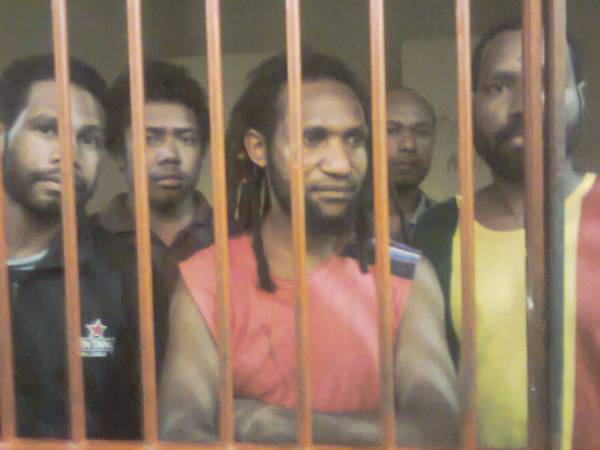
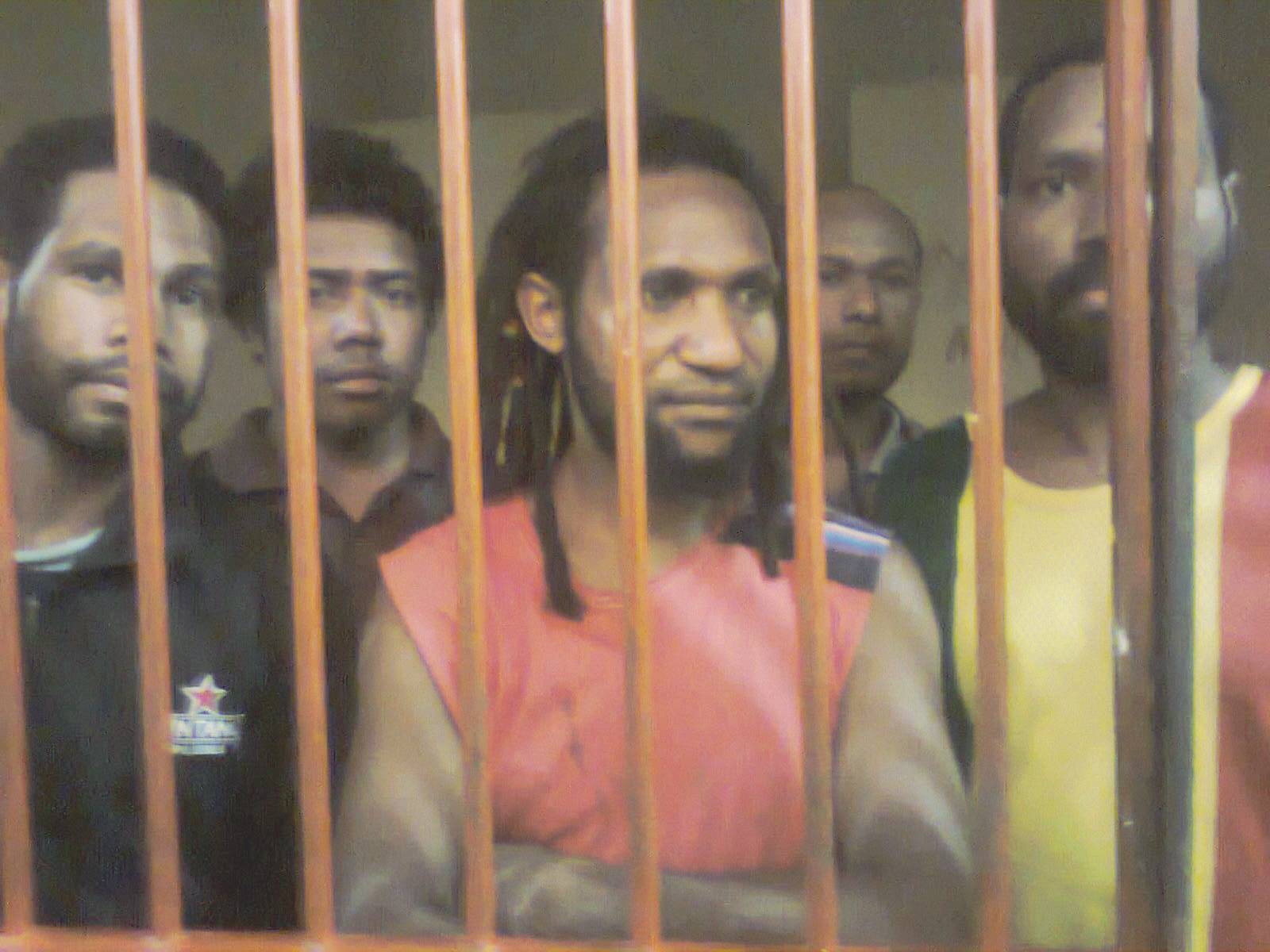
The KNPB Timika 6 back in their cells, photo taken April 17, after trial hearing. From L-R, (photo KNPB/ West Papua Media)
The KNPB Timika 6 back in their cells, photo taken April 17, after trial hearing. (photo KNPB/ West Papua Media)

The six, Romario Yatipai, Steven Itlay, Yakonias Womsiwor, Paulus Marsyom, Alfred Marsyom and Yanto Awerkion, were arrested on October 24, 2012, amidst a spate of high publicity arrests of KNPB activists by the Australian-funded counter-terror unit Detachment 88.  The then-incoming Papua Police Chief, former Detachment 88 chief Tito Karnavian,  exploited the brutal arrests to increase justification for use of Detachment 88 against political activists at a time when OTK (unknown persons, now known as Orang Terlatih Khusus or Specially Trained Persons) killings were spiralling out of control across Papua.

Despite Jakarta pinning the blame for the killings on non-violent activists from the

KNPB Timika Activist  Romario Yatipai
KNPB Timika Activist Romario Yatipai

KNPB, no credible evidence had been able to prove KNPB responsibility despite highly politicised and farcical trial processes.  Most independent observers have linked responsibility for OTK incidents in Papua squarely in the hands of agents of the Indonesian special forces.

In SMS and email communications to West Papua Media from the prison before and after the trial, KNPB activist and detainee spokesman Romario Yatipai said that the assertions made by police were “Simply lies”.

534937_10152766823260010_1179983606_n
“We are KNPB activist in Timika, West Papua. Indonesia Police jailed us with no reason.” – Romario Yatipai

“Indonesian police say that KNPB activist are criminals, terrorists, Makar (treason), separatist and so on,” Yatipai explained.

“Actually, KNPB activists in Timika always make peaceful demonstrations with all West Papuans.    We always make peaceful demonstrations to demand Referendum, as the best solution for West Papua,” he said.

Central to the police case was that the accused were allegedly carrying explosives to be used against Indonesian police posts and military targets, yet no evidence was furnished that could prove that the accused possessed explosives before t

Despite the Australian Federal Police providing Detachment 88 with state-of-the-art explosives and ballistic forensic testing capability to secure counter-terror convictions, none of this equipment or personnel were deployed in Papua for any of the OTK  trials, and no forensic proof was available at the Timika 6 trials that could have linked any of the defendants to use of explosives.

The trial heard wild accusations from prosecutors and police, but defence lawyers led by Gustaf Kawer, objected and expressed surprise when Yanto Awerkion (19) was sentenced.

As to who had ownership of explosives, Kawer explained to Suara Papua, none of the witnesses saw the defendant carrying explosives, but officials forced the defendant to claim possession of explosives.

“Since the moment of the defendant’s arrest along with five colleagues, there were absolutely no explosives he possessed … Yet when he reached the Mimika police station, the officers brought explosives and used it as evidence, and compelled the accused to confess  having an explosive. It’s very strange,” Kawer told Suara Papua.   “Our legal counsel will conduct a plea on April 23, 2013. The sixth defendant must be released immediately because of  not proven guilty, ”

Kawer also objected to the sentencing of the other defendants under makar provisions, saying the judges decision “did not correlate with the examination of the facts.”

“For the first case, it’s not proven that the five defendants were in the possession of sharp weapons.  And concerning the  treason related article, also during the course of investigation (there was) not any reference to it, but nevertheless the judge decided one year in prison by saying treason  that was proven – so we will appeal, ” Kawer told suarapapua. com.

After the defendants returned to the prison cells that have been their home since October 2012, they made a video appeal on their mobile phones, calling on the international community to do more to ensure that Indonesia ceases its persecution of peaceful political activists.

“We hope (the) International community, Amnesty International, IPWP, ILWP support us and pressure Indonesia government, Indonesia Police in Papua and Timika,” Yatipai told West Papua Media.  “West Papua activists, and all West Papuans need UN Observers,  UN Humanitarian workers, and International Journalists now in Papua.”

“Please support us with prayer and monitoring for us” said Yatipai.

westpapuamedia

Yapen treason trial accused testify of torture in custody

from West Papua Media, with local sources

April 15, 2013

Defence witnesses have revealed the extensive and systemic use of casual torture and inhumane treatment by Indonesian police, whilst testifying at the Makar (treason) trial of two West Papuan peaceful political activists in Yapen District Court, Serui, on April 9.

IMG-20130409-00019
Yan Piet Maniamboi (defendant seated on Left) during cross-examination by Matius Matulesi, SH

The activists had been threatened with twenty years jail for organising a nonviolent march about media freedom in West Papua. The two men, Edison Kendi (38) and Yan Piet Maniamboi (36) were arrested for their involvement in organising peaceful demonstrations in Yapen on May 1, and August 9, 2012 for World Day of Indigenous Peoples,  and have been held in atrocious conditions in Serui prison and have been subjected to routine and regular torture since their arrest.

Banner at freedom of expression rally rejecting Indonesian rule in Papua on the International Day for Indigenous People. Photo via Alex Rayfield from West Papua Media stringers in Yapen.

The treason trial has been beset by procedural mistakes and the failure to appear of several police officers as prosecution witnesses.  Edison Kendi is the National Federated Republic of West Papua’s Governor of Saireri region.

According to independent observers present at the April 9 hearing, the four defence witnesses testified that they were beaten and tortured during detention and interrogation by Yapen police, and were forced to provide false information to stop the torture.  The presiding judge suspended the trial for five minutes to talk with witnesses as the BAP (Case Records) were in danger of being revoked by the judge, legally inadmissible as they were based on testimony extracted under torture.

One of the witnesses, named John, answered Prosecutor Matius Matulesi’s questions on the validity of the Case Records version of testimony, the prosecutor disagreed with John and called him “Swanggi” (Devil or Ghost).   Matulesi also began to threaten both the witnesses and defendants with hoax charges for testifying about their mistreatment.  Matulesi, a Christian native of Maluku, is known as a hard-liner and being “very inhumane in demanding punishment to the fullest extent on  native Papuans in Serui, according to human rights observers at the trial.

Edison Kendi had previously testified about the brutality inflicted on him and Maniamboi whilst being held at Yapen police station, and then after their transfer to Serui  prison on December 9, 2012 .  Kendi wrote in statement provided to observers:

“Since we were arrested we were tortured, kicked, pierced with wood, hit with wood, so we suffered extraordinary bruises and swellings, but (we were) never treated (for injuries) during our detention at the Yapen police station. Police did not allow us to be treated, for the  reason we are OPM (Free Papua Movement).”

Failure to provide medical attention for injuries whilst in custody is a grave human rights violation in and of itself, under the UN Standard Minimum Rules for the Treatment of Prisoners, and also the Convention against Torture and Other Cruel, Inhuman or Degrading Treatment or Punishment – obviously in addition to the torture suffered by the defendants.

IMG-20130409-00016
Defendants Yan Piet Maniamboi (fourth from left) and Edison Kendi (5th from right), with family, supporters and legal counsel, in court before the hearing. (photo: West Papua Media stringers / NFRPB)

Matius Matulesi has also come in for heavy criticism over his violations of basic prisoner rights to medical treatment in this case, for injuries sustained by the defendants whilst under torture by Yapen police.  According to Edison Kendi, “On December 19, 2012 I submitted an application to the clinic in the Prisons for medical treatment, but I was not allowed to go out (to the hospital) by the Attorney on behalf of Matius Matulesi, SH –  so we just keep quiet and bore the pain. I’ve been treated at the clinic LP / prisons but with no improvement. I was sick when swelling on both my legs because of torture when captured and examined at the police Yapen station. I have repeatedly applied for treatment outside of LP / prisons but it’s all just all in vain since the detention December 6, 2012 – January 21, 2013 is not permitted by the prosecutor Mathius Matulesi, SH”.

Matulesi also allegedly prevented Kendi from attending the funeral of his father, allowing him only two minutes with his father’s body before being taken back to prison, despite other Indonesian prisoners, including prisoners convicted of violent terrorism offences, routinely granted this basic right.

The trial was adjourned for the prosecutor to present two investigators from the police station at the next session to be confronted with the witnesses’ testimony.

West Papua Media

Arbitrary arrests, disappearance of civilians by police in Tolikara and Mulia

Apologies for the delay in posting
by West Papua Media with local sources
April 13, 2013

Independent human rights workers in Puncak Jaya regency have reported that Indonesian police and army in the remote highlands district of Tolikara have been continuing to arbitrarily arrest civilians, allegedly to fill arrest quotas required for promotion, as part of routine crackdowns on civilians harbouring pro-independence thought in Papua.

Three civilians were also arrested by a combined Indonesian army (TNI) and Police platoon on March 9, at the Pasar Lama market in Mulia town, Puncak Jaya.   Nonggop Tabuni, Delemu Enumby and Jelek Enembe, were arrested based on false allegations according to witnesses interviewed by human rights workers, though the exact nature of the false allegations was unreported.

Credible sources have also reported that the same motive was behind the arbitrary arrest and an alleged beating by Papua Police (POLDA) in Tolikara on April 1.

Police from Tolikara station arrested a 35-year-old farmer, Josiah Karoba, 9,.25 am on April 1, while he was standing in front of a kiosk on Jalan Irian Tolikara.  The victim was arrested on the pretext of failing to carry his KTP (National Identity Card), a Suharto-era law designed to identify Communists that has been relaxed everywhere but Papua.

Karoba was then arrested “roughly” and taken to the police station Tolikara, according to witness reports, however Karoba’s family have no information about his current status or whereabouts since his arrest.   Karoba’s family and human rights workers hold grave fears for his safety and freedom from torture.

Human rights sources have told West Papua Media that the Tolikara arrests are  motivated in the interest of police promotion, by arresting innocent civilians and continuing to make victims of innocent Papuan civilians.

There is no indication as yet that the arrests are connected with a massive operation currently ongoing targeting National Liberation Army fighters under Goliat Tabuni, hunted after their killing of six Kopassus special forces soldiers on February 21.  With independent media heavily restricted by the operation, details of sweep arrest of other civilians during the operation has been unverifiable, but local sources have reported that hundreds if not thousands of civilians have been detained or forced to flee from their villages during the operation.

westpapuamedia


Create a website or blog at WordPress.com

Up ↑