POLICE AGAIN OPEN FIRE, BEAT AND ARREST PROTESTERS IN PAPUA-WIDE CRACKDOWN ON KNPB DEMOS

BY WEST PAPUA MEDIA TEAM

October 18, 2013

In several centres across West Papua on October 16, Indonesian police and army (TNI) have again cracked down violently on peaceful political demonstrations held by the West Papua National Committee (KNPB), resulting in the injuries of several participants, with unconfirmed reports of police opening fire in related incidents against KNPB members in Kaimana.

The demonstrations, called for October 15 by the KNPB to commemorate the fifth anniversary of the founding of the International Parliamentarians for West Papua, were delayed for a day out of respect for the Muslim holiday of Eid al-Adha.   The rallies were also highlighting the historic speech made by Vanuatu Prime Minister Moana Kalosil Carcasses to the United Nations General Assembly in late September, calling for the international community to take action on West Papua.

Despite formal permission being sought from the Indonesian police in Papua to conduct acts of free expression, Papua Police Chief Tito Karnavian rejected the permit due to the political and “separatist” nature of the rallies, according to KNPB spokesman Wim Medlama.  Karnavian, the former commander of Australia-funded anti-terror police unit Detachment 88, authorised the deployment of thousands of heavily armed police and military to prevent the commemorations from occurring, according to local human rights sources.

Police banned rallies from going ahead in Jayapura, Waena, Sentani, Boven Digul, Merauke, Biak, Kaimana, Nabire and Timika, however participants were allowed eventually to hold prayer sessions under tight military and police surveillance and a show of force in Biak and Nabire, according to KNPB sources.  In Timika, according to West Papua Media sources, several thousand people ignored the police ban and show of force and joined the KNPB event at Jayanti field in Timika.

Credible human rights sources have also reported that in several centres across Papua, combined Indonesian security forces of the Army (TNI), Brimob paramilitary police, and plain clothes members of Detachment 88 physically blockaded and prevented demonstrations from going ahead with dispersals and beatings in several centres.   In Merauke, police and undercover personnel said by credible sources to be members of Detachment 88, were conducting heavy surveillance of local people whilst blockading roads to prevent people from accessing the commemorations at the KNPB Merauke office.

This slideshow requires JavaScript.

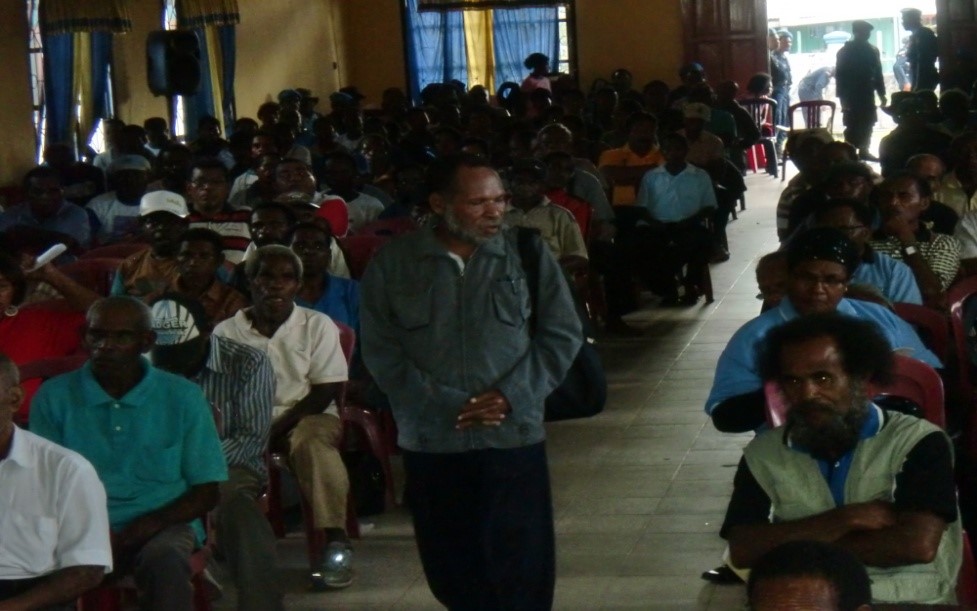
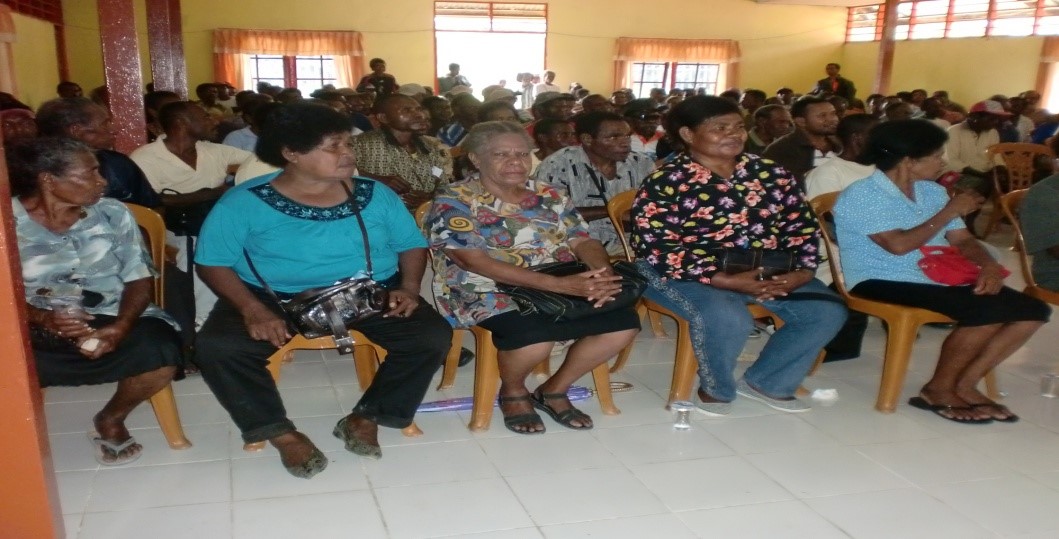
The demonstration in Waena just prior to the dispersal by Indonesian Security Forces. (Photos: KNPB)

In Jayapura, rally participants met anyway from 5 am at the gravesite of Theys Eluay, where they began music, prayers and political speeches before dawn under the rising morning star, the celestial inspiration for the banned Papuan freedom flag.  KNPB Secretary-General Ones Suhuniap told WPM stringers, “The Jayapura police began violently dispersing them at 6:30am with full force and weapons, with members of the TNI. The violent dissolution by the police also involved confiscation of KNPB member’s valuables, such as a camera and all the KNPB’s flags.”

While this peaceful demonstration was dispersed, another gathering at the Highland people’s housing complex Perumnas III in Waena, was blockaded by police under the command of Jayapura Police Chief Commissioner Alfred Papare.  This gathering was then surrounded by the police and army and were forced out of the area, according to the KNPB and confirmed by WPM stringers.

Suhuniap explained “Until the afternoon the demonstrators were violently dispersed by the combined police and army forces and assisted by the Papuan police’s special operations forces,” referring to uniformed members of the Australian trained counter-terror unit Detachment 88.

KNPB activists told WPM that they observed the army and police were prepared to suppress KNPB members with force, heavy weapons, assault vehicles and armoured vehicles. Over 200 police, including 50 fully armed Brimob paramilitary police and a platoon of TNI soldiers, and scores of plain clothes intelligence – said by KNPB to be members of Detachment 88 – participated in the dispersal and blockading the peaceful demonstrators of KNPB.

West Papua Media has been unable to confirm independently if any people in Jayapura were injured during the dispersal.

Meanwhile in Boven Digul, KNPB sources reported that Indonesian police took to local radio stations to announce the prohibition of freedom of expression, telling local people not to participate in KNPB actions.  All local people were stopped and searched, with police allegedly confiscating cameras from citizen journalists.

In Kaimana, on the south west coast of Papua, Tabloid Jubi has reported that rally organisers decided to hold a prayer service instead to commemorate the IPWP anniversary.  However, police banned that too and came to arrest organisers.

A night of terror and shootings was reportedly unleashed by Indonesian security forces against KNPB members’ families after the commemorations in Kaimana.  Police Special Forces raided the KNPB Kaimana offices three times during the night of October 16, with the first raid occurring at 2130.  Six shots were fired into the house from Police rifles during the first raid.  Three residents, Barias Wesfete, Demianus (Luter) Baunu and Jesse Irini were severely beaten and arrested by police.

However, according to KNPB spokesman Medlama when interviewed by WPM partner Tabloid Jubi,  Police returned twice more during the night, with at least ten bullets shot by Police to the house at different times throughout.  “The first shooting at 9:30 pm, was 6 times (shots.) The second shooting at 2 o’clock at night up to 2 times, and the third time at 4 am as much as 2 times,” Medlama told Jubi.

The three Kaimana arrestees returned home the morning after, however no information has been received of their charges, if any.

Jubi reports that the KNPB assessed that police are just looking for an excuse to put extreme psychological pressure on Papuan people, in ways that make no sense. “We are not concerned with their efforts to pressure us. We only know one word – LAWAN”.

WestPapuaMedia, with local sources, Tabloid Jubi, and KNPB sources

Planned MSG Foreign Ministers visit to West Papua lacks transparency

Exclusive investigation from West Papua Media team

October 12, 2013

(The Hague): As allegations surface of Indonesian military-linked businessmen providing envelopes of “hefty cash” to senior officials in the Solomon Island’s Prime Ministerial delegation during the recent APEC summit in Bali, a high level source inside the Melanesian Spearhead Group has raised concerns over Indonesia’s subversion of the agreed visit of Melanesian Foreign Ministers to West Papua, in an exclusive interview with West Papua Media.

An explosive but carefully worded article in the Solomon Star newspaper on October 11 has alleged that Indonesian officials provided members of Solomon Islands government with large amounts of cash contained in yellow envelopes, during an official dinner hosted in honour of the Prime Minister Gordon Darcy Lilo and his delegation.

According to the Solomon Star report, at least five members of the delegation have admitted to receiving the payments, amongst a total of 17 delegation members alleged to have received the envelopes.  The report, from interviews by journalist Alfred Sasako with a highly placed whistleblower in Honiara, alleged that at least two “names withheld” senior officials received USD$25, 000 each, three others received USD$10, 000  and a final two delegation members received USD$5, 000 each respectively.

“It seems the level of payment is based on seniority, the higher you are, the more you get,” the sources told the Solomon Star.

After the publication of the new allegations, West Papua Media spoke on Saturday to a well-respected customary figure in the Solomon Islands, who described the latest revelations as proof of long-standing suspicions “that Indonesia is involved in a corrupt subversion of Melanesian solidarity on the West Papua issue.  The source described the behaviour of Prime Minister Gordon Darcy Lilo in arranging unilateral visits to West Papua as “an affront to the Melanesian Way that is deliberately undermining the quality of what a properly constituted MSG Fact-finding mission can uncover in West Papua.”

“The Prime Minster is siding with Indonesia to cover up the crimes against the West Papuan people, by diluting the effectiveness of a multilateral fact-finding team to assess the real situation in West Papua.  What other deals is he doing for the Solomon Islands with these Indonesian military businessmen?  Are our islands going to be the next West Papua?” the source told WPM.   The customary source, who had no involvement with the Solomon Star revelations, declined to be identified for this article citing fears of being labelled as the whistleblower.

“This is not about me anyway, this about the questions for all Melanesian people about how far Indonesia is willing to bully or bribe Melanesians, and how some Melanesians like our Prime Minister are potentially having their pockets lined with blood money for turning their backs on the suffering of our Melanesian family in West Papua,” the source told WPM with some indignation.

Prior to the MSG meeting in Noumea in June 2013 the Indonesian and Fijian governments agreed to a multi-lateral visit to West Papua by MSG Foreign Ministers. The proposal was raised at the Noumea meeting by Fiji in part to defer a decision over whether West Papua would be granted membership into the MSG or not. The MSG Ministerial team has undertaken to write a report following their visit. This report will then help guide the MSG’s decision regarding West Papua’s membership. Since June, however, serious doubts have been raised as to how transparent the organising of the MSG Foreign Ministers is, or even whether it will happen at all.

A high-level source inside the MSG who was at the meeting in Noumea but asked not to be named told WPM  on condition of anonymity, that it was highly unlikely that the MSG will revoke Indonesia’s observer status, but that they could give West Papua ‘associative status’, which is a higher level of membership. However, the source then went on to say that it is now “not clear what is happening”.

The concerns are serious. First, no date has been set for the Foreign Ministers visit to West Papua. Second, neither the MSG Secretariat nor Melanesian nations are organising the visit. “The Foreign Ministers all rely on an invitation from the Indonesian government. It is not clear if such an invitation has been issued and it is not clear who will pay for it. My advice to member countries is that each Melanesian country pays for their own visit themselves” said the senior MSG bureaucrat. “That way the Foreign Ministers will not be beholden to the Indonesian government and that their status as independent advisors to the MSG is more likely to be guaranteed.”

Most concerning is that the idea of a multi-lateral visit could be abandoned. “It is possible” said the MSG official “that the foreign ministers could travel to West Papua separately and not as a group”.  This is the most likely possibility given the revelations in the Solomon Star.

Although privately many Melanesian politicians support independence for West Papua the official cautioned against false hopes. “West Papuans should not have high expectations from the forthcoming MSG foreign ministers support.”

At this stage it appears highly unlikely that the Melanesian foreign ministers report will reflect the political reality inside West Papua or the aspirations of the West Papuan people.  This view is reflected in the recent comments from Mr Gordon Lilo, the Prime Minister of the Solomon Islands, who told Indonesia’s Antara state news agency that he is “impressed with the progress” the Indonesian government has made in West Papua.  Mannaseh Sogovare, the Solomon Islands opposition leader, criticised Lilo’s comments saying that he had “probably been overwhelmed by the reception of the hosts and obviously the Indonesians have gone out of their way to put on the wow factor to make sure that Lilo is wooed out of any views that he may have had in support of West Papuan membership of the MSG,” reported Radio New Zealand.

Comment about the corruption of the Fact-Finding process has also been repeatedly sought by West Papua Media from the office of Vanuatu Prime Minister Moana Carcasses, however the Prime Minister was unavailable to comment on the allegations.  However, Carcasses issued a historic and moral challenge to the international community at the United Nations General Assembly in New York in late September, by calling for the appointment of a Special Representative to investigate historical and ongoing of human rights abuses by Indonesia.

‘How can we then ignore hundreds of thousands of West Papuans who have been beaten and murdered? The people of West Papua are looking to the UN as a beacon of hope… Let us, my colleague leaders, with the same moral conviction, yield our support to the plight of West Papuans. It is time for the United Nations to move beyond its periphery and address and rectify some historical errors,” Carcasses told the UN General Assembly.

These are the words that Melanesian leaders may well be reflecting on as they ponder the ramifications of accepting Indonesia’s subversion of the MSG Fact Finding Team process.

As well as sharing his concerns, the senior MSG official also had some practical advice for Papuan leaders. “All of us at the MSG are observing very closely developments inside West Papua. In order for us to assist the West Papuan application for membership Papuan leaders need to present a unified position that is backed up by strong support from civil society. The good news is that there is moral support from inside the MSG. Even senior leaders in the United Nations privately recognise that West Papua is an occupation.”

However, without unity of purpose from West Papuan leaders and strong grassroots support from inside Melanesian countries, the Indonesian government could out-manoeuver West Papua again.

WestPapuaMedia team

1 dead, 3 shot in Waghete, Paniai by Brimob for refusing to shave dreadlocks

by West Papua Media team

September 25, 2013

West Papua Media (WPM) stringers have received credible disturbing reports of a major escalation in Indonesian police operations against civilians in the Waghete, outside Enarotali in Paniai, resulting in the shooting of three civilians and the death of one.

Three men were shot by Brimob paramilitary police on September 23 after refusing to cut their hair or beards, and another two were arrested.  Alpius Mote (20) was shot dead by Brimob in the chest and died on the spot.  Fransiskus Dogopia (30) is in a critical condition after being shot with automatic fire by Brimob in his stomach and in the right side of his neck.  The third shooting victim, Alex Mote (29), has unknown gunshot injuries and his condition is also unknown at time of writing.
Police also arrested Frans Bukeja (21) and Yance Pekei (22), also for refusing to cut their hair, according to human rights workers.  Bukeja has been since released by Police, however Pekei is still being detained at the Enarotali District Police Command Post, and his family is gravely concerned for his safety, according to WPM sources.

According to local witnesses, speaking to WPM by telephone on condition of anonymity,  the operations in Waghete occurred on Monday, September 23, with house to house sweeps by hundreds of heavily armed Brimob, looking for any supporters of Papuan independence, and confiscating mobile phones searching for Papuan pro-independence songs and music,  and searching for nukens (dillybags) with any image of the banned Morning Star Flag.

During Monday night’s raids, all Papuan men with long hair, long beards or dreadlocks were allegedly ordered at gunpoint by Brimob officers to cut their hair or beards on the spot or they would be shot dead.  Long hair or beards are stigmatised by Indonesian occupation forces as an indicator of pro-independence activities, and “offenders” are summarily punished regularly in Paniai for their hairstyles, according to local human rights workers, and previous investigations by WPM.

These sweeps have been a weekly occurrence since  Operation Matoa began in late 2011, putting the Paniai regency in a unofficial war zone in a bid to wipe out armed and then nonviolent civilian resistance to Indonesian occupation.  West Papua Media reported in December 2011 on the ruthless Operation Matoa which was launched across the region to destroy the TPN forces of Jhon Yogi – resulting in the displacement of over 14,000 people, almost 150 villages burnt down and the failure of basic services that is still ongoing.

These latest sweeps, local human rights workers who visited Enarotali told WPM, are an extension of Operation Matoa, but Indonesian security forces have openly told sweep targets that nothing less than total loyalty to Indonesian security forces will be tolerated.  Extreme state violence is justified by security forces, to make an example of anyone who questions Indonesian rule, according to the human rights sources.

Local sources have also reported to WPM that a large number of security forces have amassed around Enaratoli together with several companies of the notorious 753 Battalion of  Indonesian army (TNI).  Local residents are preparing to survive another arbitrary military offensive against civilians, according to the sources.

 Several attempts to contact Police in Enaratoli or Paniai in the last 24 hours have been rebuffed.
Westpapuamedia.info


Sorong Police arrest Papuan customary leaders at Freedom Flotilla ceremony

West Papua Media

August 29, 2013

Indonesian police in Sorong, West Papua, yesterday arrested four leading Papuan customary leaders for organising a welcome celebration and prayer for the safe arrival of the Aboriginal-led Freedom Flotilla, currently sailing from Australia.

2000 people gathered in Sorong for prayers for the West Papua Freedom Flotilla (Photo: NFRPB/WPM sources)
2000 people gathered in Sorong for prayers for the West Papua Freedom Flotilla. *note – men in blue berets are from Petapa, West Papua’s community security / police force guarding West Papuan civilians against Indonesian police violence. (Photo: NFRPB/WPM sources)

The four were arrested after over 200 armed police surrounded a peaceful prayer gathering at Marantha Church in central Sorong yesterday afternoon, after thousands of local people joined with religious and adat (customary) leaders, and leaders of the self-declared National Federated Republic of West Papua (NFRPB) alternative government, to  express their solidarity with the aims of the Freedom Flotilla.  The Freedom Flotilla is  a journey being conducted with Aboriginal and West Papuan elders and Australian activists to highlight internationally the human rights situation in West Papua and is currently enroute sailing from Australia to West Papua.

Internationally renowned environmental defender, researcher and customary leader, NFRPB Sorong secretary Yohanis Goram,  was arrested together with  Apolos Sewa (Vice chair of Dewan Adat Papua, Greater Sorong),  Amandus Mirino (NFRPB State Secretariat senior worker), and  Samuel Klasjok (NFRPB’s alternative Chief of Police (Security) for  region 3, Doberay).  Sorong Police Chief Harry Goldenhad met with the organisers of the gathering, and initially “approved the activities with the proviso that they did not disturb the peace, and maintained security,” according to witnesses statements provided by established credible sources to West Papua Media.

sorong freedom flotilla congregation police
Police surrounding event just prior to arrests of organisers (Photo: NFRPB/WPM sources)

Over 2000 people had gathered for the solidarity event that spilled outside the large church compound.

About 45 minutes after the prayer meeting had finished, as participants were preparing for a press conference with local media including such as Radar Sorong, West Papua Post, and Fajar Papua, Police Chief Goldenhad took ten heavily armed officers into the church and arrested the four activists.

According to local sources who spoke with police and activists, Based on information collected on site, the arrests were made in connection with the unfurling of the Morning Star, Aboriginal, and Torres Straits flags inside the church.

Apolos Sewa in the Police interrogation room (Photo: West Papua Media)
Apolos Sewa in Police interrogation room (Photo: West Papua Media)

The four activists are still being held at Sorong Police headquarters according to local sources, and their condition is unknown.  However grave fears are held for their safety, as these are the first West Papuans to be arrested over a connection to the Freedom Flotilla, which has attracted significant international media interest, and ignited major controversy and comment from Indonesian and Australian government ministers.

International human rights organisations have reacted quickly to the arrests, with Amnesty International (AI) in London expressing concern about the arrests of the four Papuan political activists.  AI’s Indonesia and Timor-Leste Campaigner, Josef Benedict said that AI “believes they have been arrested and detained solely for their peaceful political activism and call for their immediate and unconditional release.”

Activists raise the banned West Papuan Morning Star flag during the ceremony, prompting the arrests of the organisers under makar (treason) provisions Photo: West Papua Media sources)
Activists raise the banned West Papuan Morning Star flag together with the Aboriginal and Torres Strait Islands flags, during the Flotilla ceremony, prompting the arrests of the organisers under makar (treason) provisions Photo: West Papua Media sources)

textsecure-1571866598-1 “Amnesty International calls on the Indonesian authorities to respect the rights of Papuans to freedom of expression and peaceful assembly which are guaranteed in Article 19 and Article 21 of the International Covenant on Civil and Political Rights (ICCPR), to which Indonesia is a state party. Our organisation is concerned that the Indonesian government has consistently failed to make a distinction between violent armed groups and peaceful activists, and between peaceful expression of opinion and acts of physical violence, ” Benedict told West Papua Media by email.

textsecure-1857961604-1Activists on board the  Freedom Flotilla have reacted with dismay at the news of their supporters being targeted inside West Papua, but say this highlights the daily denial of Freedom of Expression for Papuan people, that originally motivated their plans for direct action.

sorong freedom flotilla congregation  2
The Maranatha Church in Sorong during the prayer service (Photo: NFRPB/WPM sources)

Ronny Kareni, the spokesperson for the Freedom Flotilla said “It is shocking and yet not surprising, but completely unacceptable in this day and age that peaceful demonstrations of basic freedom of expression is censored in such an extreme way. We demand the immediate release of the 4 prisoners in Sorong.”

Kareni explained, “The asorong freedom flotilla congregation  1rrests yesterday of the four Papuan leaders are a reflection of the reality that there is no space for democracy in Papua and West Papua Province under the Indonesian occupation, and yet foreign governments are complicit to these ongoing abuses. The Freedom Flotilla to West Papua is aiming to highlight this entrenched long-term brutality that is demonstrated by these arrests.

Arabunna elder, Uncle Kevin Buzzacott, the elder who inspired the journey, said in a statement to West Papua Media, “Indonesian government – you must immediately release those 4 prisoners and not to harm them in any way. They need to be released and not to be harmed because they have not committed a crime. We felt very sad when we seen it in the news today. We are waiting for the other mob to turn up here on Horne Island so we can work out how to respond a bit more but for now we need to ask all Australians to take a firm position on this issue, to be strong for Human Rights in West Papua. They are hurting them everyday, for years and regardless of the Freedom Flotilla this is happening, but we having a go, tryin’ to get the World to see, to look and listen and take a stand for these people. The Papuans have had it rough for too long with Indonesia there and this can’t keep going on. The prisoners must be released immediately”.

Izzy Brown, one of the organisers of the Freedom Flotilla said: “We are dismayed to hear that the peaceful act of prayer has resulted in such extreme actions by the police and military in West Papua, highlighting once more the lack of basic human rights and freedoms that we in Australia take for granted every day. We need immediate international pressure to be placed on the Indonesian government to ensure that no harm comes to these good people who have simply undertaken to express themselves in a democratic way.:

Kareni sums up the feeling of Flotilla members: “This is the time Australia, to stand up for people who are being militarily controlled and attacked for simply trying to have a voice.”

West Papua Media, with local sources

Banned West Papuan Morning Star flags raised rejecting Merah Putih, on Indonesian independence day

by West Papua Media Eds
News Analysis
August 25, 2013
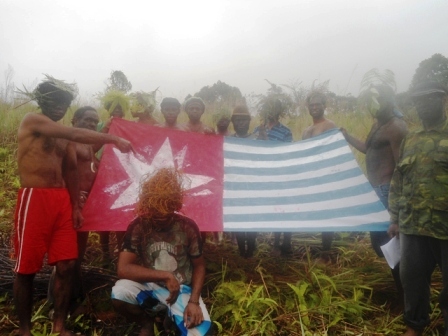
In a risky and symbolic act of defiance, unidentified West Papuan pro-independence activists raised the banned symbol of West Papuan liberation, the Morning Star flag, atop a foggy Mount Syclop, Sentani near Jayapura during the Indonesian Independence day on August 17 this year “as a form of celebration and rejection of the presence of Indonesian Papua, ” according to involved activists who spoke with West Papua Media (WPM) stringers.
West Papuan Flag Raising on August 17, 2013, atop Mount Syclop outside  Sentani, rejecting Indonesian independence celebrations. (Photo: supplied directly to West Papua Media)
West Papuan Flag Raising on August 17, 2013, atop Mount Syclop outside Sentani, rejecting Indonesian independence celebrations. (Photo: supplied directly to West Papua Media)

The flagraisings came amid a tit-for-tat psychological operations campaign ahead of August 17 by Indonesian occupation forces to raise the Merah Putih (Red/White) Indonesian national flag on prominent landmarks across Papua, and increase demands on Papuans to fly it publicly demonstrate their loyalty to Indonesia, according to a wide variety of human rights and church sources in Papua.

Organisers told WPM the act, on a mountain that could be seen from most the Papuan capital Jayapura, was about questioning the legitimacy of Indonesian occupiers to claim that all Papuans supported integration with Indonesia, and Jakarta’s claim that “Papua returned to the embrace of the Homeland.”
“Any person who was born and raised in Papua has been brought up with (the official line of the) ‘Victorious Political Integration in the NKRI, (and has) of course heard the above phrase repeatedly. This phrase has become a powerful force in the politics of integration. The Indonesian government and military believed and are so convinced that the political integration of West Papua is “absolute” they cannot answer the questions that the people of Papua ask,” the activists told WPM.
They continued their statement: “On behalf of the Nature of Papua, on behalf of the bones of revolutionary heroes who have gone before us, on our behalf and on behalf of our children, we strongly reject the claims of an Indonesian Papua.  Indonesian historians were so convinced that West Papua was breathing into the territory of several ancient empires of Srivijaya, Majapahit, Sultanate of Tidore, until the time of the Dutch East Indies. Indonesia believes it is the absolute truth, the validity of its claims of West Papua as an integral part of Indonesia. But on the other hand, shame records that the history that Indonesian historians were not able to show the valid, complete and accurate data to prove the truth of what they believe it.”
“As a form of resistance we Papuans assert our Independence of the illegal Indonesian colonial occupation of our land Papua, then we burn the flag and hoisted the flag of our “Morning Star” in the mountain region Syclop,” said the activists to WPM’s stringer.
“We do this not for Indonesian attention , nor to requested positions, (those) certain positions in the country’s NKRI (colonial) bureaucracy…. (but as) a form of resistance against colonial occupation of Indonesia (who are) illegally on our land.  That we demand and fight for “Self-determination” through an international mechanism that is Referendum,” the flag raisers said.
West Papuan Flag Raising on August 17, 2013, atop Mount Syclop outside  Sentani, rejecting Indonesian independence celebrations. (Photo: supplied directly to West Papua Media)
West Papuan Flag Raising on August 17, 2013, atop Mount Syclop outside Sentani, rejecting Indonesian independence celebrations. (Photo: supplied directly to West Papua Media)
Although traditionally raised on December 1 –  the anniversary of the 1961 thwarted declaration of West Papua’s independence from the Dutch, and the first flying of the flag –  activists claim that it was flown atop Mount Syclop to “remind Indonesia that the people of West Papua(n) nation (have) rejected the (Indonesian) pro-independence and did not participate in the anniversary celebrations.”
Indonesian colonial forces regularly attempt to enforce compulsory celebrations of Indonesia’s independence day by West Papuan people, an act many Papuans believe is designed to suppress Papuan cultural identity.
Flag raising is seen by Indonesia as a deeply political act that determines the degree of a citizen’s loyalty to the nation.  Failure to display the Merah Putih was regularly used throughout Indonesian history as a justification to extreme political violence, for example the killings of close to 2 million Indonesians during the 1965-1969 bloodbath in the first days of former dictator Suharto’s New Order regime, and the scorched-earth campaign on East TImor ending in 1999 when Indonesian security forces and militias murdered well over 180,000 civilians.  Civilians in Military operations areas (whether declared or not) across Indonesia and its colonies are regularly warned by security forces to display the Red and white in order to avoid sweep operations targeting their homes.  Public buildings are draped in it, private businesses are threatened by security forces if they fail to display it, and school children are bedecked in Red and White uniforms and forced to salute the flag daily.
Display of any cultural symbols or expression in opposition to the Merah Putih are interpreted by Jakarta as acts of makar (treason, subversion or rebellion) instead of acts of free expression guaranteed under the Indonesian Constitution.  However, Article 6 of Government Regulation 77/2007, prohibits the display of the Morning Star, the South Maluku Republic Benang Raja flag in Ambon and the Crescent Moon flag in Aceh – despite the provision of the law in the Indonesian Criminal Code (KUHP) being been declared unconstitutional for prohibiting free expression, by the Indonesian Constitutional Court.
Indonesian security forces, since their invasion of West Papua, have imprisoned thousands of people for their involvement in raising the banned Morning Star flag, and have violently broken up almost every display of the Morning Star, resulting in thousands of deaths over the last 50 years.  Each December 1 –  traditionally the anniversary of West Papua’s thwarted declaration of independence in 1961, Over 90% of the current 56 political prisoners in Papuan gaols are imprisoned under makar for non-violent acts involving the Morning Star flag, including most famously Filep Karma, one of Papua’s longest serving political prisoners, who was gaoled for 15 years for his role in organising the December 1, 2004 flagraising in Abepura.
Tito Karnavian's so-called Puncak Jaya summit Indonesian flag raising ceremony to conquer Papua.  Note the flat ground on the Grasberg mine site where the ceremony was held, and the several hundred metres of Papua's highest mountain Nemangkawi looming above the alleged "summit ceremony"  (Photo: POLRI)
Tito Karnavian’s so-called Puncak Jaya summit Indonesian flag raising ceremony to conquer Papua. Note the flat ground on the Grasberg mine site where the ceremony was held, and the several hundred metres of Papua’s highest mountain Nemangkawi looming above the alleged “summit ceremony” (Photo: POLRI)


On August 14, Indonesia’s colonial police chief in Papua Tito Karnavian (the former commander of the notorious Detachment 88 “Counter-terror” death squad supported by Australia,the US and UK), drove a group of Indonesian police, military,and management of the giant Freeport McMoRan Grasberg mine in heated luxury four-wheel drives, claiming they held a ceremony atop Papua’s highest peak, the 4844-metre high Nemangkawi (known by the Indonesians as Puncak Jaya), in order to raise Indonesia’s flag of conquest over Papua.  Participants in the ceremony claiming to be Papuans were families of senior Freeport employees,  an Indonesian army unit known as the “Pasukan Koteka Papua” and soldiers wearing blackface make-up. However the ceremony did not occur at the peak of Nemagkawi, rather in the grounds of the Grasberg mine site some 800 metres below the peak.  The Merah Putih still does not fly atop the famous summit (one of the “Seven Summits”), according to independent sources in TImika contacted by WPM.

Papua’s banned Morning Star flag, flown by climber Christian Welponer of South-Tyrol in Italy, from the top of the highest mountain of West Papua in late 2011, one of the “Seven Summits” (screen grab C. Welponer/ WPM file)
On December 1 2011, Christian Welponer, a world famous mountaineer from the autonomous South Tyrol region of the Italian-Austrian Alpine border regions, released a video of him raising the Morning Star flag atop Nemangkawi.  The act was deeply significant to West Papuan people, who sustained many casualties from Indonesian state violence inflicted on peaceful ceremonies across Papua that day.  The act infuriated Indonesian officials in the Freeport surrounds, who failed to prevent Welponer from carrying out the symbolic solidarity action.
WestPapuaMedia with local sources

Create a website or blog at WordPress.com

Up ↑