AHRC: INDONESIA: Human Rights in 2011 – The Decay of Pancasila and Constitutional Protections

Human Rights Day, December 10, 2011


On the occasion of the International Human Rights Day, December 10, 2011 the AHRC publishes its annual report on the State of Human Rights in Indonesia in 2011.

The full report will be made available for download at http://www.humanrights.asia/resources/hrreport/2011/AHRC-SPR-006-2011/view.

In 2011, the Asian Human Rights Commission (AHRC) has witnessed a deterioration of the human rights situation in Indonesia in terms of religious freedom, the role of the judiciary and accountability for violence by security forces. This report, which is based on the organisation’s documentation and monitoring work, shows that Indonesia remains heavily affected by serious human rights violations and shortcomings in the rule of law. The lack of effective prevention and legal measures taken by the legal apparatus against fundamentalist groups, shows the inability of the State to ensure fundamental rights, such as the right to life and the right to freedom of thought, conscience and religion.

Constitutional foundations such as “unity in diversity” (Pancasila) and fundamental rights are being undermined, as is being seen in the lack of appropriate responses by the State to the decay of religious pluralism and diversity. Constitutional fundamental rights are not being enforced for Aceh’s citizens, who live under discriminating Sharia laws, or for religious minorities in Java and elsewhere in the country, who face persecution, or for indigenous Papuans who lack equal access to justice, protection and social welfare and as a result increasingly reject Indonesian citizenship. Indonesia’s international recognition as a role-model for secular democracy in the region, and as the country with the world’s largest Muslim population, is losing credibility.

Numerous cases of violations of the freedom of religion were reported in 2011. This situation cannot be separated from Indonesia’s recent history. The relationship between State and religion in Indonesia is swinging from one extreme to the other. Under the authoritarian Suharto regime, which was in power until 1998, religious movements were violently suppressed, as shown in the Tanjung Priok (1984) and Talangsari (1989) incidents, during which hundreds of Muslims were killed. Alleged perpetrators in that case remain unpunished. The use of violence against religious groups was a strategy at that time to prevent Islamists from gaining political power. Conversely, the trend that has developed in recent years shows that religious organisations are now undermining State institutions and justice processes. The increased religious violence is exemplified by the killing of three Ahmadiyah followers in February 2011. The perpetrators in the case have received no or only lenient punishments, while victims among religious minorities suffer persecution.

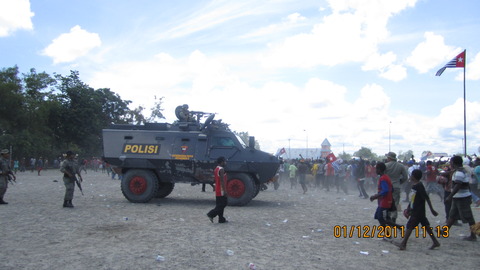
Violence by security forces, including the police and military, remains the other major concern in Indonesia in 2011. The AHRC continued to receive numerous cases of torture by the police, and, from crises regions under heavy military control like Papua, (1) it received cases of torture by the military. The AHRC is deeply concerned by the violent dispersal and killings during the Third Papuan Congress in October 2011.

The prevailing climate of impunity permits such violence to go unchecked. It is caused by the lack of effective reforms to provide impartial and professional accountability mechanisms, including for human rights violations. Efforts to develop and reform the bodies mandated to oversee the police, prosecution and judiciary, such as the extension of the mandate of the National Police Commission (KOMPOLNAS) and the mandate of the Prosecutorial Commission, are important steps taken by the GoI. However, in practice, police officers cannot be criminally prosecuted for the widespread use of torture to obtain information or punish detainees, and members of the military cannot be held accountable by independent investigations and civilian courts. They continue to be tried exclusively by the Indonesian National Army’s (TNI) legal system, which has serious flaws and typically perpetuates impunity. While Indonesia had announced the inclusion of the crime of torture in its new draft criminal code, this draft has been pending for adoption for many years. Sharia law in Aceh institutionalises corporal punishment and therefore inhuman and degrading treatment, and violates rights concerning fair trials.

The freedom of expression of activists in Papua is frequently violated through arrests of protesters and imprisonment for the peaceful expression of political opinions. More than 60 cases of violence against journalists in 2011 and several defamation law suits were reported. A new law concerning the State’s intelligence system passed in 2011, and allows for arbitrary measures that violate human rights and can be used to silence activists. Civil society faces many serious challenges to their ability to perform work in favour of human rights and reforms.

As a survey by the Kompas newspaper in 12 major Indonesian cities in October revealed, 83\% of the respondents are dissatisfied with the work of the police, judiciary and the attorney general’s office in upholding the law. Almost 100\% of the respondents felt that political conflicts within the police and corruption within State institutions is, in general, in a serious condition. (2)

Politicisation of criminal justice institutions such as the Attorney General’s Office (AGO), corruption in the judiciary and the immunity of military commanders present an ongoing problem. The lack of accountability for gross violations of human rights and ongoing impunity for the instigators of the 2004 assassination of Indonesia’s leading human rights defender, Munir Said Thalib, due to the refusal of the Attorney General to conduct new investigations, are key indicators concerning the inability of State institutions to address human rights violations effectively, and thus to fulfil their mandate to ensure a just and fair society. As a result, religious extremism grows and violations by security forces continue.

The full report will be made available for download at http://www.humanrights.asia/resources/hrreport/2011/AHRC-SPR-006-2011/view.

——-

Entire Paniai villages forcibly evacuated by Brimob Gegana

December 7, 2011

Disturbing reports have been provided to West Papua Media overnight showing the latest human rights violations by Indonesian police against civilians in West Papua.

Human rights, church sources and local activists had independently claimed that 542 people have been forcibly evacuated by troops from the Special Gegana Brimob “Counter” terrorist police unit.  The villages of Dagouto and Kopabatu and surrounding hamlets in the Dagoutu Paniai district were evicted after the Gegana unit decided it wanted to expand a new headquarters facility to deploy in the offensive against Jhon Yogi, the local leader of the armed guerilla unit of the National Liberation Army (TPN-OPM).

Two Brigades of BRIMOB based in Papua, and a Brigade from Kalimantan will be housed in the sprawling new complex squatting on the former villages.

This comes after the Gegana unit was involved in an armed attack on a peaceful raising of the banned Morning Star flag on December 1, the 50th anniversary of an event widely seen to be West Papua’s first day of independence.

POLRI GEGANA anti-terrorism troops attacking peaceful flagraisers, Taokou Village, East Paniai , December 1 (West Papua Media)

Reports from the area have been sporadic and it is still unconfirmed if civilians were arrested, injured or killed in the flag seizure.

POLRI GEGANA anti-terrorism troops attacking peaceful flagraisers, Taokou Village, East Paniai , December 1 (West Papua Media)

The Gegana unit, a specialised elite anti-terrorist unit of the Indonesian police has been deployed heavily across Papua to crackdown on pro-independece activists engaged in non-violent resistance, as well as to eliminate the armed stuggle groups.  Gegana is one of several elite Indonesian police units that receives arms, funding, and training from the Australian Government, and was blamed on December 3 for burning down a church and school in Wandenggobak, in the highland regency of Puncak Jaya.

According to sources in Paniai, the local government (regency level) have guaranteed to shelter and feed the displaced evacuees, and the local government will have to support the relief operation alone.  Reports indicate that the evacuees will be held in a secure camp in a local government owned Uwatawogi Community Hall in Enaratoli, Paniai.   Indonesian police who caused the displacement has provided no information about supporting civilians they have displaced.


Related articles:

Villagers flee to Papua’s forests fearing further Police attacks

by Yason Sambom

Edited by West Papua Media

December 5, 2011

[West Papua News with additional reporting from West Papua Media] – About 110 residents of Berap and Genyem villages, near Lake Sentani in Papua, have been forced to flee to the forest after Indonesian Police terrorized the village on November 30 in retaliation for an incident in which two officers including the head of Criminal Intelligence were injured.

Indonesian media have reported the bow and arrow attack on the police officers as an unprovoked attacked by National Liberation Army Guerillas, but independent media sources have been provided information that show that the shooting occurred in self-defence.  Ordinary villagers from Berap were attacked by Brigadier Ridwan Napitupulu and his colleague Budi, who were allegedly drinking heavily despite claiming they were patrolling to seize any Morning Star flags that were to be raised on December 1

The correspondent for West Papua News, a local citizen media outlet, met refugees  who testified the chronology of events in Berab-Genyem Village, in Nembukrang District.  Villagers were shocked by acts of terror carried out by two plainclothes Police intelligence officers, who arrived after drinking in the village on Suzuki motorcycle No. F6611BT Police.  The two officers carried out an armed robbery of a young man who was calling his wife on a mobile phone, demanding to know who the villager was speaking with.  According to the chronology recorded, the following exchange occured:

Police: “. You call what?, In the village you bring any activists?

Victim said, “I do not know”,

“In the village of Berab, would you raise the Morning Star flag?” asked the two policemen who then marched the young man into the village.

After being brought into the Berab, the two drunk officers immediately allegedly pushed and almost hit several young villagers on night patrolling duty.  The young men did not accept the officers’ pushing them, so they chased on foot the two officers to the Blue River (Kali Biru) tourist sites.

Both officers felt besieged by the youths and the panicked villagers, and fired warning shots that narrowly missed a youth PK, who then tried to beat the officer to stop him shooting.  At this point, an unidentified person allegedly shot Napitupulu in thigh with a traditional hunting bow, hitting the officer in the thigh, allegedly severing an artery.  He then escaped by diving in to the Biru River, that carried him clear.

Local human rights sources are investigating the claims further

Ridwan’s colleague, Budi, ran away and hid in foliage overnight, only emerging on December 1 when light amidst the arrival of senior officers and an armed platoon.  Budi was allegedly observed by witnesses lying to his superiors who were chastising him, saying (according to the witnesses) “I was surrounded and beaten villagers because they want to grab a weapon”.

Police then conducted a sweep operation through the village, causing many to flee.  The six villagers that were captured by Police were identified as:
1.Ruben Manggo (Berab Village Head),
2.Thomas Tarko (Member KNPB Tabi),
3.Zet Manggo (Member KNPB Tabi),
4.Yonathan Tarko (Member KNPB Tabi),
5.Joseph Manggo (Member KNPB Tabi),
6.Kalfin Tarko (Member KNPB Tabi).
The six were interrogated at the Jayapura police headquarters.  Of the six victims, Berab village Head Ruben Manggo was released by police officers on Friday at 13:00 WP with injuries from severe beatings, and is being cared for in Berab village.
These conditions make citizens feel threatened because of the mental-psychological trauma for several years in a state of trauma due to forces that normally act without compromise to act arbitrarily and brutally against village residents.This makes the act itself displaced villagers in order to save themselves from the property and their lives were shot dead drift alias.
This event took place amidst security force repression after the Third Papuan People’s Congress on October 19, 2011.  The subsequent crackdown legitimized a deep sense of trauma after the declaration of the Federal State of West Papua by the Chairman of the Tribal Council (DAP), Forkorus Yaboisembut, SPd,.  Yoboisembut as President of the Federal State of West Papua, had called for peaceful resistance on December 1, 2011,  by flying the Papuan Morning Star flag across all the land of Papua.
These conditions are making citizens feel threatened and living in a state of psychological trauma for several years, due to the arbitrary and brutal behaviour of security forces acting without compromise against villagers.  This has caused villagers to flee to the forest where they are living without access to security, displacing villagers in order to save themselves.  The refugees have had to abandon all property and are greatly anxious for their future.
Abridged report from West Papua News

STOP PRESS: Tempo.co.id has reported that Napitupulu died on Monday morning in Youwari hospital, Sentani, Jayapura.

National police spokesman Sr.Comr. Boy Rafli said that Second Brig, Ridwan Napitupulu died on Monday at 00:35 Indonesian Eastern Time after being treated at the hospital for three days. He added that the body would be brought to his family’s home in Medan by Garuda this afternoon at 12:20, tempo.co reported.
Police have named three suspects in the case, Thomas Tarko, Yonathan Tarko, and John Calvin Tarko.

Last Updated on Saturday, 03 December 2011 09:31

Troops burn down churches and villages in Puncak Jaya

by Westpapuamedia.info

December 4, 2011

According to credible local sources in Puncak Jaya, Indonesian troops razed a civilian village while conducting a massive offensive against National Liberation Army guerrillas of Goliat Tabuni.

Undercover local human right sources have claimed that at 1530 local time on December 3, that two platoons from the “Coconut” brigade of Gegana Brimob anti-terrorist police, set fire to a church, houses, and guard houses in the village of Wandenggobak.

Brimob Gegana is a specialised highly mobile bomb and anti-terrorist unit that receives funding, arming and training by the Australian Government, and is trained by the Australian Federal Police at the joint Australia-Indonesian Jakarta Centre for Law Enforcement Cooperation.  Standard weaponry used by Gegana include the AusSteyr rifle, manufactured by Australian Defence Industries.  It is not known if the flamethrowers used to burn down the church were amongst those supplied by Australia.

The church burning against civilians occurred as reprisal for an attack by Tabuni that left two Brimob officers dead earlier in the day.  Gegana Brimob police officers Bripda Ferly and Bripda Eko were killed, with Bripda Syukur being treated for minor thigh grazing.

Civilian casualties have been reported, though not verified at this stage.  It is not known if villagers were in any of the buildings, or seeking shelter in the church at the time it was razed by Indonesian police.

These reports are based on contact with two regular and established credible sources.  The usual standard for claiming fact verification for West Papua Media is our three independent source rule, but we are still awaiting further detailed reports from the area.  Papuan, Indonesian and international journalists have been banned from the area in Puncak Jaya where the offensive is occurring which has been informally declared as a Military Operations Area (Daerah Operasi Militer/ DOM)

The offensive has allegedly started after the guerrilla forces of Tabuni allegedly launched attacks on military targets on December 1, after a massive nonviolent flagraising ceremony in Tingginambut.

However, other credible sources in Wamena have sent appeals saying that Tabuni is close by Wamena.  “After General Tabuni started war on December 1 … Our international highlanders are feeling deeply traumatised …  ordinary people are starting to arm themselves with traditional weapons on the streets”, a translated SMS message sent to West Papua Media early on December 4 claimed.

The situation is tense at time of writing.  Please stay tuned for further developments.

Related articles:

Initial reports from December 1 in West Papua: TNI respond with violence in Timika

Citizen journalists on the ground have started filing the following reports by SMS (translated from Bahasa Indonesia):

(All times given are local time)

Timika

“December 1st was celebrated in Timika. The flag was raised for approximately minutes. A church service began at 9am. The military then forcibly dispersed everyone. Two people were shot (a man and a woman). The man’s name is Viktus Wamang. He is currently in the hospital in Timika. The woman is yet to be identified. Three people have been detained. The situation is very tense. People are still detained on the field in Timika Indah.” 11:30, Dec. 1.

Sorong

“We marched around the municipality office and are now joining a mass prayer. Around 1,000 to 1,500 people are involved. The police are strictly guarding us. Hope that nothing happens to us.” 10:35, Dec 1.

Manokwari

“The streets of Manokwari are crowded. People are holding a 100m long banner that reads ‘The Federal Republic of West Papua’ and includes a photo of the President [Forkorus Yaboisembut] and the Prime Minister [Edison Waromi] and hundreds of Morning Star Flags.” 11:29, Dec 1.

Puncak Jaya (Nemangkawi in the Amungme language), the highest mountain between the Himalaya and the Andes

A European mountain climber unfurled the Morning Star Flag on the summit of Nemangkawi. The photo and a video has just been released on West Papua Media.

People are now coming out of church services. More flag raisings are expected.

It is expected that tension will increase as people come on the streets across Papua.  West Papua Media will continue to monitor the situation closely.

Witness contacts are available from West Papua Media at +61450079106

Create a website or blog at WordPress.com

Up ↑