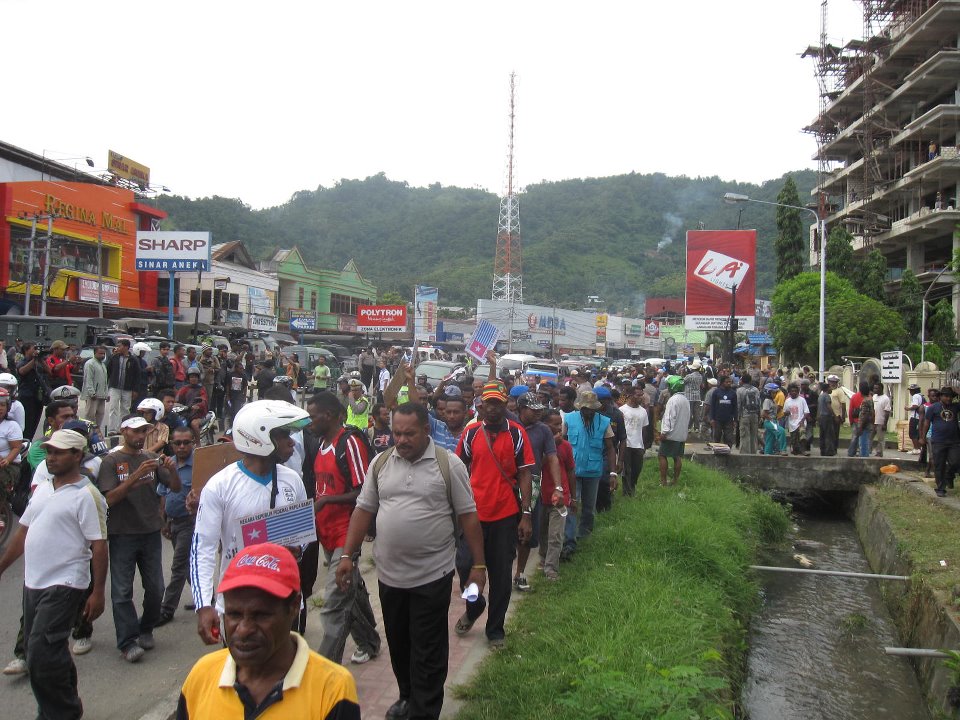
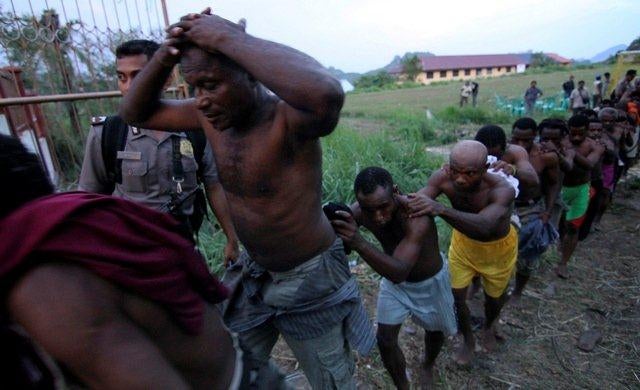
Filep Karma undergoing Medical care at Hospital DOK II

by a special correspondent in Abepura for West Papua Media

March 3, 2012

(Edited and abridged in translation by WPM)

Concerns have been raised again over the health of internationally renowned West Papuan political prisoner Filep Karma, after a series of visits to hospital to treat his worsening health, amid atrocious conditions in the notorious Abepura prison.

Filep Karma is a political prisoner sentenced to 15 years imprisonment by Indonesia after being found guilty of makar (treason) for making a speech calling for independence and raising the banned Morning Star flag on December 1st 2004.

(Gaoled in atrocious conditions and subjected to early routine torture by Indonesian security forces and prison officers, including beatings causing internal injuries, Karma’s health has been declining since 2008, also due to numerous hunger strikes and illness caused by prison conditions in Abepura prison.  Additionally, In response to a petition filed by Freedom Now, the United NationsWorking Group on Arbitrary Detention issued its opinion that the Government of Indonesia is in violation of international law by detaining Filep Karma. Amongst many other international voices, the Working Group called on the Government of Indonesia to immediately release the human rights advocate. – WPM)

He underwent medical checkups at Hospital Dock II, and underwent a colonoscopy by a Dr Arnold, on 17 February 2012, to check his intestines. He underwent the check because up until this point he regularly discharged blood when using his bowels. The results of the check were to be taken on February 21st, 2012. At the same time he also was assessed by a neurologist, Dr. Nelly Rumpaisum, because for the previous few days he felt the pain to the right of his hip when getting down to clean clothes, and now also when standing. When undergoing the examination, Fliep was accompanied by two officers and a doctor from Abepura prison. Filep was to return to the Hospital II, to undergo X-rays of his waist.

At this time, Filep cooked his own food in prison. He used a traditional stove himself, with milk cans and axes, lit with coconut oil. ‘Eating my own cooking is better for my health at the moment, because if I eat food from Abepura Prison, there can sometimes be a lot of seasoning, and this is less suitable for the condition of my body while undergoing medical treatment at the moment’, he said.

On 21 February 2012, according to Dr. Donald Arronggear at the time of the colonoscopy results, ”Filep is affected by inflammation of the intestine next to the anus, so that he must eat foods high in fibre, like fruit and vegetables”, he said. He also received various medicines from the doctor to drink when back in prison. He also did x-rays on the right side of the waist, and the results were to be checked again on 24 February 2012.

Filep Karma will undergo physiotherapy

On several weekends, Filep Karma underwent some medical treatment at the Hospital Dok II. He was accompanied by two prison officers and doctors from Abepura Prison. On 24 February 2012, he received sequence number 2 at the polyclinic at Hospital DOK II. Filep took the x-rays to neurologist, Dr. Nelly Rumapaisum. According to Dr. Nelly ”The right side of Filep’s waist, has narrowed. So, it must to undergo physiotherapy for 12 sessions. Filep can no longer lift heavy equipment and also sports is a high-risk”, said Dr. Nelly.

Filep Karma said that ‘my waist has already been sore for a while, but it felt sore for a few weeks so it had to be checked”. Filep Karma also must use a corset after undergoing physiotherapy (a very uncomfortable apparatus in the sweaty conditions of the prison – WPM) . He will undergo regular physiotherapy and will be back and forth to the DOK II Hospital for ongoing care.

“My desire is also to be an inpatient at DOK II Hospital, while undergoing physiotherapy, because the distance between the Prison Abepura and Jayapura is about 60 minutes, which makes me making a little exhausted on the journey”, Karma said.

See Also : FILEP KARMA REFUSES INDONESIA’S REMISSION Aug 20, 2011 – Video report by Cyntia Warwe

Arrests in Fak-Fak as demos support IPWP, reject UP4B

from West Papua Media and local sources

Confirmed reports have emerged from Fak-Fak, on the west coast of West Papua, that at least ten demonstrators were arrested by Indonesian police on March 1.

The demonstrations were being held to reject a new body – U4PB (or Program to Accelerate Development of Papua and West Papua) – appointed by Indonesia to re-implement the failed Special Autonomy package that was to give Papuans a greater share of their own wealth.  Regular protests from Papuan civil society have rejected this new body due to its refusal to consider Papuan demands, and  recognise the failure of the existing package.

Those arrested were identified as the following:

  1. Siswanto Tigtigweria
  2. Lukas Hegemur
  3. Quartus Ndoratndorat
  4. Modestus Komber
  5. Yeheskal Hegemur
  6. Nikson Hindom
  7. Pazco Hindom
  8. Samuel Rohrohmana
  9. Amos Wagab
  10. Renol Hegemur

The protest was also held to support the February 28 launch in Canberra, Australia, of a new regional chapter of the International Parliamentarians for West Papua.  This meeting attracted Members of Parliament from Vanuatu, New Zealand, and several parties in Australia, including MPs from the Australian Government.  Demonstrations in support of IPWP were held across ten centres in West Papua.

Neither Police or local human rights sources have been able to identity the exact nature of charges against the ten detainees.  However Indonesian police historically have laid Makar (Treason) charges against Papuans attending demonstrations in support of the right of self-determination.

West Papua Media was unsuccessful in seeking comment from Police.

This is a developing story.

westpapuamedia.info

Unconfirmed reports of imminent major security crackdown in West Papua

West Papua flag

from West Papua Media sources in Jayapura

January 15th, 2012

Across West Papua, a series of remarkable and disturbing text messages has been circulating the claim that Indonesian security forces are preparing a major security assault across Papua in an operation that allegedly began on February 10.

West Papua Media has been unable to speak with any of the alleged participants in the meeting, nor any official representative of the organisations present, to verify these reports.  However local sources are reporting that security forces have intensified patrols and street presence in Jayapura at least  that would correspond to such an operation.

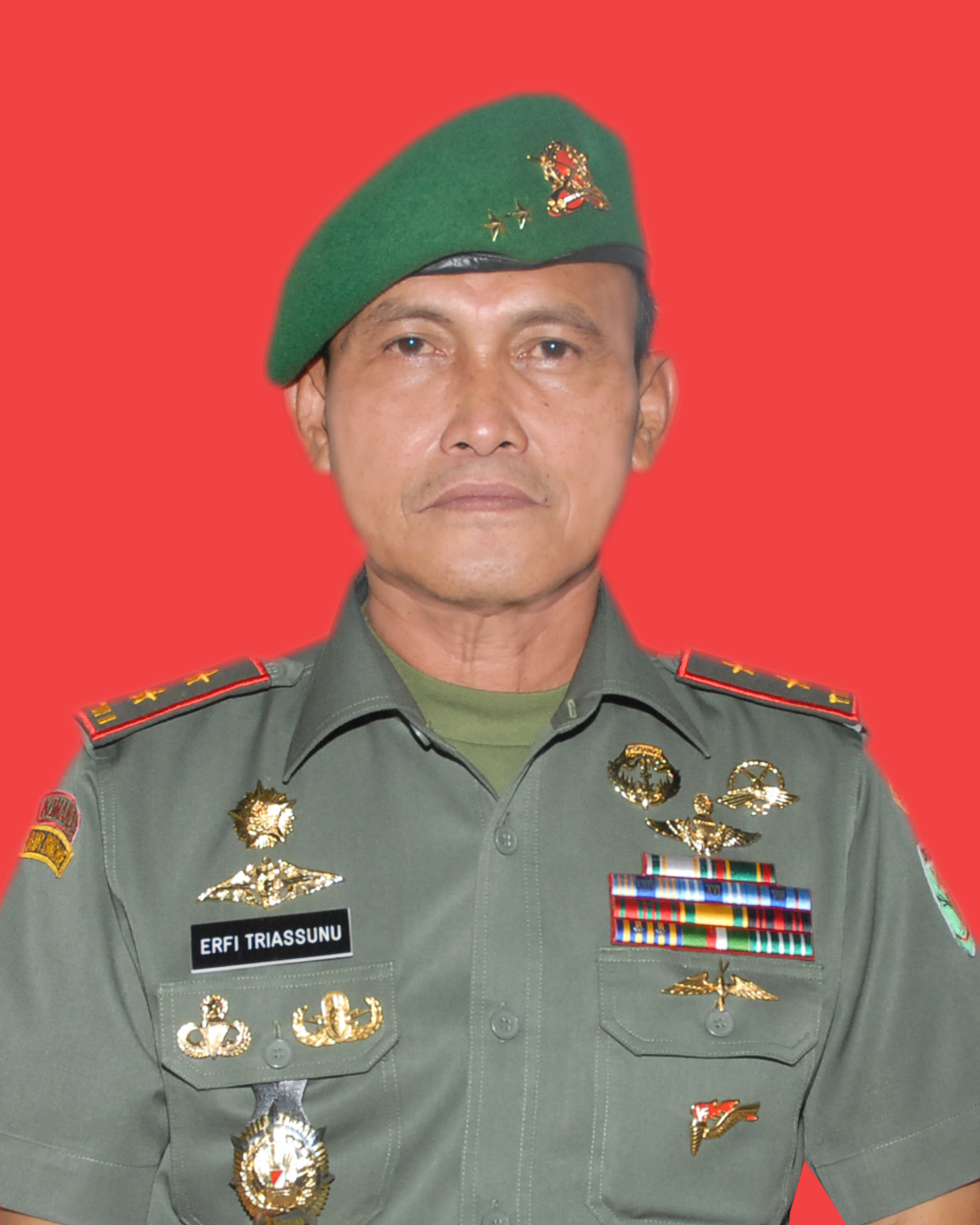
According to the messages a meeting was held at the Hotel Aston at 10am on February 9, between Polda Papua senior police officers.  Also at the meeting were the Papuan governor, the Commander of Cenderawasih Military District Erfi Triassunu, and officials from the Papua District Attorney, State Intelligence Body (BIN),  the army Strategic Intelligence Agency (BAIS), senior Kopassus officers, and leaders from Barisan Merah Putih – the main pro-Indonesia militia.  The meeting was  allegedly being held against the threat of disintegration of Indonesia  by separatist groups in Papua, according to the messages.

Erfi Triassunu - duplicitous

Participants allegedly raised the issue that “pro-merdeka” Papuan independence aspirations had been “globalized” and were attracting widespread international support especially after the brutal and heavy handed crackdown by Indonesian security forces on the Third Papuan People’s Congress on October 19, 2011, according to the source.

The  Memorandum assigned to officers present was to immediately raise “any safety risk to the smooth operation codes” – believed to indicate that security forces would be placed on high alert to prevent all expressions of self-determination.   It continued:

“The main focus is for the treason trial of Forkorus Yaboisembut and colleagues, who should not be given (political or public) space to defend themselves to their (Papuan) people and release pressure on the Makar defendants.  Any adverse condition in the control of the military from the Start Date (of) 10 February 2012 immediately increase security emergency.”

The messages then hinted darkly at the final conclusion of the meeting:  “Do not hesitate (in carrying out your duty if you have) to violate human rights for the sake of the sovereignty of Indonesia. ”

The text messages were said by local human rights sources to have come from a “very reliable source close to the military”.  It is not known at this stage if these text messages have been circulated deliberately by military intelligence as a possible tension building exercise.

West Papua has been subjected to many false SMS rumour “storms” in the past as sources believed by observers to be Indonesian intelligence officers have circulated false and inciting claims of imminent communal violence.  This includes a notorious case

Threats by SMS to human rights defenders and journalists are commonplace in Papua, widely believed to come from military sources.

Across Papua in recent weeks, SMS messages are also circulating claiming that “mysterious killings” are allegedly being perpetrated by Indonesian security forces against West Papuan civilians.  Reports have been circulating that a man allegedly from Yakuhimo, Puncak Jaya, was killed and his mutiliated body turned up in Sentani, and another allegedly was found in a marketplace in Abepura.  Additionally bodies have been reported as being found in similar circumstances in Timika and Wamena, but none of these reports have been able to be independently verified.

Westpapuamedia.

Makar accused reject charges, and Indonesian jurisdiction over Papua in adjourned trial (Photo Report)

January 31, 2012

By Nick Chesterfield from West Papua Media with local sources

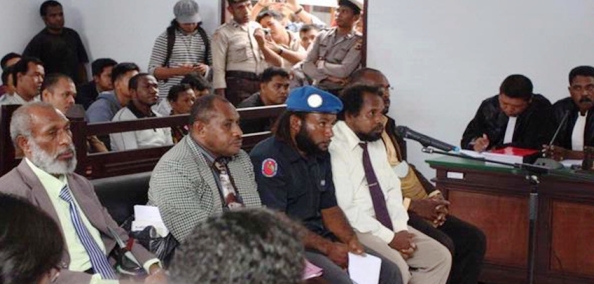
(Jayapura) The treason trial against the leaders of the Third Papuan People’s Congress in Jayapura was adjourned on Monday until February 8, after a short hearing that Indonesian authorities moved at the last moment preventing many supporters from attending.

The five defendants, President of the Federated Republic of West Papua (FRWP)  Forkorus Yaboisembut, Prime Minister Edison Waromi, together with Congress organisers Selpius Bobii, Dominikus Sorabut and Agus Sananay were charged with makar or treason under Article 106 of KUHP (the Indonesian Criminal Code) for their declaration of an independent West Papua at the close of the Third Papuan People’s Congress on October 19 last year.

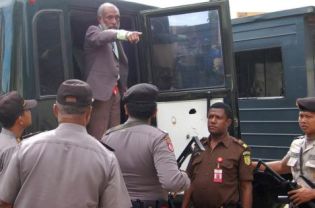
Papuan leaders accused of treason on trial in Jayapura, January 30, 2012

The historic Congress was violently broken up by Indonesian security forces using live fire and excessive violence, with at least seven people killed, hundreds beaten and tortured, despite official permission for the event to be held.  Indonesian security officers involved were given minor disciplinary sanction, with most perpetrators of violence enjoying complete impunity despite footage of the Indonesian security force violence being broadcast internationally.

Initial reports from witnesses inside the trial early in the day claimed that the team of judges argued with the defence legal team about the need to know the political position of the defendant’s, despite the fact that in a treason trial this would be self-evident.  Yaboisembut and Waromi then fundamentally rejected the charges against them, arguing that their actions were not treason“.

Forkorus Yobeisembut (Jakarta Globe)

According to Forkorus as reported by the Jakarta Post, “What we have been doing is seeking our own independence. Thus, we have cheated no one,”.  Forkorus argued that Indonesian occupation of his homeland was the real issue, and that ”this problem is not the problem of separatism and rebellion or treason”.  Both Forkorus and Waromi said that the issue of Papua should be tried in international courts as the Indonesian state did not have jurisdiction over Papua.

Forkorus Yaboisembut (Jakarta Globe)

in a short statement sent to West Papua Media, the defendant’s legal team said that the judge asked Forkorus and the accused understood the indictment.  “He answered that, yes, he understood what the prosecutors read but did not understand the charges of treason against them.”

“Forkorus then asked for time to read a statement to the assembly to process the rejection of the  law, (the request of) which was then approved by a judge.   Our attorneys will do the rebuttal (exception) to the indictment dated 8th February 2012,” according to the legal team led by Hamadi.

(Photo: Efraim Joteni)

Bintang Papua reported that another one of the lawyers for the accused, Gustaf Kawer,said that up to 32 lawyers from across Papua and Indonesia had offered pro-bono defence of the treason accused.  He said: ‘I am convinced that  the large number of lawyers who are attracted by the case is a good sign  of interest in the need to find a solution to the problem of Papua.’

Forkorus Yaboisembut and Edison Waromi media interview after trial.(Photo: Efraim Joteni)

The Panel of Judges hearing the trial are Chairman of the Jayapura District Court of Class IA, Jayapura, Papua, Jack John Octovianus, SH. MH,;  assisted by I Ketut Nyoman S, SH. MH. Syor Mambrasar, SH. MH. Orpah Marthina, SH. and Willem Marco Erari, SH.

Outside the court hearing, almost 400 hundred heavily armed riot police and a similar number of Army and Kopassus personnel were guarding the courthouse venue from dawn (0600) with close to a dozen armoured assault vehicles, mounted with heavy machine guns, according to participants.

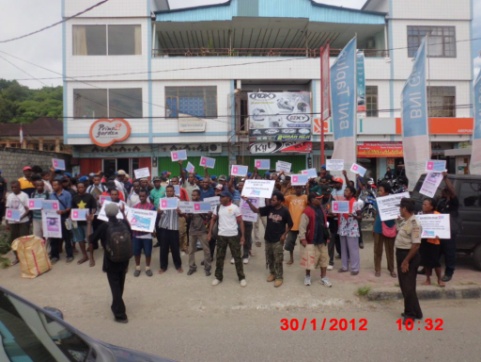
Protest in support of West Papuan leaders in trial for treason (Photo: Efraim Joteni)

Participants in the protest claimed to West Papua Media via SMS that security forces were acting in a heavy-handed manner, describing their actions as “wild and aggressive”.    “This display of armour  makes thousands of ordinary people in Jayapura traumatized and afraid to come to action,” said Jack Wainggai, the spokesman for the Prime Minister of the FRWP, Edison Waromi, on trial for treason today.  Organisers had aimed for several thousand people to attend, but amid heavy  Indonesian security that discouraged solidarity protests by West Papuan supporters of the defendants, only 500-600 braved the heavy armour and “state intimidation” outside the court.

Protest in support of West Papuan leaders in trial for treason (Photo: Efraim Joteni)
Brimob outside makar trial (Photo: West Papua Media)
one of almost a dozen armoured vehicles securing outside court venue Jan 30 2012 Jayapura (Photo: West Papua Media)

Despite promises by Indonesian authorities that the trials would be open, the presiding judges secretly started proceedings at 8.30 am before supporter could arrive.   In a press statement before the trial, Bintang Papua reported that Olga Hamadi of Kontras Papua said, “The five men will face charges under Article 106 of the Criminal Code for subversion. Based on past experience, there are concerns regarding security during the trial which will be open to the public, meaning that anyone wishing to attend the trial will be able to do so.”  Hamadi urged all present to restrain themselves and ensure that conditions surrounding the trial are conducive.

Speculation has mounted amongst local observers that the trial may be moved from Jayapura to metropolitan Indonesia to reduce any potential political flashpoint it will cause amongst pro-independence forces in Papua, with the prosecutor’s office formally warning of such a move should unrest occur.   Conversely though, any shift would create more opportunities for international observers to be present at the trial, a basic condition called for by the defence and international human rights monitors.

After the adjournment, the few hundred that did attend were able to disperse peacefully without an Indonesian security force crackdown, but tension still remains high in Jayapura as armed troops are still deployed on the streets the following day.

Elsewhere in Papua, solidarity actions were held with the treason trials against the Congress leaders.   In Manokwari, orations were held calling for international peacekeepers to be deployed to protect West Papuan people from Indonesian state violence.  Calls were also made in Manokwari  for neutral international mediators for dialogue between Jakarta and the Federated Republic of West Papua.

Westpapuamedia.info

HRW:: Indonesia – Drop Charges Against Papuan Activists

English: Human Rights Watch logo Русский: Лого...

Free Political Prisoners, Amend Treason Law to Uphold Free Speech

JANUARY 29, 2012
  • Police arrest attendees of the Third Papuan People
    Congress in Jayapura, Indonesia‘s Papua province on
     October 19, 2011.  © 2011 Reuters
The Indonesian government should show its commitment to peaceful expression by dropping the charges against these five Papuan activists. It’s appalling that a modern democratic nation like Indonesia continues to lock up people for organizing a demonstration and expressing controversial views.
Elaine Pearson, deputy Asia director

(New York) – The Indonesian government should drop charges against five Papuan activists who are being prosecuted for peacefully expressing their political views, Human Rights Watch said today. On January 30, 2012, the district court in Jayapura, the Papua provincial capital, will begin the treason (makar) trial of five leaders of the Papuan People’s Congress, which the authorities forcibly dispersed last October.

“The Indonesian government should show its commitment to peaceful expression by dropping the charges against these five Papuan activists,” said Elaine Pearson, deputy Asia director at Human Rights Watch. “It’s appalling that a modern democratic nation like Indonesia continues to lock up people for organizing a demonstration and expressing controversial views.”

On October 19, 2011, Indonesian security forces, using excessive force, broke up a three-day Papuan People’s Congress gathering in Jayapura, Human Rights Watch said. After one of the leaders read the 1961 Papua Declaration of Independence out loud, police and the army fired warning shots to disperse the approximately 1,000 Papuans gathered for the peaceful demonstration supporting independence for Papua. The security forces then used batons and in some instances firearms against the demonstrators, killing at least three and injuring more than 90 others. Witnesses said that demonstrators had been struck on the head and several suffered gunshot wounds.

Following the incident, eight police officers, including the Jayapura police chief, Imam Setiawan, were given written warnings for committing a disciplinary infraction by not giving priority to the protection of civilians. However, no other action was taken against police or military personnel for possible misuse of force.

Five of the activists– Forkorus Yaboisembut, Edison Waromi, August Makbrowen Senay, Dominikus Sorabut, and Selpius Bobii – were charged with treason under article 106 of the Indonesian Criminal Code and have been held in police detention since October 19. Another Papuan, Gat Wenda, a member of the Penjaga Tanah Papua, orPepta (Papua Land Guard), which provided security at the Congress, will be tried separately on charges of possessing a sharp weapon.

At least 15 Papuans have been convicted of treason for peaceful political activities. They include Filep Karma, a civil servant who has been imprisoned since December 2004. About 60 other people throughout Indonesia, mostly activists from the Moluccas Islands, are also imprisoned on charges related to peaceful acts of free expression. Human Rights Watch renewed its call for the Indonesian government to release all political prisoners and allow human rights organizations and foreign journalists unimpeded access to visit Papua.

The Indonesian Criminal Code should be amended to ensure that no one is prosecuted for treason for exercising their rights to peaceful protest protected under the Indonesian constitution and international law, Human Rights Watch said. The constitution in article 28(e) states, “Every person shall have the right to the freedom of association and expression of opinion.” Article 28(f) provides, “Every person shall have the right to communicate and obtain information for the development of his/her personal life and his/her social environment, and shall have the right to seek, acquire, possess, keep, process, and convey information by using all available channels.” The International Covenant on Civil and Political Rights, which Indonesia ratified in 2006, similarly protects the rights to free expression and peaceful assembly.

Human Rights Watch takes no position on claims to self-determination in Indonesia. Consistent with international law, however, Human Rights Watch supports the right of everyone, including independence supporters, to express their political views peacefully without fear of arrest or other forms of reprisal.

“The Indonesian government should be prosecuting the people responsible for the ugly and unnecessary crackdown that left three Papuans dead, not those who read out a 1961 independence statement,” Pearson said. “Pursuing this trial will only deepen the resentment that many Papuans feel against the government.”

Create a website or blog at WordPress.com

Up ↑