Kimanus Wenda’s tumour operation

andreasharsono.net
22 March 2012

[Translated by TAPOL] 
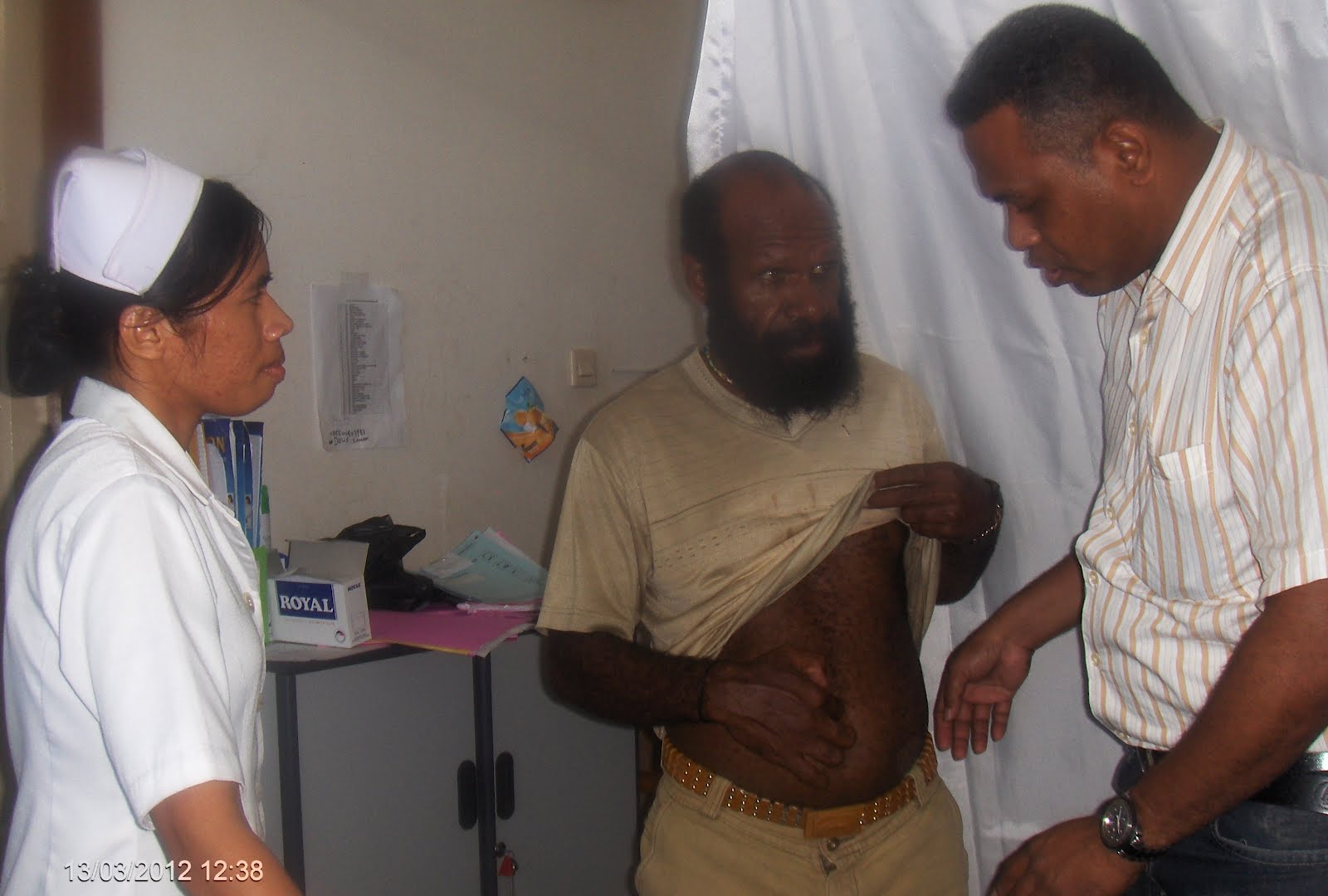
Papuan detainee Kimanus Wenda being examined by the doctor at Dian Harapan Hospital in Waena, Jayapura. ©Peneas Lokbere

KIMANUS WENDA, a prisoner usually detained in Nabire prison had an operation to remove a tumour from his stomach at Dian Harapan Hospital, Waena Jayapura on 14 March 2012.  Wenda is detained for treason (makar) and is serving a 20 year prison sentence.

According to Peneas Lokbere from United for Truth (Bersatu Untuk Kebenaran), an organisation which provides support for political prisoners in Papua, the operation began at 10:00 and lasted for two hours.

“After the operation he was transferred to the inpatient ward. The procedure went well without any obstacles,” said Lokbere.  A growth and a hernia were operated on, and he was given six stitches.

Wenda was hospitalised until Saturday 17 March 2012. On Satuday, Dr Trajanus Lauretius said that Kimanus could go “home” to the jail in Abepura, but that every Tuesday he needs a check-up at the Dian Harapan Hospital.

Lokbere took Wenda to Abepura jail on Saturday afternoon. On Sunday Lokbere came back to bring his medication.   According to Lokbere, Kimanus Wenda said that two staff from the jail came into his cell.  All his belongings – including his clothes and medicines – were turned upside down with no clear reason.  He was offended by being treated in such an impolite manner while he was just recovering from an operation.

Kimanus Wenda is actually listed as a prisoner at Nabire jail.  However he cannot return to Nabire at present because he needs to recover properly first and have the stitches removed from his stomach.

According to the Asian Human Rights Commission, Kimanus Wenda started
to complain of feeling ill in 2010, and was vomiting frequently.  The doctor at Nabire prison examined him and said that he needed to be examined in Jayapura.   However, the Ministry for Justice and Human Rights said that they could not pay for an operation in Jayapura.  They claimed they didn’t have the money to cover the costs of the operation.

An official of Nabire jail disagreed that Wenda was ill.  The proof?  Kimanus Wenda could still play volleyball in the prison field in Nabire.  His obstructive behaviour prompted Peneas Lokbere to gather funds for Wenda’s operation. Various non-governmental organisations have contributed to the cost of the journey, transfer between the Nabire and Abepura prisons, and the medication for Kimanus Wenda.

According to the Facebook page of TAPOL, an organisation which provides support for political prisoners, their internet fundraising campaign using the gofundme.com website raised £2,000, [which included £1,040 in direct donations and an anonymous private donation of £1,000 – TAPOL]. They channelled the funds through Peneas Lokbere and friends in Jayapura.

At present, Lokbere is monitoring Kimanus Wenda’s recovery in Abepura prison.  Once he recovers and the stitches are out, Wenda will return to Nabire prison.  According to Indonesian law, the Indonesian government is responsible for providing prisoners with healthcare.

However, the problem of budgets is often used by the Ministry for Justice and Human Rights as an excuse for not complying with this regulation.

Ironically, the Indonesian government has also banned the International Committee of the Red Cross (ICRC) from working in Papua since March 2009, despite the fact that ICRC often helps the families of prisoners to visit the detainees.  The ICRC also usually gives support for medication for prisoners, no matter who they are.

Peneas Lokbere and TAPOL are now collecting funds for an operation for Jefrai Murib who is currently in Biak prison.   Jefrai Murib is suspected of having suffered a stroke on 19 December 2011.  The left side of his body and his left arm and leg have lost all sensation. Murib has been examined at the Biak General Hospital, where the doctor’s diagnosis was that he needs to be examined at the General Hospital in Jayapura.

http://www.andreasharsono.net/2012/03/operasi-tumor-kimanus-wenda.html

Groups Urge U.S. Not to Sell Attack Helicopters to Indonesia

AH-64 Apache
AH-64 Apache (Photo credit: Wikipedia)
Press Release

Contact: John M. Miller, +1-718-596-7668; mobile: +1-917-690-4391, john@etan.org
Ed McWilliams, +1-575-648-2078, edmcw@msn.com

March 30, 2012 – Ninety organizations today urged the U.S. government and Congress not to provide deadly attack helicopters to Indonesia. Indonesia has announced that it plans to buy eight AH-64 Apache attack helicopters from the United States.

The groups warned that the helicopters will escalate conflicts in Indonesia, especially in the rebellious region of West Papua: “Providing these helicopters would pose a direct threat to Papuan civilians.”

The Indonesian military (TNI) regularly conducts “sweep operations,” involving attacks on villages where innocent villagers are forced from their homes. The groups write that “Papuan civilians either flee the attacks to neighboring villages or into the surrounding forests where many die or face starvation, cut off from access to their gardens, shelter, and medical care.” Sweep operations are now underway in the Central Highlands region of West Papua.

The letter was organized by the U.S.-based East Timor and Indonesia Action Network (ETAN) and the West Papua Advocacy Team and signed by human rights, religious, indigenous rights, disarmament and other organizations based in 14 countries.

Signers include: Faith-based Network on West Papua, Fellowship of Reconciliation, Peace Action, International Lawyers for West Papua, Land Is Life, KontrS (Indonesia), and Pax Christi Australia. A complete list of signers can be found here: http://www.etan.org/news/2012/03helicop.htm

The AH-64 is designed for air to ground attack. It can operate day or night and is armed with high caliber chain guns and equipped to fire missiles.

ETAN was formed in 1991. It celebrated its 20th anniversary this December 10, advocates for democracy, justice and human rights for Timor-Leste and Indonesia. See ETAN’s web site: http://www.etan.org

Text of Letter

As organizations concerned about human rights in Indonesia and West Papua, we are writing to urge the U.S. government and Congress not to allow the sale of AH-64 Apache attack helicopters to the Indonesian military (TNI). Providing these helicopters would pose a direct threat to Papuan civilians, who have been the target of deadly TNI assaults for many years.

The sale of this weapons system to the TNI — notwithstanding its long record of disregard for civilian casualties, corruption, human rights violations and impunity in East Timor, Aceh and elsewhere — would only increase the suffering of the Papuan population.

Indonesia’s Deputy Minister of Defense Sjafrie Sjamsoeddin told the Antara news agency, that  Indonesia intends to buy eight AH-64 Apache helicopter from the United States.

The heavily-armed AH-64 is a highly lethal weapon which can be used to escalate conflict within Indonesia and in West Papua. These aircraft will substantially augment the TNI’s capacity to prosecute its “sweep operations” in West Papua and thereby, almost certainly lead to increased suffering among the  civilian populations long victimized by such operations.

TNI “sweep operations,” including several now underway in the Central Highlands region of West Papua, involve attacks on villages. Homes are destroyed, along with churches and public buildings. These assaults, purportedly to eliminate the poorly armed Papuan armed resistance, force innocent villagers from their homes. Papuan civilians either flee the attacks to neighboring villages or into the surrounding forests where many die or face starvation, cut off from access to their gardens, shelter, and medical care.

The AH-64 is designed for air to ground attack. It can operate day or night and is armed with high caliber chain guns . It is also equipped to fire missiles.

Congress must be notified of major weapons sales. We urge Congress to oppose the sale of these helicopters.


Unconfirmed Reports of 3 Foreigners arrested in Fak-fak, West Papua

from West Papua Media and local sources
March 24, 2012
Unconfirmed reports are circulating that three foreigners have been arrested by Indonesian police in the west coast town of Fak-fak, West Papua, for taking photographs at a demonstration on MArch 19.
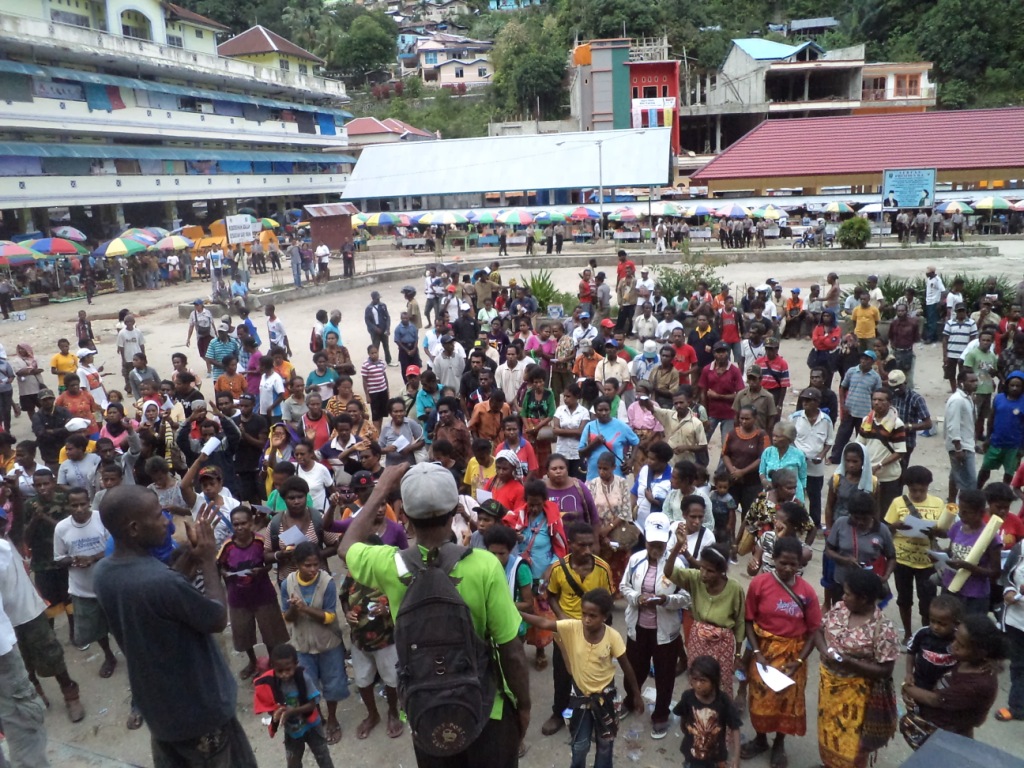
Rally in Fak-Fak, March 19, 2012
The rallies, which were held across West Papua and Indonesia, were calling on United Nations Secretary general Ban ki-Moon  to advocate for West Papua and pressure Indonesia to end human rights abuses in West Papua.  The UNSG was visiting Jakarta to speak at a Defence Policy expo and hold bilateral meetings with General Susilo Bambang Yudhoyono, the President of Indonesia.
The three men, identified as two British and one Canadian citizens, were taken by police to be interrogated after they were observed by intelligence officers taking photographs at the rally on Monday.
According to local sources, local police have claimed that the arrested men did not have a permit to enter West Papua,  are “part of a foreign interference”.
Foreigners must apply for a Surat Jalan (travel permit) to visit West Papua, and must report to a local police station or military post either daily or weekly.  Foreign journalists and human rights observers are banned by Jakarta from entering the Indonesian colony.  Due to this restriction, any non-Indonesian foreigner with a camera is subjected to surveillance.
Local police in Fak-Fak have not been available for comment.


Amnesty: Indonesia – Victims still waiting for truth and justice for past human rights violations

Amnesty International

AMNESTY INTERNATIONAL
PUBLIC STATEMENTIndex: ASA 21/012/2012
24 March 2012

Indonesia: Victims still waiting for truth and justice for past human rights violations

As the world marks the International Day for the Right to the Truth concerning Gross Human Rights Violations and for the Dignity of Victims, in Indonesia victims of serious human rights violations, including unlawful killings, rape and other crimes of sexual violence, enforced disappearance, torture and other ill-treatment continue to call for truth, justice and reparation for past crimes.

Amnesty International today urges the Indonesian Coordinating Minister for Political, Legal and Security Affairs, who is leading a team to resolve past human rights violations, to answer these calls by making the establishment of a National Truth and Reconciliation Commission a key priority.

The Commission should function according to international law and standards, including the Updated Set of principles for the protection and promotion of human rights through action to combat impunity. It should not substitute the responsibility of the criminal justice system in the country to investigate and – if sufficient admissible evidence exists – prosecute those responsible for grave human rights violations and crimes under international law. All victims should be guaranteed access to full reparation including restitution, compensation, rehabilitation, satisfaction and guarantees of non-repetition.      In 2004, the Indonesian Parliament passed the Law on a Truth and Reconciliation Commission (No. 27/2004), which provided for the establishment of a national truth commission with powers to receive complaints, investigate grave human rights violations which occurred in the past and to make recommendations for compensation and/or rehabilitation for victims. In 2006 the Indonesian Constitutional Court struck down the law, after it ruled that an article which provided reparation for victims only after they agreed to an amnesty for the perpetrator was unconstitutional. Amnesty International welcomed this ruling, as amnesties, pardons or similar measures of impunity for the most serious crimes and human rights violations such as unlawful killings, rape and other crimes of sexual violence, enforced disappearance, torture and other ill-treatment are contrary to international law.

Almost six years later, attempts to pass a new law and enact a national truth commission have stalled. Although a new law has been drafted and is scheduled for discussion in Parliament in 2011-2014; to date there has been no progress, with Parliament failing to prioritize debate of the draft in the 2012 legislative programme. The continued failure to debate and pass a new law in Indonesia leaves many victims without an effective mechanism for truth and full and effective reparation.

In May 2011, President Susilo Bambang Yudhoyono established a multi-agency team to devise “the best format to resolve grave human rights violations that occurred in the past”. The team has so far visited victims of such violations in various part of the country, including Talangsari, Tanjong Priok and Kupang. However, it has been criticized by human rights organizations and victims’ groups for failing to develop a concrete strategy to ensure truth, justice and reparation for victims.

All victims of gross human rights violations, crimes against humanity and other crimes under international law have a right to truth. Principle 4 of the Updated Set of principles for the protection and promotion of human rights through action to combat impunity states that “[i]rrespective of any legal proceedings, victims and their families have the imprescriptible right to know the truth about the circumstances in which violations took place and, in the event of death or disappearance, the victims’ fate”.

For victims, this right involves knowing the whole truth about the violations they suffered, including the identity of the perpetrators and the causes, facts and circumstances in which such violations took place. For family members, particularly of those who were killed or disappeared, it involves establishing the fate and whereabouts of their loved ones. Whether individual or collective, the right to truth involves the public acknowledgement of victims’ suffering. Truth commissions are also an important step towards understanding the circumstances that led to past violations, learning from the past to ensure that such crimes will not be committed again, and ensuring that shared experiences are acknowledged and preserved.

In addition to a lack of action at the national level, local attempts to establish truth commissions to deal with specific cases also continue to face delays. In the provinces of Aceh and Papua, civil society organizations are pushing for the establishment of local truth commissions, which are provided for in autonomy laws governing those areas. In Aceh a draft bylaw (qanun) has been on the legislative programme since early 2011 but is yet to be debated in the Aceh regional parliament, while in Papua, to date there has been no progress.

Amnesty International calls on the provincial and central government to prioritize the establishment of local truth commissions to ensure truth, justice and full reparation for victims and their families.

Efforts to deliver truth for victims and their families must form part of a wider framework of accountability for past crimes. Amnesty International calls on the Indonesian authorities to ensure that perpetrators of serious human rights violations are brought to justice in independent courts and in proceedings which meet international standards of fairness. Victims and their families must be provided with full and effective reparation under international law.

Amnesty International further calls on the Indonesian government to ratify the International Convention for the Protection of All Persons from Enforced Disappearance at the earliest opportunity, incorporate its provisions into domestic law and implement it in policy and practice.

Link: http://www.amnesty.org/en/library/info/ASA21/012/2012/en


Letters of solidarity flood in their thousands for Filep Karma

by a Special Correspondent for West Papua Media in Abepura

March 19, 2012

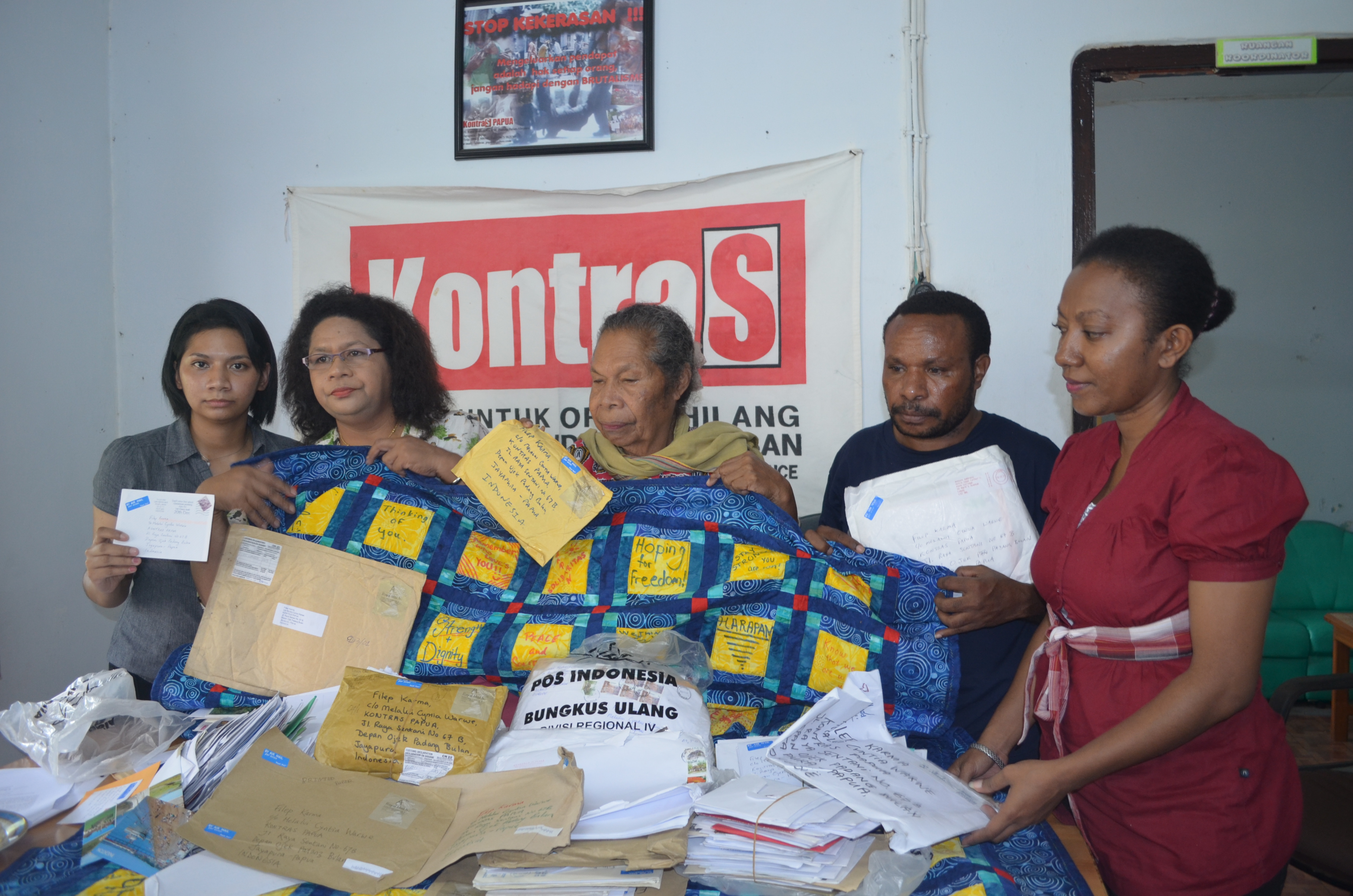
Kontras and Filep Karma's family with some of the nearly 7300 letters sent by international supporters of Karma (Photo: West Papua Media)

Filep Karma, is one of the political prisoners given sentences of 15 years of imprisonment by the government of Indonesia, by raising the Morning Star flag, on December 1, 2004, at Trikora field, Abepura. Ever since a period of 7 years, and 3 months of his prison sentence  have lasted in Abepura prison. During captivity Filep Karma received letters of solidarity sent by the International community through the office of the Commission for missing people and victims of violence in Papua (KontrasPapua).   Nearly 7292 letters of support have been sent in the period of 2011 untill 2012.

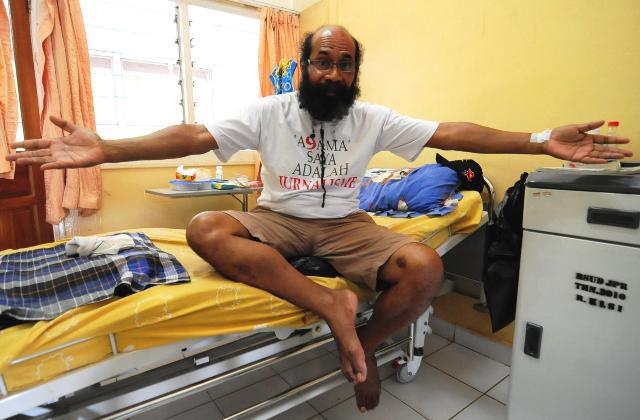
Filep Karma inside the prison hospital (Photo: West Papua Media)

United for the truth (BUK) and Kontras Papua held a Press Conference on March 19, 2012, and immediately submit a letter of support to the family representative of Filep Karma. Andrefina Karma,  Filep Karmas second daughter  said ” International Community support is strong solidarity for the freedom of my father, the people there once a month hold a simple campaign in front of the Indonesian embassy and called for the unconditional release of Filep Karma”, she said.

Letters that came from different parts of the world  proved that there is support for political prisoners in Papua. Olga Hamadi, Director of Kontras Papua says”  the government should not close her eyes  for the injustice suffered by political prisoners in Papua, both in conditions of health and food at the prison, which  received less serious attention”, she said. She also denied the statement by the Minister of Justice and Human Rights Republic of Indonesia during a visit to Papua saying that there are no political prisoners in Papua.

Filep Karma is one of  figures of political prisoners who never made a compromise with the Government of Indonesia. He rejected any form of clemency, amnesty, and abolition that is given by the Government. ” If I receive clemency, that means I ask for forgiveness to the government, but I do not feel guilty at all, I am just making a peaceful protest. Indonesia is a democratic country, am I wrong to fight for the basic rights of indigenous Papuans?

“I will continue to undergo a period of detention up to 15 years in prison, if you want to release me, I ask to be released unconditionaly”, Filep Karma said, as he was undergoing physiotherapy treatment in DOK II general hospital.

westpapuamedia

Create a website or blog at WordPress.com

Up ↑