STOP DANCING ATOP OF SUFFERING OF THE PAPUAN COMMUNITY!

Opinion

By Rufinus Madai

February 28, 2013

For 13 years now  government officials in Papua have been enjoying the benefits of the millions of Indonesian rupiah that has come its way thanks to the Special Autonomy package given by the Indonesian Government; and it’s undeniable that government officials at the provincial level as well as at the regency (local) level of the bureaucracy have allowed themselves to be ‘bought’ by this money.

They have allowed themselves to be bought in the way they think, at the level of their conscience and in regards to their sensitivity to the reality of what’s going on around them.  As a result of their ‘selling-out’, in every instance it’s the Papuan community that ends up suffering the consequences, suffering the loss.  The little people.

One can’t help wondering why in this era of Special Autonomy with all the money it brings into Papua, are we still seeing the constant suffering of the indigenous Papuan community.  Why are there still the constant injustices, the mistruths, the inequalities of the legal system and the destructive conflict that’s dragging on forever?  In fact one starts to ask the question whether the Special Autonomy is actually playing a role in creating that suffering.

Strange that in this ‘Special Autonomy’ era and with all the money that flows through that program, that the government bureaucrats are sucking the life from the Papuan community by selling off the resources of the land on which the people totally depend for survival, and meanwhile they stand idly by watching  the endless violations of the indigenous Papuan’s human rights.

The people are repressed, treated with inhumane cruelty, objectified, detained, chased, labeled separatists and even killed.   In receiving  such wealth for their ‘services’ they have become like purchased puppets of the Indonesian government.   Is it any wonder with these realities so obvious that the Papuan community time and again shows its distrust of the bureaucrats of the Indonesian government in Papua?

Whilst they enjoy the luxuries that millions of rupiah from Special Autonomy bring, the basic rights of the people are not even being considered and their sufferings go on and on without end.  We are not referring here to one remote corner of Papua but rather this is going on throughout the entire land of Papua.

The systems, policies and laws which have been created together with the Central Government to date have not only failed to bring benefit, but in fact have brought great loss to the indigenous Papuan community.   Such loss, that the  community has become convinced that the laws and policies created  for application in Papua are intended to repress and eventually annihilate the indigenous Papuan community from the land.

The government bureaucrats at the Papuan level are involved up to their necks! It’s as if they have become enchained to the big money Special Autonomy brings and they can’t break free.  Bought by the system.  No matter what they do or what decision they make under these circumstances whether regarding laws, policies or other, that will always be determined according to these ties.  Their decisions and actions are not based on good conscience made to address the needs of the people. The consequence being that the little people become the victims.

Until this time there have been no positive changes whatsoever brought about by the development programs as implemented by the government in Papua.  How could there be as the reality is that these programs in whatever form they may be, are not based on a recognition of the basic rights of the Papuan indigenous community!

They are not programs that help with poor education, or which address structural poverty or people’s basic human rights.  The Papuan community is well aware of this and believes that programs being implemented in Papua are simply those intended to support the vision , goals and programs of the National Indonesian Government.  Programs which increasingly marginalize the Papuan indigenous population, creating colonial domination, structural poverty, overpowering of the local community and ultimately leading to the death of the Papuan indigenous community.

The Papuan community is also well aware  of the way the two Provincial Papuan Governments to date have been operating,  acting  always in ways that prioritises their own tax revenue income whilst trampling on the land of the little people. Yet at the same time taking no actions in those areas where the community needs social laws to protect the people such as regarding the abuse of alcohol and the provision of sexual services.

The Indonesian Government knows it has ‘bought’ these government officials and that they are now tied tightly to and dependent on the National Indonesian Government.  Money speaks and in the same way money effectively silences voices concerning the constant human rights violations that are taking place right across the land of Papua.

However in spite of their having allowed themselves to be bought by the Indonesian government, nevertheless the Papuan community continues to hope that those Papuan  Government officials referred to will turn back to the people. That in so doing that they will  stop ‘selling out on’  the little people  of Papua, stop dividing the land further which in so doing divides the people,  stop making decisions in the interests of their own power and wealth and  stop acting in ways that support the vision and programs of the National Government and extending the conflict in Papua yet further.

The Papuan community continues to hope that the Papuan Government leaders will reject Special Autonomy so that they may not be dependent and tied in such ways to Jakarta. Continues to hope that these leaders finally may have the courage to themselves assert what policies and concepts of development are needed that truly support and are able to bring about improvements in the welfare of the ordinary people.

Such that the Papuan community might determine its own future on its own land.  Such that the paradigm of Papuans as being primitive, ignorant people who need others to organize them may come to an end. The little people of Papua have waited faithfully so long and yet still the tears flow without ceasing.

“May they who have ears to hear listen, may they who have eyes see,  and may they who have hearts and minds consider carefully and arrive at those  decisions that are right and that is acceptable to all persons.”
The Writer is a post graduate student at the Catholic Seminary in Abepura, Papua.

Blasius Sumaghai beaten by Indonesian Navy Officers in Bade, Mappi

February 20, 2014

from our partners AwasMifee, Majalah Selangkah,plus trusted sources in Mappi interviewed by both AwasMifee and West Papua Media

Mappi, Majalah Selangah – Blasius Sumaghai (23 years old), a resident of Bade village, Edera District, Mappi, Papua has been beaten by members of the Indonesian Navy. The reasons for the beating were not clear.

According to information compiled by majalahselangkah.com, Blasius
Sumaghai, the son of the late Abraham Sumaghai who was an Awyu community leader, was beaten by several Navy officers on the 26th January 2014. The beating meant that Blasius Sumaghai was unable to walk for four days. He is still in a fairly serious state of trauma.

This slideshow requires JavaScript.

The incident reportedly started as Blasius Sumaghai was seated outside a kiosk on Jalan Duyumu in Bade Village. Suddenly two Navy officers who were stationed at the Bade Navy outpost showed up. They showed no initial courtesy, just directly started striking the victim on his back and chest using the butts of their rifles

After the beating, our source said that the victim was brought to the
Navy outpost on a motorbike. On arrival at the outpost, he was beaten
over his whole body using rifle butts and hosepipes.  He suffered serious injuries.

It is reported that Blasius Sumaghai is not the only person to have suffered violent harrassment at the hands of the Navy.  Yustinus Akabagaimu, the 27-year-old son of local teacher Xaverius  Akabagaimu, has also been beaten up without any clear reason.

Yustinus is currently unable to walk as a result of the beating he
received. Several victims of harassment are unable to bring a case
against the perpetrators either because of fear or because they don’t
know to whom they should bring their complaint.

Majalah Selangkah‘s credible informant has said that that members of the security forces have often carried out beatings of young men in Bade when residents have reported that the men have done something wrong.

“But that’s what the police are for. What is Bade Police station doing?
The police are clearly tasked with maintaining law and order. The Navy’s role is to fight wars against other countries. Why should the navy take over the Police’s job right in front of their face? It’s very strange”, said the aforementioned source, sounding surprised.

The police in the Bade Police Station reportedly cannot be counted upon to maintain law and order in the area. As the community were celebrating Christmas 2009, the festive season which should be full of happiness was tainted by the murder of a young local man, Stefanus Silooy (38). He was killed by three police officers. This incident ended up with the community destroying the local police station.

In fact, a naval outpost in Bade is not strategic for national defence, because Bade is located on the shore of the Digoel River, and not on the coast. The town should really be guarded by a water-borne police unit.

So why is the Indonesian Navy present in Bade? Actually they are there to demand tribute from plywood and palm oil companies:  the Korindo group in Asiki which has been operating since the nineties and PT MAM* which has recently commenced operations near Bade.

Bade is a strategic port town, because all the plywood and Crude Palm Oil produced by PT Korindo in Asiki can only be transported by one route, the Digoel River. Bade represents the entrance and exit to this river system.

Source: Majalah Selangkah

[awasMIFEE / WPM note: a source (also in contact with WPM directly)  in Mappi has interviewed the victim and passed on these photos of his injuries, and also a letter from Blasius Sumaghai and his family addresses to the Governor of Papua Province, reproduced below in English. WPM has translated it despite the content being very similar to the Majalah Selangkah article above, and it is worth highlighting that the family request action be taken against the perpetrator and to close down the Navy Outpost.

*The article mentions a company named PT MAM, but this is slightly erroneous. MAM is the name of the location where another Korindo subsidiary PT Dongin Prabhawa has an oil palm plantation. Bade is on the Mappi side of the Digoel river, but lies close to the border with Merauke Regency – PT Dongin Prabhawa’s plantation is also just a few kilometres away.]

Open Letter: And so the Inhumane Cruelty of Indonesian Armed Forces Against Papuans Continues…..

By SOURCE in Bade, Mappi Regency in West Papua

15 February 2014

It seems the bitterly cruel treatment of the Papuan indigenous community by the Indonesian armed forces will never come to an end. This time their cruelty has been unleashed on a young 23 year old man by the name of Blasius Sumaghai from Bade in the regency of Mappi in the far southern region of Papua. The incident involved use of brutal unrestrained violence against Blasius by two members of the Indonesian Marine Corps on 26 January 2014. Blasius is the son of a well known figure from the Awyu Tribe called Abraham Sumagahai and had done no wrong whatsoever that could have given reason for the ruthless attack by the marines. The attack on Blasius left him severely traumatized and unable to even walk for four days following the incident.

The incident occurred when Blasius was sitting in front of a kiosk (at Duyumu Road in Bade) at around 1945 hours on 26 January. Two members of the Marine Corps working at the Bade Post approached him without clear reason and started viciously beating him, striking him across his back and chest with their rifle butts. They then forced him into their vehicle and took him to their military post. They continued to strike him over his entire body with their rifle butts and a hose, leaving wounds over his entire body.

Blasius is by no means the first victim of such cruel tyranny by the Indonesian Marines in Bade. There have been numerous young people from the Bade Papuan indigenous community who had suffered seriously at the hands of the Marines in Bade but whose names cannot be mentioned due to their fears of retaliation. Many have no idea to whom they could possibly safely report things that have happened. To name just one, another 27 year old man Yustinus Akabagaimu (son of the local school teacher Xaverius Akabagaimu) was beaten so mercilessly by the Indonesian Marines in 2013that he is no longer able to walk to this date.

A trustworthy source stated that the brutal treatment of local Papuan youth by the Marines usually occurs due to a citizen having made a report to the Military Post that a certain youth has done something wrong, following which the Marines immediately find and arrest the youth, beating them far beyond the limits of what is humanitarian.

To understand what’s really going on behind these regular incidents of unwarranted violence against citizens, once must question the very existence of a prime Indonesian Military post in Bade. It’s hardly needed for national defense reasons, as Bade is located on the edge of the Digul River. It’s not as if it’s a strategic location bordering with another nation or the like. So why should the second largest base for the Indonesian Marine Corps in the entire southern region of Papua be located on the edge of a river in Bade? The answer lies in the fact that the location enables the forces to demand ‘tribute’ from the nearby multinational plywood and oil-palm company Korindo (in Assiki) and also from a second company which has recently been opened at a location also close to Bade. In terms of Indonesian economics Bade is a key location for these companies as their products are shipped out only along the River Digul. There is not only an Indonesian Marine Corps Post at Bade but also a Police Post, a Regular Military Post (TNI), an Indonesian Army Shore Unit (TNI-AD).

The community leaders of the Papuan community of Bade in response to the frequent violence by the Marine Corps against the indigenous Papuan community, call on the Governor of Papua Lukas Enembe :

i) To immediately take stern disciplinary action against those members of the Marine Corps in Bade who have been unleashing brutal cruelty against the indigenous people of Bade.
ii) To close the Indonesian Marine Corps Post in Bade
iii) To carry out an investigation as to the reasons for the existence of the Marine Corps Post located at Bade on the banks of the Digul River.

Footnote :

Bade is located in the south of Papua in the district of Edera in the Mappi Regency which borders the region of Merauke.

Papuan cultural parade blockaded then broken up by Jayapura Police

From KNPB and West Papua Media sources in Jayapura

February 20, 2014

https://westpapuamedia.info/wp-content/uploads/2014/02/565e1-dscf2364.jpg
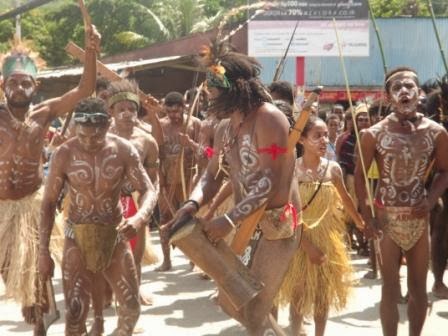
Traditional Cultural Action, Jayapura, 17 February 2014

A cultural parade organised by university students in Jayapura was blockaded and then dispersed with force by Indonesian police on February 17, after Indonesian police refused to recognise West Papuan cultural expression.

The demonstration of culture, music, art and dance from across Papua’s indigenous tribes, in which several hundred students in two groups marched wearing traditional Papuan dress, was to highlight the demand of “Save the Papuan Culture”.  The manifestation was organised by the Youth Coalition for the Rise of Students (Koalisi Pemuda mahasiswa bangkit or KPMB) and the Cenderawasih University’s (Uncen) Student Executive Body (Badan Eksekutif Mahasiswa or BEM).

This slideshow requires JavaScript.

Speakers, songs and dances were performed from 8-10am local time in two locations, outside the Uncen Waena Housing Complex (Perumnas III) and in front of the post office in the town of Abepura, and at 10am, the Perumnas III mass began to march and dance their way to Abepura.

However Police blockaded the mass action once the crowd reached the Waena traffic lights.  Despite having previously notified police of their intention to hold the parade, field coordinators of the action were forced to negotiate with the police, pointing to the KPMB’s intention to hold a peaceful action that day in the form of Papuan cultural art.

However, in an outburst witnessed by a West Papua Media stringer, the Deputy Commander of the Jayapura District Police, the notorious hardliner Kiki Kurnia refused to let the gathering continue, warning the crowd that he would not tolerate “introducing some culture from an unknown place”.  “There is no such culture such as that in Indonesia,” Kurnia asserted, dismissing over 45,000 years of Papuan language, culture and art.

Kurnia then prohibited the students from displaying any form of Papuan culture, and further stated that the crowd “was prohibited from carrying out any action of any form whatsoever as the Governor had prohibited all forms of actions,”. according to independent sources and verified by WPM.  Just after 10am local time, ordered several platoons of heavily armed police to blockade and disperse the cultural gathering.  Several injuries were reported but unconfirmed.

After being forcefully dispersed,  a much larger mass returned and gathered in front of UNCEN’s main entrance, lighting a bonfire on the road in response.  According to witnesses, this crowd was spread out as far as Perumnas III in Waena, a distance of several kilometres.

According to the cultural event organisers, the crowd outside UNCEN was angrily voicing their objections to the continued silencing of the democratic space throughout all of Papua by the Police, with speakers expressing outrage at the betrayal of the culture of Papua.

“That the police had been obstructing the mass action stating ‘Where are you bringing this culture from? We don’t have any culture like that in Indonesia’ angered us all, as it is seen as a denial of the Papuan culture,” an organiser told West Papua National Committee (KNPB) media workers.

Members of the gathering clearly spoke out that if the police continued to betray and deny Papuan culture in such a way, that Papuans would mount an even larger scale action asserting the Papuan culture, and that they would boycott the 2014 presidential election, according to reports from the KNPB.  The action Coordinator Beny Wetipo then called upon the Papuan community and all parties to save the Papuan culture from being replaced by a foreign culture that was threatening the existence of the Papuan race.

Paniai torture victim Yulianus Yeimo beaten, murdered

by John NR Gobai

(with additional reporting from WPM stringers in Paniai)

January 31, 2014

ANALYSIS

“Tolong…, Tolong…, Tolong.., “Naitai Ugatame wae…, itoo ko anii bokaga noo… “

(‘Help….Help….Help… Father God my Creator, at this moment I have died.” In the local Mee language)

Yulianus Yeimo after his beating  in November 2012 (Photo: WPM sources)
Yulianus Yeimo after his beating in November 2012 (Photo: WPM sources)

This scream to God for help in a state of great pain was uttered by Yulianus Yeimo, aged 45 years old, an ex primary school teacher who suffered mental illness towards the end of his life.  In 2008 Yulianus had  completed education at a higher level for teachers at the ISSP Institute in Enarotali, Paniai, obtaining a degree in Social Sciences.

The most saddening incident of violence against Yulianus occurred on 18 August 2012  at around 0900 hours. For 3 years since 2009 until that date, Yulianus Yeimo had always worn the old faded and shabby police uniform left by his late father together with matching shoes. Each morning he had climbed the hill of Bobaigo then when he reached the top of the hill he would take his position before the white and red Indonesian flag that flew (which at that time was flown by the Indonesian military at that location). He would spontaneously show respect to the flag and then take it down. Yulianus had become a little mentally disturbed and he acted each morning in this routine as if he was a member of the Indonesian Police force. His father before him had been a police officer under the Dutch so Yulianus remembered the ways of his father.

That day the flag that was in his hand and became into three pieces. One part was tied around his left arm, one part to his right arm and the third part around his head. After he descended from the hill he walked towards the town of Enarotali until the place where three roads meet leading to Kogekotu.  When he passed there in the direction of PLTD Enarotali, a group of immigrants approached him and immediately launched an attack on him punching him in the face.  Once knocked down he was kicked again and again in the chest. His head was beaten using an iron bar and a stick.  Collapsed on the ground his face and chest were trampled on again and again. Blood flowed from his face and nose.

“Tolong…, Tolong…, Tolong…, “Naitai Ugatame wae…, itoo ko anii bokaga noo…,”  he called out to God in the local Mee language.

His screams of pain were not enough to move the hearts of the group of immigrants wearing ordinary civilian clothes who attacked him. Bruised all over, he was then beaten yet again by the group. This time with a rifle butt so that it broke his nose. A lot of blood came from his nose so that blood was all over his body. He screamed out pleading for help,  moaning in pain and sobbing then cried:

 “Tolong……, Tolong…….Tolong………

“Naitai Ugatame wae……….itoo ko anii bokaga noo………”

He was dragged a few meters then forced to stand but fell, then was dragged again. His head and body were beaten again with the iron bar. He was forced to stand but fell again and was dragged again until the asphalt road. Then at approximately 100 metres from the kiosks on the corner of the airfield at the front of PLN Enarotali, his body was left sprawled on the ground unconscious. Not long after he was dumped a Police patrol vehicle from East Paniai came and took him to the East Paniai police station for security reasons. After he had regained consciousness he was sent home.

(Author’s Note : We acknowledge that for a person of normal mental health an incident of tearing the national flag would be an insult to the State, but for a person who had not been mentally well since 2009 does such punishment make any sense?)

It is suspected that Indonesian military (TNI) and police had been carrying out retaliation at that time against the Paniai community, with the result  that even a person who was mentally unwell had become a victim of their aggression. It is suspected that the TNI were supicious that Yulianus Yeimo was not in fact mentally unstable.

On 25 January 2014 at 0700 hours Yulianus Yeimo was found dead at the Boutai River at the village of Dagouto in East Paniai, with injuries on his nose, chest and face and with impressions in a number of places on his body.

According to Yulianus Yeimo’s family it was four days before his body was found.  He had not been seen for that period. He was suspected to have become a victim of violence of an unidentified assailant and that the violent act had been committed on the shores of the river then the victim’s body thrown into the Boutai River.

Our analysis of his death is as follows :

1)    That Yulianus Yeimo became the victim of violence of unidentified person / persons on the banks of the river, then his body was thrown into the river so that it would be concluded that Yulianus died from drowning.

 2)    It is suspected that Yulianus Yeimo was killed by either a ‘silent operation’ or alternatively was a victim of retaliation.

We (The Traditional Customary Council Paniai )demand the following:

1)       That the Head of Police in Papua and the Commander of XVI Bumi Cendrawasih immediately give instructions to the Head of Police in Paniai to carry out an exhaustive investigation into who was responsible for the violence against the late Yulianus Yeimo.

2)       That the Head of Papuan Police and the Commander of XVII Bumi Cendrawasih immediately cease all military operations including road patrols in Paniai as the area is not a security risk and is controllable without those forces.  We acknowledge that it may be a work task of the Forces however at times the Forces fail to become aware which circumstances present  security situations and risk becoming unstable.

3)       We request that the Commander of XVII Bumi Cendrawasih withdraw all military personnel, both regular and additional forces now in Paniai, including Kopassus, Paskhas and National Intelligence personnel. Furthermore that the Head of Police in Papua withdraw its members from the gold prospecting area of Paniai as their presence only creates mistrust between the forces and the community.

John NR Gobai is the Chairperson of the Traditional Customary Council Paniai and a long time human rights investigator.

Papuan human rights hearing at European Parliament a step forward

from West Papua Media stringers in Jayapura, and Tabloid Jubi in Brussels

January 29, 2014

News AnalysisDSCF2191 - Copy - Copy

Efforts to the highlight the issue of ongoing human rights abuses in West Papua to European institutions took a significant step forward last week, as a coalition of international civil society groups testified at a special European Parliament hearing in Brussels this week.

According to sources in Brussels, the Human Rights Subcommittee of the European Union Parliament in Brussels held a hearing on the situation in West Papua.  The hearing was organised after a large number of international human rights NGOs sent letters to the committee outlining violations in the occupied territory.

Outlining the precarious state of media freedom in West Papua, Victor Mambor from the Alliance of Independent Journalists (AJI) – Jayapura, presented the AJI findings on  cases of violence against journalists in Papua, calling on the EU to ensure the protection of media freedom in Papua.

“There are still double standards in Papua and Indonesia when it comes to media freedom and the application of the press law,” Mambor explained. AJI had documented 22 cases of threats and violence against journalists in Papua in 2013.

According to the International Coalition for Papua,  Members of the European Parliament stressed that the situation in West Papua had too long been ignored in discussions and called for closer involvement.

Last week, the EU Parliament’s Foreign Affairs Committee adopted a report recommending  the preparation of an EU- Indonesia Partnership and Cooperation Agreement.  Member of the European Parliament Anamaria Gomes  emphasized that this agreement should be the framework for the parliament to look further into the conditions in West Papua.

Meanwhile in Papua, despite an ongoing threat of dispersal by Indonesian security forces, Papuan civil society groups successfully held peaceful manifestations in several centres across Papua over two days, calling on Indonesia to restrain itself, and for the European Union to take action on human rights abuses in Papua.

This slideshow requires JavaScript.

In TImika, the colonial mining town downstream from the massive Freeport gold and copper mine, members of the KNPB and West Papua Regional Parliament held an impromptu photo exhibition of human rights violations in West Papua outside the Papuan parliament office.  Prayers and speeches followed with discussion and support of the European Parliament meeting underway at the time.  Unusually, no reports were received of any threats or intimidation from Indonesian or Freeport security forces, and the gathering dispersed peacefully.

Papuan students successfully conducted peaceful rallies in Jayapura and Merauke on the 23rd of January, to highlight the subcommittee hearing.   A small gathering of the Papua Student Movement (GEMPAR or “uproar” ) held the demonstration outside the front gate of Cenderawasih University (UNCEN ) in Jayapura.

Students spread a large banner at the front door of UNCEN , which included some photos of human rights abuses by army / police against indigenous Papuans . Gempar organiser Alfa Rahmadodo said at the gathering,  “we ask the International (community) to urge the Indonesian government to stop human rights abuses and suppression of democracy in Papua, and we support (the news that) European governments will discuss about human rights in Papua.” .

In Brussels, Norman Voss, from Human Rights and Peace for Papua, an international coalition of faith-based and civil society organizations (ICP), called for the release of all political prisoners in Papua and reminded of the long outstanding visit of UN human rights mechanisms to Papua. “Papua needs to be opened up and international human rights norms be realised for Papuans. A peaceful and sustainable change cannot be expected in a climate of fear and repression of political dissent.”

In June 2013, the UN Human Rights Committee in Geneva reviewed Indonesia’s implementation of civil and political rights and urged Indonesia to lift the restrictions on freedom of expression and opinion in Papua.

Zely Ariane from the National Papua Solidarity in Jakarta explained that “the Indonesian government should admit that the state of human rights in Papua is serious.” She called on the EU to put pressure on the Indonesian government to continue their commitment to conduct a dialogue with Papua.

(European reporting from Tabloid Jubi)

Create a website or blog at WordPress.com

Up ↑