Exclusive Footage has been supplied to WestPapuaMedia showing Indonesian riot police attacking a Papua owned taxi van, in Waena, near Jayapura, West Papua, earlier today (April13). The taxi was caught amidst the nonviolent demonstration called by the West Papua National Committee (KNPB) supporting the bid by the United Liberation Movement for West Papua (ULMWP) for full membership of the Melanesian Spearhead Group (MSG).
Indonesian police had claimed in a statement earlier today, reportedly issued before the conclusion of the incident filmed according to journalists on the scene, that the damage was caused by “KNPB Members action which was destructive, Anarchic, etc.” Respected independent journalist Victor Mambor tweeted immediately after, that the “media were expecting this police statement”, and that this was the normal “Modus Operandi” of police.
Indonesian police have “already memorized” the narrative, Mambor tweeted.
However, the video clearly shows a platoon of Indonesian Brimob riot police running amok (an Indonesian term), smashing the glass with a flying martial arts kick, and using batons, fists and clubs, which were also used to beat up nonviolent protestors.
Video uploader Marthen Manggaprouw told WestPapuaMedia, “This video shows the brutal actions of the national police officers while performing security on Peaceful Demonstrations coordinated action by KNPB, Gempar, Uncen and USTJ Students.”
Manggaprouw described the “brutal action was performed when the masses are doing a peaceful demonstration outside Housing 1 complex in Waena, Jayapura.”
“The security Apparatus put through beatings and destruction of many vehicles used by demonstrators. Police also damaged taxis. You can see it clearly as you watch the video,” he explained.
By JPIC-GKI Nabire* with additional reporting from West Papua Media
February 2, 2016
apologies for the delay in publication due to verification and translation delays
On December 1, 2015 the indigenous Papuan community in Nabire intended to hold worship to commemorate the December 1 Day of Papuan Independence at the community park of Oyehe, Nabire. However organisers were unaware their worship service in the park had been prohibited by Indonesian Police as an illegal gathering A joint Army and Police force dispersed the gathering with force, severely beating civilians, and then took arrested civilians to the Police Headquarters in Nabire.
Chronology
Every 1st of December in Nabire, a Christian worship service is held to commemorate the anniversary of thwarted Papuan independence, but it goes ahead without raising the banned Morning Star Papuan independence flag. For the 2015 commemoration, the Papuan Community in Nabire announced and sought permission from the Kapolres (District Police Chief) to hold a Worship service at Oyehe Garden, Nabire, however the Kapolres disallowed it from going ahead. Organisers cancelled the event, but many people didn’t find out about the cancellation, so they came anyway to the venue
The joint Army-Police force blockaded the garden entrance, so that the community could not access the venue, however more civilians arrived and stood outside the blockade.
Leader of the worship group, Zet Giay, attempted to come to the garden to explain to the gathered people that the Worship had been cancelled, however at 10:30 am Security forces ordered the dispersal of the gathered crowd. This occurred without any negotiation with Zet Giay, and so the joint Army/Police task force severely beat, attacked and arrested Zet Giay, Mikhael Zonggenu, Mirna Hanebora and another 29 Papuans, with rifle butts and pistols, according to witnesses and victims On the truck, Mikhael Zonggenaw was beaten by a police officer severely with a rifle butt. All 32 people who were then taken to the Nabire Police HQ sustained injuries from the security force beatings.
The Papuans that were arrested on December 1st 2015, around 10:30 am in Oyehe, Nabire are;
1. Mikhael Zonggenau, 45, Civil Servant , injuries to Nose & Mouth;
2. Zeth Giay, 42, Civil Servant , beaten on head with wooden pole;
3. Pius Gobai 19 years old, Student;
4. Yosep Giay, 18 years old , Youth;
5. Hendrikus Yeimo, 18 years old , Youth;
6. Naftali Gobai, 19 years old, Youth;
7. Yanuarius Pekei, 19 years old, Youth;
8. Anton Kadepa, 18 Years old, Student;
9. Martinus Youw, 19 Years old, Student;
10. Marthinus Adii 23 Years old, Academic;
11. Peni Kayame, 18 Years Old, Student;
12. Sely Ogetai, 26 Years old, Academic;
13. Derika Keiya, 27 Years old, Academic;
14. Samuel Kotouki, 23 Years Old, Student;
15. Agus Auwe, 22 Years Old, Youth;
16. Yus Degei, 24 Years Old , Student;
17. Angkian Douw, 23 Years Old, Student;
18. Yulibert Pigome, 16 Years old, Student;
19. Neles Waine, 15 Years old, Student;
20. Mesak Wakey, 26 Years old, Youth;
21. Bernard Belau, 31 Years old, Civil Servant;
22. Habel Douw, 56 Years old, Civil Servant;
23. Lince Waine, 22 Years Old, Student;
24. Willem Ikomou, 24 Years Old, Student;
25. Mina Hanebora, 33 Years old, House wife;
26. Nelius Pigai, 26 Years old, Academic;
27. Melkias Douw, 16 Years old, Student; With 5 unknown name victims. Total of the victims are 32.
Top: Mikhael Zonggenaw’s Upper lip was beaten by the Police. Bottom: Martinus Adii, Lower lip was beaten by the PolicePicture of 32 Papuans that was arrested by the Police in Nabire, Papua. The picture was taken after they were released from Nabire District Police office. When they were arrested they were not allowed to take pictures. Source : JPIC KINGMI Nabire.
*Justice, Peace and Integrity of Creation (JPIC) Desk (Keadilan, Perdamaian dan Keutuhan Ciptaan (KPKC) Bidang), Evangelical Christian Church in Papua (Gereja Kristen Injili di Tanah Papua (GKI))
The creation of human beings is indeed one of the brilliant works of God, giving freedom to humans to choose between right and wrong, good and bad. It is the very intelligence of humans which differentiates us from other living things in the creation. We are indeed unique. Animals share the characteristic of humans that they tend towards using violence in order to defend themselves. Animals also have instincts.
Unlike human beings, animals don’t possess the means to be able to evaluate the appropriateness of actions.. The instinct of animals is but one of survival. Yet despite the “higher level intelligence” of humans, at times they will act not just out of an instinct to survive when threatened, but rather as a predator against their fellow humans. (Something like a group of lions which may seize by violence the territory of another lion group.)
Sadly there are far too many instances of such predatory behaviour being seen in Papua against the indigenous people of the land.
Humanity – one would have thought – should have ceased using violence against their fellow beings long before this point in human history. What’s more those nations that call themselves ‘civilised’. It is appropriate that human violence only be tolerated when one nation is faced with an threat to their safety by another nation. So then violence would only be used in a way that is legal under human law (to defend) against that which is carrying out the wrong.
However here in Papua violence is being systematically used not against criminals, but against the people.
The State versus the Community
A State has a certain authority recognised in the protection of its community. It is regarded as the ‘protector’ of the people. Instances of the use of violence by a State should only in the context of protecting its people from some threat of harm. Violence should never be used by the State against the community itself. However what has been occurring in Papua in recent times is totally paradoxical to that (notion).
Although it is forbidden to openly admit that the Indonesian State is opposing the very community that it is supposed to protect in Papua, the fact is that frequently the Papuan community does feel as if it is being regarded as the ‘opposition’ of the State. Particularly around instances when the State forces its own will onto the people. National policies applied in Papua largely can be said NOT to be representative of the Papuan context, nor the needs of the local community. Often heard on the streets in response is “What is asked for is one thing, what is given is another.” This is a reality. The policies are not in accordance with what is asked for, or even what is wanted and hoped for by the community.
It seems likely that violence has been adopted as the one and only ‘solution’ of the State of Indonesia to solving the problems in Papua. At those moments when the community is seen to oppose the will of the State, indeed this seems ever so clear. However Indonesia does not seem to recognise that the violence of its agents is having a counter productive result: among its ramifications is that the State will predictably lose legitimacy and the trust of the Papuan community. This is an important matter for the state, which will only be changed by the State having an approach of dialogue and treating people humanely.
Obviously we are all human beings and that we should as much as possible be using means that are humane and civilised. Would it therefore not be preferable that when a government (representing the power of the state) is adopting any policy that profoundly effects the community, that they would seek the opinion of that community to be affected, prior to that point? The government must not just hide from its obligations, seeking protection behind legalities of power, with statements like ‘This is in accordance with legal procedure’. They must stop the inherent power games against the community, claiming that ‘This is in accordance with a legal decision, so it must be implemented’.
The State must seek to bring about justice and peace for the people, not the opposite! The law is an instrument to be used to attain a civilised state of affairs and good for its citizens, not to be used to spill the blood of the people and create death and tragedy in their lives. The recent human history of Papua is indeed full with the spilling of blood and killing of the Papuan people. There has been absolutely no episode of life for Papuans in this era where there has been a real peace and a lack of violence in the land against its people. The violence itself has become like a little king, a ruler in Papua. Indeed it is no mistake to say that a ‘smooth’ genocide has befallen the indigenous community of Papua.
‘Smooth’ Violence
The State violence in Papua is clothed with a smooth, soft touch. Those that commit the acts of violence and create the anarchy wear security hats and are referred to as the so-called ‘protectors’ of the community. This is a fact of what is happening. Far from the ideals of ‘Peacekeeping and protection,’ it seems have been watered down to meaning ‘closing down (cultural) pride actions that might otherwise arise’.
It’s up to each of us to interpret what is really going on in relation to those wearing those ‘hats’ in light of the realities in Papua. The Writer sees it as a ‘smooth’ violence, a ‘refined’ violence being committed against the people. This really can damage the sense of peacefulness in the community. Even the justice spoken of in the Constitution of the Republic of Indonesia 1945 is damaged as a consequence of this neglect by the State of its people.
The State could try just once in a while seeking the opinions from the community regarding policies in Papua. If the majority of opinions sought were in agreement with the policies, by all means continue to apply them. However if the community does not agree, they must be discontinued. Unfortunately there is no such mechanism as this in existence; It is but utopian as the role of the community should already be represented by the Papuan Legislative Assembly (DPRD). They are the ones in the Indonesian structure which represent the community. There is no use regretting this as this is the mechanism which we chose democratically.
The DPRD has an incredibly obvious shortcoming. All manner of aspirations of the people that reach their desk are in one way or another overlooked. As the representative of the community that sits in the most respected of positions it feels indeed like there has been some sort of ‘cutting off’ of a limb. Both attention and partiality of the DPRD towards the Papuan community are severely dulled.
It is truly hoped that the games of violence in Papua – whether of the ‘smooth faced’ type or more crude forms of violence against the people – might be questioned. The hats of the ‘peacekeepers and protectors’ must be removed as the proliferation of Indonesian military forces in Papua is not the solution! Violence is not the solution and neither is money the solution. The solution lies in listening to the true desires of the community. Not the wishes of the Papuan government officials who have no genuine concern for the suffering of the Papuan indigenous community.
The Author is a Church Worker in Timika, Papua.
Translated, annotated and edited by West Papua Media for linguistic clarity. The religious views espoused in this Opinion piece are the author’s own and not necessarily those of West Papua Media.
Jayapura, Jubi – The destruction of Papuan culture is gradually happening and is threatening the lives of indigenous people, a student group said.
The issue at heart is not the reduced number of Papuans, or rates of birth and mortality, but most importantly is the loss of cultural values, patterns of dispossession (being ignorant of the sacred connection to land), a ban on the use of indigenous languages in some urban schools, as well as the loss of indigenous content education in school, said the Chairman of Papua Highland Student Association in Indonesia (AMPTPI) for Eastern Indonesia Region, Natan Naftali Tebay.
Tebay said the most crucial issue is the loss of customary tenure rights on land, water and the values of life. “The process of land conversion such as sago forest being destroyed for oil palm plantations, is a process of extermination of the values and Papuan planting heritage ,” Tebay said in Jayapura on Monday (19/10/2015).
According to him, once Papua was recognised as the “sago barn” but it is now recognised as the “oil palm barn”. During this time the levels (of indigenous) population in Papua were politicised (inflated with inaccurate data) by some bureaucratic elites, with claims the population of Papua grew to more than three million.
“The Papua Provincial Government should be firm and realistic about the population rate of indigenous people. The Regional Parliament, Papuan Representative Council, Papua’s People Assembly and Papuan Provincial Government must not stay still and (just) watch the reality of genocide,” Tebay said.
He added they must establish strategic planning, such as forming a Special Regional Regulation, or establishing particular institutions to manage the transmigrants, and enforce sanctions over them if necessary.
“This is also prohibiting the development process. The Central Government also implements several policies that are not in synergy with the Governor’s policies. The regents and mayors must observe this situation, therefore they shouldn’t necessarily ask the Central Government for support,” he said.
It could be seen that several oil palm plantations, illegal logging and illegal fishing went ahead without any prior communication (or permission) from the Provincial Government.
Further he asked the Papua Governor to immediately issue the regulation about the population restriction and form a special body about the population issue in Papua. He also suggested the requirement of the regulation of local transmigration be extended both to people and government officials.
Earlier, the Papua Governor Lukas Enembe said the transmigration program in Papua initiated by the Minister of Villages, Rural Development and Transmigration Marwan Jafar was a depopulation threat for indigenous Papua.
“We have rejected the transmigration program from the Central Government. If they still want to realise it, it should be a local (ethnic Papuan) transmigration (within Papua) instead of replacing people from Java or other regions to Papua. Replacing poor Indonesian people to Papua means taking the problem to Papua. It’s not only related to the economy, employment, or social problems, but I do worry that the program will reduce the number of indigenous Papua on this land in ten or twenty years; the depopulation of indigenous Papua,” Enembe told Jubi at his official resident on Saturday evening (17/10/2015) in Jayapura.
Furthermore, Enembe said until today no institution has the valid data about the number of indigenous People. “So how could we protect the indigenous Papua from transmigration is still running without knowing the accurate data on the number of indigenous people?”
OIL PALM COMPANY IN NABIRE SUPPORTED BY PAPUAN BRIMOB POLICE FORCES
August 25, 2015
By Santon Tekege for West Papua Media
Nabire based human rights activist Gunawan Inggeruhi has stated that an oil palm company managed by PT New Nabire and PT SAD, has caused uneasiness amongst citizens of Wami and Sima, Yaur district, in Nabire region.
Citizens in this area have been falsely and maliciously stigmatised by the companies as being suspected OPM (Free Papua Movement) members or activists, with the result that they are constantly made frightened and anxious by security forces.
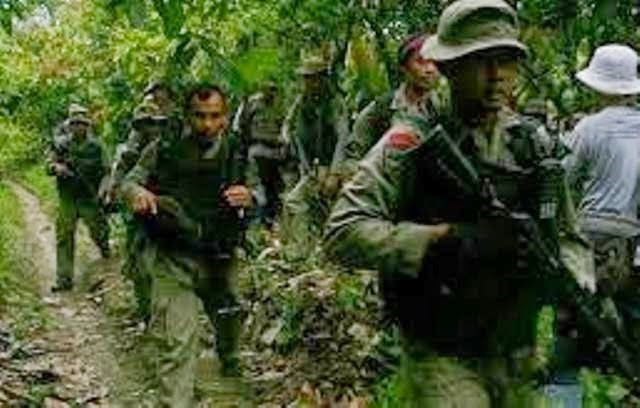
Joint Brimob/TNI sweep team in Nabire oil Palm plantations. Photo:FIle
On 4 January 2015, paramilitary BRIMOB police forces arrested a villager who is the traditional landowner of the location, by the name of Otis Waropen (aged 34 years). He was arrested at the PT New Nabire oil palm company plantation in the village of Wami in Yaur District, Nabire. In a direct telephone interview on 22 August 2015, Waropen revealed that he was arrested by BRIMOB police on “suspicion resulting from stigmatisation of being an OPM member,” and “on suspicion of making a movement of troublemakers in the vicinity of the PT New Nabire Oil Palm plantation.”
“It is not only (waropen) who has experienced such stigmatisation from BRIMOB who are acting as the protectors of that oil palm company,” Gunawan Inggeruhi told me.
“Many citizens who claim their traditional customary land rights, asking for the company to be closed and its license to operate be revoked, have been accused of being OPM members and ‘part of a movement of troublemakers’. When in fact the reality is that those who make trouble and terrify the village community in Wami and Sima are the Papuan BRIMOB forces.”
Inggeruhi explained, “Citizens previously lived in this area in a peaceful and calm atmosphere. These people are not OPM and they are not making some sort of opposition or troublemaker movement against the oil palm companies (PT New Nabire or PT SAD Perkasa).”
He described how most observers perceive that the actions of the Police and the Companies “are themselves making anarchy and intentionally killing the freedom of the people,” and creating fear amongst the people, even arresting and imprisoning them.
Inggeruhi went on to say that “All entrances into the plantation are guarded strictly and protected by Papuan BRIMOB Police. There’s around 50 BRIMOB armed forces there and they are assisted by intelligence personnel, all the way along the road from Wanggar until the village of Sima.”
“If we go to that location BRIMOB chase us and spy on us all the way along that road.” Inggeruhi said that even himself had been chased and spied on in that area.
The community feels most oppressed by the presence of PT Nabire Baru and PT SAD Perkasa in the area with BRIMOB forces supporting them. He added that “the local government is indifferent overthe closure ofthe spaceexperienced bylocal residents and their inability to move freely around in their own local area.”
He is urging the Papuan Police to immediately withdraw their BRIMOB forces from the area of the oil palm companies, and called that the oil palm plantations of PT Nabire Baru in Wami, and PT SAD Perkasa in Sima in the Yaur District of Nabire should cease immediately.
The Writer is a pastoral worker in the diocese of Timika, Papua.





 West Papua Media Alerts