The Wire: Indonesia uses psychological warfare in West Papua

Indonesia uses psychological warfare in West Papua

 
Produced by Jessica Minshall
‘Irrational Demands for customary rights to land.’ That’s a statement from a power point presentation prepared by Indonesian special forces unit Kopassus – probably in 2009. This document forms one of many that have found their way into the hands of the West Papua Project at Sydney University’s Centre for Peace and Conflict Studies. They outline the psychological tactics and violence used against West Papuans who want independence from Indonesian rule. Featured in story – CAMELLIA WEBB-GANNON, Coordinator of the West Papua Project at the Centre for Peace and Conflict studies, and REX RUMAKIEK, Secretary General of West Papua National Coalition for Liberation.
http://www.thewire.org.au/daydetail.aspx?SearchDay=2011-08-15

Related articles

Tempo: Papua MIFEE Project Faces Criticism

http://www.tempointeractive.com/hg/nasional/2011/08/15/brk,20110815-351921,uk.html

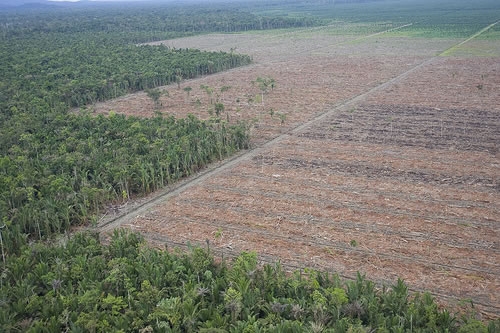
TEMPO InteractiveJakarta:The Merauke Integrated Food and Energy Estate (MIFEE) Program has been accused of disenfranchising local farmers in Papua. Berry N. Furqon, director of the Indonesian Forum for the Environment (Walhi), said that more than 100,000 ha of forest had been cut down for the project, including the sago forest on which the locals depend upon.

Abet Nego Tarigan, executive director of Sawit Watch, called on the United Nations to cancel the project. Abet said the MIFEE could endanger Indonesia as it allows companies rather than farmers to control the food supply.

The MIFEE project was inaugurated by Agriculture Minister Suswono on August 11 last year. The program sees plantations in Merauke managed by companies that also manage the local farmers. One million ha, divided in five clusters, has been allocated for the program.

As many as 32 companies have obtained principle licenses and will operate in a range of plantation sectors, namely palm oil, sugar cane and corn among others. Companies that have invested in the program include Wilmar, Sinarmas, Bakrie Sumatera Plantation, Medco, Bangun Cipta Sarana and Artha Graha.

NUR ROCHMI

————————————–

2) Indonesia Turns Back on Papua Food Bowl Plan
Faisal Maliki Baskoro | August 15, 2011

After two years with little progress, the government is considering shifting the location of its planned food estate to East Kalimantan from Papua because of the availability of land.

Suswono, the agriculture minister, on Monday said there was 200,000 hectares of land in East Kalimantan that could be used as an agriculture cluster. Under its plan, the Merauke Food Industrial Estate would have about 2 million hectares.

“The principle of the food estate is finding enough land for an agricultural zone. It doesn’t have to be in Papua,” he said. “[The East Kalimantan site] may not as big as Merauke, but it is more feasible. It has been two years since we floated the plan, but there has been no progress at all.”

Suswono said land clearance regulations were partly to blame for the slow progress.

“The construction of the Merauke food estate was obstructed by lack of regulation to clear necessary land,’’ Suswono said.

The government annually imports 2 million tons each of rice and soybean, and the nation needs to be able to feed its people without importing food, he said.

He said the government and potential investors would seek suitable areas for producing the two crops.

“The land in East Kalimantan is good for planting rice,” he said. To grow soybean, the ministry would need at least 500,000 hectares, and the government was still looking for land in Kalimantan.

While East Kalimantan has 200,000 hectares of land free, the West Kalimantan administration said it could provide 100,000 hectares of land, he said.

Suswono said farmland would not interfere with the preservation of forests. “We will be using open land, and probably convert production forests to farms. We will also empower local people to get involved in the program.”

Ecosystem in Merauke must be preserved, says agricultural expert


JUBI, 11 August 2011
The District of Merauke has a very rich ecosystem  which needs to be  preserved and protected. The problem is that when forests are cleared, this damages much of the ecosystem and virtually destroys it.
Drs Sudirman, an agricultural expert at the provincial administration of Merauke district, speaking during a technical guidance event  in Wasur, said that as the  population increases, land will be cleared everywhere  which will have a very damaging impact on the ecosystem in forested regions.
‘One example: When forests were cleared to make way for the MIFEE (Merauke Integrated Food and Energy Estate) project, recently, a significant part of the ecosystem was lost and much of is it already dead. It is the responsibility of everyone concerned  to think about the best way to deal with this problem so as to ensure that the ecosystem is not damaged.’ he said.
He said that the TH Wasur region in particular has a large number of species which means that it is the responsibility of everyone, including the original inhabitants of the district, to play their part in preserving  the ecosystem.

The Age: Independence at threat from enemy within

Tom Allard

August 13, 2011

A Papuan protester addresses a crowd.Mako Tabuni, KNPB leader addresses a crowd on August 2

Papuans remain under Indonesia’s menacing grip, reports Tom Allard from Jakarta.

It would seem, to most observers, to be a singularly unremarkable venture. A group of American tourists visiting a cultural centre in the Papuan town of Abepura, just outside the capital Jayapura. On the agenda was an opportunity to view some historical artefacts and watch a traditional dance.

But, as the group of some 180 visitors toured the facility and enjoyed the performance, they were being watched. In the shadows was an informant for Indonesia’s elite special forces unit, Kopassus.

Advertisement: Story continues below
Indigenous traders sell produce in Jayapura, where migrants own many businesses.Indigenous traders sell produce in Jayapura, where migrants own many businesses.

In a report back to his handler, the informant observed the tourists had been warmly welcomed by the centre’s manager and been amused and entranced by the dance. The visit had lasted precisely 35 minutes, from 11.50am to 12.25pm, and had been ”safe and smooth”.

The informant warned there was no room for complacency, a point heartily endorsed by the Kopassus handler, Second Lieutenant Muhammad Zainollah.

”With visits from overseas tourists to Papua, there is the possibility of influencing conditions of Papuan society,” Lieutenant Zainollah wrote in his report to the local Kopassus commander. ”Politically, there needs to be a deeper detection of the existence hidden behind it all because of the possibility of a process of deception … such as meetings with pro-independence groups.”

<img src=”http://images.theage.com.au/2011/08/12/2554865/art-353-14-papua-1-200×0.jpg&#8221; alt=”Freedoms under surveillance … from left, Kopassus officer Lieutenant Muhammad Zainollah, author of many of the intelligence reports obtained by the Herald.” />Freedoms under surveillance … Kopassus officer Lieutenant Muhammad Zainollah, author of many of the intelligence reports obtained by the Herald.

The note is bizarre and even amusing. It is one of hundreds of intelligence briefs obtained by the Herald from Kopassus intelligence posts in Papua and part of a cache of 19 documents that includes a highly detailed analysis of the ”anatomy” of the separatist movement.

But it is also instructive of what the material in its entirety reveals: the Indonesian government runs a network of spies and informants in Papua that is staggering in its scope and range of targets. And infecting all the reporting and analysis is a deep paranoia that is both astonishing and disturbing.

In the easternmost reaches of Indonesia’s sprawling archipelago and located in the western half of the island of New Guinea, the resource-rich region of Papua is a running sore and source of angst and embarrassment for Indonesia, a country that has otherwise made substantial strides as a democratic and economic power.

Despite being granted special autonomy 10 years ago and targeted for accelerated economic development, its indigenous Melanesian people are the country’s poorest and many are deeply unhappy with Jakarta’s rule and a heavy security presence.

The documents, which date from 2006 to 2009, reveal that independence activists and members of the OPM-TPN, the small armed resistance, are under intense surveillance, but so too are many ordinary Papuans and civic leaders who do not advocate independence but are concerned about the advancement of their people or are influential in the community.

”Everyone is a separatist until they can prove they are not,” says Neles Tebay, a pastor and convener of the Papua Peace Network that is promoting dialogue with Jakarta. Around the capital, Jayapura, there are 10 Kopassus spy networks infiltrating ”all levels of society”, including the university, government agencies, the local parliament, hotels and the Papuan Customary Council.

A worker at a car rental agency tips off his Kopassus handler whenever a suspicious customer visits the establishment or talks about ”M”, shorthand for ”merdeka” or freedom. A phone shop employee ”often provides information on the phone numbers of people purchasing phone credits”.

Journalists, university students, bureaucrats, church leaders, teachers, motorcycle taxi drivers, clan leaders, village chiefs, farmers and forest workers are all on the books of Kopassus. One leader of the OPM-TPN has eight Kopassus informants within his network, including a 14-year-old family member.

Each of the informants, who cannot be identified to protect their safety, is described by temperament and motivation. The motivation is usually ”to make money”. Temperaments range from ”hard-working”, ”courageous” and ”quiet” to ”unstable”, ”explosive” and ”drunk”.

And the Kopassus intelligence documents are just a snapshot of the total campaign under way in Papua. Other units of the Indonesian military, known as the TNI, run similar operations, as do the police. There are also scores of agents in Papua from Indonesia’s national intelligence agency, known by its acronym BIN.

Benny Giay, a leader of the Gospel Tabernacle Church, is one of the civic leaders branded a separatist and targeted by Kopassus. For Dr Giay, the suffocating presence of the intelligence network is part of daily life, as is interference in the affairs of his church by the military.

”If someone joins the church, we always have to ask ourselves, ‘what did they come here for? Are they intels or worshippers?’,” he says.

And, given the disappearance and deaths of other leaders under the gaze of Kopassus, the surveillance leaves Giay constantly uneasy. ”I have to check my meals to make sure they are not poisoned and I have to be home by 7pm. If I walk around after then, I have to bring someone with me, always.”

Marcus Haluk, the secretary general of the Central Highlands Papuan Student Association, features heavily in the documents. It seems most of his meetings are attended by a Kopassus spy.

”I’ve lost count of the attempts to kill or threaten me,” he says. ”I’ve had guns pointed at my head, I’ve been thrown from a motorcycle. There are always SMS threats.”

Underpinning the spying is the view that most institutions in Papua are riddled with separatists. The documents outline a two-stage intelligence operation to address the perceived problem.

The first involves disrupting alleged separatist networks and the second is dubbed the ”diminishing dominant influence phase” or ensuring ”traditional institutions used for politics in Papua lose the trust of the indigenous peoples of Papua”.

In short, the objective is to discredit the institutions and arrangements introduced by the central government under Papua’s special autonomy deal introduced in 2001, the very policy supposed to give Papuans economic and cultural rights, dampen independence sentiment and secure national unity.

Agus Sumule, a long-term resident of Papua and adviser to Papua’s Governor, Barnabas Suebu, is an immigrant, a nationalist and was a key player in drafting the special autonomy laws which created a new legislative body to represent indigenous Papuans known as the Majelis Rakyat Papua (MRP).

Special autonomy has never had a chance, he argues, and much of that blame lies with Jakarta’s refusal to implement it properly.

Papua was divided into two provinces against the wishes of the MRP, Dr Sumule says. Moreover, the home affairs ministry interferes in the election of MRP candidates, and has banned people from taking their seats. Despite provisions in the special autonomy law for symbols of Papuan identity to be displayed, the cherished Morning Star flag has been outlawed. Those caught displaying it can be sentenced to 15 years in prison.

Some $3 billion in aid has flowed from the central government to the region in the past decade, but it is handed out haphazardly and most of it has been siphoned off by corrupt officials or wasted on bureaucracies to support the new province and dozens of new regencies in Papua.

Meanwhile, Papua has been swamped by migrants from other parts of Indonesia who dominate its economy. Explaining the economic disparity, one Kopassus report offered a plainly racist rationale. Indigenous Papuans ”lack the willingness to work and the willingness to make a better life, so their lives seem to be making no substantial progress”, it said. Migrants, in contrast, had a ”high spirit and work ethic”.

Asked about the extensive intelligence operations, Dr Sumule observed: ”On the one hand its paranoia, but it’s also much more than paranoia. It shows they don’t have a relevant policy for Papua, an understanding of Papua or what Papua should be in Indonesia. The problem with the intelligence is it’s not intelligent. They send so much wrong information for the people in Jakarta, and they make decisions on it. It’s very dangerous.”

Indeed, the major report on the Anatomy of Separatists had a detailed section on the alleged foreign support networks for a ”Free Papua” and it bears out Dr Sumule’s criticism of the quality of the intelligence.

The list of 32 Australians includes academics, politicians and religious leaders who could understandably be placed in the category. Others have simply shown an interest in Papuan affairs, raised concerns about human rights or are journalists.

The appearance of the former current affairs host Naomi Robson on the list is a stand-out.

The former Today Tonight host, now running a web-based dating service and TV show, presumably gets a mention because she entered Papua without media accreditation in 2006 to ”save” Wa-wa, the boy who was the subject of a story by rival program60 Minutes.

Famously, Channel Nine’s current affairs flagship alleged Wa-wa was destined to be consumed by his fellow Korowai tribespeople, who were cannibals, but after filming they left him behind to an uncertain fate.

Foreigners in Papua are viewed suspiciously, especially non-government groups. Indonesia has expelled several foreign NGOs from the territory in recent years. The International Committee of the Red Cross is banned from visiting more than 100 political prisoners. By contrast, the ICRC is allowed into Guantanamo Bay and could visit prisons in apartheid-era South Africa.

One part of the intelligence analysis that is presumably more accurate is the assessment of the strength of the OPM-TPN. It is reckoned to have 1129 fighters with mixed weapons totalling only 131, and grenades.

While the poorly armed resistance fighters do have some success in ambushing Indonesian military posts and are adept at hiding in Papua’s mountainous terrain, the low estimate of their strength calls into question why there is such a large military presence in Papua.

The Indonesian government will not release precise figures on its armed deployments in Papua, but since special autonomy was introduced in 2001, it has doubled the number of battalions from three to six. It has 114 posts along the border with Papua New Guinea alone.

Estimates put the military numbers at about 15,000, roughly 13 soldiers for every armed separatist.

As one Indonesian official told a US embassy staffer, revealed in cables released by WikiLeaks: ”The TNI has far more troops in Papua than it is willing to admit, chiefly to protect and facilitate TNI interests in illegal logging operations.”

The massive military and intelligence apparatus in Papua makes a lie of Indonesia’s insistence that it long ago junked its ”security” approach to managing Papua and it is now formulating policy under the rubric of ”development and prosperity,” says Neles Tebay.

”[The troops] are trained to see Papuans as the enemy,” he adds. ”I’m not saying all the troops are bad but if one group of them is threatening the indigenous people then it creates widespread fear. Also, they are always interrogating people. It’s very threatening.”

Neither the TNI or Kopassus would respond to questions for this article, sent to them two weeks ago. However, it has maintained human rights abuses such as that depicted last year in a video of a man being tortured by soldiers holding a burning stick against his genitals, revealed in the Herald, do not reflect policy.

It also says it devotes energy towards improving living conditions in remote villages. Certainly, the Kopassus documents include accounts of its officers going to hamlets in the remote central highlands region to help with health clinics, building bridges and homes as well playing sport and attending religious and cultural ceremonies.

But, as shown by mass protests in Papuan towns last week, special autonomy has not worked for Papua’s indigenous people or for the Indonesian government. Papuans such as Neles Tebay have called for dialogue and President Susilo Bambang Yudhoyono talked last year about embarking on ”constructive communication”.

Progress, however, has been painfully slow and, as the cache of documents reveals time and again, the security forces make no distinction between demands for dialogue and militant separatism. If a lasting settlement is to be achieved, many believe it will require a significant scaling back of the military in Papua, its policy influence in Jakarta and the spy networks that treat ordinary Papuans like criminals and worse.

Read more: http://www.theage.com.au/national/independence-at-threat-from-enemy-within-20110812-1iqur.html#ixzz1UtYnzIxc

Strike pressures PT Freeport Indonesia into serious negotiations

Alex Rayfield and Claudia King11 August 201

Indigenous Papuans are waging a four-decade long nonviolent struggle for independence from Indonesia. At the heart of Papuan grievances lies Freeport, the world’s largest gold and copper mine, owned and operated by US based company Freeport McMoRan and their Indonesian subsidiary PT Freeport Indonesia.

Perched on the western rim of the Melanesian Pacific, adjacent to independent Papua New Guinea is West Papua. Here, in a land so diverse that you can stand on a tropical glacier 15,000 feet high and peer down on the equator, indigenous Papuans are waging a four-decade long nonviolent struggle for independence from Indonesia. At the heart of Papuan grievances lies Freeport, the world’s largest gold and copper mine, owned and operated by US based company Freeport McMoRan and their Indonesian subsidiary PT Freeport Indonesia.

Recently trouble at the mine flared up again, as around 12,000 Indonesian and Papuan Mine workers and contractors went on strike, joined by local indigenous leaders. Walking off a job has never been so hard, Yan Ampnir told us. When he decided to join the mine workers’ strike in the remote Indonesian province of Papua, it was not a simple case of heading out the gate and driving home to his family. It involved a gruelling 40-mile trek down a roller-coaster road that plunges 8,400 feet down from the vertiginous cloud-cloaked mountain walls of Tembagapura, the remote mine base camp, to the sprawling swamp lowlands of Timika.


SPSI collection. Freeport Mine.

Tembagapura is a company town. The only people who live there are mine workers. After long shifts in the Grasberg open pit or in the underground mine, workers are bussed on four-wheel drive trucks back to Timika or the US lookalike suburb of Kuala Kencana, replete with shopping malls, manicured lawns and street lights, all carved out of the middle of the jungle. So, when the company refused to bus the workers outside the Indonesian military– guarded mine area, Ampnir and his compatriots picked up their bags and started walking.

Seventeen hours later the first group arrived in Timika; tired, wet, cold and hungry. Eight days later the strike ended. In the process some 12,000 mine workers (of a total workforce of 23,000) halted production at the world’s largest gold and copper mine, inflicting a loss of USD$95,000 per day on US-based Freeport McMoRan, Indonesian subsidiary PT Freeport Indonesia and their Anglo Australian partner, Rio Tinto.

After a quick search on the Internet, Albar Sabang, the local union branch secretary, hands us an excel spreadsheet. On it is a list of pay scales. Sabang is a mechanic who fixes heavy machinery like bulldozers and excavators. He has worked for PT Freeport Indonesia since 1994 and earns $3.00 per hour. He is one of the highest paid local employees out of a group PTFI calls “non-staff”. Others earn as little as $1.80 per hour, a wage that rose 98% after a similar workers strike in April 2007.

Sudiro (his only name) is a softly spoken tall Javanese man, unassuming in person. He is the local SPSI (Seluruh Pekerja Serikat Indondesia – or All Indonesian Workers Union) chair of the Freeport Mine Workers Union, an affiliate with the national SPSI network. Recently sacked by PT Freeport Indonesia for organising workers, he only just got his job back. “Of all the Freeport mines”, Sudiro tells us, “PT Freeport Indonesia is the most profitable. It has the lowest production costs. But workers are paid the lowest salaries. We are even paid less than Freeport mine workers in Mongolia and the Democratic Republic of Congo. That’s not right.”

A history of local grievances 

Freeport is emblematic of much that is wrong in West Papua.

The company’s Contract of Work was signed in 1967, two years before the Act of Free Choice was concluded, a referendum that was supposed to give the indigenous West Papuans a chance to say whether they wanted to be independent or part of Indonesia. In fact, there was no vote. Instead, 1,022 West Papuans, less than 0.01% of the population, were corralled into camps and told to “vote” for integration with Indonesia or have “their tongues cut out”. But it was not just the Indonesian government that consented to democratic fraud writ large; the US, Australian and European governments were also not prepared to contest the election or risk stability in the region for what one US Embassy source at the time called a handful of “Stone-Age illiterate tribal groups”.


SPSI collection.Strike Leaving Tembagapura.

The biggest prize of all was Freeport. Suharto declared the company a national asset and instructed the military to guard the mine, which led to a long history of human rights violations, including un-investigated mass killings, theft of Papuan land and massive environmental degradation, all of which has led to ongoing violent and nonviolent resistance.

This was the era before the notion of “free, prior, and informed consent” became best practice for extractive industries. According to local indigenous landowners, they still feel that they have not been consulted or their rights respected.

As the Amungme people’s sacred mountain is consumed, tailings are dumped in the Ajkwa River at the rate of 200,000 tons a day. The result: over 30,000 hectares of rainforest have been wiped out and huge levee banks built to stop Timika from being smothered by sludge waste. In the process, Freeport became a lightning rod for all Papuan grievances.

Although the company tried to respond to local indigenous West Papuan grievances by hiring Papuan staff and redirecting 1% of the profits to support members of the local seven tribes, new problems continue to be added on top of old, unresolved issues. The local tribes (a number of whom work in the mine) and Freeport mine workers from elsewhere bring in massive profits for the company. They work under extreme conditions at high altitude but feel like they have little stake in the company and few worker benefits.

“We are not valued as human beings. We are treated as an instrument of the company. Our goal is to get to a position where we are treated as human” says Sudiro.

According to miners interviewed in July 2011, many workers are forced to take out bank loans to pay for basic needs and to support their families. After retirement, some must seek alternative types of income. Yet when workers attempt to raise these issues with Freeport management, they have received warning letters from them in return.

“It seems like the company sees us as the troublemakers. But,” says Sudiro, referring to workers’ contributions to gold and copper production, “we are the solution-makers.”

SPSI finds its teeth 

SPSI PT Freeport Indonesia is one local branch of the national labour union federation of Indonesia. The organization has represented PTFI mine workers in 16 Collective Labor Agreements (CLA) dating back to 1977. But until recently it functioned as little more than a rubber stamp for company policies.

Freeport has a history of suppressing workers’ rights and union organizing. Under Suharto, independent labour organising was prohibited. Those that tried were often killed or spent years in jail. But over the past decade, as political space has slowly opened up, Sudiro and other workers have been quietly organizing. But because of the closed-off nature of West Papua, they have done so through exchanges on the Internet, educating themselves on best practice and lessons learned from unions in other parts of the world. “We particularly admired the quiet, peaceful way Japanese workers raised their grievances,” said Sudiro.


SPSI collection. Strike Congregate at Tembagapura.

SPSI PT Freeport Indonesia’s mission and objectives are limited to workers’ rights and their tactics are exclusively nonviolent. But they continue to be associated with violence and separatism. “We use a peaceful way. We don’t want to get into the political arena, this is not our area. We just want to struggle for our rights, and to have the same rights as workers elsewhere.”

Campaigns to educate fellow mine workers about their rights and the role of unions in protecting workers seem to be paying off. Reflecting on worker participation in the recent strike, Sudiro said, “The workers finally opened their eyes and minds to the situation. The company cannot stop this. We have woken up. We will never go back to how we were treated before the strike.”

Nevertheless, SPSI Freeport members continue to face threats and intimidation from the company. When two of the union members travelled to Jayapura to seek advice from Papuan leaders, they were followed by Indonesian security forces who have long been paid by Freeport to guard the mine.

“The company does not like us organizing for workers’ rights, but we are not doing anything wrong. The strike is an action that is guaranteed by the law. Indonesia is a member of the ILO and the ILO is very clear. We have the right to form a union and we have done so according to Indonesian law” says Sudiro.

Article 104 (1) of Indonesian National Law Number 13, 2003 explicitly states: “Every worker/ labourer has the right to form and become a member of a trade/ labour union.”

The decision to strike 

The company has utilized a range of “dirty” tactics to avoid dealing with SPSI demands over wages and conditions. One of the most galling for mineworkers was the creation of a ‘new’ union aimed at pushing out SPSI’s union. The new union was created in response to SPSI Freeport mineworkers’ agitation around wages and conditions.

At the same time the company declared the SPSI Freeport Mine Workers Union – an organisation that has grown from a low of 4,000 to 8,200 members – illegal, and promptly fired six of the leadership including Sudiro himself. The only problem was this ‘union’ had no members. Its board was appointed by Nur Hadiah, a lawyer based in Jayapura, in violation of SPSI regulations. “It was a completely fake union” said Sudiro.

The reaction from the workers? An overwhelming decision from all of the 254 union representatives to strike and nearly 100% participation from SPSI Freeport union members. “We were up against a wall. We had no other choice,” Sudiro said.

But the strike was not just about wages. “We wanted the company to recognise the union, the right to freely organise, and to reinstate the six SPSI Union leaders who were dismissed by Freeport for conducting union business” said Sudiro.


SPSI collection. A female striker
After more than a week of strikes and continuous demonstrations, on the evening of July 11 PT Freeport Indonesia gave in to SPSI’s

demands. They reinstated the union leaders without any deduction in salary, agreed to pay the wages of all striking workers for the duration of the strike, agreed to recognise SPSI Freeport Mine Workers Union as the sole legal representative of Freeport mine workers and also agreed to enter into Collective Labor Agreement negotiations. Those negotiations opened Wednesday July 20 at the Freeport-owned Hotel Rimba Papua in Timika. They are still continuing and according to Company sources are not expected to finish until 19 August. Both workers and management are remaining tight-lipped about their progress.

The seven tribes

The current  (seventeenth) Collective Labor Agreement negotiations are different. They are not only about wages and conditions. They also concern the company’s relationship with local landowners, the Amungme and Kamoro, as well as five other major highland tribes – the Dani, Moni, Damal, Mee/Ekari and Nduga.

Amungme tribal elder Hengky Uamang speaks to us at one of the SPSI union leaders’ rented duplex house in the back lanes of Timika. His voice is quiet and one of his compatriots translates from Amungme into Indonesian so that we can understand what he is saying. His message is simple and profound.

“My heart is broken. It is as if we are not human beings but a piece of gold to be consumed. I am gold but I get no benefit.” Tears slowly roll down his face.

Others in the crowded living room become angry. “Does Moffet (the US Chair of Freeport McMoRan) have no shame?” Jecky Amisim rhetorically asks. “Does he not fear God? Don’t you people in America know that if you come to someone’s place and want to take something, you have to ask first?”

The seven tribal leaders nod in agreement. Sudiro tells us: “If these negotiations fail, we will see it as a death of democracy.”

“If Moffett and Armando Mahler (the president of PT Freeport Indonesia) can’t help us, if the wealth of these mountains do not bring a benefit to us the local tribes, the workers and the people of Papua,” says Mr. Amisim, “then it is better we just kick this company out.”

The strike may be over,  but as union and management begin month-long negotiations over their biannual Collective Labour Agreement, the company continues to face the possibility of continued disruption from disgruntled workers and restive landowners seeking significant changes after years of opposition to Freeport mining.

“This article was originally published in the independent online magazine www.opendemocracy.net

About the authors
Alex Rayfield is a freelance journalist based in Timika
Claudia King is a freelance journalist reporting from Timika


Create a website or blog at WordPress.com

Up ↑
