17 August 2013Efforts to deal with the spread of HIV/AIDS are clearly being made in many cities and districts in the Province of Papua. However, in the sub-district of Dogiyai, local people are concerned that the local government is not seriously dealing with this deadly virus.
A youth leader, Laurensius Tebay, said this week that dealing with this disease must be top priority, which means “more testing centers available for everyone – near you and near me (STD clinics)“. It is essential to spread information to the people that this virus is deadly and incurable. ‘We very much hope that the local government will deal with this problem with the seriousness that it merits,’ he said.
He said that as yet there have been no activities to inform people about the danger of the spread of HIV and AIDS, adding that this was the case in ten local areas. ‘We are very disappointed that the local authorities are failing to deal with AIDS with the necessary urgency.’
He said that spreading information and examining people with regard to HIV/AIDS has been proceeding well in the District of Paniai during the past month and this should be done in all the other areas, including the sub-district of Dogiyai. ‘While this is not something that should be made compulsory, the authorities should do everything possible to persuade people about how important it is to be examined.’
These views were confirmed in remarks made by the head of the Department to Combat HIV/AIDS, Kristianus Tebai who admitted that dealing with AIDS is a critically important part of the work of the health authorities. ‘Since I was recently appointed to this job, I have discovered that there are many issues that are not being dealt with properly. We are doing everything we can to improve work on this programme,’ he told JUBI. He said that combating the disease was going well in some sub-districts but not yet in the sub-district of Dogiyai.’
FRIDAY FILE: After 42 years of Indonesian rule, women in West Papua continue to fight for their freedom and peace.
By Rochelle Jones
West Papua – officially under Indonesian rule since 1963 – is located in the Western half of the island of New Guinea – 250km north of Australia. In 2012, West Papua Media conducted interviews with four West Papuan women who are active in the nonviolent movement for freedom. Here, AWID gives some background, and excerpts from the interviews.
Act of No Choice
The Australian-based Free West Papua describes how during the 1950s, West Papua was under Dutch Colonial rule, but by 1961 were moving towards independence with their own flag, the ‘Morning Star’, and Papuan government officials. In the early sixties, however, “Conflict erupted over West Papua between The Netherlands and Indonesia, and a United Nations agreement gave control of the colony to Indonesia for six years. This was to be followed by a referendum. These six years of Indonesian control saw well-documented cases of violence and abuse by the military. Then in 1969, Indonesia conducted a sham referendum called the Act of Free Choice. Only 1025 Papuans, representing a population of one million, were picked to vote. Under severe duress, including threats from senior ranking military officials to cut their tongues out, they voted to remain part of Indonesia. Despite a critical report by a UN official who was present, citing serious violations, the UN shamefully sanctioned the vote and West Papua officially became a part of Indonesia. Papuans call this referendum the ‘Act of No Choice’”
With a track record of denying foreign journalists access to West Papua (or arresting and deporting them) – the Indonesian government continues its stronghold over this resource-rich region. A stronghold held together largely by the presence of the Indonesian military¾which are known for their violence enacted with impunity, but also by the silence of the international community. Free West Papua estimates that “since 1962, 100,000 people have been killed or disappeared by the brutal military regime. Thousands have been raped and tortured and entire villages, especially in the highlands, have been destroyed.” In May this year, West Papua Media published one disturbing report of recent killings and rapes, perpetrated by the Indonesian military.
Tragically, reports such as these are part of every-day life for West Papuans, who are of Melanesian descent and culturally different from Indonesians. Resistance to Indonesia’s occupation has existed from the beginning – but the military has repeatedly responded with violence and intimidation. Whilst more information is getting out about West Papua and international concern grows over the human rights situation, this can be marred by politics and economics, with governments hesitant to upset Indonesia. In recent years a new independence organisation, the National Committee for West Papua (KNPB) has held “huge independence rallies… across West Papua and the West Papuan’s voice is united more than ever.”
Women in the struggle
Asked why they joined the nonviolent movement, Fanny Kogoya, Rini Tabuni, Heni Lani and Ice Murib (1), the women interviewed by West Papua Media, each recount experiences of injustice, disrespect and the violence of growing up in a land without freedom. Murib highlights the simplicity of their struggle: “We want to be free. We want you to help us be free. Indonesia doesn’t care about us as people. So the only thing that we want is to be free…to live our own life in our own land.”
Kogoya says: “As a child I often saw people beaten-up by the police, without any reason at all… As a student I started to compare government policies with what was actually happening… On the one hand you had the constitution, which talked about freedom and the Pancasila, which talked about social justice, but in reality there was very little political space for us Papuans. When I was living in Java I could compare the health and education system with what we had in West Papua and it was just so different…There is very little political difference for Papuans before or after [the regime of] Suharto… Papua has yet to experience a real democratic space. These kinds of things make me really emotional. I realized I had to resist. I can’t be silent.”
Tabuni recalls: “my father was one of the victims of 1977. Indonesian soldiers cut open his chest with knives. They took out the contents of his stomach and they removed his heart. My grandfather saw this happening with his own eyes. As the soldiers were cutting open my father’s chest they were saying, “Where is your God now? Who is here to save you?” Tabuni explains how freedom activist Benny Wenda, now living in exile in the UK, inspired her after her family lived in Jayapura with Wenda’s people: “In 2000 Benny started to become more active… [and was granted] refugee status in England. We watched… how he continued to struggle. That inspired those of us who lived inside Papua to continue to struggle… It was in this context that the KNPB entered. My friends and I said let’s stay with this organization, let’s sit down with them and see what we can do together.”
After witnessing countless events as a young girl, like the arrest of her father, Lani recounts her political awakening as a student when she was told about the history of West Papua’s struggle: “Before [this] it was like I was sitting in this small dark room with little rays of light coming through. These rays of light were like my father getting arrested and Benny Wenda getting arrested. When I got my education it was like the door of this room was flung open… I went outside for the first time and saw what was really happening. The day on the beach in Hamadi was the first time I saw the Morning Star flag. I grabbed it and held it. Finally, I realized, I’m not an Indonesian, I’m a Papuan!”
However, there is a struggle within the movement. Kogoya describes it as a “double challenge” that women face: “We struggle against Indonesia but we also struggle against patriarchy in the movement. See we have two enemies: the way women are treated within the movement and the evil and injustice of the state. We are definitely fighting against some of the men within the movement who think we aren’t capable.” To that, however, Lani says “Women are in leadership positions and telling men what to do, so we’re already there… playing positions of leadership in the movement.”
Ongoing nonviolent resistance
Living with such violence and oppression, the women still agree that nonviolent resistance is the way forward, and yet they also admit to thinking about taking up arms. One of the obvious barriers to taking up an armed struggle is the sheer strength of the Indonesian military. Kogoya says “Even though we’re struggling nonviolently the Indonesian state continues to respond violently. They arrest people, beat people, kill people. Often my activist friends say, “What’s the point? If we struggle nonviolently they’re going to beat us, arrest us … if we struggle violently they’ll do the same things. Often people join the armed struggle because… they’ve had these traumatic experiences and… it’s an emotional reaction. Of course in our culture we also have a history of fighting back… of tribal warfare. We are a courageous people. So with these three things – our memories of suffering, our history and culture, and our courage – armed struggle is a real option for us….But Papuans are also a very practical people. We know civil resistance can also work. So my dream is to learn more about civil resistance.”
Tabuni understands why people would want to respond with violence, however, she says: “If I struggle through violence I am going to experience a number of problems. I’m going to lose a lot of my rights. I’m going to lose my best friends. And people are going to… steal my land and kill me… But now I see that there’s an opportunity to resist through nonviolent struggle. People at the grassroots need to know that nonviolent action can be really successful… We can learn from the examples of other countries.”
How can the international community help?
To be an independent nation is the goal for West Papua¾freedom from Indonesian rule and its associated violence. But this is also a struggle for culture and for the environment. Lani says since she joined the struggle “my friends have been arrested, some have died in jail, some have fled to Papua New Guinea. It’s like we are migrants in our own land. So many people from Java, from Sulawesi, from Sumatra have come to our land.” Large scale migration of Indonesians into West Papua has the potential to unthread the very fabric of their culture and existence – and the mining and deforestation of pristine forests threatens to destroy the environment as well.
To achieve freedom these women stress the need for as many people as possible to stand in solidarity. Kogoya says they need the support of environmental groups around the world to join the struggle, adding “We need institutional support. And we want people to campaign about Papua to stop the violence… We really need technical assistance with media. We also need to influence other countries, particularly the U.S.”. Lani’s message is “for all the Papuan people to be involved in the civil resistance struggle. We have to work together.” She adds “Tell your friends in Australia and the U.S., ‘Stop sending military weapons to Indonesia. Stop.’ Because whenever we do things we face the military with those arms, and those arms are sent by your countries. The military are being trained by your countries to kill us.”
1) “We want to be free”: An interview with four women from the West Papuan Movement for Freedom. Interview by Alex Rayfield and Claudia King from West Papua Media. Photos taken by Javiera Rose.
Around 100 people from the SSUMAWOMA Malind Woyu Maklew Intellectual Forum are currently occupying PT Mayora and PT Astra’s company offices on Jalan Ternate, Merauke City.
The occupation started at 11.00 local time, involving youth and community members from the Malind Muli Woyu Maklew sub-ethnic group, from villages such as Wamal, Dokib, Wambi, Dodalim and Kimam.
Their demand is that the two companies stop their operations and drop their investment plans for sugar-cane plantations in Okaba, Ngguti, Tubang and Ilwayab. At the time of writing, two hours after the action started, the companies had yet to respond to the people’s demands. The action was being guarded by dozens of local police.
Recently it was reported that the companies had used Brimob military police and the accusation of separatism to force people in affected villages to accept an agreement with the company.
After villagers in Yowid village reported that they had been intimidated into signing PT Mayora’s document, the SSUMAWOMA forum recorded video testimony of the elders who had been forced to sign (which can be watched here: https://awasmifee.potager.org/?p=472 ).
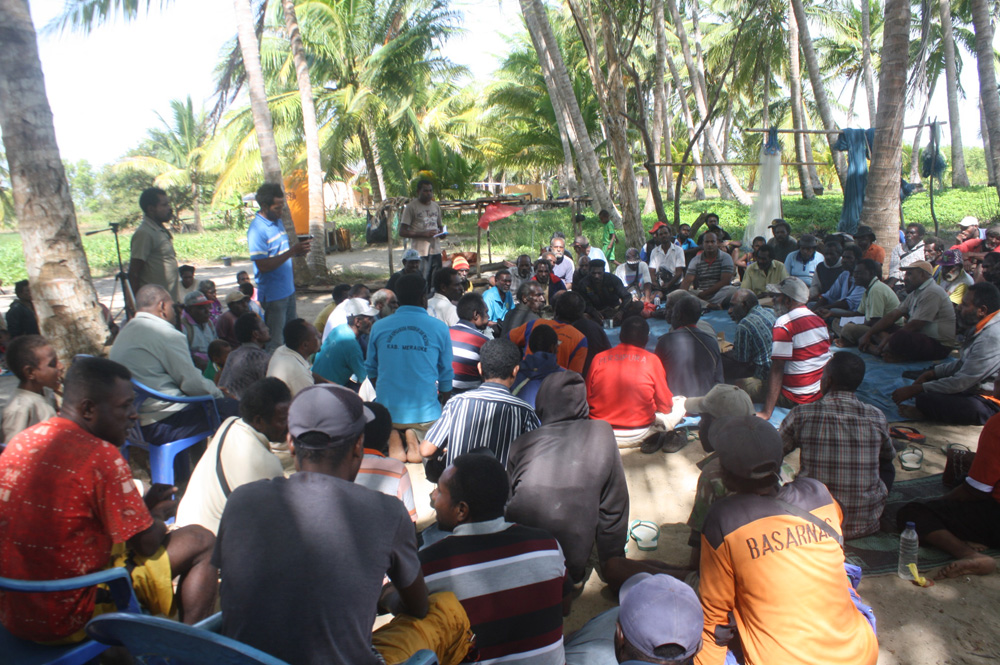
Then yesterday ( Sunday 11/8) the SSUMAWOMA forum organised a meeting and press conference in the Payum beach area of Merauke city. As tabloidjubi.com reported the discussion, there was heated argument between the people attending, but in the end all present were agreed on the need to oppose the two companies.
Aside from the intimidation experienced in Yowid, the discussion focussed on some of the other impacts that villagers are already experiencing as companies engage in the first phase of their plans, to survey the land and open negotiations with indigenous landowners. From Tabloid Jubi’s report:
A well-known Marind intellectual, Leonardus Moyuend, explained how villagers in the area were already feeling the pressure and can no longer sleep well. They also cannot go about their everyday activities as before, knowing about the companies’ plans to start operations around their villages. “To be honest, when the companies move in, it totally destroys the arrangement between one village and its neighbours,” he explained.
The problem, Leonardus continued, was that each village would make different claims about the boundaries of their land. “We never ad clear information from the government about this major program. If there is really a desire for companies to operate here, then all concerned parties such as the District Legislative Council, indigenous leaders from each village and other stakeholders should sit down with the government and investors and start discussions again from the beginning”, he said.
Instead what has been happening, he said, is that companies move in to the different villages on the quiet and then tell some of the people there that they are going to invest. “This is a really bad method the companies are using. It is the reason we have a strong commitment to resist the various areas of work they are focussing on”, he said.
He added that village elders had already given a mandate to local intellectuals to speak out and make interventions to oppose investment activities in their villages “We will never stay passive in the face of the companies’ efforts” he stated.
Meanwhile, an indigenous leader from kampung Wambi, Wilhelmus Bole Kaize said that he had already held meetings together with local indigenous people around ten times. The outcome was always that the people of that village opposed investment. The reason was because it would destroy the natural environment the people had taken care of through the years.
According to him, the area around Kampung Wambi should be used for tourism and culture. The outlook could be promising. In that way, there would be no more possibilities for corporate investors to move in. “We are completely agreed to resist the investors,” he said.
Three years after the MIFEE megaproject was launched, opening up Merauke Regency to plantation companies, initiatives by local people to organise to resist the companies appear to be on the increase. While the SSUMAWOMA forum is mostly concerned with the western part of the MIFEE area, a week ago on August 3rd another meeting brought together villagers from all over the central area of Merauke Regency. In that area companies such as Medco, Rajawali and Wilmar are operating and land is also being taken over for agriculture by transmigrants. That meeting also demanded that the government withdraw the permits for companies that are destroying the forest.
Johanes Mahuze, from Tanah Tinggi explained the predicament: “Real Marind people live with the land and the forest and wildlife are kept safe. We sit, we stand and we live from the land. We carry out our traditional rituals from the land and the forest, and the animals provide our food. If the land, forest and animals are all gone and we no longer own them, then the Marind Anim people are wiped out and become Plastic Marind, having to buy what we need for our traditions from the shops. We don’t want to become Plastic Marind”.
We will try to provide information on the outcome of the occupation action when we receive it.
Jayapura: Papuan indigenous traders are very worried about the fact that they are not able to compete economically because of the arrival in Papua of immigrants who are ‘taking over’ the trade in many simple commodities which has for a long time been where Papuan women (mama-mama) are conducting their business activities.
‘If nothing is done about this, we can be sure that within the next ten years, the mama-mama will not be able to compete in the markets. Many shopping malls, shops, agricultural product businesses, self-service shops and hypermarkets will be selling these commodities, with the help of lorries which are transporting the commodities everywhere, even along alleyways,’ said Robert Jitman, an activist in SOLPAP (Indigenous Papuan Traders Solidarity).
He said that he was seeking the help of the MRP (Majelis Rakyat Papua) to play a more active role with regard to building markets for the mama-mama to ensure that they can carry out their business activities. He also said that he was seeking support from the MRP with regard to what happened to some mama-mama who were recently evicted from Jalan Irian.
Robert Jitman stressed the importance of these markets in ensuring a self-supporting economy and said it is necessary for the government to take action as quickly as possible. He said that he wrote last month to the Governor of Papua, Lukas Enembe, to seek information about the fact that a permanent market where the mama-mama can trade has not yet been built in one of the main roads in Papua, Jalan Percetakan Negara.
SOLPAP is also seeking an audit from the BPK (?) with regard to the allocation of funds for building the market for the mama-mama, which was allocated as long ago as 2009. He was also seeking to ensure the inclusion in SOLPAP of church leaders, NGOs, students and the press (Alliance of Independent Journalists).
The letter to Governor Enembe also suggested that there should be a special regional regulation (perdasus) to protect and assist the mama-mama in conducting their trade in certain commodities and also suggested that a team be set up to ensure that the special market for the mama-mama is built.
Kampung Yowid, like other villages in Tubang and Ilwayab districts, has taken a determined and united stance against plantation companies, which have recently been moving in to the area. But now indigenous leaders in Kampung Yowid have been intimidated into signing a document from PT Mayora, one of Indonesia’s leading food brands, which is trying to take over their land for a sugar cane plantation. The people were accused of being OPM separatists by the police mobile brigade members the company employs as guards, who also accused them of storing weapons in their indigenous meeting house (adat house). Knowing that villagers were scared and thinking they might have to run to the forest, some community leaders felt they had no option but to sign the document. The contents of the document are unknown – villagers were never given a copy. Now, as before, the community states its clear opposition to Mayora’s plantation plan.
Merauke, like the rest of West Papua, is a militarized zone bearing the scars of fifty years of conflict. Now, as plantation companies continue to push their way in, it is not the first time that companies have been accused of using the ‘separatist’ stigma as a way to threaten indigenous people to give up their ancestral land. The people are quite reasonably afraid – they know that elsewhere security forces have unleashed violent repression countless times after labelling people as separatists.
This kind of link between military might and corporate ambition also has a clear parallel in Suharto’s New Order regime: plantation companies seized huge swathes of peasant farmers’ land in Sumatra in the 1970s and 1980s, threatening to kill people as communists if they resisted. Many communities are still trying to reclaim this land through land occupations and other forms of resistance.
The elders of Kampung Yowid who were forced to sign have now testified on video of how they were the victims of Mayora’s manipulation. Below, the Woyu Maklew sub-ethnic group Intellectual Forum and JPIC-MSC have also provided further background information on what happened.
Merauke, Friday (2 August 2013), the Woyu Maklew Sub-ethnic groupIntellectual Forum wishes to make clear that PT Mayora has violated the rights of the Marind Woyu Maklew indigenous people. The traditional (adat) chief and village head were forced to sign a document which PT Mayora presented to them, after the village was threatened with the stigma of being considered OPM members. A few villagers which supported the company were used to terrorise the others into accepting PT Mayora’s prescence in Yowid, Dokib, Wamal, Bibikem, Woboyu, Wanam and Dodalimvillages.
According to Ambrosius Laku Kaize, Kampung Yowid’s adat chief, he was forced to sign after pressure from PT Mayora’s staff. “I was forced to sign, because the villagers of Kampung Yowid had been accused of being OPM members”, he said. Mr Kaize went on to explain how he, theadministrative village head and the head of the Geb-Zami clan had all been similarly intimidated after PT Mayora made clear that the people of Kampung Yowid would be considered OPM if they didn’t sign the company’s letter.
The Woyu Maklew Sub-ethnic group Intellectual Forum’s monitoring hasrevealed that Marind people in the affected villages ( Yowid, Dokib, Wamal, Dodalim, Woboyu, Bibikem, Wanam and Uliuli) have not receivedreliable and truthful information about any policy for investment on their ancestral lands in general, and about PT Mayora’s presence in particular. This is an indication that the investment process is already violating the Marind indigenous people’s right to receive informationwithout compulsion and before investment activities commence. Aside from that, Marind people from the Woyu Maklew sub-ethnic group have already made clear that they oppose all investment on their ancestral land,because they do not have the skills required to get work with companies.
PT Mayora has already brought insecurity into the lives of local people,by going around villages in the area escorted by fully-armed Brimob from Merauke Police Station, and now by inciting individuals from the villages, the company has also created an unsafe situation by sowing fear. Further Background Information
On 21st May 2013, PT Mayora and PT Astra’s management met with Marind customary landowners in the Swiss-Bel Hotel on Jalan Raya Mandala in Merauke city. In this meeting, the people, through the Woyu Maklew Sub-ethnic group Intellectual Forum, expressed their opposition to the two companies. The reasons for this can be read in the forum’s letter here: https://awasmifee.potager.org/?p=352
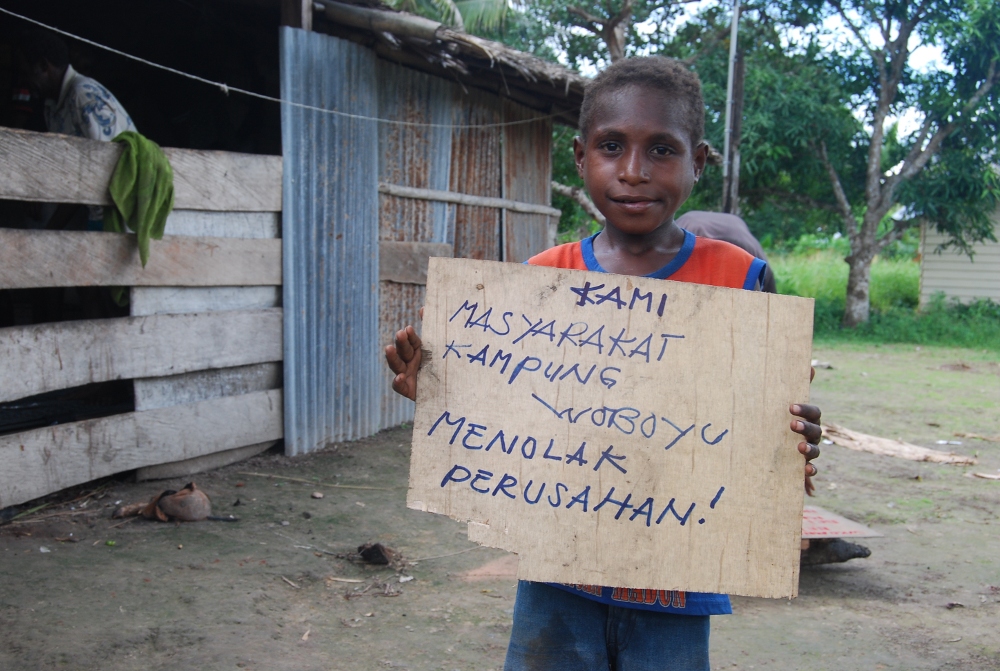
Villagers from Woboyu, Bibikem, Dadalim, Yowid, Wambi, Wanam, Wamal and Dokib villages have all made their opinion clear. In March and April this year each village has erected markers as a way to use customary law to prohibit the companies’ presence, also putting up signs with messages like “Oppose the companies, because we don’t have much land, and because we want to defend the Marind culture and our children and grandchildren’s future”.
While most of the people have maintained their strong stance against Mayora and Astra, two villagers from Yowid who had been won over by the company, together with one of PT Mayora’s Brimob guards and the company’s staff, got hold of a leaflet about human rights in Papua. The leaflet had been put together by the Merauke branch of the West Papua National Committee (KNPB) and was a summary of news from the mass media about the human rights situation. The deputy adat chief admitted that it was him who had distributed the leaflet so that people could read about the human rights situation. After all, they have the right to know.
However he was shocked to see how PT Mayora reacted towards the community after seeing this leaflet. As the adat chief explains in the video, PT Mayora started claiming that villagers were OPM separatists. The company also reportedly claimed that the adat house was used for storing weapons or OPM equipment.
During their monitoring from the last part of July to 4th August, JPIC MSC Indonesia and the Woyu Maklew Sub-ethnic group Intellectual Forum found that the people of Yowid had been severely frightened as a result of Mayora’s accusations that they were OPM separatists. There was a plan for the women and children to seek refuge in the forest. On 27th July, a meeting was held in the adat house (the local name is Sawiya) to discuss the fear they were living under. In that meeting village leaders told of how they had been forced to sign the document. Others didn’t sign, but their signatures were forged by the pro-Mayora villagers.
They never received a copy of the document they signed, and this made the community even more nervous. They were concerned that word would spread amongst neighbouring villages that they had given away their land to the company. All villages in the area had agreed some time ago that no-one should sell their land, and anyone who betrayed that agreement would be sure to face harsh repercussions.
On 27th July 2013, villagers wrote a letter to the Merauke Regency leader, Papuan Provincial Investment Board and Indonesian National Land Agency explaining that Kampung Yowid continues to oppose PT Mayora.
Photo shows the community in Yowid making their opposition to plantations clear earlier this year (Photo: AwasMIFEE)
.
-Mayora’s brands include Kopiko coffee and sweets, Energen cerealdrinks, Torabika coffee, Bengbeng chocolate wafers and Slai O’lai biscuits. They are mostly sold in Indonesia, but selected lines are exported to around 50 countries worldwide.








 West Papua Media Alerts