JUBI: Discrimination against women must stop

JUBI:  Merauke.
5 September, 2013
A large gathering of people, mostly women, took place in Kampung Matara in the District of Semangga, Merauke to publicise the widespread occurrence  of domestic violence.Several of the women present wondered what happens to complaints made by women about the domestic violence they have suffered because as things stand at the moment, they have no idea about how these complaints are handled. Some of them wanted to know the telephone number of Engelberta, a well-known Papuan woman activist, so that they can phone her and inform her about having experienced domestic violence.

Such  incidents are clearly a serious violation of human rights as laid down in a number of international conventions …. [part of the text is missing at this point].

One participant said that the victims of such violence are mainly women and children. There are incidents when men are the victims but they can be counted on the fingers of one hand.

Engelberta said that the violence in most cases takes the form of physical or psychological violence. The latter refers to situations for instance where there is absolutely no communication between men and women. ‘This must not be allowed to continue, she said.

She stressed the importance of people reporting incidents of violence when they occur. ‘We must put an end to this discrimination against women. Whenever anyone commits an act of violence and behaves as if they can take the law into their own hands, the matter should be reported to  the police. It is the responsibility of the police to take anyone alleged to have committed an act of violence into custody for investigation.

She urged parents to pay close attention to what happens to their children at school or when they are playing together in the streets. These are situations, she said, when many acts of sexual abuse occur. She mentioned in particular a recent incident when a young boy was sexually abused by  an elderly person.

During the discussion, the head of the District of Semangga, Recky Samkakai said that no one, in particular women,  should be afraid of reporting incidents when they have personally experienced an act of violence. Such occurrences should be reported to the local police in order for the case to be handled in accordance with the law.

Translated by TAPOL

Forum to Care for Papua’s Natural Resources Opposes ConocoPhillips Seismic Testing in Boven Digoel

AwasMifee

September 5, 2013

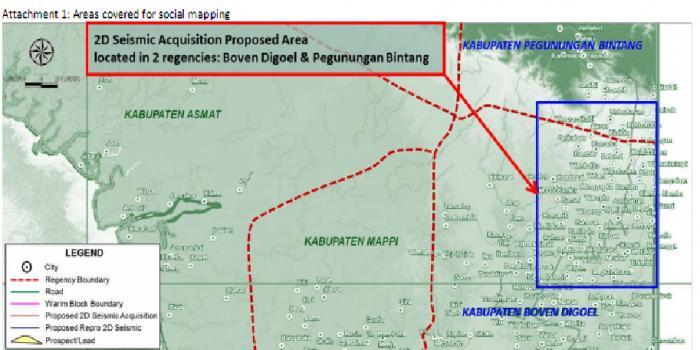
It is not just plantations – oil and gas companies are also threatening to turn Southern West Papua into an industrial landscape. ConocoPhillips is planning to restart exploration (seismic testing) in the Warim block in the near future, a remote forest area mostly located in Boven Digoel regency, several hundred kilometres inland from Merauke. The Forum to Care for Papua’s Natural Resources drew attention to this latest threat in a recent press release, summarised in this article from Majalah Selangkah:


Forum to Care for Papua’s Natural Resources Opposes ConocoPhillips’ Papuan Operations
https://awasmifee.potager.org/uploads/2013/09/20130903_075222_7180_l.png.jpeg

The Forum to Care for Papua’s Natural Resources has stated its clear opposition to ConocoPhillips commencing operations in West Papua.  In a press release issued in Yogyakarta, 31 August 2013 the forum explained various past, present and potential future impacts that arise when giant corporations move in and start operations anywhere in the land of Papua.

If ConocoPhillips moves in, they say, this will only aggravate symptoms of social breakdown and environmental damage, as such corporations are only interested in their own profits, and do not care about the environment and Papuan indigenous people.

As with other corporations in Papua, they claim that ConocoPhillips will only destroy the land which was used for extraction, destroy agricultural land, convert forest into an industrial area and reducing the land available for hunting and gathering peoples. In the long term, mining (including oil and gas exploitation) is a main contributor to turning land into wasteland, which is then almost impossible to restore.

According to the forum, mining in West Papua has caused land, water and air pollution such as dust, poisonous gases and noise. Coastal fish enclosures and coral reefs have been destroyed, floods and landslides have wiped out biodiversity. Acidic water flows into rivers and eventually to the sea, where it has destroyed coastal and marine ecosystems and resources. Mining causes various health problems, and local infrastructure such as roads are severely damaged. Mining also means new migrants move in to the area, either working for the company or starting their own business in the mining area.

They also say that mining creates symptoms of social distress such as prostitution, strong alcohol, gambling, and billiards. Land conflicts can occur, bringing with them a shift in socio-cultural values. Food sources such as forest gardens are polluted or damaged, meaning harvests fail. These are just some examples of the complex problems which the Papuan people in general suffer.
An Overview of ConocoPhillips

ConocoPhillips, according to data collected by the Forum to Care for Papua’s Natural Resources, is the third biggest US integrated energy company after Exxon and Shell based on market capitalisation and reserves. It operates in the oil and gas sector and is the USA’s second largest refiner, the fourth biggest globally.

ConocoPhillips has the fifth largest oil and gas reserves in the world. The company is known worldwide for its technological expertise in deep-sea exploration and production, reservoir management and exploitation, 3D seismic technology, high-grade petroleum coke upgrading and sulphur removal.

Operating in more than 40 countries, the company has around 38,300 employees worldwide and assets worth 164 billion US dollars. The company has four main activities around the world: Oil exploration and production; Refining, oil marketing, supply and transport; collecting processing and marketing natural gas; production and distribution of chemicals and plastics.

source: http://majalahselangkah.com/content/forum-peduli-sda-papua-tolak-conoco-philips-masuk-ke-papua

Since the report is somewhat short on details on ConocoPhillips’ actual plans in Papua, here’s a short article published by news website tempo.co in March with some more background information. In July the company reiterated its plans to carry out seismic testing in Boven Digoel and Pegunungan Bintang in 2014.
Govt Revises Conoco Phillips’ Contract in Papua

TEMPO.CO, Jakarta – The government will reimburse the standstill period of the exploration in Block Warim, Papua, to oil and gas company Conoco Phillips. The block, a sharing contract for which was signed in 1987, had not been worked on since 1997 because most of the area has been used as Lorentz National Park.

Head of public relations at the Upstream Oil and Gas Special Task Force (SKK Migas) Elan Biantoro said the Warim block has about 14,000 square kilometers left, some 30 percent of the block’s original size. Other than being used as a national park, some areas in the block were returned to the state because no reserves were found there.

“This block has actually been explored; the initial commitment has been fulfilled and wells have been drilled. After the contract revision is signed, seismic studies may be done this year or next year,” Elan said.

He added that the Warim Block is believed to have considerable amount of hydrocarbon potential. Other oil and gas contractors, he said, are developing areas near the block.

“Around (Block Warim) there are plenty of oil and gas blocks owned by Exxon Mobil,” he said.

BERNADETTE CHRISTINA

Source: http://en.tempo.co/read/news/2013/03/25/056469265/Govt-Revises-Conoco-Phillips-Contract-in-Papua

MIFEE: People of Woboyu Traumatised by Gunshots / Continuing Opposition to Plantations

August 30, 2013

Tabloid Jubi

On 29th August, Romanus Mbaraka, the Bupati or Regency Leader of Merauke, travelled to Kampung Wambi in Okaba District, to try to convince local people that plantation development did not necessarily have to be a bad thing. Hundreds of people from surrounding villages came to hear him speak. A local journalist with tabloidjubi.com also travelled to the event, and took the opportunity to speak to administrative and customary leaders from neighbouring villages about the fear caused by a shooting incident two months previously, and also about the ongoing opposition to all investment plans.

The People of Woboyu Traumatised by Gunshots

The people of Kampung Woboyu until now still feel traumatized by two gunshots which were fired into the air by someone believed to be a member of the security forces.

The shooting incident occurred in July.  Nikodemus Kahol, the customary chief in Woboyu told tabloidjubi.com that the two shots were fired at around 11pm at night.  At the time, the villagers were very scared and traumatized and feelings of fear still linger until the present day.

When asked why the shooting might have occurred, Kahol claimed that at the time there was a delegation from a company that was collecting data about the people, claiming that they would provide aid. However the people were not certain what the company meant when they talked about aid. The company was not collecting data about all of the people in the area, only some of them.

That caused a commotion amongst the people, Kahol continued, and so two shots were fired into the air. “To tell the truth we were shocked and started to panic when we heard the shots. People went to hide in their houses”, he said.

Questionned separately, Suprayogi, the chief of police for Okaba district, said that he would visit the village in the near future. “We will go there to find out whether there really were shots fired, as we have been told by local people,” he said.

Source: Ans.K (tabloidjubi.com)
http://tabloidjubi.com/2013/08/30/masyarakat-woboyu-trauma-dengan-dua-kali-tembakan/

The People of Okaba, Ngguti and Tubang oppose investment.

In general, people in villages around Okaba Ngguti and Tubang districts oppose plans for investment in the area.  This opposition is in consideration of the fact that forest habitat will be lost.

That was the message of Kampung Wambi’s village head, Kristoforus Basik-Basik when taboidjubi.com spoke to him.  In his opinion, in this wide carpet of forest is a diverse ecosystem, starting with tree kangaroos, wild pigs, deer and other animals.

Therefore if the forest is destroyed, the ecosystem it supports will also be lost.

“We have unanimous agreement to oppose any company, wherever they might come from, that comes and wants to invest. The reason is because the people are bound to suffer a great loss if the forest is cut down. I’ll repeat that once more, we do not want our forest habitat destroyed just like that”, he said.

The Customary Chief of Wambi, Wilhelmus Kaize added that the ancestors have reminded us that the land cannot be surrendered to anyone, and that includes investors. It is better to continue to safeguard it and take care of it, because a lot of wildlife can be found there.

Merauke’s Bupati (Regency Leader), Romanus  Mbaraka said that if the people refuse to accept the presence of corporate investors, then the government should never force the issue. “We will grow in our own way.  However, these corporate investors are part of national government policy. I hope that village leaders can help the people to understand correctly.  So they do not misinterpret the situation”, he requested.

Source:Ans.K (tabloidjubi.com)
http://tabloidjubi.com/2013/09/01/warga-okaba-ngguti-dan-tubang-tolak-investasi/

English Translation: https://awasmifee.potager.org/?p=542


Dozens of Morning Star flags unfurled in NRFPB Demonstration

Bintang Papua
28 August 2013
Manokwari:  Although controversy is still raging about the Freedom Flotilla which has a number of Papuan activists on board,  a group of Papuans who recently proclaimed the establishment of the Federal Republic of the State of West Papua (NRFPB) in Manokwari held a demonstration on 27 August.  The demonstration which was organised by the NRFPB was highlighted by a number of Morning Star flags.  The demonstration started from the office of DAP (Dewan Adat Papua  – Papuan Customary Council) on Jalan Pahlawan and continued until 10am.  In a speech at the demonstration, the deputy governor of NRFPB Markus Yenu called on all Papuans living in Manokwari to welcome the Freedom Flotilla which is sailing from Australia to West Papua.

This slideshow requires JavaScript.

Some of the scenes from the Manokwari August 28 mobilisations in support of the Freedom Flotilla (Photos: WPM stringers/ NFRPB) 

Security forces composed of members of the Indonesian police force mounted a strong guard round the demonstration. The demonstrators marched round the City of Manokwari distributing leaflets proclaiming freedom for the Papuan people.

Morning Star flags were unfurled in several places but the security forces failed to take action.   They just stood along the route without doing anything to confiscate the flags being carried by the demonstrators.

As has previously been reported,  the Freedom Flotilla  with Papuans on board as well as Aboriginals (Australia)  who have expressed deep concern about the situation in West Papua is now sailing towards Papua New Guinea. From there, the Flotilla will sail to Merauke, West Papua.  The Flotilla is due to arrive in West Papua at the beginning of September.

[Translated by TAPOL]

MRP Recommendation on Jakarta-Papua Dialogue must be followed up

Bintang Papua
24 August 2013Jayapura: The Deputy Director of the Alliance of Democracy for Papua (ALDP), Yuman Corona, has called on all Papuans at home and abroad to press for the implementation of the recommendation by the Majelis Rakyat  Papua (Papuan People’s Council) that  the correct way to solve the Papuan problem is by means of dialogue between Jakarta and Papua.

‘At a plenary session held on 12 August 2013, the MRP said that Special Autonomy for Papua (OTSUS) has  been a failure and there should be a dialogue between Jakarta and Papua. ‘

As has already been reported, the MRP called on the President, the Governor of Papua and the Governor of West Papua to carry  this recommendation forward. The MRP recommendation stated that Dialogue should occur within the next sixty days.

In this connection, the ALDP, as part of civil society in Papua, made the following points:

1. The MRP which is the representative body of the Papuan people as stipulated in Law 21/2001, must be consistent and focus on the recommendation it adopted at its plenary sessions for a dialogue to take place.

2.  Fully supports the policy and  position adopted by the MRP which needs to be publicised to all the Papuan people.

The DPRP (Legislative Assembly of West Papua ) and the DPR PB (Legislative Assembly of Papua) ‘should both support the MRP recommendation  and keep in close communication with the MPR. and convene plenary sessions in order to set up a PANSUS (Special Committee) for the Jakarta-Papua Dialogue.

It  further called on the Governor of Papua and the Governor of West Papua to fully support the  recommendation of the MRP and maintain close communications with the MRP (Papua) and the MRPB (West Papua) in order to work out their strategy  and to make the question of Dialogue their top priority.

Furthermore, the President of the Republic of Indonesia should fully support  the recommendation of the MRP for Dialogue as the way to solve the problem of West Papua in accordance with what he said in his State Address on 16 August  2011 regarding the resolution of the question of Papua and should set up a special committee in preparation for the Jakarta-Papua Dialogue and hold talks with various elements in Papua and Jakarta.

Furthermore, the DPR RI (National Parliament ) and the DPD RI (Assembly of Regional  Representatives)  should express their full support for the recommendation of the MRP as the way to resolve the Papuan issue. Commission 1 of Parliament should discuss this matter with the various political groups and commissions  to declare their support for Jakarta-Papua Dialogue in order to resolve the Papuan issue.

Finally, he said: ‘Why do we (ALDP) support the idea of dialogue between Jakarta and Papua? Because this is the way to solve the problem without resorting to the use of violence. It is our vision to promote justice and a democratic process  in Papua  The MRP which is a legal institution  must act to find the best possible solution for Papua.’

[Translated by TAPOL]

Create a website or blog at WordPress.com

Up ↑
