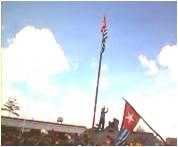
Thousands across Papua demand UN step up to protect Papuan people: PHOTO AND VIDEO REPORT

Ban Ki-moon with Indonesia President Susilo Ba...
Ban Ki-moon with Indonesia President Susilo Bambang Yudhoyono (Photo credit: Wikipedia)

PHOTO AND VIDEO REPORT

from the West Papua Media Editorial team, and local sources across Papua

March 21, 2012

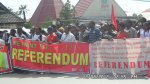
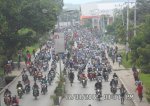
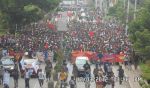
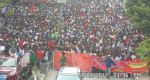
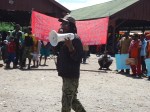
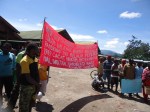
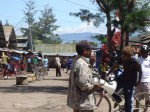
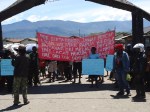
Rallies held across West Papua, Indonesia, and Australia have drawn tens of thousands of people on to the streets calling on UN Secretary-General Ban Ki-Moon to do more to protect West Papuans to Indonesian state violence, and to allow them exercise their universal human rights to self-determination.

Despite significant threats of violence prior to the rallies by Indonesian security forces against peaceful unarmed protestors, the mass mobilisations across West Papua significantly outnumbered security forces and were peaceful.  In some centres, the police only sent a handful of undercover intelligence agents to monitor the situation.
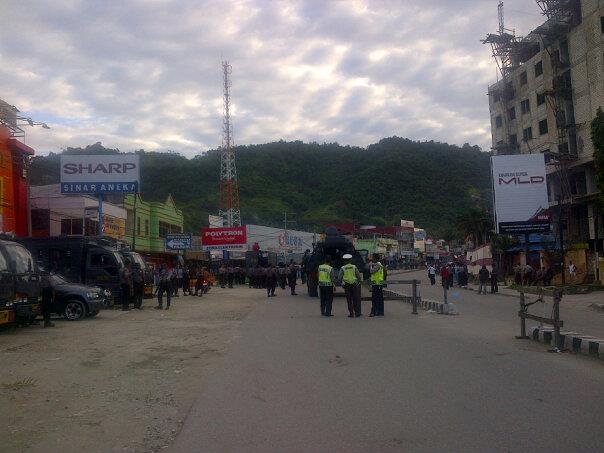
Security forces blocking access to Jayapura (photo Matias Murib)

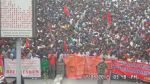
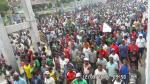
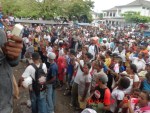
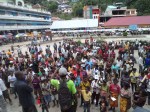
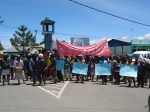
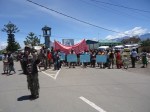
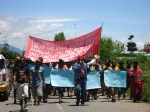
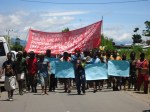
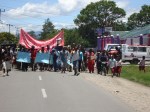
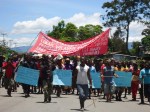
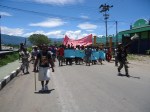
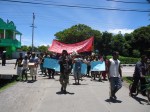
In Jayapura, over 5000 demonstrators marched from Taman Imbi and joined with a long march of several thousand people.  Security forces blocked access to the centre of Jayapura with heavy weaponry, but the rallies avoided provocation.  Jayapura was reported to be a ghost town as the rallies paralysed normal business and movement.

[youtube http://youtu.be/1Y0jMhuygXE] [youtube http://youtu.be/Zjz3Vj4Mv3A] [youtube http://youtu.be/xNgwCGiqB6E] [youtube http://youtu.be/lStemYrVRIo] [youtube http://youtu.be/IcoGo4fXRBY]

Speakers in Jayapura demanded that the UN Secretary-General listen to the people of West Papua and tabled seven key demand on the UN.  Buchtar Tabuni, from the West Papua National Committee (KNPB) told the crowd that the UN must take responsibility for its role in the sham 1969 Act of Free Choice handover of West Papua to Indonesia, actions that violated international law.

“Ban Ki-Moon and SBY have to know the wishes of the sovereign independence of Papua on the land itself.  KNPB will mediate the West Papuan people so they can determine their political choices through a mechanism that is democratic, peaceful, dignified and final in accordance with the principles and standards of international law”, said  Tabuni.
Jayapura

Herman Wainggai, a West Papuan  the West Papuan independence advocate based in the United States explained at the solidarity rally in Melbourne, Australia, “Our troubles began in New York in 1962, and I hope they will end there soon. We ask the United Nations to host talks between the Indonesian Republic and the Federated Republic of West Papua, just as the UN did between the Indonesians and the Dutch”

Ban Ki-Moon was visiting Indonesia to participate in  The Jakarta International Defence Dialogue, hosted by the Indonesian Ministry of Defence on 21 March 2012, a move widely seen by human rights observers as giving legitimacy to Indonesian militarist objectives over West Papua and beyond.

West Papuan activists called on Mr Ban to use the opportunity to press Indonesia on human rights in Papua and its consistent denial of basic freedoms and rights to West Papuan people, including rights to life and of freedom of expression, and freedom from arbitrary detention.

“We would like Mr Ban Ki-moon to attend to our defence while he’s in Jakarta” said Herman Wainggai,

“The Universal Declaration of Human Rights establishes the right of all individuals to freedom of opinion and expression and the right to peaceful assembly and association. Also,  Indonesia is a signatory to International Covenant on Civil and Political Rights (ICCPR), which guarantees the rights to freedom of expression and peaceful assembly and Indonesia’s constitution also protects these rights,” Wainggai told West Papua Media.

“So,  it would be appropriate for the Secretary-General to negotiate the release of all political prisoners in Indonesia while he is visiting the new ‘Peacekeeping’ Centre in West Java,” said Wainggai.

Widespread Mass Actions

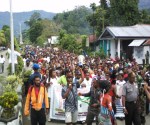
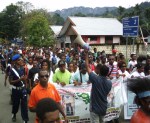
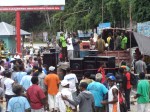
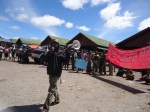
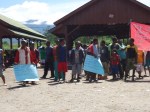
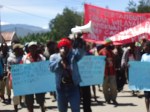
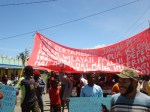
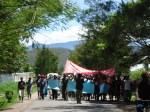
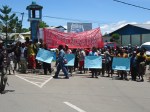
The rallies across Papua drew tens of thousands of people in total in Wamena, Biak, Serui, Yapen, Sorong, Nabire, Jayapura and Fak-Fak.  Security forces engaged in their standard procedures of intimidation and disruption at all rallies, but protesters maintained non-violence discipline at each area.

On Yapen island, close to 6000 people in total held two long marches to support the demands of the day, all under threat of arrest.  Local police had refused to issue a permit for the rallies to go ahead, claiming the rallies would upset the security and integrity of Indonesia.  After a week of pamphleteering and socialising the rallies, police had no choice but to allow the rally to go ahead.  The rally began in the village of Mantembu, where former political prisoner Yawen Wayeni was brutally disembowelled and filmed by Brimob police in a video leaked on Youtube in 2010.
Mantembu, Yapen Island

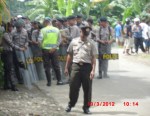
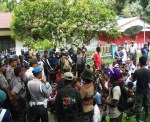
The same Brimob unit on Monday attempted to block the long march from leaving Mantembu, using over 50 police to block the narrow road, and attempted to seize all Morning Star flags.  Negotiations ensued, led by Reverend Jhon Pairire and FRWP Doberay Governor David Abon, who got agreement from police for the rally to continue to Serui city.  Police continued to intimidate Papuans all day, but Morning Star flags still appeared throughout the day despite Police.

Serui, Yapen Island

Manokwari saw more than 7000 people from across Papuan society and resistance raise the Morning Star flag and conduct long marches all over town after prayer, eventually settling down to listen to orations from a wide range of speakers.  Speakers called for the freeing of all political prisoners in Papua in Indonesian prisons, including the President and the Prime Minister of the Federal Republic of West Papua.  Brimob officers tried to seize the Morning Star flags early unsuccessfully, but soon stood aback training their weapons on the crowd, who studiously ignored the provocative intimidation according to stringers for West Papua Media.


Manokwari

In Sorong, our stringers reported that almost 1000 people took to the streets in a festive atmosphere.  Organisers claimed that few security forces turned up other than about ten plain clothes intelligence agents.  “It is clear that this drastically changed the atmosphere, it must be because of international pressure,” said our stringer by SMS.

On the West Coast in Fak-Fak, almost 1000 people took part in prayers and listened to speeches in the main market square, with little interference by security forces present.
Fak-Fak

In Jayapura, stringers for West Papua Media reported a wide range of colourful, festive and dramatic demonstrations for Papuan aspirations, including the release of almost 300 balloons painted with banned Morning Star flags and the UN flag, which drifted across town and out to sea.  This tactic has been used repeatedly as a tactic for distributed symbolic resistance in both Papua and Maluku for years.  Isolated gunfire was heard when the balloons passed over military barracks, according to local sources, believed to be Indonesian soldiers attempting to shoot down the balloons.

And in Wamena, in the Baliem Valley, a thousand people joined in a rally and march to support the call for the UN to take action by sending peacekeeping force to protect Papuan people against Indonesian security forces.  Stringers for West Papua Media report that few security forces were in overt attendance, but there was an understanding that troops were close by at all times.  The Baliem Valley and West Papuan highland people have borne the brunt of Indonesian violence since the occupation began, with sweeps against civilians by the Australian funded Detachment 88 counter terrorism group and Indonesian army still ongoing in Tingginambut, Mulia and the outer areas of the Baliem Valley.

Wamena

More demonstrations are planned in coming weeks.

westpapuamedia

Letters of solidarity flood in their thousands for Filep Karma

by a Special Correspondent for West Papua Media in Abepura

March 19, 2012

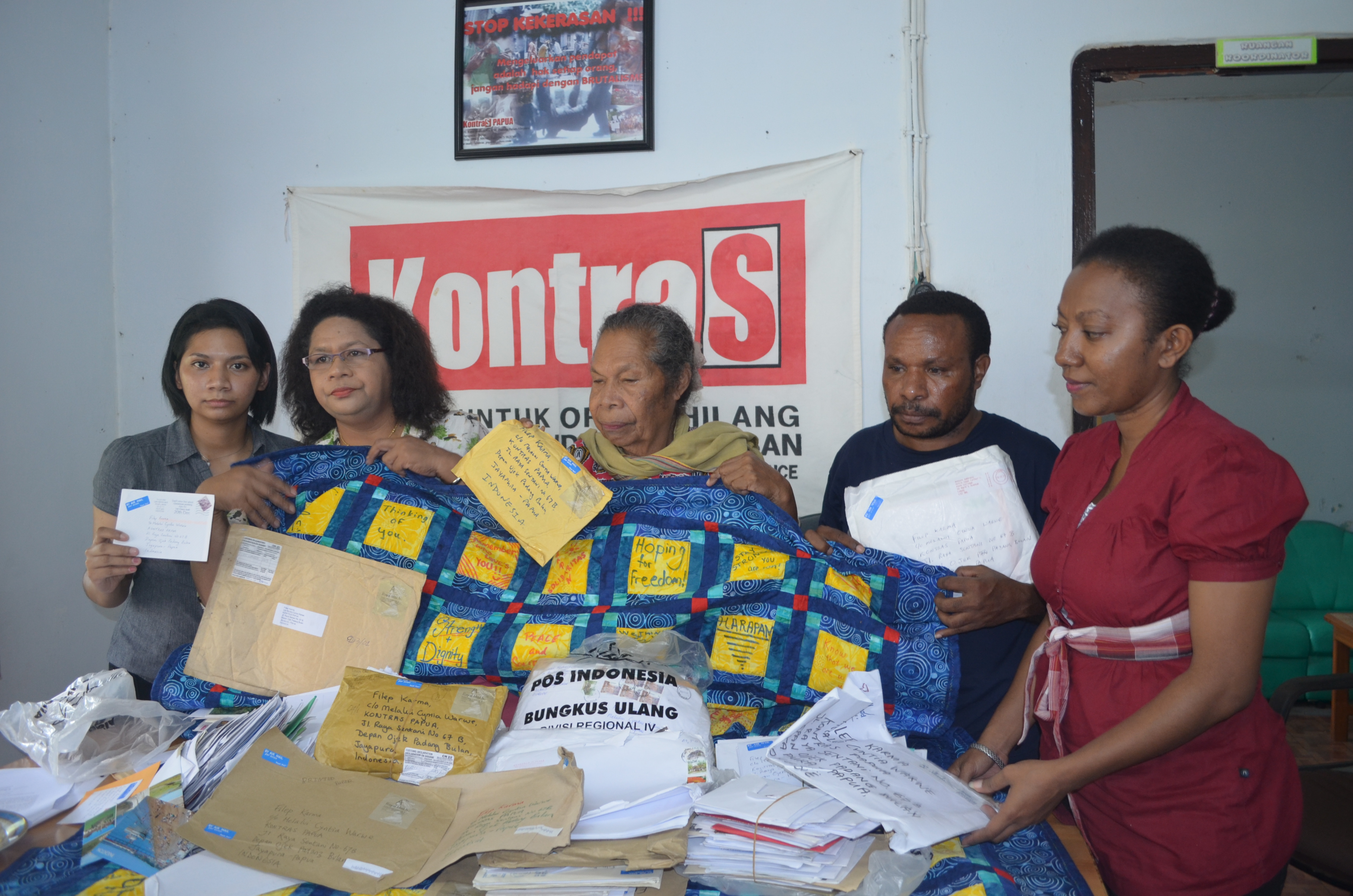
Kontras and Filep Karma's family with some of the nearly 7300 letters sent by international supporters of Karma (Photo: West Papua Media)

Filep Karma, is one of the political prisoners given sentences of 15 years of imprisonment by the government of Indonesia, by raising the Morning Star flag, on December 1, 2004, at Trikora field, Abepura. Ever since a period of 7 years, and 3 months of his prison sentence  have lasted in Abepura prison. During captivity Filep Karma received letters of solidarity sent by the International community through the office of the Commission for missing people and victims of violence in Papua (KontrasPapua).   Nearly 7292 letters of support have been sent in the period of 2011 untill 2012.

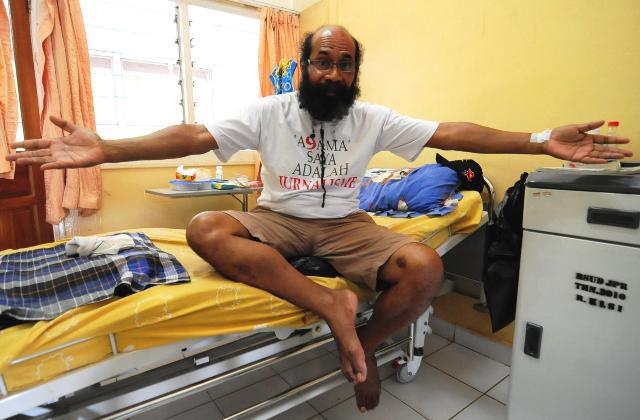
Filep Karma inside the prison hospital (Photo: West Papua Media)

United for the truth (BUK) and Kontras Papua held a Press Conference on March 19, 2012, and immediately submit a letter of support to the family representative of Filep Karma. Andrefina Karma,  Filep Karmas second daughter  said ” International Community support is strong solidarity for the freedom of my father, the people there once a month hold a simple campaign in front of the Indonesian embassy and called for the unconditional release of Filep Karma”, she said.

Letters that came from different parts of the world  proved that there is support for political prisoners in Papua. Olga Hamadi, Director of Kontras Papua says”  the government should not close her eyes  for the injustice suffered by political prisoners in Papua, both in conditions of health and food at the prison, which  received less serious attention”, she said. She also denied the statement by the Minister of Justice and Human Rights Republic of Indonesia during a visit to Papua saying that there are no political prisoners in Papua.

Filep Karma is one of  figures of political prisoners who never made a compromise with the Government of Indonesia. He rejected any form of clemency, amnesty, and abolition that is given by the Government. ” If I receive clemency, that means I ask for forgiveness to the government, but I do not feel guilty at all, I am just making a peaceful protest. Indonesia is a democratic country, am I wrong to fight for the basic rights of indigenous Papuans?

“I will continue to undergo a period of detention up to 15 years in prison, if you want to release me, I ask to be released unconditionaly”, Filep Karma said, as he was undergoing physiotherapy treatment in DOK II general hospital.

westpapuamedia

Papuan Leaders Jailed For Speaking Out

with New Matilda

By Alex Rayfield

Five West Papuans were given jail terms on Friday for peaceful expressions of political opinion. Alex Rayfield reports on a trial that will only amplify calls for independence.

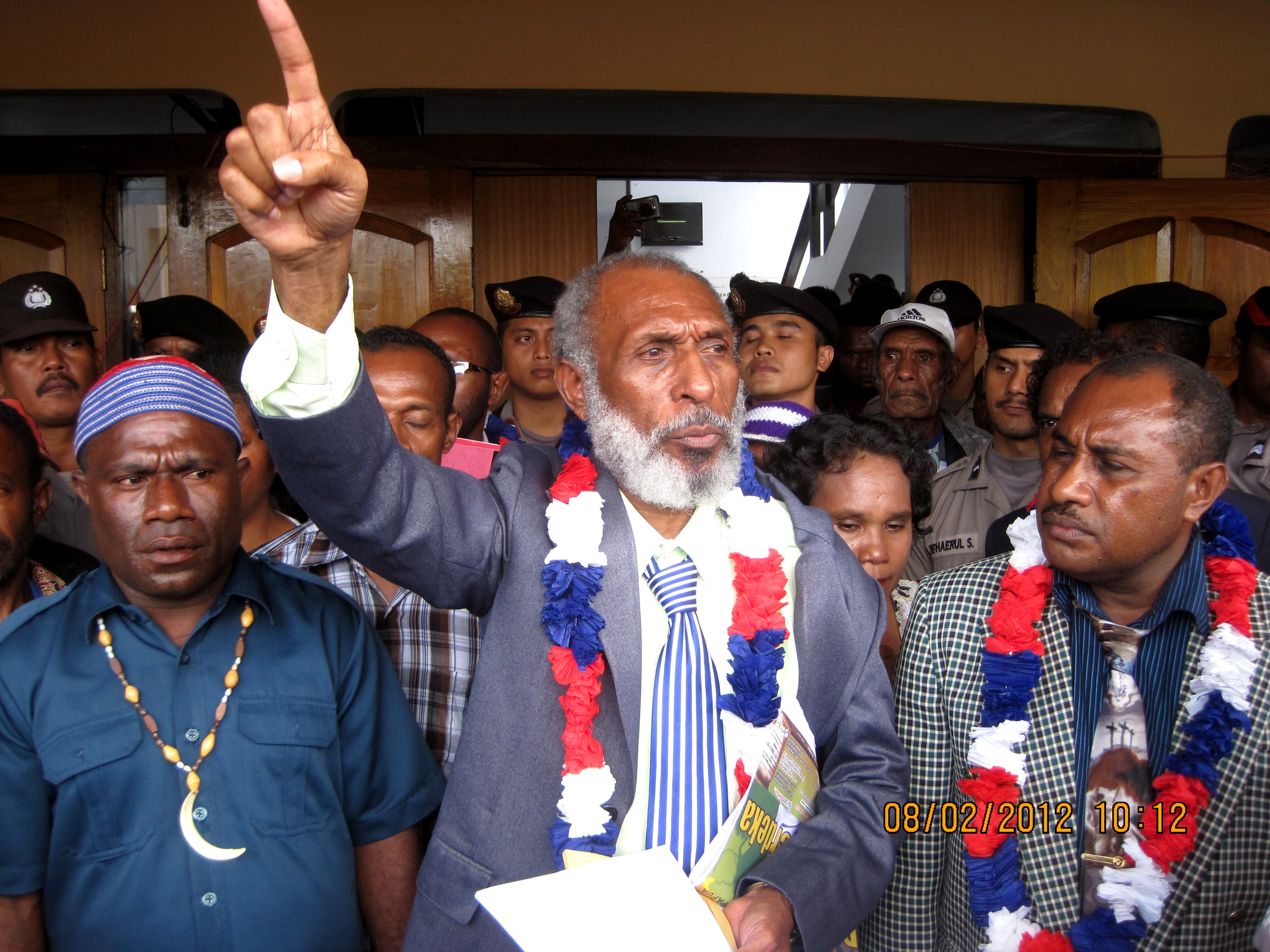
Last Friday presiding Judge Jack Johanis Oktavianus sentenced the men known as the Jayapura Five to three years in prison. The Five — Forkorus Yaboisembut (the president-elect of an independent West Papua), Edison Waromi (prime minister-elect), Dominikus Surabut, Agus Krar and Selphius Bobii — were charged with treason for their role in organising the peaceful Third Papuan People’s Congress which took place in October 2011.

Forkorus Yaboisembut outside court. Photo: West Papua Media

The Five’s legal team immediately declared they would appeal to Indonesia’s High Court in Jakarta. Outside the packed District Court in Jayapura hundreds of Papuan protesters sang, danced and prayed. Many carried banners calling for a referendum. Ringed around the Papuan crowd were Indonesian riot police, military personnel and a fleet of armed troop carriers, army assault vehicles and water cannons.

The Third Papuan People’s Congress, a three-day open air gathering that was attended by thousands of Papuans last year, ended with Forkorus Yaboisembut reading a declaration of independence from Indonesia. After he had finished the 74-year old tribal leader thanked the police and military for allowing the Congress to take place and retired to a nearby monastery.

Forty minutes later — and for no apparent reason — the police and military opened fire with live ammunition. Five Papuans were killed by the Indonesian security forces. Witnesses told New Matilda that some of the police who opened fire on the unarmed crowd were members of the Australian and US-funded, armed and trained Detachment 88.

But rather than the Indonesian police being arrested and charged with murder, Forkorus and his colleagues were the ones dragged before the court. The police and military officers that opened fire last October were given a slap on the wrist. Seventeen police officers received little more than a written warning.

The Jayapura Five were charged under antiquated sections of Indonesia’s Criminal Code that date back to the Suharto era and before that to Dutch colonial times. But given the fact that treason can fetch life imprisonment in Indonesia, the three-year sentences handed down last Friday were much less than many people expected.

When New Matilda asked Gustaf Kawer, the senior legal counsel for the men, whether the three-year sentence could be read as a signal that the Indonesian legal system was asserting more judicial independence his response was an emphatic “no”.

“The Five invited the Coordinating Minister for Political and Legal Security and the Minister for Home Affairs to attend the Congress. The gathering was held in the open and everyone was welcome to attend. It would be much better if the court and police did not attempt to obstruct their democratic right of freedom of expression,” Kawer said.

Kawer and other members of the legal team told New Matilda that the trial was marked by irregularities, interference and intimidation. There was a heavy presence of armed members of the security forces at all 15 court hearings — inside and outside. Question marks also hang over the extent to which the court acted independently. Immediately prior to sentencing the judges met with senior military commanders, police and government officials for a one-hour closed meeting, according to Tapol. Kawer has also been threatened with prosecution by the police for defending the Five.

In an interview with the Jakarta Globe, Indonesian presidential spokesperson, Teuku Faizasyah, asserted that the court did act independently. “Our political system today fully respects trias politica and the ongoing legal process.”

Faizasyah went on to say that the right to freedom of speech in Indonesia does not extend to separatist activities. According to Faizasyah, declaring independence from Indonesia is separatism and the European Union classifies separatism as a form of terrorism. “Any expression of separatism in the EU is thus considered an act of terrorism” said Faizasyah.

In the case of the Jayapura Five the men operated openly. They were unarmed and behaved in a disciplined and non-violent manner. They may be revolutionaries — but they are not violent.

In an SMS from prison a defiant Selphius Bobii told New Matilda that sentencing the Five to prison sends a message to Papuan activists that Indonesian law is incapable of delivering justice for the Papuan people.

“The police, Attorney General, and Indonesian judges … cannot deliver justice for the people of West Papua. They cannot imprison democracy and they cannot imprison the peaceful struggle for a free West Papua. It is the Papuans who possess sovereignty over our land … and the Papuan people will continue to struggle,” wrote Bobii.

Dominikus Surabut, another member of the Five, told New Matilda that it was illogical to accuse West Papuans of wanting to separate from Indonesia when it was Indonesia that invaded and annexed West Papua. Surabut argues that the invasion and continued occupation of West Papua by the Indonesian state is in violation of the right to “free choice” that the United Nations guaranteed West Papuans but failed to deliver.

For people like Surabut and Bobii and their three jailed colleagues, and for the Papuans who watched the treason trial unfold, state repression in West Papua is evidence that Indonesia can never lay claim to being a democracy while West Papuans are denied the chance to freely and fairly determine their future.

The jailing of the Jayapura Five pushes West Papuans further down the path of insurrection. The denial of free speech invites the international community to join Papuans on that journey.

“Holland didn’t fall over when Indonesia became independent, and neither will Indonesia when we do,” says Herman Wainggai, a West Papuan independence leader and former political prisoner living in the United States. “Bali principles, Lombok treaties, peace centres in West Java … these are all meaningless while Indonesia continues to escalate its troops and its judiciaries against us”.

With West Papua Media.

RA: Freeport mine strike ends (interview with West Papua Media)

”]
  • Updated December 28, 2011 07:58:41

Thousands of workers at Freeport mine in Indonesia have ended their three-month strike for better wages, after a signing a pay-rise deal with the company.

Production at Freeport‘s giant gold and copper mine in Papua has been at a standstill since workers began their industrial action. The workers are expected to return to work this week, but there are reports the Papuan police chief will charge protest organisers with sedition.

Presenter: Melanie Arnost
Editor of West Papua Media Nick Chesterfield

CHESTERFIELD: It’s seen to be a bit of a bitter sweet victory because whilst there have been ceremonies to enable peaceful resolution, the company, Freeport has given very little ground on the original demands and the Indonesian police in Papua have decided that they’re also going to charge the union leaders and the organisers with sedition.
ARNOST: What does this mean for the workers?
CHESTERFIELD: Well sedition is basically the charge under which everyone in West Papua gets charged if they raise the Morning Star flag. What it means is basically between 10 to 15 years in prison, and it’s not exactly a good faith act by the police. So there’s a lot of people who are going to be fearful. It’s designed by the police to stop anyone from taking legitimate industrial action by making out that it’s treasonous.
ARNOST: And how many workers are we talking about that look like they’ll be charged?
CHESTERFIELD: Well at the moment it’s looking at the union organisers, certainly the heads of the union and key organisers who’ve been manning the blockades and doing the education out there and doing what union organisers do on the ground during strikes. Whether or not they charge everyone, this is a question that the workers certainly want to have answered, and also one of their conditions in returning to work is there’s going to be no sanction on them for going on strike. There’s no real gains in wage justice for any of the workers there, I mean they were initially going for quite a significant pay rise, and in the end they’re getting less than seven dollars an hour for their efforts.
ARNOST: So why did they decide to end the strike?
CHESTERFIELD: At the end of the day companies like Freeport and the Freeport mine which is the most profitable mine on earth, it’s the largest gold and copper mine on earth. It doesn’t want to pay its workers, not its indigenous workers anyway. There’s an understanding simply that there was no willingness on behalf of management to even budge even a few cents. So any money is better than no money.
ARNOST: So these seven dollars, is that what they were originally being paid in the first place?
CHESTERFIELD: Look they were originally being paid about a dollar 50 to three dollars an hour. So certainly there have been a few increases but it’s far less than what they’re asking for and there’s no real guarantees of safety and security, and especially security from these ongoing attacks by unknown forces, which the police and military seem to not want to solve.
ARNOST: When do you expect the workers will return to work?
CHESTERFIELD: It could be any day but nothing is entirely guaranteed until we get the pictures from the ground really.
ARNOST: It’s said to be the longest in recent Indonesian history this strike, so do you predict something like this happening again?
CHESTERFIELD: Look certainly there’s an appetite for industrial action in Indonesia and certainly in West Papua. Certainly the Freeport Mine’s got to be separated in some way obviously from the independence struggle in West Papua, but there’s certainly issues of corporate behaviour and corporate impact on surrounding environments and surrounding social dislocation that workers have really switched on to. You can’t unlearn what you’ve gone through in a situation like that, so certainly there’s more of a willingness to take this kind of action. And they’ve certainly learnt a lot of lessons from it.

West Papua- December 1 2011 – Breaking the Media Blackout

50 years ago on the 1st of December 1961, West Papuans flew their flag for the first time in preparation for their independence from the Dutch.

In 2011, despite ongoing repression, the Morning Star flag was once again flown across the country. The non-violent demonstrations and gatherings, as well as the military crackdown against them, were reported to the world via a network of citizen media journalists, breaking through the media blackout of West Papua.

This short wrap-up shows how the West Papuan people would not let outrageous threats of Indonesian state violence suppress their desire to declare their independence.

[vimeo http://vimeo.com/34163958]

Create a website or blog at WordPress.com

Up ↑