What should be the role of the Australian government as a member of the UN Security Council ?

Opinion / Analysis
By Herman Wainggai
September 11, 2013

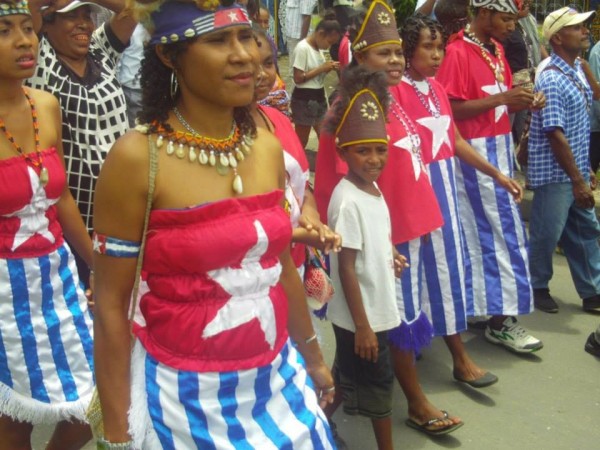
Papuan women wearing the banned Morning Star flag as clothing at Manokwari demo to welcome Flotilla (Photo: West Papua Media stringers)

Knowing  the history of the Indonesian state’s Army and Police invasion of West Papua there is no surprise in the fresh news of increased Indonesian military troops to the region, who are growing rapidly on this Melanesian ground like fertile mushrooms.

The Freedom Flotilla sailboat is currently on its voyage from Australian waters to the land of West Papua , and it has been confirmed that it is due to arrive within the next few days. Throughout the land of West Papua citizens and activists have been holding a number of peaceful demonstrations as a signal to welcome this boat. Thousands of West Papuans have bravely taken to the streets, high in enthusiasm and taking with them a variety of traditional instruments used in West Papua – ukuleles , guitars , drums , flute drums. They are also wearing traditional dress, and along with raising banners of the Freedom Flotilla sailboat, they are also displaying the national symbols of West Papua – the Morning Star flag.

This represents a challenge to and hope for the Indonesian government, that it ‘opens up’; that Jakarta demonstrates that it possesses genuine democratic maturity to negotiate peacefully with the political leaders of West Papua.  The people of West Papua, moreover, sincerely look forward to the newly elected Australian Federal government, especially in its new role as one of the member states of the UN Security Council, to act as a  mediator and by standards of international law help resolve the long running political conflict between the Indonesian government and the people of West Papua.
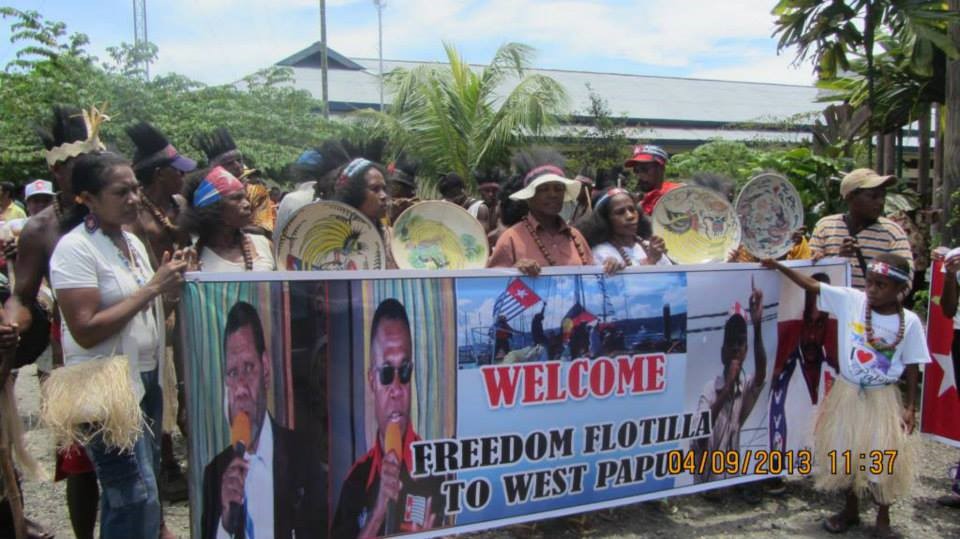
Demonstration welcoming Freedom Flotilla, Sorong (photo: supplied from Herman Wainggai, NFRPB)

Our hope is that the precise opposite does not happen – that the Australian Government merely lets the Indonesian government continue to unilaterally kill the political, human rights and democracy activists of West Papua. This has been their lot for over 50 years – arrests, kidnapping, detention, shooting, killing, raping, long imprisonments.

The people of West Papua also hope that the Australian government will not forget this tiny Freedom Flotilla who will be facing the storm of the Indonesian military whose numbers have been newly swelled in the border area. Whatever happens, Australia needs to be assured that the people of West Papua will maintain their struggle to govern themselves, and will fight for that freedom by non-violent means.

The Freedom Flotilla to West Papua logo

The history of Indonesian brutality in West Papua over decades must be stopped by the international community, which includes Australia in its significant roles in the UN and  the Asia-Pacific region.  The data has been clearly documented from year to year – how long must West Papuans continue to be slaughtered like animals? The question is very pertinent then – what will be Australia’s role, and the USA and the United Nations – in regards to West Papua?  This land of the Mambruk – the beautiful Crowned Pigeon and symbol of Papua – which we love, shall we close our eyes and stop our ears to the injustices?

In the same way that attention is currently being given to the political situation in Syria, so must attention be given to the little Freedom Flotilla, and to the suffering people of West Papua, who have struggled for freedom and justice under the brutal regime of the military of the Indonesian state

Papua Ablaze! The Need for a Touch of Hearts

Opinion

by: Selpius Bobii.

Abepura Prison

September 8, 2013

“ In Syria hundreds of civilians are dead from a suspected attack with poison gas on Wednesday 21 August 2013 at a location close to the Syrian capital of Damascus. Meanwhile in Papua hundreds of thousands of Papuan citizens are also dead, having been killed over the time frame of the last 50 years. Killed as a result of military operations both covert and overt, undertaken in a planned, systematic and measurable way since the 1960’s until this time. (For further information see https://westpapuamedia.info/2013/03/30/selpius-bobii-the-annihilation-of-indigenous-west-papuans-a-challenge-and-a-hope/).

The United Nations (UN) Security Council held a sudden meeting to discuss the suspected use of poison gas in Syria and to find out who was responsible and acted swiftly to organise a Fact Finding Team, as the use of any weapon to annihilate people in mass numbers such as a poison gas falls within the category of ‘humanitarian evils’. Meanwhile the USA is considering a military attack against the Syrian Government if it is proven without doubt that they in fact used a weapon of mass destruction was used by the Syrian Government’s military. (Source: www.voaindonesia.com).

The incident in Syria is shocking beyond words and Papuans are also so deeply saddened by this tragic news.  Yet what about the lack of response by the UN to the humanitarian evil that has been continuing for over 50 years now against the people of Papua by the Republic of Indonesia? What is the attitude and actions of the UN towards the situation on Papua? Every hour there are Papuans being killed due to a range of causes that all form part of a systematic and measurable plan of the Indonesian Government that is planned to annihilate the ethnic people of Papua.  Are member states of the UN and other countries of the world going to stand-by forever and allow Indonesia to continue to carry out brutal acts of colonial domination until such time that the ethnic people of Papua are wiped out from the land of their ancestors? (For supporting evidence see: www.scoop.co.nz/stories/HL1308/S00090/genocide-of-ethnic-papuans-for-whom-what-was-un-created.htm).

Perhaps the UN and those other countries are of the opinion that the problem of Papua is not as complicated as the humanitarian problem in Syria, so it doesn’t need their involvement.  However that can only mean that they have not yet looked closely and carefully enough at the situation there.  As Papua has already become a humanitarian emergency: a hidden and horrifying humanitarian emergency that is systemic, planned and measurable.

Papua burns

Papua is ablaze and the first and primary source of that fire is the annexation of the nation of Papua into Indonesia through a military and political invasion in the 1960’s. There were four parties involved in that annexation, four parties that were responsible for  ‘lighting the fire of conflict’ in Papua: Namely Indonesia as the initiator and primary actor in the annexation; the Dutch as both an actor and a victim of aggression; the USA as the designer and primary supporter of the annexation; and the UN as the executor. Whilst Papua is the unceasing victim of those four parties’ conspiracy of economic, political and security interests.

The fire of the ideological political conflict, between the Papuan Mambruk way of looking at the world and the Indonesian Pancasila ideology, creeps through and destroys the seams that hold life together for the nation of Papua. A fire of conflict that in turn has led to a range of smaller fires sparked by the first. This raging fire has burnt through the most basic rights of the indigenous Papuan community, including the very right to life.

A dense smoke has constantly billowed forth from the centre of the fire in the land of Papua. A number of parties have seen that thick smoke but there’s been no response. Of course as we all know where there is smoke there is also fire and conversely where there is fire we know there will be smoke. Similarly where there is conflict of course there are victims and conversely where there are victims we know there is conflict behind that. Until now a number of means have been used by Papuans and the international community in solidarity to try to put out the raging fire of the primary conflict and also the smaller fires that have been sparked. However the flame of conflict has continued to spread relentlessly due to Indonesia together with the support of its various allies  continuing to defend its hold on Papua. In fact they have caused the fire to spread even wider.

To extinguish this fire in the land of Papua it will need the involvement of all parties, and particularly those four primary actors being Indonesia, the Netherlands, USA and the UN together with Papua as the unceasing victim of their conspiracy of interests. The primary fire that must be extinguished  is that of the conflict around the political history of the nation of Papua. For it was this that gave rise to the other fires.  If the primary fire can be extinguished then the smaller fires will also be able to be extinguished. However if the primary fire is not extinguished then so the other smaller fires will also continue to blaze. Until ethnic Papuans are scorched – that is annihilated – in the land of their ancestors.

All those parties of good heart and which hold in high esteem those values which are worthy, have a moral responsibility whether by direct or indirect means to take control of and extinguish the fire of conflict between the supporters of the Pancasila  ideology (those who are pro Indonesia) and the supporters of the Mambruk ideology (those who are pro Papuan independence).

For as long as the fire of conflict continues to blaze between the followers and supporters of the two ideologies, so the innocent human community of Papua is being burnt. For as long as this continues, the tears of blood of the nation of Papua will continue to drip.  Indigenous Papuans must continue despite the cost of lives to redeem the situation and bring about total liberation of Papua; and the voices of liberation crying out from the people of Papua will without ceasing to fill the air until that moment when the faith revolution is realised in the land of Papua.

The nation of Papua has not asked for anything that is the possession of another. We just ask for the acknowledgement of the basic political rights of our people, the nation of Papua. As a nation-state with full independence. Just as other nations and states of the world have already had their independence recognised. This is the faith, the hope and the longing of the nation of Papua.

With all limitations and capabilities that exist within us, the nation of Papua will continue to struggle until that revolution of faith is realised.  Then with those same existing limitations and capacities we will develop our own country of Papua, standing on our own two feet.

It is dearly hoped that the voice of the nation of Papua will be heard and will be responded to by actions of all parties wherever you may be, in order to uphold the values of justice, truth, democracy, honesty, human rights and peace for all.

The prayers and tears of the nation of Papua without ceasing accompany all of those amongst you who care for our situation, wherever you may be located and working to support us.

Solidarity without limits!
Selpius Bobii is the General Chairperson of Front PEPERA West Papua & is a Papuan Freedom Political Detainee in Abepura Prison


Leading Indonesian NGO Condemns the continued use of Treason Charges against Papuans

by ALDP (Alliance  for Democracy in Papua)

Opinion/Statement

September  6, 2013

68 YEARS SINCE INDONESIA BECAME INDEPENDENT, TREASON [MAKAR] IS STILL BEING USED AGAINST PAPUANS.

The  Indonesian people recently celebrated the 68th anniversary of their independence on 17 August 2013.   What lessons can we draw from this anniversary in order to resolve problems faced by our people who experience so many problems in various parts of the country,  especially in regions where there is conflict such as Aceh and Papua?

Especially with regard to Papua, it is not acceptable for the articles about treason  to be used any more.   This is because for a country that is now based on democratic principles, it clearly violates these principles.  Furthermore, the law on treason which is still included in Indonesia’s Criminal Code is no longer used in the country where it originated [The Netherlands].  The continued use of these articles will only widen the gap between Papua and Indonesia and lead to acts of violence because of  feelings of revenge about history, or may cause friction between different groups of people.

These articles on treason are always held ready for use against activists or anyone who demands justice and the right to express their views in public, in accordance  with the right to freedom of expression.

The treason articles were first included in the Criminal Code in the 19th century. The Dutch Minister of Justice adamantly refused a move to include an article on treason which could be applicable to anyone.  He said:  ‘These articles should be enacted to meet the needs of a colonial territory and should not be applicable to  European countries.’

The articles on treason were adopted by the Dutch colonial government and were based on Article 124 of the British Indian Penal Code.  In 1915. The Indian Supreme Court and the East Punjab High Court declared that they were invalid because they contradicted the Indian Constitution which upheld the principle of freedom of expression.  In The Netherlands, these articles were regarded as being undemocratic.   However, the Dutch East Indies government made use of the articles in their colonial territories.

In this day and age, several decades after Indonesia declared its independence, these articles should no longer be applicable to citizens of the country, including Papuans, bearing in mind that Papua is not a colony of Indonesia. {Eds – This statement does not reflect WPM’s position}

In judicial terms, treason is a unilateral act against the authorities, for the purpose of ensuring that part of its territory falls into enemy hands or should be ceded in order to become part of another state.

The crime of treason  is regulated under Articles 104 to 129 of the Criminal Code – KUHP.  Treason is also classified as a crime against the president and vice-president [the head of state and/or the head of a rival state], against the legitimate government or against government agencies, being involved in espionage on behalf of the enemy, resistance to government officials, rebellion and other activities that are directed against state interests.  Treason is also committed against the government (the head of state and his/her deputy) for the main purpose being to render an individual incapable of governing, to annihilate the country’s independence, to overthrow the government, to change the system of governance by unlawful means, to undermine state sovereignty by  separating part of the country on behalf of another country, or to create an independent state.

The crimes of spreading hatred or incitement are dealt with in Articles  154, 155 and 156 of the Criminal Code. These articles state that ‘public statements which express feelings of hostility or are offensive to the government’ are regarded as crimes as well as public statements which support such sentiments. These articles are punishable for up seven years.

During the era of the late President Soeharto, these articles were frequently used to restrict freedom of expression. They were also used against political opponents, critics, students and human rights defenders in order to silence them. The people in power used these articles like rubber, something which can be pulled in any direction as a way of restricting the right to freedom of expression.

Nowadays, in {after} the era of ‘reformasi’, the articles are frequently used to bring charges against pro-democracy activists.  In Papua. They are used in every way possible against pro-democracy activists on occasions when it has not been possible to charge them for involvement in treasonous activities.

In a report published by Human Rights Watch (HRW) in 2007, ‘Protest and the Punishment of Political Prisoners in Papua’ , Indonesia was mentioned as one of the countries where exceptions and restrictions apply that are in conflict with the basic principle of freedom of opinion. HRW drew attention to the many cases of people being arrested and imprisoned simply because they took part in peaceful protest or for peacefully raising flags. This is in violation of international law on basic human rights.  Indonesian courts frequently apply the law on ‘spreading hatred’ or ‘incitement’  towards people who are exercising their right to freedom of expression. These clauses also violate the spirit of the Indonesian Constitution which was adopted when the country became independent in 1945.

There is a tendency in Papua for a court, having been unable to prove that treason was committed, to use the crime of incitement. The articles about treason  were used when Indonesia was a Dutch colony to charge individuals or groups of people with rebellion. But these days, ‘the articles on treason are used against the civilian population when they publicly express their aspirations,’ said Harry Maturbongs, the former co-ordinator of KontraS.

A lawyer in Papua, Gustaf Kawer, said that the tendency of courts and prosecutors to use the charge of incitement when they are unable to prove that treason has been committed, is a sign that the court is apprehensive and wants to avoid the possibility of people who have been charged making counter-charges against the state, where the case against them had not be proven.

It is often the case that pro-peace Papuan activists who are brought before the courts are charged on several counts for a variety of misdemeanours.  In the trial of Buchtar Tabuni in 2010, he was charged under five articles.  Article 106 and Article 110, as well as Article 160, Article 212 and Article 218, for treason, for incitement and for disobeying an order by an official.  Another group of people were sentenced and convicted for treason. Forkorus Yaboisembut and his colleagues were arrested by the police for organising the Third Papuan People’s Congress on 19 October, 2011.  [After formally declaring the establishment of an independent Federated State of Papua] ‘President’ Forkorus, along with his Prime Minister Edison G. Waromi, were arrested with others who were involved in organising the Congress, Dominikus Surabut, Agus M. Sananay Kraar and Selfius Bobii. They were charged by a team of prosecutors headed by Yulius D.

Even today In 2013, the treason article continues to be used. A group of men were recently charged. They are Klemens Kodimko (71 years old), Obeth Kamesrar (68 years old), Antonius Saruf (62 years old), Obaja Kamesrar (52 years old), Yordan Magablo (42 years old), Hengki Mangamis (39 years ) and Isak Klebin (52 years old) . They were charged at the first hearing of their trial in a court in Sorong on Monday, 19 August 2013.

A spokesman for the police in Papua, I Gede Sumerta Jaya, said that the men were charged with treason because they are leaders of the OPM (Organisasi Papua Merdeka) or of radical groups that are active planning or speaking out in favour of resistance to the legitimate government.

Earlier this year, on 30 April, hundreds of people gathered at a posko  [a small construction] which they had  just set up. They sang together as they gathered there on 30 April to make preparations to celebrate 1 May on the following day.  While they were singing, shooting was heard aimed in the direction of the posko. The shots came from some people aboard an avanza vehicle with darkened windows, accompanied by a police patrol vehicle.

[Translated by TAPOL]

War of Nerves between Papuan Governor and Papuan Political Prisoners

OPINION* / ANALYSIS

By: Selpius Bobii

Abepura State Prison, 19 August 2013

This was the first time the Governor of Papua had visited the Abepura State Prison. The Governor Lukas Enembe together with the Provincial Secretary, the Chairperson of the Papuan People’s Consultative Assembly, the Implementation Officer of the Chairperson of the Papuan Legislative Assembly, the Territorial Military Commander (of XVII Cenderawasih) and a high-ranking officer from the Police Headquarters in Papua, together visited the Abepura Indonesian State prison on 17 August 2013. The stated aim of the visit being to represent the National Indonesian Government in reading out the giving of remission to the political prisoners and to read the speech from the national Minister for Law and Human Rights.

However there was also another hidden agenda for their visit and that became apparent once the Governor commenced his address inside the prison.  On Enembe asking the prison warden how many political prisoners were there who had been charged with treason and hearing there were ten, he then questioned the prisoners “What is it that you who have committed treason are looking for?  Stop your struggle. We will achieve freedom in prosperity. In the very near future the Government will pass the Regulations for Governance in Papua and once that occurs we will already have our independence within the Republic of Indonesia and I will be the president. So don’t cry out anymore for independence for Papua.”

Only one political detainee attended the ceremony for the giving of remission, whilst the remaining 25 Papuan political detainees chose not to attend but rather to stay in their cells to avoid the hidden agenda of the Governor and his entourage. However because the Governor used loud amplification to give his address, so all the political detainees could not avoid hearing his words despite their choosing not to attend the ceremony.  The Governor stated “I have many family members who have died because they have spoken about independence for Papua, whilst others have fled to PNG, Manokwari and in all directions. Since I was small people have always said ‘Tomorrow we will have freedom!’  But where are the results? Now I have become governor.”

Several political detainees including Victor Yeimo and a number of others in the same cell block raised their voices from their cells to assert their protest against Enembe’s statement in the middle of his address. Police Officers, plain-clothed Indonesian military (TNI) and prison officers quickly moved to deal with the few vocal detainees. However the Governor who heard the detainees’ voices of protest instructed  “Let them yell back there.”  One of the officers present said he would deal with them later.

Following the ceremony the Governor and his entourage moved towards a cell block occupied by several well-known Papuan Freedom Political Detainees. Filep J.S. Karma was suddenly met by the Governor and his entourage, so he was forced to receive their visit even though he had no prior intention of speaking with them. Filep Karma stated “It’s impossible for the people of Papua to unite with the people of Indonesia as until now the majority of Indonesians consider Papuans to be half animal. I myself also experienced that whilst studying higher education in Java. Recently when I was taken to Jakarta for medical treatment I asked friends there whether attitudes towards Papuans had changed, however they responded there had been no change at all in attitudes towards Papuans and that Indonesians continued to regard Papuans as similar to human monkeys”. Filep Karma went on to say “So many Papuans have become victims because of the Papuan Struggle for Freedom and we also are imprisoned for that same Struggle. Therefore we reject the offer of clemency from the President of Indonesia.  Thank you for your efforts Governor however we political detainees cannot accept the clemency offered.”  Governor Enembe merely responded with “Very well.”

Victor Yeimo was also in the same block with Filep Karma and stated “I am Victor Yeimo, the Chairperson of the West Papuan National Committee (KNPB), and I tell you that the time will come when Papua will get independence. So please don’t offend us by making statements that Papua will not get independence.” He continued “Go ahead Governor and guard your position, but our commitment is due to our old people suffering back in the villages. Suffering not because of welfare needs or some similar problem, but because Papua must be independent.” Governor Enembe responded “I also was previously part of the struggle for ten years, but my work now is to develop Papua and to make the community prosperous. I have been shot and orally abused also and I live with that, but I have recently come out from that and am now governor.”

At the moment the Governor and his entourage started to leave the area the Writer left his cell and approached them introducing himself as the Chairperson of the Organising Committee of the3rd National Papuan Congress. Then expressing in a harsh voice “At the Congress we declared Papua to be a state and because of that we are here in prison. Tell President SBY that the nation of Papua is ready to negotiate. Also tell him that the nation of Papua firmly rejects Special Autonomy Plus and the Regulations for Papuan Governance. Furthermore we as Papuan political detainees reject the giving of clemency in whatever form that may take. We have been imprisoned not because we struggle for food and drink or because we are chasing some position in government. So many Papuans from the 1960’s until now have been sacrificed, not because they were chasing food and drink or positions of influence but for full independence (of Papua).”

Governor Enembe replied “I also previously lived with the Struggle but no longer, as my work is now to address welfare needs of the people of Papua. You have been a long time in the city but I have only recently come from the mountains.” To which the Writer in a harsh tone responded “Sir coming here from the mountains is not to save the people of Papua, but rather to shatter that which is your way of stating that we will achieve our freedom whilst within the Republic of Indonesia; and that we will achieve freedom through prosperity. Stop saying that! The people of Papua struggle for full sovereignty!”  With the conversation closed the Governor’s entourage wanted to shake hands but the Writer refused and withdrew to return to his cell.  However the Territorial Military Commander and the head of the regional Department of Law and Human Rights Demianus Rumbiak together with a guard, followed the Writer from behind. They still wanted to shake hands so the Writer stated to the Territorial Military Commander “I’m sorry I cannot shake hands with you. We are fellow human beings yes but in terms of political ideology you and I are enemies”. The Writer then shook only the hand of the head of the regional Department of Law and Human Rights. The Governor and his entourage then left.

It is ironic that since that visit the political detainees in Abepura prison have been informed by family members that certain persons have been spreading stories that at the time of the Governor’s visit the Political Detainees chased the Governor with blocks of wood until the Governor was forced to leave the prison. That is but a story created by the Indonesian forces or perhaps Indonesian National Intelligence. The truth is that what really happened that day was a war of nerves between the Governor and several Papuan Freedom Political Detainees at the Abepura State Prison.

Lukas Enembe is showing himself to be very different from previous Papuan governors. He is the most arrogant and seems to really dislike the movement of the Papuan Freedom Struggle. On a number of occasions he has openly asked Papuans who are part of the Struggle to give up and instead work to develop Papua within the Republic of Indonesia and to find freedom in prosperity. He has even asked the OPM/TPN who have for many years endured in the remote forests to give up the Struggle; and now he asks the political detainees. This really touches on some very deep old wounds for the people of Papuan who for more than 50 years have constantly struggled and their people been sacrificed again and again, losing  thousands of their people killed by both overt and covert means in the long struggle for freedom. Enembe’s words are deeply hurtful for Papuans.

It’s understood that Lukas Enembe is playing the role of the representative of the National Indonesian Government in the Province of Papua.  However his ways are so unlike that of previous Papuan governors. He is much more confrontational in dealing with those from the Struggle.  It’s clearly evident that one of the tasks that have been entrusted by Jakarta to Lukas Enembe is to ensure Papua remains within Indonesia. Enembe is from the Democrat Party so it’s to be expected that he would implement SBY’s instructions with the latter as the leader of the Party as well as the leader of the Nation and the Indonesian Government. Enembe has clearly been pushed by Jakarta to use this confrontational method but in so doing his statements are most hurtful and indeed deeply saddening coming from a Papuan.

We are aware that several months ago Enembe requested of President SBY that he be provided with security by the police and military for as long as he was carrying out the required task of approaching members of the Papuan Struggle (including both civilians and member of the OPM/TPN in the forests). This was proven once again with Enembe’s visit to the Abepura Prison on which due to his hidden agenda he asked to be escorted by the Territorial Military Commander and a high-ranking officer from the Police Headquarters in Papua.  The Governor is holding hands with TNI and the police not only to try and make a success of Jakarta’s ‘project’ in Papua but also with the hidden intention of indirectly terrorising and intimidating those of the Papuan Freedom movement. However his agenda as he visited the Abepura Prison totally failed, being received with only protest and warnings from a number of the Papuan Freedom Political Detainees. The Political Detainees at that moment had not the slightest fear in conveying the position of the community of the nation of Papua to the Governor together with the Territorial Military Commander and senior ranking officer from the Papuan police headquarters. They were mistaken to think the detainees would be fearful in the presence of the police and TNI leaders escorting Enembe. The political detainees fear only God and the community of the nation of Papua that longs for the sovereignty of the nation of Papua.

The Indonesian Government is really pushing a number of Papuans – both officials and certain members of the community – to confront members of the Papuan Freedom Struggle.  Indonesia is also using certain Papuans by sending them to foreign countries to try and silence any support for the Papuan freedom movement from the international community. So the entire community of the nation of Papua  together with the international community in solidarity, are reminded wherever you may, to be on alert and careful to avoid any approaches that could be political manoeuvres of Indonesia. Manoeuvres aimed at weakening the motivation of the Struggle and at repressing support from the international community in solidarity with the movement for the liberation of the nation of Papua from the colonial domination of Indonesia and its allies.

Let us struggle without ceasing! ‘Salam solidaritas without limits1’

Selpius Bobii,General Chairperson – Front PEPERA West Papua & Papuan Freedom Political Detainee

*OPINION PIECES REPRESENT THE VIEWS OF THE AUTHOR, AND DO NOT NECESSARILY REFLECT THE VIEWS OF WEST PAPUA MEDIA

MIFEE: Changes to the Moratorium Map around Merauke, and Medco’s Sugar Plans

Analysis

By

August 4, 2013

The forestry ministry recently released decision (SK) 2796 of 2013, concerning the Indicative Map for the Moratorium on New Forest Use Licences (PIPIB). This provision sets out the fourth revision of Indonesia’s moratorium map. In various parts of Merauke Regency, Papua Province, there have been several important changes to the moratorium map since the original map was published in 2011. These changes have tended to accommodate the permits of investor companies in the MIFEE framework, who want to develop food and energy businesses.

Comparing sheet 3407 of the moratorium map’s fourth revision (2013), to the corresponding map from 2012 shows that the forest land has been reduced around Kampung Sermayam Indah. This change can be identified as a way to accommodate the permits of two sugar cane plantation companies: PT Papua Daya Bio Energy and PT Tebu Wahana Kreasi, which are believed to be owned by the Medco Agro Group.

The Merauke local government issued location permits in 2010 for the two companies. PT Papua Daya Bio Energi was awarded 13,396 hectares while PT Tebu Wahana Kreasi got 20,282 hectares. During 2012, the companies presented their plans to the public at the Tanah Miring district office, where they spoke about compensation and made promises, as well as handing out t-shirts.

“The company has only spoken of its plans that one time, after that I don’t  know. They want to use forest land from SP9 here in Kampung Hidup Baru up to the Senayu area. Maybe they have already surveyed the land but we don’t know”, said Bonefasius Kaize, a customary landowner from Kampung Hidup Baru, Tanah Miring district.

Marind people living around the companies’ concessions in Tanah Miring know very little about the two companies plans or activities. They have also never met with government officials from the Forestry and Plantation Service who have conducted their own survey on the use of forest lands in the area.

“We don’t have any information, many people come and claim they have rights over this land, without sitting down and talking to local landowners, such as a cocoa plantation in Tanah Miring”, said Natalis Ndiken, a traditional leader in Kampung Tambat, Tanah Miring district.

The people do not know – and have never been given information about – changes to the moratorium map. They don’t know which people or institutions have been giving out permits to use the forests grasslands and swamps owned by local people between Kampung Hidup Baru and Senayu.

This claim of the local people conflicts with the contents of decision SK 2796/2013, that changes to the moratorium map were based on community input.  This provision is based on nothing more that companies’ claims and permits.  It ignores the rights of the people to their land and the Papuan people’s local knowledge and systems of managing natural resources.

Source: Pusaka
http://pusaka.or.id/revisi-peta-indikatif-pipib-2013-di-merauke-hanya-berdasarkan-izin-perusahaan/
English translation: https://awasmifee.potager.org/?p=456

Create a website or blog at WordPress.com

Up ↑
