Reportage of Obama and Gillard discussions on Papua at ASEAN, Bali

FYI -Media information only

Note: these items contain Contradictory reporting. Independent media is banned by Indonesia from attending  gatherings like ASEAN in Bali, and therefore West Papua Media cannot independently verify claims made by corporate mainstream media or US/Indo or Australian government activists as being factual and reflective of what was discussed during the summit.

1) Yudhoyono quizzes Gillard on US marines
2) Obama, Gillard assure SBY on Darwin plan, Papua
3) Indonesian president defends military in Papua
—————————————————
http://www.smh.com.au/world/yudhoyono-quizzes-gillard-on-us-marines-20111119-1not3.html
1) Yudhoyono quizzes Gillard on US marines

Daniel Flitton and Tom Allard, Nusa Dua, Indonesia

November 20, 2011

INDONESIA’S President Susilo Bambang Yudhoyono quizzed Julia Gillard and Barack Obama over the new American ”base” in northern Australia but was assured that it posed no threat to Indonesia’s territorial integrity.

Dr Yudhoyono wrapped up the East Asia Summit last night and hailed the talks – which for the first time included the US and Russia along with regional giants China, India, and Japan – for tackling sensitive issues.

He told reporters last night that a joint Australia-Indonesia plan presented to the gathering for improving disaster readiness in the region had called for rapid deployment of emergency workers to save lives.

Asked if this would include a role for the 2500 US marines to be eventually stationed near Darwin, he said he would welcome the idea.

President Obama had raised the US presence in Australia during talks yesterday and said it would not unsettle the region, Dr Yudhoyono said.

Prime Minister Gillard also sought out Dr Yudhoyono to discuss the role of the American troops ahead of a formal meeting today.

”I’m happy they explained it to me personally,” the Indonesian leader said. ”On the establishment of that military base, it is not expected to change anything, it is not expected to distract or disturb neighbours … she [Ms Gillard] gave her guarantee.”

Indonesia has historically been highly sensitive to outside interference, and some Indonesian nationalists hold lingering suspicion about Australia after it led the peacekeeping mission to East Timor.

Indonesian military commander Agus Suhartono had also raised concerns that the training arrangement could result in Indonesia being dragged into a dispute involving the South China Sea.

Dr Yudhoyono said he had asked Mr Obama and Ms Gillard about their policy towards Indonesia in light of the new military arrangements and was happy to be told Australia and the US supported Indonesia’s territorial integrity.

Mr Obama also raised with Dr Yudhoyono the vexed issue of the restive region of West Papua, where there have been killings of independence activists in recent months and persistent allegations of human rights abuses by security forces.

Dr Yudhoyono said he told the US leader that Indonesian forces were conducting legitimate operations against an ”insurgency” and that Indonesian forces came under attack from separatists.

”If there are members who have violated the laws, gross violations of human rights, then they will go before the law,” he said.

”I told him personally, there is no impunity, no immunity.”

The Indonesian leader added that Mr Obama told him ”explicitly” that he respected Indonesia’s sovereignty over the territory, which was incorporated into Indonesia after a highly contested referendum in 1969 when 1025 hand-picked West Papuan delegates unanimously endorsed integration.
I
——————————————
http://www.thejakartapost.com/news/2011/11/20/obama-gillard-assure-sby-darwin-plan-papua.html
2) Obama, Gillard assure SBY on Darwin plan, Papua
Esther Samboh and Abdul Khalik, The Jakarta Post, Nusa Dua, Bali | Sun,

East Asian Summit (EAS) leaders wrapped up their meetings here on Saturday, with ASEAN member nations trying their best to remain united, despite conflicting interests between the US and China, both of which, in different ways, have reportedly threatened to divide the 10-member regional grouping.

There have been concerns that different stances on crucial issues, such as tensions in the South China Sea and the Trans-Pacific Partnership free trade pact, which some say have essentially divided the world into two sides — the US and China — would disrupt ASEAN’s ambitions towards forming an integrated and secure political, economic and socio-cultural community.

The US plan for a military base in Darwin, a city only 850-kilometers from Indonesia, has raised concerns from some ASEAN members, but perhaps most especially from China.

President Susilo Bambang Yudhoyono dismissed such concerns.

“Countries have economic interests or other interests — any country has its own national interests. But when we unite into a regional grouping, there are common interests,” Yudhoyono told a press briefing after the three-day ASEAN and East Asia Summit in Bali on Saturday.

“Whenever there are respective interests, we ensure that with this association we build a common interest pattern, instead of having a common platform or common interest. ASEAN could still maintain its centrality and we will play roles in the region’s cooperation.”

The planned military base in Darwin has raised fear it may spark new tension in the ASEAN territory.

Yudhoyono said Obama and Australian Prime Minister Julia Gillard have “guaranteed” there are “no intentions” to disrupt neighboring countries. “Presumption and prejudice could disintegrate us all in the region,” Gillard said.

The EAS meeting was part of US President Barack Obama’s nine-day Asia-Pacific trip, in which he has focused on bulking up America’s presence in the region, including setting up the Darwin base. The Darwin plan has been largely viewed as a hedge against the rise of China’s economic and military prowess and a guarantee to US allies in the region that if China were to use force in settling South China Sea disputes, the world’s largest economy would stand ready to help.

Four ASEAN countries — Vietnam, Malaysia, the Philippines, Brunei — have competing claims over areas in the South China Sea.

Chinese Premier Wen Jiabao reaffirmed China’s stance on the South China Sea issue but stressed the summit was not the right place to discuss such issues.

Obama held an impromptu meeting with Chinese Premier Wen on the summit’s sidelines Saturday to discuss the South China Sea and economic differences.

The US has planned to form a free trade alliance with its Pacific counterparts in the Trans-Pacific Partnership (TPP), which would exclude China but comprise four ASEAN countries (Singapore, Malaysia, Vietnam, Brunei Darussalam) as well as Japan, Australia, New Zealand, Chile and Peru.

“We are ready to join the TPP. But as President, I chose to assess matters more deeply. If it brings benefits, we would say ‘we will join the TPP’,” Yudhoyono said.

———————————
http://www.reuters.com/article/2011/11/19/indonesia-papua-idUSL3E7MJ06W20111119
3) Indonesian president defends military in Papua

JAKARTA | Sat Nov 19, 2011 8:00am EST

Nov 19 (Reuters) – Indonesian President Susilo Bambang Yudhoyono defended on Saturday the actions of its military in remote Papua province following accusations of human rights abuses and the recent killing of three people.

Three people were killed on Oct. 19 as police and military tried to disperse a political meeting in Abepura, a sub-district of Papua, a resource-rich yet underdeveloped province with a simmering separatist insurgency and heavy military presence.

The government’s national human rights commission found strong evidence of excessive acts that led to rights violations.

Human Rights Watch and other rights groups have called on U.S. President Barack Obama to address the issue when he met Indonesian President Susilo Bambang Yudhoyono in Bali during an East Asia Summit.

But Yudhoyono said on Saturday there was accountability and military personnel who committed crimes would be investigated.

“The world must know that in Papua there are armed cells who are launching attacks at us, including at an area of a firm there,” he said, referring to a mine run by Freeport McMoRan Copper & Gold Inc where a worker was killed by gunmen on Thursday.

“When our soldiers are doing self-defense then it can’t be categorised as violating human rights.”

Yudhoyono said Papua was not specifically discussed during his meeting with Obama in Bali.

West Papua at Boiling Point: Strike at Freeport Mine

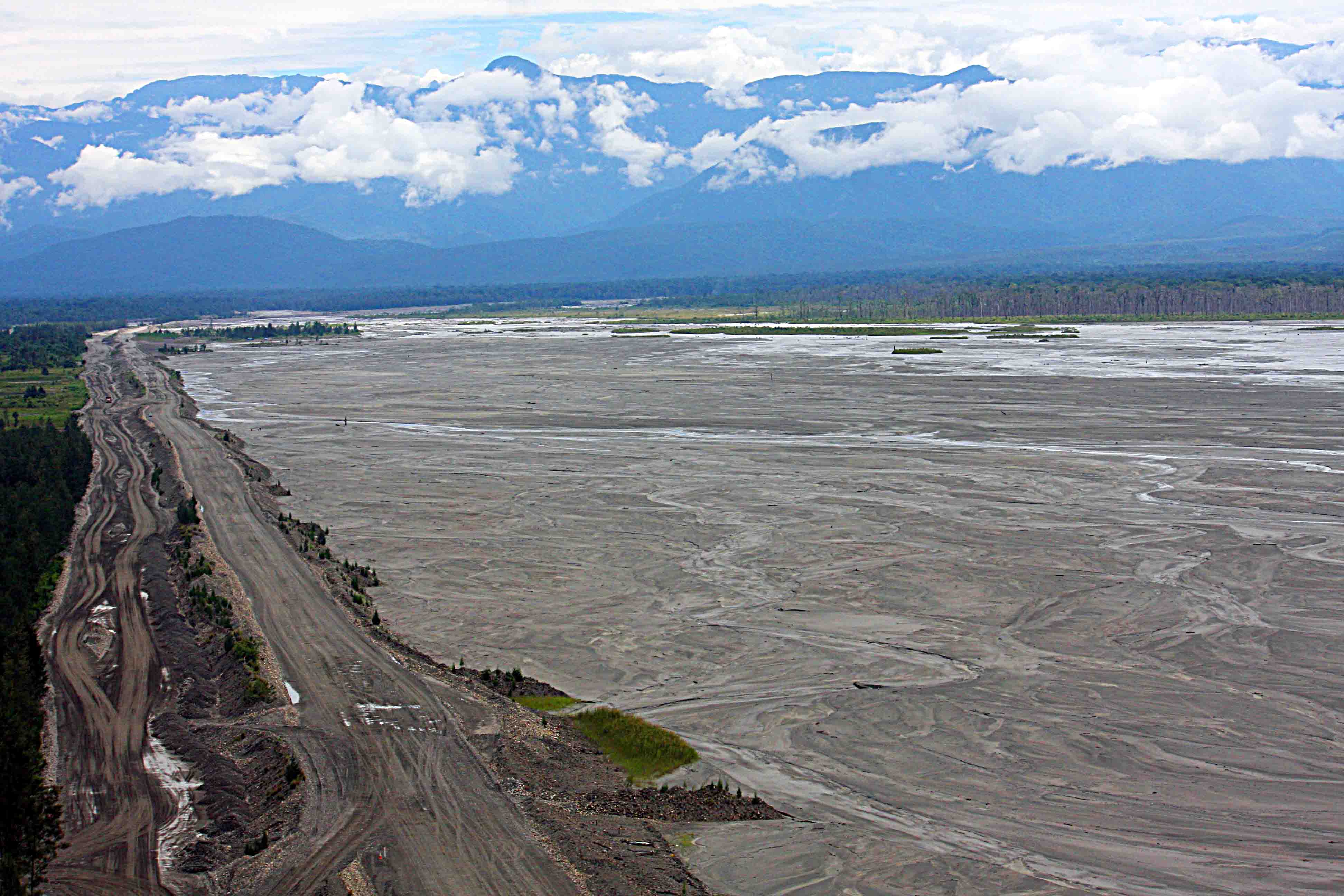
Astronaut photo of the Grasberg Mine in Papua ...
Image via Wikipedia

Workers at Freeport McMoran‘s Grasberg mine in West Papua, one of the world’s biggest copper and gold mines, have been on strike since September 15th. Their immediate demand is a large wage increases to bring their salary into line with what the company pays its workers in other countries. The conflict has raged over the past six weeks with unremitting action and brutal repression, bringing the company to its knees at a time when Papua is in turmoil generally.

Several people have already lost their lives around the mine, which has been an ongoing source of tension in West Papua since the 1960s. On Monday 10th October police opened fire on striking miners as they tried to gain access to company premises. One man, Petrus Ayamseba was killed in the incident. Several others were wounded, and one of these, Leo Wandagau, died of his injuries five days later.

There have also been three incidences of shooting along the road that leads to the Freeport mine. Three contract workers were killed in an ambush on Friday 14th October, and then another three men were also killed a week later. Three police officers from the mobile brigade narrowly escaped when their vehicle was shot at on October 26. The perpetrators and their connection with the strike remain unknown. Such ambushes have happened on many occasions in the past in the area. Security forces routinely blame the actions on OPM guerrillas who are fighting for an independent West Papua. However as US-based solidarity group West Papua Action Team explains, “In the past, similar assaults against security and Freeport personnel have been attributed to conflicts among police, military and Freeport security personnel who have long feuded over the division of spoils from extortion practices that target Freeport, as well as conflict over freelance gold-mining efforts by local people.”

The struggle of workers, nevertheless, continues unabated: The strikers have kept up a blockade of the road leading to the mine, with the result that food and medicine supplies have run very low at the mine (although reportedly the local Papuan community near the mine is also suffering from this blockade). The company was also forced to shut production when it discovered that the 60-mile long pipeline carrying gold and copper concentrate from the mine to the port had been sabotaged in several places. Freeport has claimed that it has been able to repair the pipe and resume operations, although on 26th October it had to declare ‘force majure’ meaning that it would not be able to meet its contractual obligations to supply metal concentrates to its customers.

Aside from the shootings mentioned above there have been acts of intimidation from the company. The chief negotiator of the All Indonesia Workers Union (SPSI) which represents the striking workers, Sudiro, was sitting on the verandah of his house when a shot from a silenced gun hit a bowl on a table beside him. He understood this incident as a death threat rather than a direct attempt on his life.

Anger and suspicion in the workers remains high. Duma Tato Sanda, a journalist working for Cahaya Papua, told Papuan newspaper Jubi how he was beaten by the striking workers when he was trying to research a story about an action involving the burning of three Freeport trucks. ‘I said that I was a journalist but nevertheless they beat me and threw stones at me. Luckily, someone came by on a motor-bike otherwise I could have been killed from being beaten by so many people.’ Apparently the workers are reacting to the links which Freeport has made with other journalists, and so see journalists as a threat.

Solidarity actions with the strike have taken place outside of Papua. On the second day of ‘Occupy Jakarta’ protests, the Freeport building in the Indonesian capital was chosen as a focus for the action, and in the US city of Phoenix, activists planned to picket Freeport’s global headquarters on October 28th. In Yogyakarta on the 13th of Octob er and Jakarta on the 26th October there were also demonstrations, but with the demand that the Freeport mine be nationalised. This analysis might fit uneasily with the wishes of many Papuans, who quite clearly identify the Indonesian State as part of the oppression they face, just as much as foreign corporations.

solidarity action in Jakarta

All this is taking place in a moment of intense turmoil for Papuans. At the same time as the actions around Freeport, security forces violently broke up the third Papuan People’s Congress, being held outside Jayapura. With the excuse that the meeting of many thousands of people had decided to call for independence, troops dispersed the crowd using live ammunition. Over the following days six bodies were found in the area. Three-hundred people were arrested, six of which are currently being charged with treason.

Then on the 24th of October, in Mulia in Puncak Jaya two men jumped on the local police chief, Adj. Comr. Dominggus Oktavianus Awes at Mulia airport and used his gun to shoot him dead. The remote Puncak Jaya regency has been the scene of many of the state’s most brutal operations over the past several years, including village burnings, murder, rape and sweeping operations that terrorise the whole community. The Vanuatu-based international spokesperson of the Free Papua Movement (OPM), John Otto Ondawame did not say whether or not this was the work of the OPM, but did make the point that Dominggus had been one of “those who must take responsibility for the series of crimes against humanity in Puncak Jaya.”

Of course the links between the Freeport strike and the wider struggles of the Papuan people for peace and self-determination are not straightforward. But the climate of tension which has put Papua on edge right at the moment surely has its effects on the mineworkers too, as they struggle to make a decent living from this company whose presence in Papua has long been one of the key reasons for the continued militarisation across the whole island, as well as widespread ecological destruction.

Freeport McMoran is a US company headquartered in Phoenix, Arizona, US,although its Grasberg mine in Papua is operated in a joint venture with UK-Australian Rio Tinto, which recieves 40% of the mine’s profits.

http://hidupbiasa.blogspot.com/2011/10/west-papua-at-boiling-point-strike-at.html

Global outrage may be the only hope for West Papua

by Kim Peart

East Timor was still on the list of colonial territories at the United Nations, even though Australia led the World in recognising Indonesian occupation and incorporation.

After the fraudulent 1969 vote, when 1025 hand-picked men we lectured under the shadow of guns and told to step over a line drawn in the dirt as the method of voting, the United Nations accepted Indonesian occupation and the incorporation of half of New Guinea, an area the size of France, into Indonesia.

Recent events in West Papua demonstrate that Indonesia will continue to use brutal force to maintain control, even when people peacefully call for natural justice from a world that has so brutally betrayed them for since 1962, when the United States intervened to rig the theft of West Papua and the slave trade in all her people, to buy an alliance with Indonesia.

In 1957 Australia had signed an agreement with the Dutch to work toward the independence of the whole island of New Guinea, where the outcome could have been one large and strong island nation of Papuans and there were many Australians on the ground helping to prepare the West Papuans for independence.

When Washington told Holland to get out and Australia to butt out, we were deeply humiliated, as we learnt a brutal truth; that we had been a British nation, but were now no more than a vassal state of the United States.

No wonder we have never found the spirit of independence and become a fully independent nation, as we enter an era when we may find ourselves obeying the wishes of Beijing; never having found our own independence, we may all too easily slide into becoming a vassal state of yet another empire.

With China’s hunger for our resources and their need for secure shipping lanes through Indonesia, they are unlikely to look kindly on any political change in New Guinea, especially with their own West Papua type situation in Tibet and on-going demand for the acquisition of Taiwan.

That we stepped out of our colonial responsibilities in Papua New Guinea so swiftly in 1975 and have allowed the emergence of a basket case of poverty, violence, disease and illiteracy in the north, hardly signs our care of the Papuan people, no matter how often we praise the Fuzzy Wuzzy angels who braved Japanese bullets with us on the Kakoda Trail.

The only hope for justice in West Papua and for New Guinea as a whole, is if a wave of rage spreads around the World, against how the West Papuans were enslaved, their lands stolen and all their aspirations so brutally trampled into the mud with the blood of this ancient people.

If a wave of rage goes global to demand justice for the long suffering people of West Papua, then there will be hope of a proper UN run plebiscite on self-determination and Australians may again step forward to help New Guinea, if we can get government stupidity out of the way and justice on the table.

We may even find our independent spirit as a nation and avoid the slide toward vassal status with China; and be able to resist any further expansion of Indonesia, as the geopolitical power of the World steadily shifts to our north.

West Papua: A history of exploitation -Opinion – Al Jazeera English

West Papua was taken over by Indonesia in 1969, and a legacy of oppression and environmental devastation has followed.
Listen to this page using ReadSpeaker
”]

The Grasberg mine has damaged surrounding river systems, such as the Ajikwa river above [West Papua Media]

Investing in conflict-affected and high-risk areas is a growing concern for responsible businesses and investors. Companies based in developed countries often operate in lesser-developed foreign markets, where governance standards are lax, corruption is high and business practices are poor.

These pieces focus on one specific Anglo-Australian company and their American partner that jointly operate a mine in West Papua, one of the poorest provinces of Indonesia. The risks for the company include the potential to contribute to environmental and social damage in a foreign market. The risks for investors include financing a company that does not get its risk management right.

This is the second chapter of a four-part essay that examines how the Norwegian Pension Fund came to blacklist the mining giant Rio Tinto. The first part can be found here.

Part 2: A history of exploitation

New Guinea, geographically as well as historically, is Australia’s closest relative. Separated from the mainland during the last glacial period, the waters filled in what now separates them: about 152km of the Torres Strait.

While Australia and New Guinea both have enviable mineral stores, economic and political exploitation has left the latter as home to many of the poorest people on Earth. New Guinea is also an island of two histories.

The eastern half forms the independent state of Papua New Guinea – a status it has enjoyed since breaking from Australia in 1975. With its natural resources of oil and industrial metals, Papua New Guinea has long been exploited for its minerals at places like Ok Tedi and Bougainville.

Both projects ended in social and environmental disaster. The environmental impact of Ok Tedi was so great that, in 1999, Paul Anderson, then chief executive of Australian mining company BHP, conceded that the mine was “not compatible with our environmental values”. But it did serve the company’s pursuit of profit. It was not until the Ok Tedi environmental disaster three years later that the true impact of BHP’s mining practices came to the attention of the global public. BHP subsequently sold its interest, established a fund to restore the sustainable development of the affected people, and received immunity from further prosecution.

The western half of New Guinea has had a lesser-known but equally tragic history centred around the Jayawijaya Mountain, home to the Amungme, and farther downstream, the Kamoro people. As with much of East Asia, the indigenes were under Dutch rule when a geological expedition in 1936 located a significant ertsberg (ore mountain) deep in the southwestern highlands. World War II intervened, and the Japanese claimed Indonesia and some of the western parts of New Guinea.Following defeat in the war, the Japanese were marshalled back to their home territory, and Dutch colonialism resumed. Importantly, when Indonesian independence was obtained from the Dutch in 1949, few knew of the ertsberg (mineral ore) hidden deep in West Papua’s wilderness.The Dutch began a ten-year Papuanisation programme in 1957 that would see West Papua handed back to the indigenes, and would create the independent state of West Papua around 1972.Despite multiple territorial claims, the ore mountain lay dormant for over 20 years.On March 6, 1959, the New York Times reported the presence of alluvial gold in the Arafura Sea just off the coast of West Papua. Reminded of their earlier discovery, Dutch geologists were said to be returning to the ore mountain, now simply known as Ertsberg.Independence deniedThe indigenes, meanwhile, as part of their programme toward independence, established a Papuan National Council and provisional government as well as their own military, police force, currency, national anthem, and flag. At the time, West Papua’s independence was due before the United Nations Decolonisation Commission, and representatives took part in various cultural and political activities throughout the region. By December 1, 1961, the West Papuan “Morning Star” flag had been raised alongside the Dutch for the first time. Many assumed that independence was imminent.Unbeknown to both the indigenes and the Dutch, US mining company Freeport-McMoRan Copper and Gold was negotiating directly with Suharto – at the time an Indonesian army general – for a small group of its experts to prospect this ore mountain. The path into West Papua through Suharto promised to be fruitful for Freeport, since its board was stacked with the Rockefeller’s Indonesian oil interests who already were versed in the general’s way of doing business. An exploration agreement was reached, and soon after a geologist from Freeport was forging his way through the wilderness toward Ertsberg.West Papua was about to change hands again.Armed with Chinese and Soviet weapons, as well as an increasingly public friendship with the communists, Indonesia declared war on the Netherlands. To protect Western interests from the threat of communism, on August 15, 1962, the United Nations and the United States orchestrated a meeting between Dutch and Indonesian officials during which interim control of West Papua was signed over to Indonesia.Six years of UN interregnum followed, after which a plebiscite would decide whether to form a separate nation or integrate into Indonesia. All 815,000 West Papuans were to vote in an Act of Free Choice.To ensure a favourable outcome, the Indonesians worked to suppress Papuan identity. Raising the West Papuan flag and singing of the national anthem were banned, and all political activities were deemed subversive. Indonesia ruled through force, for self-interest. Alarmed by ongoing media reports, on April 5, 1967, in the British House of Lords, Lord Ogmore called for a UN investigation. By early 1968, with Suharto having assumed the presidency of Indonesia, a US consular visit almost unanimously agreed that “Indonesia could not win an open election” in West Papua.West Papua still wanted its independence.In a desperate attempt to secure West Papua’s right to self-determination, two junior politicians crossed the border into Australian-administered Papua and New Guinea on May 29, 1969. They carried damning evidence of Indonesian repression; the hopes of a yet-unformed nation rested on the politicians reaching the UN. As Australia and its allies were amenable to Indonesian control of West Papua, the two were imprisoned upon crossing the border until after the referendum. Their brave plea was silenced.Between July and August 1969, less than a quarter of one per cent of the population – some 1,026 West Papuans – signed the country’s freedom over to Indonesia. The election, held under the aegis of the UN, was far from an act of free choice. The following day West Papua was declared a military operation zone, the local people’s movement was restricted, and expression of their national identity banned under Indonesian law.Poor, neglected West Papua.Selling West PapuaControl of West Papua proved a lucrative business deal for the Indonesians. Two years prior to the Act of Free Choice – coincidentally on the same day the plight of Papua was raised in the House of Lords – Freeport signed a contract of work with the Suharto government entitling a jointly owned company, PT Freeport Indonesia (Freeport-Indonesia), full rights to the Ertsberg mine. In return, Indonesia would derive significant tax revenues and fees as well as a minority 9.36 per cent shareholding. Without the authority to do so, Indonesia nevertheless cut itself into a deal that sold large tracts of West Papua to the US company, intent on sifting it for copper and gold.Although Ertsberg fulfilled its promise, as production slowed in the mid-1980s, Freeport-Indonesia began to explore surrounding mountains and ridges for other reserves. As is often the case, the best place to establish a new mine is next to another. Sure enough, significant copper and gold reserves were located at Grasberg only a couple of miles southwest of Ertsberg.Grasberg has the largest recoverable reserves of copper and gold in the world. It’s also Indonesia’s economic beachhead.Observing the Grasberg mine via Google Earth, one sees a scar like no other: Located about 13,000 feet (4,000 meters) above sea level, open-pit (above ground) mining has bored a hole through the top of the mountain more than half a mile (1 km) wide. What they’re digging for is more than $40bn worth of copper and gold. Every day the operation discharges 230,000 tons of tailings (waste rock) into the Aghawagon River. This process is expected to continue for up to six more years, at which point exploration will go underground until there’s no value left. Freeport estimates that will occur by 2041.The operation is so large that it has shifted the borders of the adjacent Lorenz National Park. Listed as a World Heritage site by the UN’s Educational, Scientific, and Cultural Organisation (UNESCO) in 1999, the park is “the only protected area in the world to incorporate a continuous, intact transect from snowcap to tropical marine environment, including extensive lowland wetlands”. For the Amungme and Kamoro indigenes, corporate imperialism had replaced European colonialism.The ramifications are both environmental and social.‘Slow-motion genocide’The social and economic condition of the indigenous Amungme and Kamoro poses fundamental human rights concerns. Although Freeport-Indonesia directly or indirectly employs a large number of West Papuans and is regularly Indonesia’s biggest taxpayer, in 2005, the World Bank found that Papua remained the poorest province in Indonesia. With a marked rise in military personnel and foreign staff has come a number of social issues, including alcohol abuse and prostitution such that Papua now has the highest rate of HIV/AIDS in Indonesia.Indonesian control of West Papua has been characterised by the ongoing and disproportionate repression of largely peaceful opposition. Few sustained violent interactions have occurred; however, in one major conflict in 1977, more than 1,000 civilian men, women, and children were killed by the Indonesian military in Operasi Tumpas (“Operation Annihilation”) after a slurry pipe was severed and partially closed the Ertsberg mine.More recently, in 1995, the Australian Council for Overseas Aid reported that the Indonesian army and security forces killed 37 people involved in protests over the mine in the preceding seven-month period. While the level of violence is difficult to establish, academics at the Centre for Peace and Conflict Studies at the University of Sydney maintain that up to 100,000 West Papuans may have been killed since Indonesian occupation. They call what’s happening to West Papua “slow-motion genocide”.There are also two primary environmental concerns over Grasberg. The first is that the mine discharges 230,000 tons of waste rock a day into surrounding waterways; given the escalating rate of processing, this rate is arguably above that allowed by national law. Secondly, acid rock drainage – the outflow of acidic water – has resulted from the disposal of a further 360,000 to 510,000 tons a day of overburden and waste rock in two adjacent valleys covering 4 miles (6.5 km), up to 975 feet (300 metres) deep. The mine operators dispute both claims.Riverine methods of waste disposal are banned in every developed country on Earth. The World Bank no longer funds projects that operate this way, due to the irreversible ecological devastation, and the International Finance Corporation requires that rock be treated prior to disposal, which is not a practice carried out at Grasberg. Since the mid-1990s, a number of independent environmental assessments have found unacceptably high levels of toxicity and sediment as far as 140 miles away.Freeport and Rio Tinto maintain that riverine tailings disposal is the best solution, given the difficult terrain, the threat of earthquakes, and heavy rainfall.Grasberg’s reserves are so vast that extracting them is expected to create 6 billion tons of industrial waste.President Suharto, who is now recognised as one of the most corrupt and tyrannical leaders in history, renewed Freeport-Indonesia’s exclusive mining rights in 1991 for a further 30 years with an option of two 10-year extensions. The license included an option to prospect another 6.5 million acres (2.6 million hectares), as far as the Papua New Guinea border. “The potential is only limited by the imagination,” Freeport’s chairman, James Moffett, remarked to shareholders in March 1995. “Every other mining company wants to get into Irian Jaya [West Papua]. Bougainville and Ok Tedi don’t hold a candle to Grasberg.”Part 3 to follow next week.This is an extract of a chapter from the book, Evolutions in Sustainable Investing: Strategies, Funds and Thought Leadership, to be published by Wiley in December 2011. NAJ Taylor is a PhD candidate in the School of Political Science and International Studies at the University of Queensland, and casual lecturer in the Faculty of Law and Management at La Trobe University.Follow NAJ Taylor on Twitter: @najtaylordotcomThe views expressed in this article are the author’s own and do not necessarily reflect Al Jazeera’s editorial policy.Related articles

BHP Billiton acknowledged that its mine at Ok Tedi was ‘not compatible with our environmental values’ [GALLO/GETTY]
“Grasberg’s reserves are so vast that extracting them is expected to create 6 billion tons of industrial waste.”

Indonesia gives full backing to Palestinian independence at the United Nations, what about West Papua?

Opinion/Article

by Victor Yeimo,
International Spokesperson for West Papua National Committee [KNPB]

21st September 2011

[Jayapura]: As the UN General Assembly begins today (21/9) in New York, Indonesia will be in front line of supporting Palestinian efforts to become a member of the United Nations.

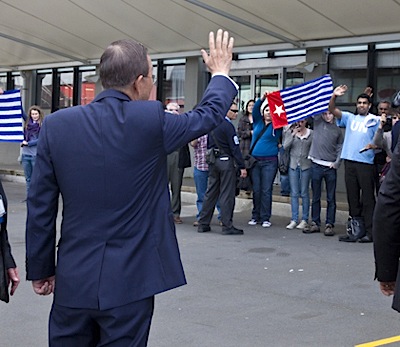
Ban Ki-moon waves to protestors for West Papua, PIF NZ Sept 2011 (Photo: Henry Yamo/ PMC)

Indonesia has been supporting the Palestinian case ever since they declared their independence. But what about the fate of West Papua which has been under Indonesian rule for half a century?

This week, from 19 to 28 September 2011, Foreign Affairs Minister, Marty Natalegawa, will be representing Indonesia at the UN General Assembly during its 66th session in New York, United States. He previously recalled, in a press release last Thursday (15/9), that Indonesia had recognized the independence of Palestine just a few hours after it had been declared in 1988.

Mahfudz Siddiq, chairman of House of Representative’s Commission I overseeing foreign affairs, also stated that agreement had been reached by the Indonesian Parliament and Government, for the full support of Palestinian independence and the Palestinian State bid at the UN General Assembly in New York this week.

As a logic consequence of this backing, Indonesia’s foreign policy should also be shown in its commitment to support the right to independence and the recognition of the sovereignty of the people of West Papua. If Indonesia is aware that Israel’s occupation of Palestinian territories is a state of colonization, then Indonesia has to realize that the occupation of West Papua by Indonesia since 1963 is likewise a state of colonization.

Already too many Palestinians have fallen victims of the Zionist regime of Israel, and already too many West Papuans have fallen victims of the colonialist and militarist regime of Indonesia. It is time for the people of West Papua to set their own destiny, in the same way that the Palestinian people, the people of South Sudan, Kosovo, and others, are deciding their own.

Indonesia as a member of the United Nations should actively participate in promoting and creating world peace. But, what about the fate of the people of West Papua? It has been a while since Indonesia and the international community decided to look away from the suffering of the people of West Papua. West Papuans continue to be victims of the vested interests of Indonesian colonialism and global capitalism on their land.

Because of those interests, the United Nations and Indonesia have been denying the right of independence to the people of West Papua, a right which should have been granted to them in accordance with General Assembly Resolution 1514, through the Decolonization Committee. Indonesia should welcome the statement of UN Secretary-General, Ban Ki-Moon in Auckland, New Zealand, on 7 September 2011, when he stated that the issue of West Papua should be discussed again in the UN decolonization committee, a committee which has several times been chaired by none other than Marty Natalegawa.

Create a website or blog at WordPress.com

Up ↑