POLICE AGAIN OPEN FIRE, BEAT AND ARREST PROTESTERS IN PAPUA-WIDE CRACKDOWN ON KNPB DEMOS

BY WEST PAPUA MEDIA TEAM

October 18, 2013

In several centres across West Papua on October 16, Indonesian police and army (TNI) have again cracked down violently on peaceful political demonstrations held by the West Papua National Committee (KNPB), resulting in the injuries of several participants, with unconfirmed reports of police opening fire in related incidents against KNPB members in Kaimana.

The demonstrations, called for October 15 by the KNPB to commemorate the fifth anniversary of the founding of the International Parliamentarians for West Papua, were delayed for a day out of respect for the Muslim holiday of Eid al-Adha.   The rallies were also highlighting the historic speech made by Vanuatu Prime Minister Moana Kalosil Carcasses to the United Nations General Assembly in late September, calling for the international community to take action on West Papua.

Despite formal permission being sought from the Indonesian police in Papua to conduct acts of free expression, Papua Police Chief Tito Karnavian rejected the permit due to the political and “separatist” nature of the rallies, according to KNPB spokesman Wim Medlama.  Karnavian, the former commander of Australia-funded anti-terror police unit Detachment 88, authorised the deployment of thousands of heavily armed police and military to prevent the commemorations from occurring, according to local human rights sources.

Police banned rallies from going ahead in Jayapura, Waena, Sentani, Boven Digul, Merauke, Biak, Kaimana, Nabire and Timika, however participants were allowed eventually to hold prayer sessions under tight military and police surveillance and a show of force in Biak and Nabire, according to KNPB sources.  In Timika, according to West Papua Media sources, several thousand people ignored the police ban and show of force and joined the KNPB event at Jayanti field in Timika.

Credible human rights sources have also reported that in several centres across Papua, combined Indonesian security forces of the Army (TNI), Brimob paramilitary police, and plain clothes members of Detachment 88 physically blockaded and prevented demonstrations from going ahead with dispersals and beatings in several centres.   In Merauke, police and undercover personnel said by credible sources to be members of Detachment 88, were conducting heavy surveillance of local people whilst blockading roads to prevent people from accessing the commemorations at the KNPB Merauke office.

This slideshow requires JavaScript.

The demonstration in Waena just prior to the dispersal by Indonesian Security Forces. (Photos: KNPB)

In Jayapura, rally participants met anyway from 5 am at the gravesite of Theys Eluay, where they began music, prayers and political speeches before dawn under the rising morning star, the celestial inspiration for the banned Papuan freedom flag.  KNPB Secretary-General Ones Suhuniap told WPM stringers, “The Jayapura police began violently dispersing them at 6:30am with full force and weapons, with members of the TNI. The violent dissolution by the police also involved confiscation of KNPB member’s valuables, such as a camera and all the KNPB’s flags.”

While this peaceful demonstration was dispersed, another gathering at the Highland people’s housing complex Perumnas III in Waena, was blockaded by police under the command of Jayapura Police Chief Commissioner Alfred Papare.  This gathering was then surrounded by the police and army and were forced out of the area, according to the KNPB and confirmed by WPM stringers.

Suhuniap explained “Until the afternoon the demonstrators were violently dispersed by the combined police and army forces and assisted by the Papuan police’s special operations forces,” referring to uniformed members of the Australian trained counter-terror unit Detachment 88.

KNPB activists told WPM that they observed the army and police were prepared to suppress KNPB members with force, heavy weapons, assault vehicles and armoured vehicles. Over 200 police, including 50 fully armed Brimob paramilitary police and a platoon of TNI soldiers, and scores of plain clothes intelligence – said by KNPB to be members of Detachment 88 – participated in the dispersal and blockading the peaceful demonstrators of KNPB.

West Papua Media has been unable to confirm independently if any people in Jayapura were injured during the dispersal.

Meanwhile in Boven Digul, KNPB sources reported that Indonesian police took to local radio stations to announce the prohibition of freedom of expression, telling local people not to participate in KNPB actions.  All local people were stopped and searched, with police allegedly confiscating cameras from citizen journalists.

In Kaimana, on the south west coast of Papua, Tabloid Jubi has reported that rally organisers decided to hold a prayer service instead to commemorate the IPWP anniversary.  However, police banned that too and came to arrest organisers.

A night of terror and shootings was reportedly unleashed by Indonesian security forces against KNPB members’ families after the commemorations in Kaimana.  Police Special Forces raided the KNPB Kaimana offices three times during the night of October 16, with the first raid occurring at 2130.  Six shots were fired into the house from Police rifles during the first raid.  Three residents, Barias Wesfete, Demianus (Luter) Baunu and Jesse Irini were severely beaten and arrested by police.

However, according to KNPB spokesman Medlama when interviewed by WPM partner Tabloid Jubi,  Police returned twice more during the night, with at least ten bullets shot by Police to the house at different times throughout.  “The first shooting at 9:30 pm, was 6 times (shots.) The second shooting at 2 o’clock at night up to 2 times, and the third time at 4 am as much as 2 times,” Medlama told Jubi.

The three Kaimana arrestees returned home the morning after, however no information has been received of their charges, if any.

Jubi reports that the KNPB assessed that police are just looking for an excuse to put extreme psychological pressure on Papuan people, in ways that make no sense. “We are not concerned with their efforts to pressure us. We only know one word – LAWAN”.

WestPapuaMedia, with local sources, Tabloid Jubi, and KNPB sources

Planned MSG Foreign Ministers visit to West Papua lacks transparency

Exclusive investigation from West Papua Media team

October 12, 2013

(The Hague): As allegations surface of Indonesian military-linked businessmen providing envelopes of “hefty cash” to senior officials in the Solomon Island’s Prime Ministerial delegation during the recent APEC summit in Bali, a high level source inside the Melanesian Spearhead Group has raised concerns over Indonesia’s subversion of the agreed visit of Melanesian Foreign Ministers to West Papua, in an exclusive interview with West Papua Media.

An explosive but carefully worded article in the Solomon Star newspaper on October 11 has alleged that Indonesian officials provided members of Solomon Islands government with large amounts of cash contained in yellow envelopes, during an official dinner hosted in honour of the Prime Minister Gordon Darcy Lilo and his delegation.

According to the Solomon Star report, at least five members of the delegation have admitted to receiving the payments, amongst a total of 17 delegation members alleged to have received the envelopes.  The report, from interviews by journalist Alfred Sasako with a highly placed whistleblower in Honiara, alleged that at least two “names withheld” senior officials received USD$25, 000 each, three others received USD$10, 000  and a final two delegation members received USD$5, 000 each respectively.

“It seems the level of payment is based on seniority, the higher you are, the more you get,” the sources told the Solomon Star.

After the publication of the new allegations, West Papua Media spoke on Saturday to a well-respected customary figure in the Solomon Islands, who described the latest revelations as proof of long-standing suspicions “that Indonesia is involved in a corrupt subversion of Melanesian solidarity on the West Papua issue.  The source described the behaviour of Prime Minister Gordon Darcy Lilo in arranging unilateral visits to West Papua as “an affront to the Melanesian Way that is deliberately undermining the quality of what a properly constituted MSG Fact-finding mission can uncover in West Papua.”

“The Prime Minster is siding with Indonesia to cover up the crimes against the West Papuan people, by diluting the effectiveness of a multilateral fact-finding team to assess the real situation in West Papua.  What other deals is he doing for the Solomon Islands with these Indonesian military businessmen?  Are our islands going to be the next West Papua?” the source told WPM.   The customary source, who had no involvement with the Solomon Star revelations, declined to be identified for this article citing fears of being labelled as the whistleblower.

“This is not about me anyway, this about the questions for all Melanesian people about how far Indonesia is willing to bully or bribe Melanesians, and how some Melanesians like our Prime Minister are potentially having their pockets lined with blood money for turning their backs on the suffering of our Melanesian family in West Papua,” the source told WPM with some indignation.

Prior to the MSG meeting in Noumea in June 2013 the Indonesian and Fijian governments agreed to a multi-lateral visit to West Papua by MSG Foreign Ministers. The proposal was raised at the Noumea meeting by Fiji in part to defer a decision over whether West Papua would be granted membership into the MSG or not. The MSG Ministerial team has undertaken to write a report following their visit. This report will then help guide the MSG’s decision regarding West Papua’s membership. Since June, however, serious doubts have been raised as to how transparent the organising of the MSG Foreign Ministers is, or even whether it will happen at all.

A high-level source inside the MSG who was at the meeting in Noumea but asked not to be named told WPM  on condition of anonymity, that it was highly unlikely that the MSG will revoke Indonesia’s observer status, but that they could give West Papua ‘associative status’, which is a higher level of membership. However, the source then went on to say that it is now “not clear what is happening”.

The concerns are serious. First, no date has been set for the Foreign Ministers visit to West Papua. Second, neither the MSG Secretariat nor Melanesian nations are organising the visit. “The Foreign Ministers all rely on an invitation from the Indonesian government. It is not clear if such an invitation has been issued and it is not clear who will pay for it. My advice to member countries is that each Melanesian country pays for their own visit themselves” said the senior MSG bureaucrat. “That way the Foreign Ministers will not be beholden to the Indonesian government and that their status as independent advisors to the MSG is more likely to be guaranteed.”

Most concerning is that the idea of a multi-lateral visit could be abandoned. “It is possible” said the MSG official “that the foreign ministers could travel to West Papua separately and not as a group”.  This is the most likely possibility given the revelations in the Solomon Star.

Although privately many Melanesian politicians support independence for West Papua the official cautioned against false hopes. “West Papuans should not have high expectations from the forthcoming MSG foreign ministers support.”

At this stage it appears highly unlikely that the Melanesian foreign ministers report will reflect the political reality inside West Papua or the aspirations of the West Papuan people.  This view is reflected in the recent comments from Mr Gordon Lilo, the Prime Minister of the Solomon Islands, who told Indonesia’s Antara state news agency that he is “impressed with the progress” the Indonesian government has made in West Papua.  Mannaseh Sogovare, the Solomon Islands opposition leader, criticised Lilo’s comments saying that he had “probably been overwhelmed by the reception of the hosts and obviously the Indonesians have gone out of their way to put on the wow factor to make sure that Lilo is wooed out of any views that he may have had in support of West Papuan membership of the MSG,” reported Radio New Zealand.

Comment about the corruption of the Fact-Finding process has also been repeatedly sought by West Papua Media from the office of Vanuatu Prime Minister Moana Carcasses, however the Prime Minister was unavailable to comment on the allegations.  However, Carcasses issued a historic and moral challenge to the international community at the United Nations General Assembly in New York in late September, by calling for the appointment of a Special Representative to investigate historical and ongoing of human rights abuses by Indonesia.

‘How can we then ignore hundreds of thousands of West Papuans who have been beaten and murdered? The people of West Papua are looking to the UN as a beacon of hope… Let us, my colleague leaders, with the same moral conviction, yield our support to the plight of West Papuans. It is time for the United Nations to move beyond its periphery and address and rectify some historical errors,” Carcasses told the UN General Assembly.

These are the words that Melanesian leaders may well be reflecting on as they ponder the ramifications of accepting Indonesia’s subversion of the MSG Fact Finding Team process.

As well as sharing his concerns, the senior MSG official also had some practical advice for Papuan leaders. “All of us at the MSG are observing very closely developments inside West Papua. In order for us to assist the West Papuan application for membership Papuan leaders need to present a unified position that is backed up by strong support from civil society. The good news is that there is moral support from inside the MSG. Even senior leaders in the United Nations privately recognise that West Papua is an occupation.”

However, without unity of purpose from West Papuan leaders and strong grassroots support from inside Melanesian countries, the Indonesian government could out-manoeuver West Papua again.

WestPapuaMedia team

Scepticism as Papuan governor Enembe invites foreign journalists to Papua

Tabloid Jubi

by Alexander Leon

October 9, 2013

JAYAPURA, 9/10 – Papuan Provincial Governor, Lukas Enembe, shows progress by inviting foreign journalists to visit the most Eastern part of Indonesia.

“Yes, why not? Of course they can come here, there is no problem, because foreign journalists must see straight away the progress which is happening here in Papua,” said Governor Lukas Enembe to journalists in Jayapura, Wednesday (9/10).

What has happened or occurred in Papua cannot be hidden, because the outside world must also know what is actually happening in Papua. If this matter is hidden, the outside world will ask questions.

“Foreign journalists must see the progress which is happening in Papua. We can’t hide what is definitely happening here, but if we are open they can see the massive changes which are occurring,” he said.

Before, Independent Journalist Alliance (AJI) a press organisation, has not yet seen a positive reaction from the Indonesian government about the international community’s demands which are to allow open access for international journalists in Papua. In 2012, Marty Natalegawa the Indonesian Foreign Minister, said to a group of foreign journalists in Indonesia that there were 35 foreign journalists who were given access to the Papuan Province from 2011 – 2012. Although these journalists experienced Papua, not all journalists can gain coverage of the news in Papua.

“Seven foreign journalists have been deported from Papua because of their journalistic work. Marty then promised to review this case, although he confessed he was worried about their safety,” said Jayapura’s AJI Worker’s Union & Avocation’s co-ordinator, Jack Wally.

According to AJI Jayapura, who reject Marty’s statement saying some journalists from New Zealand, Netherlands, England and Australia all experienced difficulties when submitting and applying for entry visas into Papua. AJI Jayapura sees the Indonesian government as not having an attitude which is clear between limiting and opening a space for foreign journalists, because there’s not yet any formal regulations which limit foreign journalists from entering Papua, but in practice international journalists believe they’re limited because of the difficulties in obtaining an entry visa. AJI Jayapura see this situation as proving the grey space which allows the hampering of independent and free press processes in Indonesia, which in turn has the potential to downgrade Indonesia in the World Press Freedom Index.

(Editor: Cunding Levi, translated by West Papua Media translators)

Papua, a Thorn in the Side of Indonesia

Opinion / Analysis

by Selpius Bobii in Abepura Prison

written 25 September 2013

“The Republic of Indonesia is quite capable of removing a thorn in the side of another nation but is not capable of removing the thorn in its own side” were the words of a certain Indonesian commenting on the State of Indonesia at this time.

For some time now Indonesia has been busily involving itself in finding solutions for problems of other nations, as if it had no domestic problems of its own.  Yet there are still many extremely serious problems within Indonesia that need the Indonesian Government’s urgent attention and Papua is one that’s most obvious.  For the last 50 years Papua has been a ‘thorn in the side’ of Indonesia . Indeed the Indonesian Government has tried to ‘fix’ the problem by applying a range of strategies and approaches, however all have been according to Indonesia’s agenda and so each has failed to remove the thorn. The reality is that as long as the thorn remains buried deep in Indonesia’s flesh that there will continue to be problems.

Indonesia has been using its charm in a number of both official and non-official forums held around the world, talking of its commitment to being involved in handling various issues of conflict currently being faced around the world. Problems such as that in Palestine, Egypt and the Moro Islamic tribal issue in the Philippines to name but a few. However the Indonesian Government is not ready to face up to addressing the situation in its own backyard when it is Indonesia that is under the spotlight by the international community.

Indonesia has continued until this time to accuse foreigners of meddling in the internal affairs of Indonesia, however Indonesia for some reason doesn’t seem to recognise that Indonesia itself has meanwhile continued to interfere in the affairs of another nations. The Indonesian Government has for instance had a hand in the affairs of Israel and Palestine with Indonesian having stepped forward to the front line to defend the acknowledgement of the world community regarding the independence of the Palestinians. Yet despite Indonesia giving attention to these various problems overseas it has not addressed the matter of that thorn in the side back home in Indonesia. Not only have the problems in Papua remain unaddressed, but in fact there has never even been any efforts made to find a solution to bring an end to the problems in Papua, such as through dignified unconditional dialogue between the nations of Indonesia and Papua.

Following the launch of the branch of the Free West Papun Campaign in Oxford in the United Kingdom (UK) for example, the Indonesian Government at both the legislative and executive level were infuriated. Even Indonesian civilians became involved with the upset and it was talked about at every level of society. The UK Government was criticised and even accused of meddling in the affairs of another nation. The Deputy Chairperson of the Indonesian Legislative Assembly (DPR) Priyo Budi Santoso  stated “ The Indonesian Government must officially convey its protest to the UK Foreign Affairs Minister with a copy to the Queen of England. There should be mutual respect.”(www.merdeka.com/peristiwa/dpr-inggris-terlalu-mencampuri-urusan-indonesia.html).

Then there was the most recent issue with the Freedom Flotilla from Australia entering Indonesia waters. An incident that attracted harsh and high level criticism from a number of parties within Indonesia. The Coordinating Minister for Politics, Law and Security was most concerned at the time of the Flotilla’s expected arrival and stated that the Indonesian Navy and Airforce were both on alert in anticipation of its arrival. Even the Indonesian President made a severe warning to other nations  at the time stating that other nations must not violate the sovereignty of Indonesia and in so doing create international friction (www.majalahselangkah.com). Through its Foreign Affairs Minister Marty Natalegawa, Indonesia diplomatically sought the Australian Government’s assistance to interrupt the Flotilla’s journey. However as a democratic nation Australia could not interfere as no law had been broken and they were obliged to allow the allow freedom of expression and opinion and accordingly the convoy to continue. The Australian Government however through its Foreign Minister Bob Carr made quite clear that they would give no assistance to, and were in no way responsible for the Australian citizens on the Flotilla, if they entered Indonesian or PNG rterritory and were arrested by Indonesian or PNG armed forces and legally charged (www.republika.co.id/berita/internasional/). Tony Ervianto even made accusations that there was some foreign interests behind the Freedom Flotilla. (www.news.detik.com).

Internationally, Indonesia has always stressed that the problems in Papua are domestic business and not the business of foreign nations, however the circumstances are clearly proof that the Indonesian Government is not in fact capable of handling and bringing an end to that so called ‘domestic business’. In the Indonesian President’s state speech on 16 August 2011, he promised that the problems in Papua would be finalised through an approach of dignified dialogue. However until this time SBY’s promises have yet to be realised. Indeed fine words but words with no actions.

If Indonesia could bring a dignified end to the problems in Papua, then of course those in the international community who are concerned about Papua would not feel a need to interfere in the internal affairs of Indonesia. However as Indonesia is only capable of the talk and there is no realisation, whilst meanwhile human rights violations continue unceasingly, so that ‘thorn in the side’ of Indonesia will continue to  attract the international spotlight.

Until this time Indonesia has undertaken a range of strategies and means to stem the spread of support for Papuan independence aspirations, yet all their efforts have failed totally. One of those strategies was the implementation of Special Autonomy in Papua but that also failed to achieve Indonesia’s objective of repressing Papuans independence aspirations. Special Autonomy was not something born out of the desires of the Papuan community but rather something was based on Jakarta’s agenda with the hidden goal of repressing Papuan’s desire for independence.

Following the failure of Special Autonomy in Papua, Indonesia is now in the process of planning to pass certain Papuan Governance legislation. The fact that the draft of that legislation is but a copy of the Aceh Governance legislation has attracted concern from a number of circles. The Executive Director of the Organisation for Research, Investigation and the Development of Legal Assistance (LP3BH), Yan Christian Warinussy, commented that the draft was the work of a few people around President SBY acting recklessly and unconstitutionally in allowing the draft Papuan Governance legislation to slip through. That this draft legislation is but a copy and paste of Aceh’s legislation is indeed an embarrassment and poor reflection of the Presidency(www.majalahselangkah.com).

Indonesia has also tried the welfare (illusion) approach in its efforts to face up the movement of the Struggle of the Papuan nation. Then there has been the security approach, the legal and then the social-cultural approaches.  Not one of these approaches however will ever be successful in removing that ‘Papuan thorn’ in Indonesia’s flesh.  Indonesia must change its paradigm and undertake an approach based on wisdom to handle and bring an end to the Papuan problem.  As long as Indonesia has an attitude that the issue of Papua was finalised back in 1969 with the ‘Act of Free Choice’ and continues to defend its hold on Papua through a number of approaches that are but one of the same, so the problems of Papua will continue without cease, like a thorn that irritates Indonesia.

To avoid the Papuan issue attracting the constant spotlight of the international community, Indonesia should have taken real steps before now to deal with the problems in Papua, one of which should have been the mechanism of dignified dialogue between the nations of Indonesia and Papua.  As long as Indonesia continues NOT to take real steps to bring an end to the problems in Papua, the international community in turn will continue to keep the spotlight on Papua.

Or is Indonesia is actually waiting for the international community to intervene to sort out the Papuan problem? If Indonesia is not capable of sorting out the Papuan problem, then Indonesia should be honest about that before the international community including the UN. So that others can handle and bring an end to the problems. Indonesia has not only allowed the problems in Papua to continue too long already without any real steps or solutions to make’ Papua a land of peace’ but in fact  Indonesia has continuously taken actions intended to delay the time when the problems in Papua will be brought to an end.  Allowing the problems in Papua to continue will only lengthen the list of victims; And not only loss of human lives but also the loss of earthly things, time, and endless thoughts and feelings as a consequence of the oppression.

The international community including the USA, have again and again requested Indonesia to bring an end to the problems in Papua through means of dialogue between Jakarta and Papua. However until this time Indonesia has constantly  ignored pressure from the international community. Perhaps because Indonesia considers the matter of Papua was already finalised back in 1969. However this perception is so very wrong! If the problem of Papua had already been finalised why are there still constantly people in Papua losing their lives? Why is there relentless marginalisation and discrimination? And why are Papuans intentionally being increasingly made a minority on their ancestor’s land? All of which are amounting to an annihilation of the ethnic Papuan race.

These things have continued without ceasing from the origin of this political conflict commencing with the annexation of the nation of Papua into the Republic of Indonesia through a military and political invasion by Indonesia. It’s time that Indonesia left its longtime paradigm that closes the door on finding a solution and rather undertakes a democratic and dignified approach through dialogue and negotiations, to give rise to a dignified solution – as the first step towards bringing peace and prosperity to the land of Papua and its people.

 ‘Humans which value basic human rights are those who will protect and respect the rights of their fellow beings.’

Selpius Bobii is the General Chairperson of Front PEPERA West Papua & is a Papuan Freedom Political Detainee held in Abepura State Prison


PMW: Activists ‘forced’ to leave consulate, call for greater press freedom

by Daniel Drageset, Pacific Media Watch

October 7, 2013

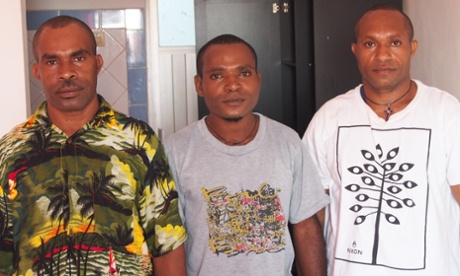
West Papuan student activists Rofinus Yanggam (left), Yuvensius Goo and Markus Jerewon (right) left the Australian consulate in Bali Sunday. Image: Marni Cordell

AUCKLAND (Pacific Media Watch): Three West Papuan student activists entered the Australian consulate in Bali this weekend with calls on Australian Prime Minister Tony Abbott to open up for greater press freedom and push Indonesia to release at least 55 political prisoners jailed in the Indonesian-ruled region.

“We want the Indonesian government to lift the 50 year restriction it has imposed on West Papua.

“We want foreigners, including journalists, diplomats, observers and tourists to be able to visit West Papua freely without asking for special permits,” the West Papuans wrote in an open letter addressed to the Australian people.

The student activists said in the letter they wanted to deliver a message to the leaders attending the 25th Asia-Pacific Economic Cooperation (APEC) summit in Bali this weekend.

Several organisations have asked Australia to give sanctuary to the three West Papuans, but according to Australian Trade Minister Andrew Robb the West Papuans did not seek asylum.

“They left [the consulate] voluntarily so the matter’s been resolved,” Robb said, according to Radio Australia.

The Guardian, however, reported that the consul-general had warned the three West Papuans that the Indonesian army would be called if they did not leave the consulate.

One of the students, Rofinus Yanggam, told the newspaper the group left in fear of their lives.

Calls for sanctuary
Australian independent senator Nick Xenophon called on Foreign Minister Julie Bishop to give sanctuary to the three West Papuans.

“These three young men were not asking for West Papuan independence from Indonesia. All they were asking for is entirely consistent with the Lombok Treaty of 2006, signed by both Australia and Indonesia,” he said, according to AAP.

“Instead of getting sanctuary and help, the Australian government effectively threatened them and now there is serious concern over the activists’ safety,” Xenophon said.

Professor Clinton Fernandes at the University of New South Wales backed Xenophon’s call.

He said when the media circus had moved on after APEC, the trio “may be tried, most certainly they will be beaten, and at some point might be disappeared”.

Rinto Kogoya, co-ordinator of the Alliance of Papuan Students, said it was time the world understood what was happening inside the province, which was officially acquired by Indonesia in 1969.

“The international community doesn’t know the reality in Papua. The military oppresses the civil society – we’re not free to do anything – and I think this is the moment to open democracy to Papua,” he said in The Guardian.

‘Great concern’
Joe Collins, of the Australia West Papua Association (AWPA), was alarmed by the events at the Australian consulate in Bali.

“It’s of great concern that they [the West Papuan students] may have been coerced to leave as the students would have great reason to fear the Indonesian security forces.

“There are ongoing human rights abuses in West Papua and the security forces have been banning and cracking down on recent rallies to try and stop international attention being focused on the territory,” he said in a statement.

AWPA wrote a letter to the consul-general Brett Farmer in Bali yesterday asking for “clarification” regarding the students.

“We understand that they have now left the consulate and we would like clarification from you if they left voluntarily or as some media reports have indicated that they were told that they would be handed over to the Indonesian military if they did not leave,” AWPA wrote in the letter.

Australian Green senator Dr Richard Di Natale has also joined those who have called for Australia to give sanctuary to the three West Papuans.

“By speaking out in this way, these brave West Papuans have put their lives in serious danger.

“If Australia fails to offer them protection, I have grave fears for their safety,” he said in a statement.

‘Stand up to Indonesia’
Yet another senator to voice his support for West Papua this weekend was John Madigan.

“It is about time our government had the courage to stand up to Indonesia, instead of ignoring the issue of West Papuan oppression and the human rights abuses that occur there on a daily basis,” he said in a statement.

He also said he demanded that the Australian government provided sanctuary for the three West Papuans.

The issue of the West Papuan students came just days after pleas from several organisations that Australia should not deport seven West Papuans who arrived in the Torres Strait Islands in northern Queensland recently.

The group of seven, who took part in the recent West Papua Freedom Flotilla sought asylum in Australia, but were deported to Papua New Guinea under a memorandum of understanding between Australia and Papua New Guinea, Radio New Zealand International reported.

Refugee advocates in Australia said the deportation failed to abide by the Refugee Convention that Australia was a party to.

Spokesperson for the West Papua Freedom Flotilla Izzy Brown said she wanted to draw the United Nations’ attention to Australia’s commitment to the Refugee Convention.

“It’s really unfortunate that Australia thinks it can send asylum seekers offshore without due process or just blatantly illegally deported like in this case here, and we really want to try and draw the world’s attention and especially the UN’s attention to Australia’s behaviour in this matter,” she said.

Read the West Papuan students letter to “the people of Australia”

Creative Commons Licence

About the author

PMW contributing editor

Daniel Drageset is a Norwegian radio journalist enrolled in the Master in Communication Studies degree at AUT University.

Create a website or blog at WordPress.com

Up ↑