Papuan cultural parade blockaded then broken up by Jayapura Police

From KNPB and West Papua Media sources in Jayapura

February 20, 2014
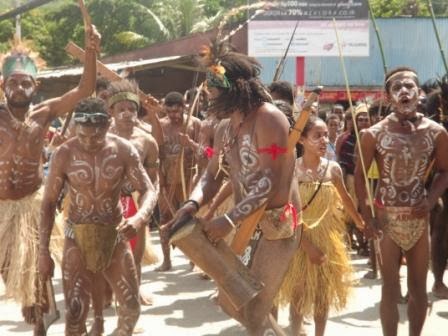
https://westpapuamedia.info/wp-content/uploads/2014/02/565e1-dscf2364.jpg
Traditional Cultural Action, Jayapura, 17 February 2014

A cultural parade organised by university students in Jayapura was blockaded and then dispersed with force by Indonesian police on February 17, after Indonesian police refused to recognise West Papuan cultural expression.

The demonstration of culture, music, art and dance from across Papua’s indigenous tribes, in which several hundred students in two groups marched wearing traditional Papuan dress, was to highlight the demand of “Save the Papuan Culture”.  The manifestation was organised by the Youth Coalition for the Rise of Students (Koalisi Pemuda mahasiswa bangkit or KPMB) and the Cenderawasih University’s (Uncen) Student Executive Body (Badan Eksekutif Mahasiswa or BEM).

This slideshow requires JavaScript.

Speakers, songs and dances were performed from 8-10am local time in two locations, outside the Uncen Waena Housing Complex (Perumnas III) and in front of the post office in the town of Abepura, and at 10am, the Perumnas III mass began to march and dance their way to Abepura.

However Police blockaded the mass action once the crowd reached the Waena traffic lights.  Despite having previously notified police of their intention to hold the parade, field coordinators of the action were forced to negotiate with the police, pointing to the KPMB’s intention to hold a peaceful action that day in the form of Papuan cultural art.

However, in an outburst witnessed by a West Papua Media stringer, the Deputy Commander of the Jayapura District Police, the notorious hardliner Kiki Kurnia refused to let the gathering continue, warning the crowd that he would not tolerate “introducing some culture from an unknown place”.  “There is no such culture such as that in Indonesia,” Kurnia asserted, dismissing over 45,000 years of Papuan language, culture and art.

Kurnia then prohibited the students from displaying any form of Papuan culture, and further stated that the crowd “was prohibited from carrying out any action of any form whatsoever as the Governor had prohibited all forms of actions,”. according to independent sources and verified by WPM.  Just after 10am local time, ordered several platoons of heavily armed police to blockade and disperse the cultural gathering.  Several injuries were reported but unconfirmed.

After being forcefully dispersed,  a much larger mass returned and gathered in front of UNCEN’s main entrance, lighting a bonfire on the road in response.  According to witnesses, this crowd was spread out as far as Perumnas III in Waena, a distance of several kilometres.

According to the cultural event organisers, the crowd outside UNCEN was angrily voicing their objections to the continued silencing of the democratic space throughout all of Papua by the Police, with speakers expressing outrage at the betrayal of the culture of Papua.

“That the police had been obstructing the mass action stating ‘Where are you bringing this culture from? We don’t have any culture like that in Indonesia’ angered us all, as it is seen as a denial of the Papuan culture,” an organiser told West Papua National Committee (KNPB) media workers.

Members of the gathering clearly spoke out that if the police continued to betray and deny Papuan culture in such a way, that Papuans would mount an even larger scale action asserting the Papuan culture, and that they would boycott the 2014 presidential election, according to reports from the KNPB.  The action Coordinator Beny Wetipo then called upon the Papuan community and all parties to save the Papuan culture from being replaced by a foreign culture that was threatening the existence of the Papuan race.

Paniai torture victim Yulianus Yeimo beaten, murdered

by John NR Gobai

(with additional reporting from WPM stringers in Paniai)

January 31, 2014

ANALYSIS

“Tolong…, Tolong…, Tolong.., “Naitai Ugatame wae…, itoo ko anii bokaga noo… “

(‘Help….Help….Help… Father God my Creator, at this moment I have died.” In the local Mee language)

Yulianus Yeimo after his beating  in November 2012 (Photo: WPM sources)
Yulianus Yeimo after his beating in November 2012 (Photo: WPM sources)

This scream to God for help in a state of great pain was uttered by Yulianus Yeimo, aged 45 years old, an ex primary school teacher who suffered mental illness towards the end of his life.  In 2008 Yulianus had  completed education at a higher level for teachers at the ISSP Institute in Enarotali, Paniai, obtaining a degree in Social Sciences.

The most saddening incident of violence against Yulianus occurred on 18 August 2012  at around 0900 hours. For 3 years since 2009 until that date, Yulianus Yeimo had always worn the old faded and shabby police uniform left by his late father together with matching shoes. Each morning he had climbed the hill of Bobaigo then when he reached the top of the hill he would take his position before the white and red Indonesian flag that flew (which at that time was flown by the Indonesian military at that location). He would spontaneously show respect to the flag and then take it down. Yulianus had become a little mentally disturbed and he acted each morning in this routine as if he was a member of the Indonesian Police force. His father before him had been a police officer under the Dutch so Yulianus remembered the ways of his father.

That day the flag that was in his hand and became into three pieces. One part was tied around his left arm, one part to his right arm and the third part around his head. After he descended from the hill he walked towards the town of Enarotali until the place where three roads meet leading to Kogekotu.  When he passed there in the direction of PLTD Enarotali, a group of immigrants approached him and immediately launched an attack on him punching him in the face.  Once knocked down he was kicked again and again in the chest. His head was beaten using an iron bar and a stick.  Collapsed on the ground his face and chest were trampled on again and again. Blood flowed from his face and nose.

“Tolong…, Tolong…, Tolong…, “Naitai Ugatame wae…, itoo ko anii bokaga noo…,”  he called out to God in the local Mee language.

His screams of pain were not enough to move the hearts of the group of immigrants wearing ordinary civilian clothes who attacked him. Bruised all over, he was then beaten yet again by the group. This time with a rifle butt so that it broke his nose. A lot of blood came from his nose so that blood was all over his body. He screamed out pleading for help,  moaning in pain and sobbing then cried:

 “Tolong……, Tolong…….Tolong………

“Naitai Ugatame wae……….itoo ko anii bokaga noo………”

He was dragged a few meters then forced to stand but fell, then was dragged again. His head and body were beaten again with the iron bar. He was forced to stand but fell again and was dragged again until the asphalt road. Then at approximately 100 metres from the kiosks on the corner of the airfield at the front of PLN Enarotali, his body was left sprawled on the ground unconscious. Not long after he was dumped a Police patrol vehicle from East Paniai came and took him to the East Paniai police station for security reasons. After he had regained consciousness he was sent home.

(Author’s Note : We acknowledge that for a person of normal mental health an incident of tearing the national flag would be an insult to the State, but for a person who had not been mentally well since 2009 does such punishment make any sense?)

It is suspected that Indonesian military (TNI) and police had been carrying out retaliation at that time against the Paniai community, with the result  that even a person who was mentally unwell had become a victim of their aggression. It is suspected that the TNI were supicious that Yulianus Yeimo was not in fact mentally unstable.

On 25 January 2014 at 0700 hours Yulianus Yeimo was found dead at the Boutai River at the village of Dagouto in East Paniai, with injuries on his nose, chest and face and with impressions in a number of places on his body.

According to Yulianus Yeimo’s family it was four days before his body was found.  He had not been seen for that period. He was suspected to have become a victim of violence of an unidentified assailant and that the violent act had been committed on the shores of the river then the victim’s body thrown into the Boutai River.

Our analysis of his death is as follows :

1)    That Yulianus Yeimo became the victim of violence of unidentified person / persons on the banks of the river, then his body was thrown into the river so that it would be concluded that Yulianus died from drowning.

 2)    It is suspected that Yulianus Yeimo was killed by either a ‘silent operation’ or alternatively was a victim of retaliation.

We (The Traditional Customary Council Paniai )demand the following:

1)       That the Head of Police in Papua and the Commander of XVI Bumi Cendrawasih immediately give instructions to the Head of Police in Paniai to carry out an exhaustive investigation into who was responsible for the violence against the late Yulianus Yeimo.

2)       That the Head of Papuan Police and the Commander of XVII Bumi Cendrawasih immediately cease all military operations including road patrols in Paniai as the area is not a security risk and is controllable without those forces.  We acknowledge that it may be a work task of the Forces however at times the Forces fail to become aware which circumstances present  security situations and risk becoming unstable.

3)       We request that the Commander of XVII Bumi Cendrawasih withdraw all military personnel, both regular and additional forces now in Paniai, including Kopassus, Paskhas and National Intelligence personnel. Furthermore that the Head of Police in Papua withdraw its members from the gold prospecting area of Paniai as their presence only creates mistrust between the forces and the community.

John NR Gobai is the Chairperson of the Traditional Customary Council Paniai and a long time human rights investigator.

Warinussy: Stop ‘Otsus Plus’, reinstate original Otsus Articles 77, 78

January 31, 2014

By Yan Christian Warinussy (via Tapol)

Opinion

After reading the contents of the Draft Law (Rancangan Undang-Undang, RUU ) on Papuan Special Autonomy (recently known as ‘Otsus Plus’) – in particular the twelfth and thirteenth drafts – as a Senior Advocate and Papuan Human Rights Defender I would urge the Governor of Papua Lukas Enembe, and Governor of West Papua Abraham Octavianus Atururi, to immediately return to the mandate of Articles 77 and 78, Law No. 21/2001 on Papua Special Autonomy as amended by Law No.35/2008.

The Mandate of Article 77 No.21/2001 states: “Proposals for the amendment of this Law may be submitted by the people of the Papua Province through the MRP and DPRP to the House of People’s Representatives or the Government according to the statutory  regulations.”

While article 78 No.21/2001 reads: “The application of this Law shall be evaluated annually and for the first time at the end of the third year after this Law comes into effect.”

In my opinion, both governors should have been aware that the two draft laws that have been submitted to President Susilo Bambang Yudhoyono were not rooted in the interests of the people of Papua, in particular indigenous Papuans.

This process has come about as a result of the desire of both provincial governments to amend the Papua Special Autonomy law without meeting the legal and mandatory constitutional requirements mandated in Article 77 and the 78.

This has been exacerbated further by the lack of understanding of the Papuan People’s Consultative Assembly (Majelis Rakyat Papua, MRP) about law making procedures and processes, and the failure of the institution to act as a cultural representation of the indigenous people and struggle for their aspirations; the people have already rejected Special Autonomy as a failure and they demand a peaceful dialogue facilitated by a neutral third party.

The draft ‘Governmental Law on Special Autonomy in the Land of Papua’ has now been submitted to the President, and if eventually used to formulate an Act to replace Law No.21/2001 on Papua Special Autonomy, then it will only open the floodgates to numerous judicial review applications in the Constitutional Court.

In addition, I am certain that the House of Representatives (Dewan Perwakilan Rakyat RI) will not accept and approve the bill on the basis that the drafted Otsus Plus law fails to respect the procedures and processes required by our constitutional law.

Moreover, the Papua Special Autonomy Law was initiated by the House of Representatives in 2001; any changes to the scope of the legislation would require it to go through various stages of readings in the House of Representatives itself.

Yan Christian Warinussy is the Executive Director of LP3BH Manokwari,  Member of the Steering Committee of Foker LSM Papua, and Secretary of the Commission on Human Rights, Justice, Peace and the Integrity of Creation Working Committee, GKI Manokwari diocese.

Available online in Indonesian:

(Edited for clarity by WestPapuaMedia)

Plan similar to MIFEE in FakFak

January 29, 2014

News

from awasMifee

Fakfak (on the Southern Coast of West Papua Province), has plans to
start a program to develop integrated agribusiness similar to MIFEE in
Merauke.  It turns out that the program’s “designer”, (Ir. Omah Laduani Ladamay, MSi) the current head of the Fakfak Agriculture Service, is a former member of the MIFEE team in Merauke. The planned investments are as follows:

1. Fakfak local government is working together with the Agriculture Ministry to develop an ‘agricultural city’ (Agropolitan) program in Bomberay and Tomage districts made up of:

– An Oil Palm Plantation of around 30,595.89 hectares to be developed by PT Rimbun Sawit Papua in PT Agoda Rimba Irian’s former Forest Management Concession and the Bomberay transmigration zone. The Environmental Impact Assessment is currently being compiled by PT Sucofindo.

– Developing around 100,000 hectares of cattle farming / ranching and transmigration (opening up new transmigration areas SP1 to SP7 in and around Tomage)

– A planned sweetcorn plantation for diet sugar substitute Tropikana Slim (PT Mayora)* and other similar projects covering around 100,000 hectares. (National business groups which are ready to invest include Salim Group and Medco Group)

2. Fakfak Local government to work together with the Ministry of Maritime Affairs & Fisheries on a MINAPOLITAN program (integrated sea fisheries) in the East Fakfak area (areal extent currently unknown as the Master Plan is still being compiled), and further transmigrant
arrivals are also planned.

3. A plan to develop an industrial forestry plantation for the pulp and
paper industry by the Raja Garuda Mas group from Riau. Three subsidiaries, PT Fakfak Anugrah Abadi (FAA), PT Kreasi Permata Hijau
(KPH) and PT Kesatuan Mas Abadi (KMA) plan to develop around 350,000 hectares of Acacia Mangium in an area ranging from Bomberay district to the south of Karas district. The companies are currently in the process of compiling an environmental impact assessment.

The latest information which has been obtained by the Gemapala Fakfak NGO (in 2013) reveals that PT Rimbun Sawit Papua’s planned oil palm plantation investment lies between Kampung Otoweri, Tomage District, and Kampung Mbima Jaya in Bomberay District, based on a location permit (SK) from the Fakfak District Head No. 170, dated 30th December 2010, and the technical assessment of the head of the West Papua Forestry and Plantation Service No. 522.1/608, dated 27th December 2010.

Source: Information received from Gemapala Fakfak

* [awasMIFFE note: as far as we are aware Tropikana Slim is a brand owned by the Nutrifood company rather than Mayora, and we are not  sure which company is active in Fakfak. Also, as additional  information, PT Rimbun Sawit Papua’s Jakarta address is the same as several subsidiaries of the Salim Group (Indofood Agri), strongly suggesting a link.]

Papuan human rights hearing at European Parliament a step forward

from West Papua Media stringers in Jayapura, and Tabloid Jubi in Brussels

January 29, 2014

News AnalysisDSCF2191 - Copy - Copy

Efforts to the highlight the issue of ongoing human rights abuses in West Papua to European institutions took a significant step forward last week, as a coalition of international civil society groups testified at a special European Parliament hearing in Brussels this week.

According to sources in Brussels, the Human Rights Subcommittee of the European Union Parliament in Brussels held a hearing on the situation in West Papua.  The hearing was organised after a large number of international human rights NGOs sent letters to the committee outlining violations in the occupied territory.

Outlining the precarious state of media freedom in West Papua, Victor Mambor from the Alliance of Independent Journalists (AJI) – Jayapura, presented the AJI findings on  cases of violence against journalists in Papua, calling on the EU to ensure the protection of media freedom in Papua.

“There are still double standards in Papua and Indonesia when it comes to media freedom and the application of the press law,” Mambor explained. AJI had documented 22 cases of threats and violence against journalists in Papua in 2013.

According to the International Coalition for Papua,  Members of the European Parliament stressed that the situation in West Papua had too long been ignored in discussions and called for closer involvement.

Last week, the EU Parliament’s Foreign Affairs Committee adopted a report recommending  the preparation of an EU- Indonesia Partnership and Cooperation Agreement.  Member of the European Parliament Anamaria Gomes  emphasized that this agreement should be the framework for the parliament to look further into the conditions in West Papua.

Meanwhile in Papua, despite an ongoing threat of dispersal by Indonesian security forces, Papuan civil society groups successfully held peaceful manifestations in several centres across Papua over two days, calling on Indonesia to restrain itself, and for the European Union to take action on human rights abuses in Papua.

This slideshow requires JavaScript.

In TImika, the colonial mining town downstream from the massive Freeport gold and copper mine, members of the KNPB and West Papua Regional Parliament held an impromptu photo exhibition of human rights violations in West Papua outside the Papuan parliament office.  Prayers and speeches followed with discussion and support of the European Parliament meeting underway at the time.  Unusually, no reports were received of any threats or intimidation from Indonesian or Freeport security forces, and the gathering dispersed peacefully.

Papuan students successfully conducted peaceful rallies in Jayapura and Merauke on the 23rd of January, to highlight the subcommittee hearing.   A small gathering of the Papua Student Movement (GEMPAR or “uproar” ) held the demonstration outside the front gate of Cenderawasih University (UNCEN ) in Jayapura.

Students spread a large banner at the front door of UNCEN , which included some photos of human rights abuses by army / police against indigenous Papuans . Gempar organiser Alfa Rahmadodo said at the gathering,  “we ask the International (community) to urge the Indonesian government to stop human rights abuses and suppression of democracy in Papua, and we support (the news that) European governments will discuss about human rights in Papua.” .

In Brussels, Norman Voss, from Human Rights and Peace for Papua, an international coalition of faith-based and civil society organizations (ICP), called for the release of all political prisoners in Papua and reminded of the long outstanding visit of UN human rights mechanisms to Papua. “Papua needs to be opened up and international human rights norms be realised for Papuans. A peaceful and sustainable change cannot be expected in a climate of fear and repression of political dissent.”

In June 2013, the UN Human Rights Committee in Geneva reviewed Indonesia’s implementation of civil and political rights and urged Indonesia to lift the restrictions on freedom of expression and opinion in Papua.

Zely Ariane from the National Papua Solidarity in Jakarta explained that “the Indonesian government should admit that the state of human rights in Papua is serious.” She called on the EU to put pressure on the Indonesian government to continue their commitment to conduct a dialogue with Papua.

(European reporting from Tabloid Jubi)

Create a website or blog at WordPress.com

Up ↑
