Breaking News: Troops seeking arrest of Bpk Terrianus Israel Yoku, WPNA

BREAKING NEWS – URGENT.

westpapuamedia.info

1340 AEST, Tuesday Juy 11, 2011

Information has just been received from credible sources in Serui, West Papua, that Indonesian Army (TNI) soldiers are occupying the village of Mantembu in preparation for the arrest of Reverend Terrianus Israel Yoku, the Chairman of the National Congress of West Papua National Authority.

According to witnesses in Mantembu, 30 armed soldiers from KODIM Serui entered Mantembu at around 9.30am asking the whereabouts of the President of Papua – meaning Chairman of national Kongress WPNA, Terry Yoku.  The witnesses described via SMS that the soldiers are wearing full combat equipment complete with rifles, and ammunition.  People in the village are very scared.

The West Papua National Authority is a key sector within the West Papuan resistance movement, and is styled as a Transitional Government.  It has played a leading role in the mass non-violent resistance movement across Papua.  Together with KNPB, this week it boycotted the Indonesian-sponsored dialogue process of Neles Tebay and LIPI.

Currently, the Indonesian Army are also attempting to capture the head of the TPN-PB armed resistance in Tingginambut, Puncak Jaya.

Mantembu is the area from which the late ex-political prisoner Yawan Wayeni came.  Wayeni’s death was captured on a Youtube video in 2009 after having been bayoneted and disembowelled by Brimob troops in a case that provoked international outrage, although no-one has been held to account for his treatment or death.

Please stay tuned for more information.

Freeport must recognise rights of Moni people; contract of work should be re-negotiated

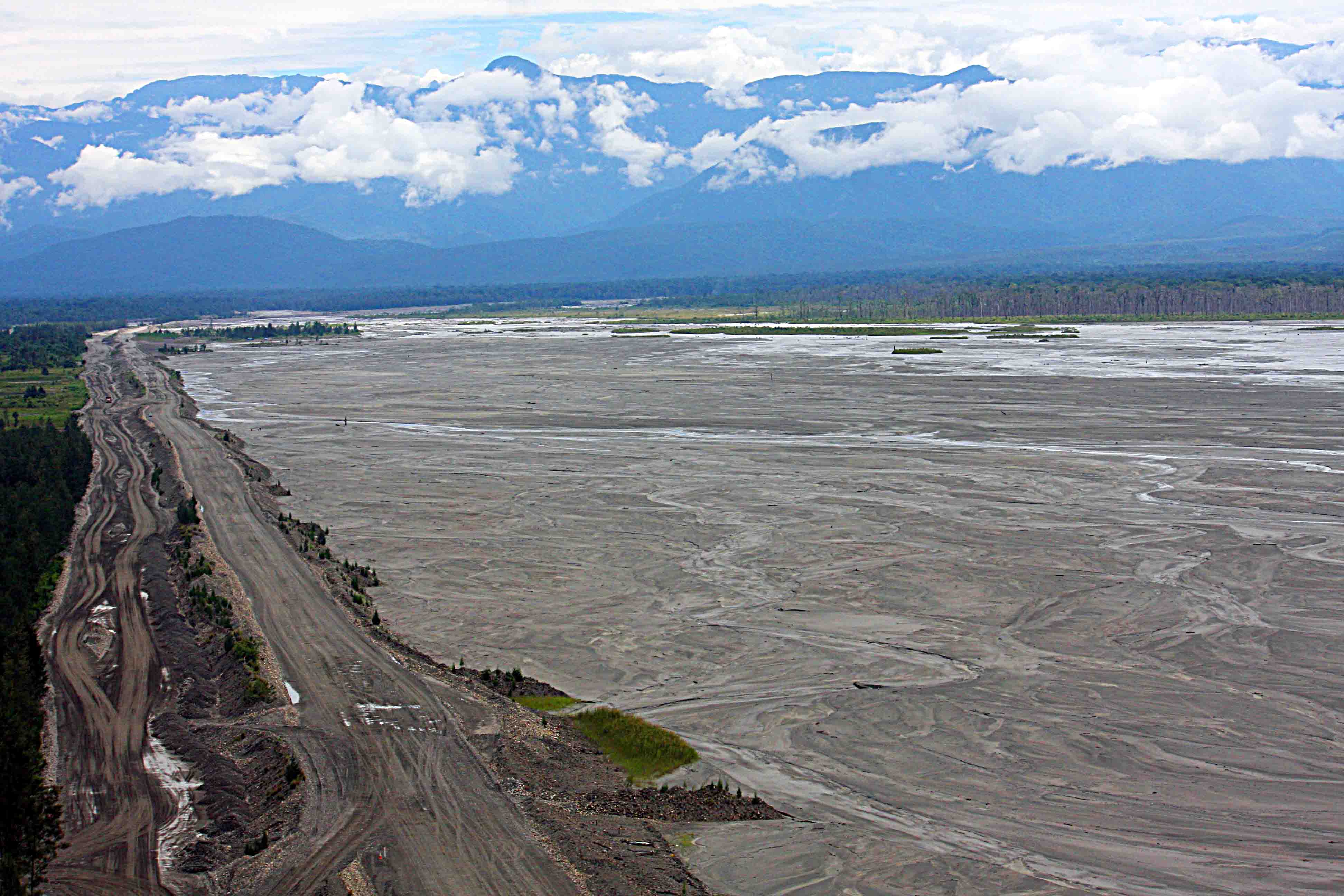
Freeport's contribution to Papua's welfare - Riverine tailings pollution

Bintang Papua, 8 July 2011

Jayapura: At a time when thousands of workers at Freeport are taking part in demonsstrations, demanding improvements in their conditions, the Moni people are calling on Freeport to acknowledge their rights.

According to Ema Zongganau, a women’s leader of the Moni people, Freeport has failed in the fifty years that it has been operating in the central highlands of Papua, to make any contribution to the indigenous Papuan people, in particular the Moni and Komoro people who have for generations been acknowledged as the rightful owners of the land where Freeport is now operating.

‘These two people have a claim to the land on which the largest mining company in the world is now operating. The company also operates in land owned by Amungme people,’ she said. While the Amungme people have land in the vicinity of Freeport operations with the company acknowledging their rights, the company has never acknowledged the rights of the Moni and Komoro people,’ she said.

In fact, according to Ema Zongganau, the company should contribute to all the Papuan people, in the two provinces of Papua and West Papua, those living in the coastal regions as well as those living in the mountainous interior. She said that what infuriates the Papuan people is that virtually all the profits earned by the company go abroad. The natural resources of Papua are being drained away with almost nothing being enjoyed by the Papuan people.

Speaking on behalf of the Moni people, she said that her people should get a just share of all this wealth. She said that in the fifty years that Freeport has been operating there, there has been no improvement whatsoever in the living standards and welfare of the Papuan people.

Ema said that the contract of work with Freeport should be re-negotiated, bearing in mind that the current contract is very weak indeed. Anyone who plays a leading role in Papua must immediately deal with the relationship with Freeport.

Strike causing Freeport the loss of Rp 800 billion a day

According to a separate article in Bintang Papua on the same day, relating to the strike of thousands of Freeport workers, it is estimated, according to a report by the DPRP, that the suspension of the company’s operations as a result of the strike is thought to be losing the company Rp. 800 billion a day which, at the current exchange rate of Rp 9,000 to the dollar, is a little short of $100,000 a day.

If this figure is roughly correct, it puts into perspective the huge profits the company is making from its mining of copper and gold, while the Papuan people, even those whose land is being used by the company, continue to live poverty-stricken lives. (TAPOL)

Police Reject Allegations of Hostage-Taking in W. Papua Mining Flap

http://www.thejakartaglobe.com/home/police-reject-allegations-of-hostage-taking-in-w-papua-mining-flap/452167

2) Police Reject Allegations of Hostage-Taking in W. Papua Mining Flap
Banjir Ambarita | July 11, 2011


Raja Ampat Police on Monday denied reports that legal advocate Johnson Panjaitan has been held hostage as a result of a dispute between two mining companies in West Papua.

Earlier on Monday, Tagor Simanjuntak, Johnson’s colleague, told Liputan6.com that Johnson went to Kawe Island to represent Kawe Sejahtera Mining, which is filing a lawsuit against fellow miner Anugerah Surya Indotama.

Tagor said that Kawe Sejahtera claimed that a ruling from the State Administrative Court stipulates that Anugerah Surya should suspend all its mining activities until the legal dispute is over.

Johnson was sent to the site following a report that the company was continuing to operate in defiance of the court order. Tagor said that he received reports from Johnson’s staffers that the legal advocate was being held hostage.

But the local police chief denied the report.

“I was in Jayapura, but from the report I got, Johnson Panjaitan is in Kawe Island, but the hostage issue was not true,” police chief I Nyoman Suastra said.

He said he had already looked into the allegation, and had turned up no evidence of hostage-taking. “It’s clear there are no hostages, I’ve crosschecked already,” he said.


Breaking News: Strike at Freeport’s Grasberg Mine Ends

Grasberg mine
Image via Wikipedia

 http://www.tempointeractive.com/hg/nasional/2011/07/12/brk,20110712-346056,uk.html

TEMPO InteractiveJakarta:A week long strike that left Freeport Indonesia’s Grasberg mine in Papua shuttered and paralyzed has come to an end. Freeport Indonesia’s spokesman Ramdani Sirait confirmed at midnight that an agreement had been reached with the PT Freeport Indonesia union to end the strike which began on July 4 and led to a suspension of mining and milling activities.

“Under the agreement, negotiations for the upcoming collective labor agreement, scheduled for renewal in October 2011, will commence. The agreement provides that employees will begin reporting to their positions on Tuesday, July 12, 2011,” Ramdani said in a text message, received by TEMPO English Edition at 12. a.m. on Tuesday,

“The agreement was the result of collaboration by representatives of the union, the Mimika Regency Legislative Council (DPRD) and PTFI.”

The strike ran from July 4 till July 11 at the mine, as leaders of the workers’ labor union had refusing to negotiate, pointing out that any sort of compromise was only a possibility with US-based Freeport chairman James Moffett. The Grasberg mine is one of the world’s biggest sources of copper and gold.

A total of 8,000 of the 19,500 workers employed at the Grasberg mine would continue this strike , according to labor union leaders last Saturday evening, until they knew their wages had been increased sufficiently. Previous media reports have pointed out a demand for an increase from $1.50 to $3 per hour.


KONTRAS: Torture acts are not taken seriously

(WEST PAPUA MEDIA has edited this article for linguistic clarity)

Summary for International Day in Support of Victims of Torture

To commemorate International Day in Support of Victims of Torture (26 June), the Commission for the Disappeared and Victims of Violence (KontraS) published an annual report titled, “Torture: Cruel Acts That Are Not Taken Seriously”.  This report is a summary of several torture incidents that received broad public attention (both nationally or internationally) throughout July 2010 – June 2011, especially elaboration of various complaints on torture cases, which were handled directly by KontraS.

The report checks how far the state has implemented human rights standards in their policies and national regulations produced.

KontraS’ advocacy work regarding torture cases are still to become part of the main agenda and needs to be mainstreamed to the public.   This agenda, besides pressuring the state to proactively deliver positive outcomes in human rights protection through policies and regulation reform,  also will provide public education to keep pushing for maximum protections on non-derogable (inalienable) rights, in all spheres of life.

State  “stuttering”  in responding to torture incidents can be seen from the cancellation of President Susilo Bambang Yudhoyono’s visit to The Netherlands at the end of last year.  The cancellation was in response to a legal suit submission to  a Netherlands court by activists of South Maluku Republic (RMS) residing in the Netherlands.   The Lawsuit was a legal-political action against Indonesian National Police officers  who tortured alleged RMS activists after a Cakalele dance performed in front of SBY, present with many foreign diplomats and guests during their visit to Maluku in 2007.

The next failure continues at the end of 2010.  Two torture videos circulated freely and widely on Youtube website.  In the short video  shown several people in military uniform are committing brutal and inhuman treatment followed by intimidating interrogation questions.  The SBY regime responded swiftly, confirming torture practice (did occur) in Tingginambut, Puncak Jaya District, Papua Province.   Although in the end, the Military tribunal III-9 (of Military Command District Cenderawasih, Jayapura, Papua) fall short by giving only light sentences to the 7 defendants which were all military personnel.

Beside two case exposed above, KontraS documented at least 28 cases of torture done by Indonesian military and police.   Quantitatively, we believe torture practices have happened even more.   Difficulties occur in monitoring torture acts because often it occurs inside the military and police compound – and due to lack of victim’s courage to report any torture case because the perpetrators are the law enforcer itself.  Cases directly handled by KontraS, among others are:

(1) Torture case of RMS activists in Ambon,
(2) Torture of Hermanus in Maluku,
(3) Torture lead to fatal casualties of Charles Mali in NTT,
(4) Engineered case of Aan Susandhi in Artha Graha.

KontraS also highlighted other cruel, inhuman and degrading treatment including caning punishment in Aceh.

In particular, KontraS highlight Komnas HAM capabilities to investigate and uncover the patterns and causal roots of torture, especially of torture cases in conflict area such as Papua.   The degree of seriousness in torture cases often fit the requirement of a pattern that is widespread and systematic, but in several case (such as on the torture video and violence upon Reverand Kinderman Gire cases), torture is framed as an (isolated or) individual case , but is still a serious violation of human rights subject to the international law norm ‘Jus Cogens’.

Komnas HAM neglectfulness in resolving torture cases paves the way for further impunity and lack of respect of victims’ rights. From various complaint reports sent by KontraS together with victims’ family, not a single case has ended up with justice where the perpetrators are given a fair punishment.   These made worse by the absence of reparations toward victims of torture and their families. Those conditions are in line with the small numbers of torture cases resolved fully in trial. Torture in Indonesia is a typically a crime practiced with impunity.

Criminalization of perpetrators of torture must be done under a legal framework,  with respect of human rights, and by ensuring preventions so that similar cases will not repeat in the future.   Therefore, KontraS urge the state to highlight recommendations below:

1. Hasten criminalization of acts of torture – The Indonesian government, especially the Ministry of Law and Human Rights, must draft a special legislation on efforts in preventing and punishing acts of torture. Criminalization of torture will be an important benchmark for Indonesia in fighting future torture practice.   This effort will become an alternative step while efforts to enact a new Criminal Code procedure is yet to be fulfilled;

2. Indonesian Police and Military must have a vetting mechanism in their rank and file (promotions) process, that considers their officers track record as to who has committed torture, in order to further their members professionalism.

3. Police must increase their personnel capacity in conducting investigations and probes, whilst also maximizing effective and deterrent punishment for torture perpetrators. Torture cases continue to occur due to a lack of capacity for adequate investigation technique, thus Police resort to shortcuts in gathering evidence and gain confessions through torture;

4. Indonesian military must improve their internal accountability mechanisms by revising Military Tribunal Bill to ensure acts of torture are classified as criminal acts and receive maximum punishment.

5. National Commission of Human Rights must be able to resolve patterns and causal roots of torture practices, especially those committed by security forces, so they can provide adequate recommendations for relevant state institutions to make strategic policies to combat torture practices;

6. The government must implement recommendations from the UN Committee Against Torture; Follow up results from the country visits of the Special Rapporteur on Torture, Manfred Nowak in 2007; and the Universal Periodical Review (UPR) of 2008.

With the election of Indonesia to the United Nations Human Rights Council for the second time, the implementation of those recommendations is an indicator of Indonesia’s seriousness on human rights enforcement.

Jakarta, 26 June 2011

Executive Board

Haris  Azhar
Coordinator

Create a website or blog at WordPress.com

Up ↑