Papuan youth set alight by Indonesian civil security officers

TAPOL Press release

3 November 2011 – Evidence has emerged of a horrific attack on a Papuan student in the town of Wamena in West Papua‘s central highlands.

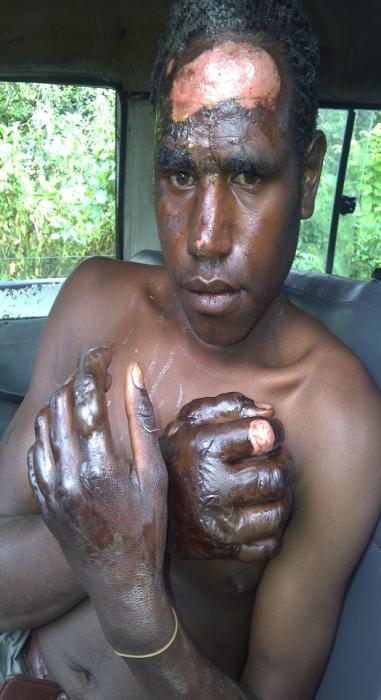
Yusuf Hiluka, set alight by police officer in Wamena on Oct 19 (via TAPOL)

According to a report received by TAPOL, at around 04:45 am on Wednesday 19 October, Yusuf Hiluka, 23, was stopped outside the office of the Regent of Jayawijaya District by two officers from Satpol PP (Satuan Polisi Pamong Praja), the district civil security unit, while making his way from a friend’s house to the Wamena bus terminal.

Without questioning Mr Hiluka, the Satpol PP officers poured glue on his head and set it alight. Mr Hiluka’s head and the back of his neck were engulfed in flames.

Mr Hiluka fled screaming to the nearby police station to seek protection. The perpetrator was detained immediately and held in police detention. An investigation has been conducted, and in accordance with customary law, a payment by the perpetrators to the victim’s family is being arranged.

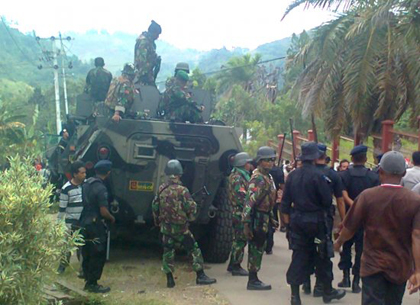
Mr Hiluka suffered burns to his forehead and hands [1], and according to reports he is still awaiting hospital treatment for his wounds. The motive for this attack is not known, but it is yet another unexplained incident in a series of violent events that have devastated West Papua in recent months. It occurred on the same day that up to six people were killed during the violent dispersal of the Third Papuan Peoples’ Congress by Indonesian security forces in the provincial capital, Jayapura [2].

TAPOL calls on the regional Chief of Police, Inspector General Bekto Suprapto, to recognise the gravity of this cowardly attack, ensure that a thorough independent criminal investigation is carried out and that those responsible are brought to justice. The use of customary law in such cases cannot be deemed sufficient, either in obtaining justice for the victim, in punishing the perpetrator, or in acting as a deterrent against future violations.

ENDS

Contact: Paul Barber +44 (0) 7747 301 739 or paul.barber@tapol.org

Notes:
1. Photos of Mr Hiluka and his injuries are available on request from TAPOL.

2. See TAPOL/WPAT/ETAN press release, ‘Indonesian crackdown on Papuan
Congress sparks outrage’, 20 October 2011, at
http://tapol.gn.apc.org/press/files/pr111020.pdf.

NZ NGO statement on the violence around the Third Papuan People’s Congress in West Papua


Below is a statement from New Zealand human rights, development and peace organisations about the use excessive use of force and human rights violations perpetrated by Indonesian police and military personnel breaking up the Third Papuan People’s Congress in Jayapura, West Papua, on 19 October 2011.
 

The statement by Father Dr Neles Tebay, Rector of Fajar Timur School of Philosophy and Theology, and Father Gabriel Ngga OFM, Provincial of the Franciscan Order in Papua (referred to in the NZ NGO statement) which documents the associated violence against Catholic institutions is available at http://www.converge.org.nz/pma/wp-cath1011.pdfNGO statement on violence following Third Papuan People’s Congress in October 2011

3 November 2011

We the undersigned New Zealand human rights, development and peace organisations call for the Indonesian government to immediately investigate allegations of excessive force and human rights violations by police and military personnel in breaking up the Third Papuan People’s congress on 19 October 2011 in Jayapura, Papua.

We also deplore the entry by military forces – without permission or prior notice –  into the nearby Yerusalem Baru seminary and Fajar Timur School of Philosophy and Theology and associated facilities within the Catholic mission compound in the area.

We call for an immediate dialogue between the Government of Indonesia and Papuan leaders to prevent further instances of unnecessary violence; and to address the issues that underpin conflict in Papua.

***

At least six deaths have been reported and hundreds of people were initially detained when security forces moved in with guns and violence to disperse several thousand unarmed people who had gathered peacefully for the congress on 17-19 October.  Video and documented evidence shows that police and military officers used pistols, canes and batons to beat congress participants, and threatened them. Such actions are a violation of rights to freedom of expression, opinion and peaceful assembly guaranteed under both the International Covenant on Civil and Political Rights and the Indonesian Constitution.

A statement from the Rector of Fajar Timur School of Philosophy and Theology, Father Dr Neles Tebay, and the Provincial of the Franciscan Order in Papua, Father Gabriel Ngga OFM, documents the violence with which security forces entered Catholic mission buildings, and the fear and intimidation imposed on occupants and those who sought refuge there. Bullets shattered windows, items were damaged, teargas was used, and one Franciscan brother was so badly beaten that he was admitted to intensive care at the local hospital after being released from overnight detention.

We endorse the statement and measures called for by Fathers Tebay and Ngga, in particular, we:

  • Reject repressive means to deal with issues because such violent acts undermine the human dignity of both victims and perpetrators.
  • Affirm the right of religious and other organisations to provide asylum where necessary, based on the universal humanitarian principle that a person exposed to a life-threatening situation is to be given protection and sanctuary. (The protection provided by the religious brothers and staff was given for humanitarian not political reasons, as congress participants sought refuge from persecution and threats.)
  • Ask the Indonesian Human Rights Commission (KOMNAS HAM) to investigate the violent incidents post-congress to look at how such serious human rights abuses have occurred.
  • Support a peaceful dialogue between the Government of Indonesia and Papuan leaders to stop violence and prevent a recurrence of such acts in Papua. This is in line with the Indonesian government’s own commitment, as expressed by President Susilo Bambang Yudhoyono, to deal with Papua ‘with heart’.

·         Ask for all people of goodwill and justice to support the implementation of such dialogue. ‘Because only through dialogue, issues that underpin conflicts in Papua can be identified and proper solutions can also be found without resorting to violence and bloodshed’ say Fathers Tebay and Ngga.
We are deeply concerned about the situation in Papua and the underlying tensions that impede Papuans’ access to development. We urge all parties to take immediate steps to prevent violence and enter into dialogue to resolve the serious underlying tensions.

JOINT STATEMENT OF:

Michael Smith, Director, Caritas Aotearoa New Zealand
Maire Leadbeater, Spokesperson for the Indonesia Human Rights Committee
Edwina Hughes, Coordinator, Peace Movement Aotearoa
Pat Jackman, President, Women’s International League for Peace and Freedom Aotearoa
Judith Crimmins, President, Pax Christi Aotearoa New Zealand
Peter Hosking, Executive Director, Human Rights Foundation of Aotearoa New Zealand
Pauline McKay, National Director, Christian World Service
Leigh Cookson, Director, Arena (Action, Research and Education Network of Aotearoa). – http://www.facebook.com/notes/peace-movement-aotearoa/nz-ngo-statement-on-the-violence-around-the-third-papuan-peoples-congress-in-wes/256380261076017

West Papua – Question and Motion to the Australian Senate, Nov 1st 2011

From the Australian Greens office of Senator Richard Di Natale

Question and motion that Senator Richard Di Natale, Greens spokesperson for West Papua, put to the Australian Senate this week, on Tuesday 1 November.

Senator Richard Di Natale  put a question to the Minister representing the Minister for Home Affairs, Joe Ludwig, regarding the Australian government’s support for the Indonesian military, in light of recent events in West Papua. Senator Di Natale also moved a Motion in the Senate to condemn the violent crackdown at the recent Papuan People’s Congress, to recognise the rights of West Papuans to freely assemble, and to call for the humane treatment and timely release of those arrested.

Richard is working to raise awareness of the situation in West Papua, and to seek the Australian government’s action to suspend their ties with the Indonesian military.

You can watch and share a video of Senator Di Natale’s Senate question and motion here: http://youtu.be/OEvswm5J9oE

[youtube http://youtu.be/OEvswm5J9oE]

You can also follow Richard’s work as Greens spokesperson for West Papua here: http://richard-di-natale.greensmps.org.au/portfolios/west-papua

Freeport strike: Police accused of siding with Freeport. Union given one-day ultimatum

Bintang Papua, 31 October 2011
[Abridged in translation by TAPOL]Timika: The actions taken by the police in Mimika have created the impression that the police are siding with Freeport-Indonesia, said a commissioner of Komnas HAM, the National Human Rights Commission, Ridha Saleh. In an interview with Kompas, he said that the police have warned that firm measures are being planned against the strike and the blockade set up by Freeport workers if  the blockade is not lifted within two days.

‘The measures being planned by the police reinforce the impression that, along with the money being paid by Freeport to the security forces, they are siding with the company,’ he said.

Ridha said that there was nothing unconstitutional about the strike and therefore workers should not be dispersed. The police in Mimika are going too far, he said. These measures would also  damage the negotiations now under way between the two sides  which are currently proceeding well.

‘We intend to talk to the police and ask them to abandon these measures. We also intend to speak to the national chief of police and the chief of police in Papua.’

The strike which started on 15 September is intended to persuade the company to pay attention to the welfare of the workers. The increase in wages offered by the company is not acceptable, in view of  terrain in which they work and the risks involved.

Police ultimatum to the workers:

The executive of the Freeport branch of the trade union, the SPSI, have been given an ultimatum by the police in Mimika, not to spread the strike to Mile 28, Mile 27 and Gorong-Gorong. The ultimatum was contained in a letter dated 30 October, along with a request to open access  which has been blocked by strikers. The police along with other security forces have given an ultimatum of only 24 hours, starting from the moment this request is made, for the strikers to conform with the regulations in force. ‘If this does not happen, the police will take firm action in accordance with the regulations in force,’ the letter from the police says.

The SPSI was also told to co-ordinate with the strikers  and ensure that the laws in force are not violated.

According to the police, the basis for these measures is the Criminal Code, Law 9/1998 on Freedom of Expression and Law 13/2003 on Labour Relations.

The chief of police in Mimika has also said that conditions  in the vicinity of Freeport-Indonesia are becoming less and less conducive  as a result of the strike which is, according to the police, being conducted in violation of the earlier notification given by the trade union.

According to the police, a number of anarchic actions have occurred in violation of strike regulations. Moreover, the workers have started holding demonstrations  without having informed the police, blocking access to a ‘vital national asset’ and disturbing the public order. [The police ultimatum goes on  mention a long list of laws and regulations which are deemed to have been violated by the strikers.]

The police ultimatum to the SPSI has also been sent to the governor of Papua, the chairman of the Mimika DPRP, the commander of the Cenderawasih Military Command, the President-Director of Freeport and other relevant agencies.

Maire Leadbeater reflects on West Papua’s ‘Arab Spring’

November 1, 2011
Indonesian forcesIndonesian security forces staking out the Third Papuan People’s Congress in Jayapura earlier this month. Photo: West Papua Media

Pacific Scoop:
Opinion – By Maire Leadbeater

It was not in the headlines, but our neighbourhood has had its own ‘Arab Spring’. The Melanesian people of Indonesian-controlled West Papua, have shown the same determination to pursue non-violent struggle as their counterparts in Egypt and Syria.

A 5000-strong Third Papuan People’s Congress took place over three days in a Jayapura field ringed with menacing armoured riot control vehicles and heavily armed police and soldiers. It was led by Forkorus Yaboisembut, chair of the Papuan Customary Council, who is highlighted on the Indonesian military’s leaked watch list of dangerous “separatists”.

As the Congress came to an end on October 19, Forkorus read a Declaration of Independence first penned in 1961, prior to the Indonesian take-over of the territory.

He then announced that he had been elected to be the “President” of the “Democratic Republic of West Papua”.

As the gathering began to disperse, the military began firing from their assault weapons and launched themselves on the crowd, arresting and beating some 300 people. Forkorus was forcibly arrested along with his “Prime Minister” Edison Waromi and they and three others now face charges of treason.

Dozens were injured, many with gunshot wounds, and up to six people were killed. The first death to be confirmed was that of a law student Daniel Kadepa who was shot in the head as he tried to flee.

Many terrified delegates tried to seek refuge in the nearby Catholic Seminary. Fr Neles Tebay, a prominent advocate for peaceful dialogue, has supplied a detailed account of the violent disruption and brutality displayed as the soldiers invaded the sacrosanct mission complex.

Terrified students
Terrified students were tear-gassed and threatened at gunpoint while one Franciscan brother was taken into custody despite the serious injuries he sustained in the attack.

A menacing security force presence is also ongoing in the remote Timika region, location of Freeport McMoRan mine, where an American multinational makes vast profits from the largest recoverable reserves of gold and copper in the world. About 8000 workers have been on strike since September seeking to lift their wages from the current hourly rate of around NZ $1.80 to $3.60 to parity with the wages paid to Freeport’s workers in other parts of the world.

Petrus Ayamiseba, one of the striking workers, was shot dead by the Indonesian police on October 10, provoking Papuan outrage and an unprecedented level of international union solidarity for the Freeport workers. Since then at least three others have been killed in the area by unknown assailants.

Rather than conciliation, the mine management has resorted to hiring contract workers as scabs.

Freeport McMoRan has had a dream run for more than 40 years. The first contract negotiated with President Suharto gave the mining company virtually free rein as well as generous tax concessions. This was in 1967 when Indonesia did not even have formal control over the territory.

In 1969, Indonesia pulled off a self-determination fraud by conducting a so called “Act of Free Choice” ( known as the “Act of No Choice” to the indigenous Papuans). Just over a thousand Papuan men took part out of a population at the time of nearly one million.

The Freeport mine has always been synonymous with violence and grave human rights abuses, as well as environmental destruction and the abuse of customary land rights. Amungme and Kamoro tribal people have had little recourse but to watch as the mine took over their lands and “decapitated” their sacred mountain.

Gunned down
In the last few years, especially since some Western mine employees were gunned down on the mine access road, the company has come under international scrutiny. However, the Jakarta government is in no hurry to interrupt the flow of taxes, dividends and royalties from Freeport, its biggest taxpayer.

There is an ongoing controversy around the way in which Freeport pays out millions of dollars so that Indonesian military and police forces can provide its security. Direct payments to individual police officers were supposed to have stopped, but the National Police Chief Timur Pradopo revealed in October that these payments of “lunch money” continue.

The security forces have a direct stake in a level of ongoing insecurity, a factor many believe underlies much of the violence in the area.

Following recent events, Indonesia has sent in yet more police and tried to justify the scandalous actions of its security forces as necessary to deal with “separatism”.

Why has New Zealand made no public statement condemning this latest crackdown? Our Government Superannuation fund and other Crown Financial Institutes invest in Freeport McMoRan.

Both government and the Superannuation Fund Board have so far resisted all calls to follow the ethical example of the Norwegian Government Pension Fund which divested from Freeport in 2006.

The New Zealand Minister of Defence recently talked about increasing our defence ties with Indonesia by extending the training we currently offer to Indonesian officers and hosting some “higher level” visits of Indonesian personnel. We also have an NZAID training programme for the mainly migrant West Papua police.

We promote “community policing”, a non-confrontational model that is about as far from current Papuan police practice as it is possible to imagine.

The buzz word is “engagement” – if we talk nicely, the military and police will learn not to open fire on unarmed civilians and Freeport will improve its human rights and environmental standards. Instead we should go with the tide of history, and start listening to West Papuan leaders who want us to support their call for peaceful dialogue

Maire Leadbeater is spokesperson for the Indonesia Human Rights Committee. This article was first published on the New Zealand Herald Online.

Create a website or blog at WordPress.com

Up ↑