Message to the Papuan Peoples by the climber Christian Welponer of South-Tyrol in Italy, from the top of the highest mountain of West Papua, one of the “Seven Summits”
Christian Welponer, the world- famous seven summit climber from South Tyrol, an autonomous region of Italy, has summitted the peak of Puncak Jaya where he raised the banned Morning Star flag in solidarity with people of West Papua commemorating the 50th anniversary of Papua’s Day of Stolen Independence on December 1.
Papua's banned Morning Star flag, flown by climber Christian Welponer of South-Tyrol in Italy, from the top of the highest mountain of West Papua, one of the "Seven Summits" (screen grab/ Welponer)
Indonesian security forces on November 30 threatened to “Shoot to kill on sight” any Papuan who raises the Morning Star flag, or hold any event that affirms Papua’s independence from Indonesia. Indonesia applies charges of treason and Rebellion – or Makar – to any displays of political expression that speak of self-determination or an independent West Papua.
Significant crackdowns by security forces on unarmed peaceful protestors are expected across Papua on December 1, and Welponer has dedicated his flagraising to all Papuans fighting for their freedom on this day.
West Papua Media has been provided with exclusive imagery of the Welponer holding the Morning Star atop Papua’s highest peak, also the highest peak of the Australasian (not Asian) continent, sitting at 4,884 metres above sea level. Named Puncak Jaya by invading occupation forces from Indonesia in 1969, known for hundreds of years as Carstensz Pyramid, and known for up to 45,000 years by local Amungme people as Nemangkawi, the peak is adjacent to the massive Freeport gold and copper mine of Grasberg. Military security is exceptionally tight around the mine area.
In the video, Welponer compares the struggle of the West Papuan people to the struggle of his people of South Tyrol, who won Special Autonomy status from Italy in 1972, and delivers a heartfelt message of solidarity for Papuan people for December 1.
Please watch the video below or (if shared) by following this link: http://www.youtube.com/watch?v=d0oo1q2Kb3E&feature=colike
Pro-independence Papuans are planning widespread rallies this Thursday to mark 50 years since they first raised their symbolic ‘Morning Star’ flag. A climate of fear surrounds the anniversary as Indonesia continues to brutally suppress any opposition, and hands derisory sentences to security forces implicated in the violence.
It is now a treasonable offense to carry the flag, which has become an emblem of West Papua’s struggle for independence since it was first flown on 1 December 1961.
As recently as October, West Papuans were left critically aware of the risks still involved in proclaiming independence. Up to ten people were killed when Indonesia’s security forces broke up an independence rally. The main officers involved have reportedly received reprimands.
Thursday’s peaceful protests aim to show there is still a strong appetite to end almost half a century of occupation and flagrant human rights abuses.
Since 1963, an estimated 100,000 civilians have been killed under Indonesian occupation.
One of the main rallies will be held in the city of Jayapura, by the grave of former Papuan leader, Theys Eluay. He was killed in 2001 by the Indonesian military. The seven men convicted of his murder were only given paltry jail terms.
The disproportionate use of force by Indonesia, and the clear lack of justice, leaves Papuan protesters fearful ahead of Thursday’s anniversary, says Reverend Benny Giay.
Speaking to Survival from West Papua, he said, ‘Most of the businesses will close down so people are stocking up on essentials…(and) in Jakarta lots of students are leaving their hostels to go back to their families, as they fear the military. The situation is very tense.’
Survival’s Director Stephen Corry said today, ‘Indonesia’s illegal occupation of West Papua is almost unparalleled in its brutality. It’s outrageous that the international community is turning a blind eye on almost half a century of ruthless oppression and unbridled violence against the Papuan people.’
There are growing calls for Australian monitors to enter West Papua ahead of Thursday’s rallies, and for Indonesia to allow foreign journalists back in.
Note to Editor
West Papuan independence activist Benny Wenda is available for interview in connection with this press release. Please contact here for more.
Wenda set up Free West Papua after being granted asylum in the UK. The Indonesian government wants him to return and has asked Interpol to arrest him. Wenda says the charges against him are made up and politically motivated.
IN the aftermath of October’s brutal crackdown by Indonesian police on the Third Papuan People’s Congress, local pro-independence committees have organised mass civil resistance in most towns across West Papua to commemorate its 50th anniversary of Independence, tragically cut short by Indonesia’s invasion in 1963.
The banned symbol of West Papua’s independence, the Morning Star flag, will be raised in provocative actions that occupying Indonesian security forces have deemed as an act of rebellion, and have threatened to shoot to kill anyone participating.
Flagraising ceremonies are scheduled to be held in almost twenty centres across Papua and West Papua provinces, including Jayapura, Wamena and Timika. Massive shows of force have been reported from Indonesian forces to prevent local people from taking part in planned events.
Tensions are high across the Bird’s Head Penninsula of West Papua as hundreds of paramilitary police (Brimob) seconded to the area exchanged gunfire with local units of National Liberation Army (TPN) and conducted heavy handed searches of homes and villages.
Shots were exchanged from 3pm local time on November 29 in the farming and gold panning village of Markus Eduda between Brimob personel and the village based unit of the National Liberation Army (TPN), led by Jhon Yogi. An estmiated 300 Brimob personel, who are not usually based in the area, are currently stationed in the western villages of Dagouto, Pasir Putih and Bibida.
On November 30 Indonesian soldiers were stationed at the location in the nearby city of Nabire nominated as the venue for a peaceful “praise and worship only” commemeration ceremony, with no flag raising.
Other previously unreported events in the area include escalating fear in villages, since combined military and police forces opened fire in the village of Madi Paniai on August 15, 2011.
Local human rights workers say that since the August shooting, residents of Madi Paniai and the neighbouring villages of Ugi, Weya and Aga have been living in fear, especially people who had fled to the area from other parts of Papua because of its relative safety.
They added that armed personnel were searching homes, rummaging through people’s belongings supposedly looking for sharp tools, and confiscating needles, knives, shovels, arrows and machetes.
They added that the continued presence of the police and military forces and the intimidating and invasive searches were causing widespread distress and prompting people to move to other villages.
According to latest reports the residents of Dagouto, Muyadebe, Uwamani and Badauwo have fled, deserting the villages.
Massive troop buildup
Around Jayapura, several thousand Papuans are expected to attend the 50th anniversary celebrations in Sentani, at the grave of slain independence leader Theys Eluay, who was murdered by Kopassus special forces officers in 2001.
Negotiations with police are still ongoing to allow a gathering and prayer fellowship after organisers were prohibited to raise the Morning Star At time of writing, Permission had still been refused by Jayapura Police to allow any gatherings.
Local sources have described urban centres across Papua as being like cemetaries with people staying off the streets whilst security force personnel are conducting shows of force.
In Manokwari, a prayer vigil and flagraising is planned together with a nonviolent mass demonstration, but statements from hardline leaders from the guerrilla National Liberation Army (TPN/OPM) have threatened to play into hands of Indonesian security forces planning a crackdown on flagraisers.
On Wednesday night, Manokwari was described as a “Blood Danger Zone” by organisers of independence celebrations after Richard Jouweni, a commander of the TPN, declared he would use violence against security forces to ensure the banned Morning Star would fly. Indonesian military commanders in Manokwari have prohibited local organisers from carrying out flagraisings, however these calls are likely to be defied. The location of the ceremonies are still unknown, while civilians in nearby villages have already started arriving in Manokwari town centre for the events.
Concerns are mounting of significant bloodshed in Serui and Waropen. Papuan and Indonesian media and human rights workers have reportedly been barred from the centres off the north coast, and the head of police has issued warnings to anyone engaging in political expression. The police chief in Serui, Daniel Pryo Dwiatmoko, Kepala Kapolres (+6282198480889, +6282198683246) said on November 29 in a interview on Radio Republic Indonesia “If Papuans wish to talk about independence of a nation-state, find another place to talk… We will permit no event regarding flag raising, if there is, its shoot to kill on sight”.
This statement is an eerie echo of Ali Murtopo, the architect of Suharto’s military takeover of West Papua, who in 1969 told the 1025 imprisoned delegates to the contentious Act of “free” Choice – the disputed process by which Indonesia took over West Papua – “We do not want you Papuan’s, we just want your land. If you want a country of your own, you can go to the moon. Vote for Indonesia,’ or we will cut out your accursed tongues”.
In Nabire and Biak, prayer gatherings will take place instead of flag raising due to fear.
In Merauke, on the edge of the Torres Strait, 1600 troops from the Indonesian army were airdropped down on November 29, and unconfirmed reports have filtered through of flagraising actions near the vast Merauke Integrate Food and Energy Estate.
The Australian trained Indonesian special force unit Kopassus is also deploying significantly across Papua to crackdown on peaceful free expression. Confirmed reports from disgruntled Kopassus sources to West Papua Media are describing 213 troops (2 companies) being deployed in Keerom and Jayapura, and another two companies of Kopassus have been deployed in Yakuhimo regency in the Highlands. Local human rights sources have described these Kopassus groups as “waiting around for a chance to crackdown”.
International media and human rights organisations are banned from Papua by Jakarta, however close monitoring of the situation is occurring through international media in conjunction with citizen media sources.
The Australian Government, while deepening ties with the Indonesian military despite widespread international condemnation of it’s human rights abuses, claimed to West Papua Media that Australia and Indonesia regularly exchange views on the situation in Papua. According to a spokesperson for the Australian Foreign Minister Kevin Rudd, “The Australian Government closely follows developments in the Papuan provinces … and encourages all concerned to act with restraint”. No mention was made of the need for Indonesian forces to allow peaceful political expression to occur without escalation.
West Papua Media will be monitoring this developing situation closely, and encourages other journalists to maintain close contact with us.
A West Papuan leader-in-exile fears Indonesian security forces will violently suppress the 50th anniversary celebrations of the independence movement’s flag … the Morning Star.
Thousands of police, military and special forces are reportedly massing in the two provinces just north of Australia, ahead of Papuan rallies planned for Thursday.
On Monday, Indonesian police said no officers would face charges over last month’s crackdown on the Papuan People’s Congress.
The crackdown left three Papuans dead and there are claims dozens were tortured.
Stefan Armbruster spoke with London-based West Papuan leader Benny Wenda, for whose arrest Indonesia this week issued an Interpol Red Notice.
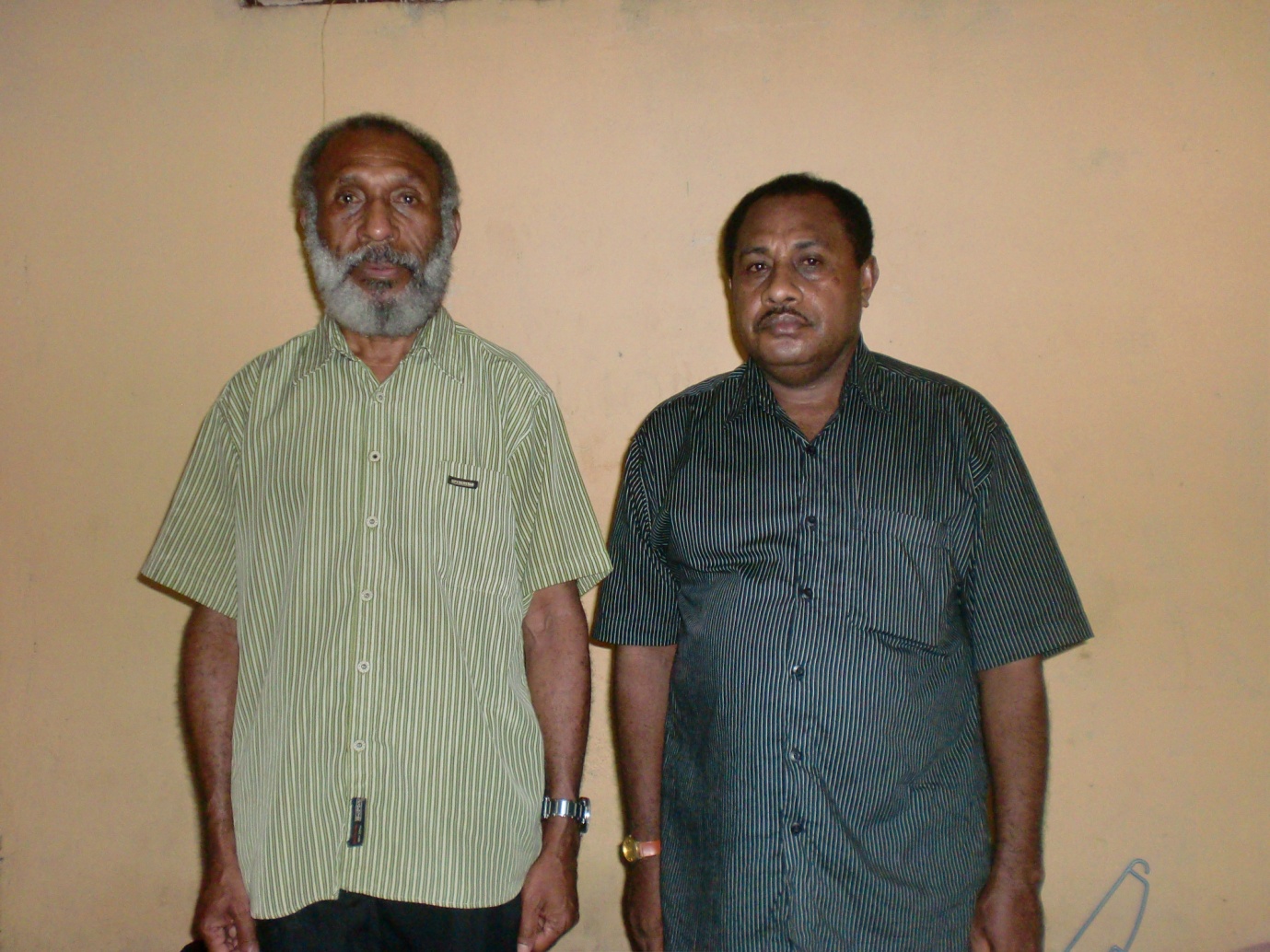
Papuan Leaders take a sit in floor of Papuan Police Prison. From left to right each of them; Edsison Waromi SH (Prime Minister), Forkorus Yaboisembut S.Pd ( President Republic Federal State of West Papua), Dominikus Surabut ( Aktivist)), Gad Wenda (Aktivist ), Agus Senandy Kraar (Aktivist ) and Selpius Bobii (Chair of Orginizing Commettee of Third National Papua Congress). (Photo: West Papua Media)
30 November 2011
Exclusive interview by Alex Rayfield (New Matilda) with West Papua Media
The President of the Federal Republic of West Papua may be behind bars, he may have been savagely beaten by the Indonesian police, but he has not been silenced. From his 5×4 meter cell in the bowels of the Jayapura Police Station – quarters he shares with five other Papuans also charged with rebellion against the Indonesian state – Forkorus Yaboisembut recently issued a rousing call to action smuggled out of prison.
“To all the Papuan people” Yaboisembut writes, “don’t be afraid to celebrate December 1st, whether you do so simply, or as part of large gatherings. Do not be afraid because we, the Papuan people, do not intend to destroy any country; we only wish to defend our political rights.”
Our interview, the first – clandestine – interview with Western media, may be constrained by time and space, but I can picture the tribal elder from previous meetings. He is a quietly spoken man, late in years but strong and alert. He walks tall, sits up straight and dresses neatly in long dark pants; polished slip-on shoes and patterned but subdued crisply ironed business shirts. His short hair and longish grey beard gives him the look of an Old Testament prophet, grandfatherly if you like.
It is painful to think that he when he was arrested on October 19 he was tortured so badly that he could barely sit down – or stand. Dominikus Surabut, from the West Papua Council of Customary Tribal Chiefs, who was detained with the man who is now the President of the Federal Republic of West Papua and who was also badly tortured, tells me that when Mr Yaboisembut was arrested the Police beat him mercilessly with a rifle butt, raining blows down on his head and crashing their weapons into his solar plexus. In a widely published Indonesian language account of the arrest, a religious leader said that an Indonesian soldier was ready to shot him dead but was urged not to by a policeman.
West Papuan’s political rights, Mr Yaboisembut says, are inalienable. “Whether you take the United Nations founding document, the International Covenant on Civil and Political Rights, the International Covenant on Economic, Social and Political Rights or even the Indonesian Constitution as your starting point, Papuans have the right to self-determination.”
Forkorus Yaboisembut S.Pd and , Edison Waromi,SH
“The preamble to the 1945 Indonesian Constitution mentions expressly, that independence is the right of all Nations, and because of this colonialism must be swept away, it is consistent with the principles of justice and humanity. Consequently, the people of Papua cannot be blamed in accordance with any law for wanting to celebrate their national day.”
These ideas, the same ideas that inspired Indonesians to liberate themselves from Dutch rule, are igniting the imagination of entire generation who yearn to be free. What makes Mr Yaboisembut’s ideas even more extraordinary is that he is urging an insurrection that grounded in what he calls “human dignity”.
“December the first 2011, is the fiftieth anniversary of when Papuans first raised the Morning Star flag. It is our golden anniversary, the year of God’s liberation” he says evoking the images of the ancient Jewish custom of Jubilee – of freeing captives and erasing debts. “It must be celebrated in an atmosphere of peace, safety and calm”.
“To Papuans, I therefore say, do not carry out acts of terror, intimidation or commit violence of any kind towards anyone, for whatever reason, whether they are Papuan or migrants.
“Do not be afraid,” Mr Yaboisembut repeats, “God is with us.”
Papuan leaders are standing infront; Forkorus Yaboisembut S.Pd, Edsison Waromi SH .behind Dominikus Surabut, Gad Wenda, Agus Senandy Kraar and Selpius Bobii (Photos: West Papua Media)
“The roots of our oppression is political” says Mr Selphius Bobii, Chair of the Committee of the Third Papuan Congress, who also shares a cell with Mr Yaboisembut and Surabut. “The annexation of our country by Indonesia and the acquiescence of the international community has resulted in state sanctioned human rights violations and creeping genocide.”
Those arrested on October 19 in the wake of the Third Papuan Congress are not backing down from the declaration of independence. “We are committed to using people power, diplomacy and the law to achieve our rights” Bobii tells me.
Dominikus Surabut says that he and the other prisoners are refusing to sign police statements charging them with “rebellion” (makar) under sections 106 and 110 of the Indonesian Criminal Code.
“We have done nothing wrong” Surabut says. “We have a political right to declare independence. We do not seek to destroy Indonesia or any other country. On the contrary, it is the Indonesia state that has attacked us.”
How can it be, they rhetorically ask, that the Indonesian police get written warnings for killing Papuans when Papuan activists nonviolently exercising their rights to freedom of expression are beaten and jailed?
Is this the same country that Obama and Gillard lauded for being a beacon of democracy?
In a widely published letter in support of Papuan political prisoners Human Rights Watch says that the articles under which the six Papuan political prisoners arrested after the Third Papuan Congress have been charged “are a legacy from the Dutch colonial era”. Charging nonviolent activists with rebellion is “in violation of the Indonesian Constitution, Articles 28(e) and 28(f) which respectively afford “the right to the freedom of association and expression of opinion,” and “the right to communicate and obtain information for the development of his/her personal life and his/her social environment, and shall have the right to seek, acquire, possess, keep, process and convey information by using all available channels.”
The charge of rebellion is also inconsistent with Indonesia’s international obligations under the International Covenant on Civil and Political Rights (ICCPR) which Indonesia ratified in 2006, a point which the jailed Papuan leaders make repeatedly to me. Besides, the Papuan leaders sigh, we have been left with no other option. “Special Autonomy has totally failed and even the MRP, a state institution convened a meeting which came up with eleven recommendations, one of which was to hold the Third Papuan Congress.”
Outside their police cell, in the streets of the cities and towns of West Papua, in the cloud covered mountains and on the coconut palm fringed coasts a new political consensus is emerging. This consensus has been forged not through endless meetings of the Diaspora, nor in stillborn discussions with political elites in Jakarta, nor in the conference halls of NGO deliberations, but in the furnace of political action. It is simply this: that West Papua must be free.
After the Congress three overlapping political groupings have emerged: the Papuan Peace Network who is calling for political dialogue, the West Papua National Committee who demands a referendum, and the Papua Congress leaders (supported by a loose alliance made up of the West Papua National Authority, the Council of Customary Papuan Chiefs, the Presidium Dewan Papua, and the West Papua National Coalition for Liberation).
The killings of nonviolent Papuans by the Indonesian police and military on October 19 have divided ordinary Indonesians, flushing out ultra-nationalists and their racist discourse, and outraging political moderates longing for a different kind of future than the one left to them by former dictator Suharto.
Inside Papua the massacre appears to be having a unifying effect, although Papuan politics remains complex affair. The West Papua National Committee who opposed the Congress later marched in support of the six political prisoners. Father Neles Tebay, respected intellectual and leader of the Papua Peace Network has intensified the demand for political dialogue. It is a call that has been supported by Yaboisembut and others. “All Papuans, wherever they are must respect the dialogue process democratically initiated through the Papuan Peace Conference and the Papuan Peace Network” wrote Mr Yaboisembut in a message smuggled out of prison.
Whether the Indonesian police and military act in a similarly dignified manner, or not, remains to be seen.
As I write this a long-term Papuan human rights activist sends me this message: “there’s an increase of military patrol of soldiers around Jayapura Township.” Some put the numbers as high as forty thousand. Reports are filtering in of troop surges in Sorong, Paniai (where gunshots have been heard), the border region and Jayapura.
“The atmosphere here is quiet but eerie” my friend writes. We are all waiting to see what December 1 will bring.


 00:03:54
  2MB
2MB




 West Papua Media Alerts