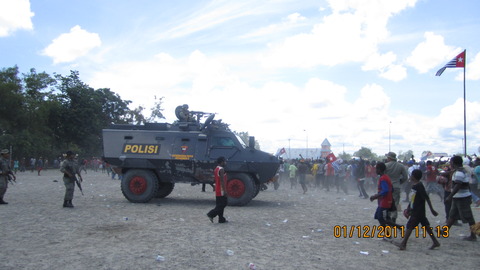
Entire Paniai villages forcibly evacuated by Brimob Gegana

December 7, 2011

Disturbing reports have been provided to West Papua Media overnight showing the latest human rights violations by Indonesian police against civilians in West Papua.

Human rights, church sources and local activists had independently claimed that 542 people have been forcibly evacuated by troops from the Special Gegana Brimob “Counter” terrorist police unit.  The villages of Dagouto and Kopabatu and surrounding hamlets in the Dagoutu Paniai district were evicted after the Gegana unit decided it wanted to expand a new headquarters facility to deploy in the offensive against Jhon Yogi, the local leader of the armed guerilla unit of the National Liberation Army (TPN-OPM).

Two Brigades of BRIMOB based in Papua, and a Brigade from Kalimantan will be housed in the sprawling new complex squatting on the former villages.

This comes after the Gegana unit was involved in an armed attack on a peaceful raising of the banned Morning Star flag on December 1, the 50th anniversary of an event widely seen to be West Papua’s first day of independence.

POLRI GEGANA anti-terrorism troops attacking peaceful flagraisers, Taokou Village, East Paniai , December 1 (West Papua Media)

Reports from the area have been sporadic and it is still unconfirmed if civilians were arrested, injured or killed in the flag seizure.

POLRI GEGANA anti-terrorism troops attacking peaceful flagraisers, Taokou Village, East Paniai , December 1 (West Papua Media)

The Gegana unit, a specialised elite anti-terrorist unit of the Indonesian police has been deployed heavily across Papua to crackdown on pro-independece activists engaged in non-violent resistance, as well as to eliminate the armed stuggle groups.  Gegana is one of several elite Indonesian police units that receives arms, funding, and training from the Australian Government, and was blamed on December 3 for burning down a church and school in Wandenggobak, in the highland regency of Puncak Jaya.

According to sources in Paniai, the local government (regency level) have guaranteed to shelter and feed the displaced evacuees, and the local government will have to support the relief operation alone.  Reports indicate that the evacuees will be held in a secure camp in a local government owned Uwatawogi Community Hall in Enaratoli, Paniai.   Indonesian police who caused the displacement has provided no information about supporting civilians they have displaced.


Related articles:

West Papua’s Rise and Defy

by Alex Rayfield

West Papua Rising – Analysis

The raising of the banned Morning Star flag across West Papua on December 1 made two things abundantly clear: political defiance in West Papua is growing and the Indonesian Government is losing control.

Despite Papuans fearing they would be shot if they raised the flag, the Morning Star was raised in Jayapura, Sentani, Manokwari, Sorong, Merauke, Timika, Puncak Jaya, Paniai, Genyem, Wamena and inside Indonesia in Yogyakarta and Jakarta.

The Indonesian government may have banned the Morning Star, stepping back from a constitutional commitment to free speech, but when tens of thousands of people display the flag and it is raised across the country, and when people sing the banned national anthem, “Hai Tanahku Papua” in open defiance of the police, that law is effectively ripped up. What good is law77/2007 outlawing the flag and national anthem if people don’t obey it?

In many places police were powerless to do anything. Video footage shows Indonesian police driving as crowds of protesters wave the Morning Star flag and shout freedom.

Members of the West Papua National Committee, Papuan Peace Network and Congress members marched together holding banners like “STOP COMMITTING HUMAN RIGHT VIOLATION IN PAPUA”, “INDEPENDENCE YES, NKRI NO” (NKRI stands for the Unitary Republic of Indonesia) and “FEDERAL REPUBLIC WEST PAPUA”.

This slideshow requires JavaScript.

At many of the demonstrations, the Declaration of Independence was read again in defiance of police and military who looked on. This is the same statement that precipitated fatal shooting by police and military last month when it was read out at the Congress.

A senior foreign correspondent based in Jakarta told me that prior to December 1st police in West Papua were briefed during a phone hook-up not to respond with violence. Not because they love Papuans. Not because they suddenly become supporters of democracy. Not because they decided to serve and protect instead of beat people to a bloody pulp; but because virtually everyone in West Papua has a cell phone.

As one of the key organisers for West Papua Media operating inside West Papua remarked, “the media network across Papua is like a spider web. Now when there is an incident we can quickly get reports across the country and out to the world.”

“The mainstream media in Papua is owned by Indonesians. They publish things that terrify the Papuan community” the same source said. “So our most powerful weapon has become our independent media network.”

It is that media network that has helped turned the Congress and December 1st into a watershed moment.

The killing of nonviolent Papuan protesters at the Congress last month – relayed by phone, facebook, you-tube and mailing lists – has outraged Papuans, leading more to support independence. It has divided political elites inside Indonesia, attracted more third party support for the West Papuan cause, and revealed the ugly face of Indonesian colonial rule in West Papua.

It has widened the circle of dissent and tipped the political scale in the Papuans favour.

In Sorong, for example, even Papuan government civil servants and the retired military members joined the protest, prompting one local organiser to remark that “this really different from previously which always attended by the community.”

The Indonesian government may still have a ban on foreign media in West Papua but when people can send SMS news reports in seconds and photos and film in a matter of hours, a ban on media is also meaningless.

The Papuan people have become the media.

But communication tools don’t make a revolution. They are simply that, tools; necessary to get around the ban on journalists, but not sufficient by themselves to bring about change. That will require old fashioned community organising, urging even larger numbers of people and other sectors of society – inside Papua, Indonesia and internationally – to become involved, and raising the political and economic costs of the occupation.

Technically, of course, the Indonesian government is still in control. Jakarta still makes the political decisions and the police and security forces have the capability and personnel to crush any rebellion – armed or nonviolent. But they have lost moral authority. Papuans are no longer willing to go along with the status quo. The mood is angry, defiant, uncooperative and militantly peaceful.

Senior tribal elders and young people who were shot at last month have decided not to give in to fear. Instead, they went back out onto the streets. They raised the flag. They re-read the declaration of independence. And a big contributor to this courage has been the leadership of the Congress leaders in prison. Forkorus Yaboisembut, the 72year old President of the Federal Republic of West Papua encouraged everyone to celebrate December 1st in whatever way they could, and to do so with determined nonviolent discipline.

However, there was still violence. In Timika the Indonesian military opened fire on unarmed crowds when Papuans raised the Morning Star flag. Four people were wounded (two men and two women). Two of the victims are in critical condition in hospital. In another part of the country a Papuan shot an Indonesian policeman with a bow and arrow. In Puncak Jaya and Paniai in the remote highlands Goliat Tabuni and Jhon Yogi, the two Papuan Liberation Army commanders from those areas, engaged the Indonesian military and police in fire fights, killing two members of the Indonesian Paramilitary Police (Brimob) in Puncak Jaya and sabotaging bridges and burning government posts in Paniai. The overwhelming response by the Papuans, however, was mass unarmed political defiance.

Papuan frustration at the lack of change is as intense as it has ever been. At the same time the Indonesian government’s options are narrowing. For years the Indonesian government could ignore problems in West Papua. It was not worth expending political capital on. But West Papua is quickly becoming Indonesia’s Achilles heel.

Congress and December 1st has created a dilemma for the Indonesian Government. Essentially they have two choices: more repression or political dialogue. More repression will only increase support for independence and further erode Indonesia’s standing. If the government does nothing or does not come up with a credible plan for political dialogue they can expect support for independence to grow. The Indonesian government recently announced they would fast track economic development in West Papua. But this won’t cut it. The Papuans are asking for political freedoms, not more money.

Papuans I spoke to want to be genuine participants in a political process, not objects of policy, and they have lost faith with their own political class who are increasingly viewed as corrupt and unwilling to stand up to Jakarta.

They are disgusted that police who shot dead unarmed Papuans and beat 72 year old tribal elders get a written warning and nothing happens to the soldiers who killed people.

Now as Papuans return to their homes after December 1st many fear that the Indonesian police and military will return to the practice of targeted repression and that organisers and participants will be hunted down, one by one, community by community.

West Papua may not yet be free, but for many Papuans, Indonesia lost their loyalty a long time ago. Now it seems the government is losing their obedience as well.

Alex Rayfield is an independent freelance journalist writing with West Papua Media.

TNI/Polri accused of still using militaristic approach in Papua

JUBI, 2 December 2011The shooting that occurred while a Morning Star Flag was being lowered in Timika resulted in a civilian being shot and wounded would  not have occurred if the security forces had adopted the ‘persuasive’ approach. Unfortunately such an approach is not being used, especially when an incident involves the Morning Star Flag. [This event was in commemoration of 1 December 1961.]

These views were expressed by the chairman of the Justice and Peace Secretariat (SKP) of the Timika Diocese, Saul Waminbo. ‘In the interests of justice and peace, such actions should never be taken by the police or the army against anyone, nor should violence have been used to disperse crowds of people, which could result in people getting being injured.’

He went on to say that the police, as the force which had granted permission for the commemoration of the 50th  anniversary of the Morning Star Flag, ought to have engaged in talks with the people there and asked them to lower the flag.’But something quite different happened. As soon as the flag was unfurled, Barakuda vehicles used by  Brimob which  had been parked round the edge of the field drove onto the field towards the flag pole. As they were nearing the flag pole, they started shooting in the direction of the flag pole and whoever happened to be nearby. This was then followed by many rounds of firing which resulted in several people being injured’  He said that this was not the persuasive approach but a militaristic approach.

In the opinion of the bishopric of Timika, the police and Brimob also used sharp weapons and live bullets.’I am certain that  that they did not use rubber bullets. Had they done so, why was it that after the shooting, the men crawled along the path of the bullets they had used.’ He said that after the random shooting, the men rushed  forward to collect the bullet shells on the ground, making sure that the local people would not be able to collect them as evidence of what happened.’ Why were the police afraid of the people gathering the bullets.’  This is proof that TNI/Polri were indeed using sharp weapons and bullets, in an attempt to end the lives of people who were simply exercising their right?’

According to SKP Tuimika, injustice in still widespread in Timika, especially as a result of the actions of the security forces in Tanah Amungsa, Bumi  Kamoro Papua.’ ‘This also includes cases where the police arrest people  at events attended by thousands of people. What should happen,’ he said, ‘is that the police should summon people and find out who was responsible for these activities, instead of just arresting anyone who happens to be walking along the road, or people who are involved in activities for which permission had already been granted.’

ABC: West Papuan village torched in unrest

By Brigid Andersen

fixed by West Papua Media

Updated December 05, 2011 20:43:45

Reports from West Papua claim Indonesian anti-terrorist police have torched a remote village amid clashes with guerrilla rebels in the region.

Activists say civilians have fled into the jungle in response to the unrest and there are now grave fears for their safety.

Media is strictly controlled in the region, making reports hard to verify, but it is claimed that Indonesia’s Gegana Brimob police unit attacked the village of Wandenggoback, in the Papuan highlands, in response to the shooting deaths of two police officers on December 3.

The two Indonesian police were reportedly killed earlier in the day during an offensive launched by the militant Free Papua Movement (OPM) and the anti-terrorist brigade responded by setting fire to schools, a church and houses in the village.

Reverend Benny Giay from the Papuan Christian Church in the province’s capital, Jayapura, says he has spoken to school teachers and young people who are among those who fled Wandenggoback.

“The police mobile brigade burned the church, schools and houses of the people and people have fled to the bush. They’ve become local refugees,” he said.

“It is in response, according to the military and the government sources here, to the two police who were shot.”

Hiding

He says there are concerns for the safety of the villagers who have fled and are now hiding out in the rugged highlands.

“Some have run to a neighbouring district. Some we think they are in the bush and we are worried that they may get sick and even die out of starvation,” he said.

“What we are worrying about is that [the Brimob] have been doing this, they’ve been terrorising people, people are fleeing the villages and people are dying in the bush out of sickness.

“We are worried that this will continue to be the military’s [tactic] to kill Papuans off.”

Mr Giay says Indonesian authorities have blamed OPM guerrillas for the death of the two police officers, but he says that claim needs to be investigated.

“We are saying as a church to make sure, if the government allows human rights NGOs to go there and do an investigation so we can find out who made the shootings which killed two policemen,” he said.

Security crackdown

On December 1 West Papuans marked 50 years since the province declared independence from Indonesia. Rallies were held in many areas and the province’s banned morning star flag was raised.

Nick Chesterfield, editor of West Papua Media, says they are getting reports from villages around Wandenggoback of a security crackdown in response to the independence ceremonies.

“The reports that we’re getting at the moment are that Indonesian security forces have been rampaging in areas near Nulia and that people are fleeing to the hills in the area,” he said.

“The district of Pagalome is now quote ’empty of humans as all have fled’.

“We’ve got a lot of difficulty getting strong verification up there because it’s been reported to us that troops are controlling all the roads out and any places that you can get a phone signal.”

People have no ability to grow food up in the mountains; they have fled with whatever they can carry, so there are grave fears.

Nick Chesterfield, editor of West Papua Media

Mr Chesterfield says as many as several thousand civilians could now be hiding out in the jungle.

“There have been instances in the past where up to 10,000 people have hidden out in the mountains for up to three months,” he said.

But he says there is little food and shelter for those who have fled.

“There’s not much cover in the highlands. Where people will be fleeing is to the mountain peaks,” he said.

“This is the monsoon time, so the the nights are a little warmer but the conditions are atrocious. People have no ability to grow food up in the mountains, they have fled with whatever they can carry so there are grave fears.”

Following developments

Indonesia’s anti-terrorist police receive training and funding from the Australian Government.

The Department of Foreign Affairs and Trade says it seeking to verify the reports from Wandenggobak.

“The Australian Government deplores violence in all its forms. The Australian Embassy in Jakarta follows closely developments in Indonesia’s Papua provinces and is seeking to verify reports of incidents around Wandenggobak in the Papuan highlands,” the Department said in a statement.

“Australia continues to urge Indonesia to investigate thoroughly any allegations of human rights abuses and to hold perpetrators to account and welcomes president Yudhoyono’s commitment on November 19 to take legal action against any security forces personnel who commit human rights abuses.

“The Australian Government does not train or fund Indonesia’s security forces to counter separatism.”

West Papua has seen several instances of unrest in the past few months, with Indonesian military and police blamed for killing three activists in August and arresting hundreds more.

Shots were fired and a number of West Papuans were also arrested during independence ceremonies on December 1.

Topics: unrest-conflict-and-warworld-politicspapuaindonesia

First posted December 05, 2011 20:21:12

Villagers flee to Papua’s forests fearing further Police attacks

by Yason Sambom

Edited by West Papua Media

December 5, 2011

[West Papua News with additional reporting from West Papua Media] – About 110 residents of Berap and Genyem villages, near Lake Sentani in Papua, have been forced to flee to the forest after Indonesian Police terrorized the village on November 30 in retaliation for an incident in which two officers including the head of Criminal Intelligence were injured.

Indonesian media have reported the bow and arrow attack on the police officers as an unprovoked attacked by National Liberation Army Guerillas, but independent media sources have been provided information that show that the shooting occurred in self-defence.  Ordinary villagers from Berap were attacked by Brigadier Ridwan Napitupulu and his colleague Budi, who were allegedly drinking heavily despite claiming they were patrolling to seize any Morning Star flags that were to be raised on December 1

The correspondent for West Papua News, a local citizen media outlet, met refugees  who testified the chronology of events in Berab-Genyem Village, in Nembukrang District.  Villagers were shocked by acts of terror carried out by two plainclothes Police intelligence officers, who arrived after drinking in the village on Suzuki motorcycle No. F6611BT Police.  The two officers carried out an armed robbery of a young man who was calling his wife on a mobile phone, demanding to know who the villager was speaking with.  According to the chronology recorded, the following exchange occured:

Police: “. You call what?, In the village you bring any activists?

Victim said, “I do not know”,

“In the village of Berab, would you raise the Morning Star flag?” asked the two policemen who then marched the young man into the village.

After being brought into the Berab, the two drunk officers immediately allegedly pushed and almost hit several young villagers on night patrolling duty.  The young men did not accept the officers’ pushing them, so they chased on foot the two officers to the Blue River (Kali Biru) tourist sites.

Both officers felt besieged by the youths and the panicked villagers, and fired warning shots that narrowly missed a youth PK, who then tried to beat the officer to stop him shooting.  At this point, an unidentified person allegedly shot Napitupulu in thigh with a traditional hunting bow, hitting the officer in the thigh, allegedly severing an artery.  He then escaped by diving in to the Biru River, that carried him clear.

Local human rights sources are investigating the claims further

Ridwan’s colleague, Budi, ran away and hid in foliage overnight, only emerging on December 1 when light amidst the arrival of senior officers and an armed platoon.  Budi was allegedly observed by witnesses lying to his superiors who were chastising him, saying (according to the witnesses) “I was surrounded and beaten villagers because they want to grab a weapon”.

Police then conducted a sweep operation through the village, causing many to flee.  The six villagers that were captured by Police were identified as:
1.Ruben Manggo (Berab Village Head),
2.Thomas Tarko (Member KNPB Tabi),
3.Zet Manggo (Member KNPB Tabi),
4.Yonathan Tarko (Member KNPB Tabi),
5.Joseph Manggo (Member KNPB Tabi),
6.Kalfin Tarko (Member KNPB Tabi).
The six were interrogated at the Jayapura police headquarters.  Of the six victims, Berab village Head Ruben Manggo was released by police officers on Friday at 13:00 WP with injuries from severe beatings, and is being cared for in Berab village.
These conditions make citizens feel threatened because of the mental-psychological trauma for several years in a state of trauma due to forces that normally act without compromise to act arbitrarily and brutally against village residents.This makes the act itself displaced villagers in order to save themselves from the property and their lives were shot dead drift alias.
This event took place amidst security force repression after the Third Papuan People’s Congress on October 19, 2011.  The subsequent crackdown legitimized a deep sense of trauma after the declaration of the Federal State of West Papua by the Chairman of the Tribal Council (DAP), Forkorus Yaboisembut, SPd,.  Yoboisembut as President of the Federal State of West Papua, had called for peaceful resistance on December 1, 2011,  by flying the Papuan Morning Star flag across all the land of Papua.
These conditions are making citizens feel threatened and living in a state of psychological trauma for several years, due to the arbitrary and brutal behaviour of security forces acting without compromise against villagers.  This has caused villagers to flee to the forest where they are living without access to security, displacing villagers in order to save themselves.  The refugees have had to abandon all property and are greatly anxious for their future.
Abridged report from West Papua News

STOP PRESS: Tempo.co.id has reported that Napitupulu died on Monday morning in Youwari hospital, Sentani, Jayapura.

National police spokesman Sr.Comr. Boy Rafli said that Second Brig, Ridwan Napitupulu died on Monday at 00:35 Indonesian Eastern Time after being treated at the hospital for three days. He added that the body would be brought to his family’s home in Medan by Garuda this afternoon at 12:20, tempo.co reported.
Police have named three suspects in the case, Thomas Tarko, Yonathan Tarko, and John Calvin Tarko.

Last Updated on Saturday, 03 December 2011 09:31

Create a website or blog at WordPress.com

Up ↑