Don’t blame OPM for mysterious shootings, says DPRP member

JUBI, 18 April, 2012
There have been a number of shootings in Papua in recent months but mystery surrounds the problem of who is responsible.Ruben Magay, the chairman of Commission A of  DPRP, the provincial legislative assembly  of Papua, said that  the failure of the police to deal with this problem was a sign of their lack of professionalism. This is what is worrying the Papuan people, ‘ he said ‘What they are doing is far from what the people expects. and hope for.’He said that he had warned the chief of police and the military commander to stop blaming the OPM. Making such claims is a sign of the lack of ability of the security forces.’

‘We can only accuse the OPM if there is clear evidence of their involvement.’ He said that the police should also stop talking about unidentified persons. It is only when someone is arrested and charged before a court of law on the basis of evidence that things become clear.’ We need to make things clear for the people. It is as though the police are trying to conceal their own incompetence.’

He said for a second time: ‘Dont keep talking about the OPM until you have evidence. And don’t talk about geographical problems as the facilities available are the ones that have been provided by the state.. Is anything lacking?’

AMNESTY INTERNATIONAL: PRISONER’S MEDICAL TREATMENT PREVENTED

PRESS RELEASE
http://www.amnesty.org/en/library/info/ASA21/017/2012/en
UA: 109/12 Index: ASA 21/017/2012  Indonesia        
Date: 19 April 2012
AMNESTY INTERNATIONAL
URGENT ACTION
PRISONER’S MEDICAL TREATMENT PREVENTED
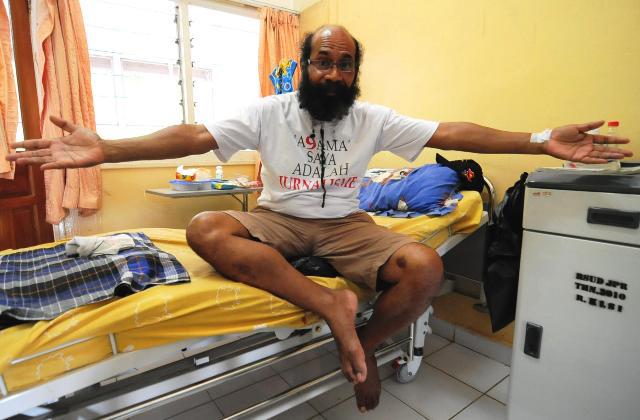
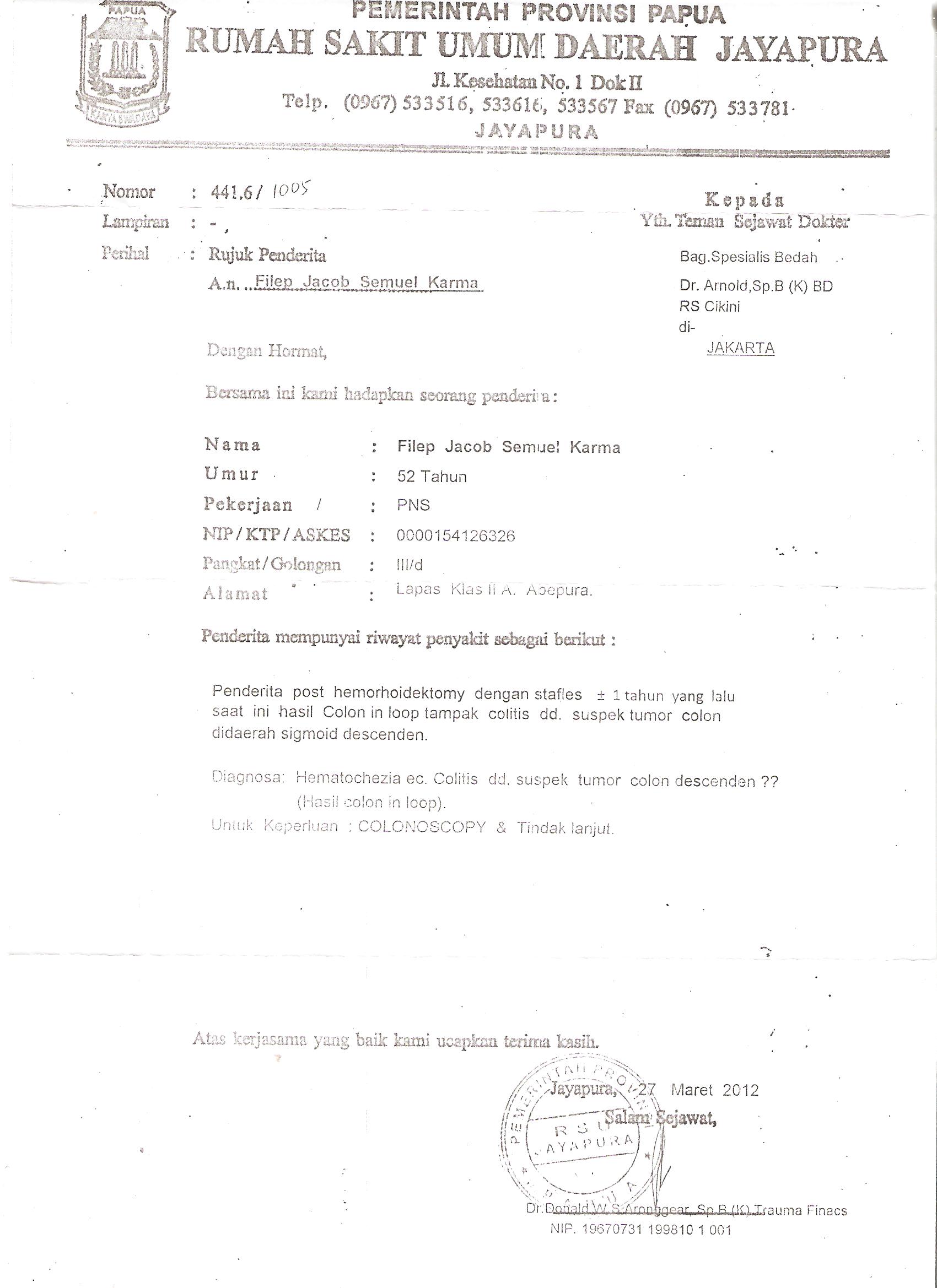
Indonesian prisoner of conscience Filep Karma is in urgent need of medical treatment. He needs to travel to receive this treatment, but the prison authorities have refused to pay for his transport and medical costs.Filep Karma is serving a 15-year sentence at the Abepura prison in Papua province for raising a banned regional flag. Doctors at the Dok Dua hospital in nearby Jayapura conducted a medical examination last month and suspect a tumour of the colon. They have confirmed that he requires a colonoscopy and follow-up treatment. However the necessary equipment is not available in Papua province and they have referred him to the Cikini hospital in the capital, Jakarta. The Abepura prison authorities have given permission for Filep Karma to travel to Jakarta, but they have refused to cover the cost of his medical treatment and travel. By law, all medical costs for treatment of a prisoner at a hospital must be borne by the state (Regulation No. 32/1999 on Terms and Procedures on the Implementation of Prisoners’ Rights in Prisons).

Filep Karma has suffered a number of medical problems in detention, including bronchopneumonia, excess fluid in the lungs and a urinary tract infection. In July 2010 he was sent to a hospital in Jakarta for prostate surgery and other care. In November 2011 he was transferred to the Dok Dua hospital in Papua for an operation after he experienced bleeding haemorrhoids, chronic diarrhoea and blood in his stool. He has continued to pass blood in his stool since the operation. Filep Karma is also undergoing physiotherapy for an injury to his hip bone from a fall he suffered in detention in 2006.

Please write immediately in English, Indonesian or your own language:
– Urging the authorities to ensure that Filep Karma receives full and immediate access to any medical treatment he may require;
– Urging them to cover the cost of such treatment in accordance with the UN Body of Principles for the Protection of All Persons under Any Form of Detention or Imprisonment (Principle 24) and Indonesian regulations;
– Calling on them to release Filep Karma, and all others prisoners of conscience in Indonesia, immediately and unconditionally;
– Urging them to ensure that prison conditions and the treatment of prisoners meet standards provided for in Indonesian law as well as UN Standard Minimum Rules on the Treatment of Prisoners.

PLEASE SEND APPEALS BEFORE 31 MAY 2012 TO:
Head of Abepura Prison
Liberty Sitinjak
Lembaga Pemasyarakatan (Lapas) Abepura
Jl. Kesehatan 11, Jayapura
Papua 99351, Indonesia
Fax: +62 984 24721
Salutation: Dear Liberty Sitinjak

Head of Papuan Provincial Department of Justice and Human Rights
Daniel Biantong
Jl. Raya Abepura No. 37,
Kotaraja – Jayapura 99117,
Papua, Indonesia
Fax: +62 967 586112
Salutation: Dear Daniel Biantong

And copies to:
Director General of Prisons
Drs. Untung Sugiyono
Ministry of Justice and Human Rights
Jl. Veteran No. 11
Jakarta Pusat
Indonesia
Fax: +62 21 3483 2101
       

Additional Information

Filep Karma was arrested on 1 December 2004 after taking part in a peaceful ceremony in Abepura, Papua province. He was among approximately 200 people who took part in the ceremony during which the banned “Morning Star” flag, a symbol of Papuan independence, was raised. He was charged with “rebellion” (makar) under Articles 106 and 110 of the Indonesian Criminal Code, and sentenced to 15 years’ imprisonment on 26 May 2005. His sentence was upheld by the Supreme Court on 27 October 2005. Amnesty International considers him to be a prisoner of conscience.

In November 2011 the UN Working Group on Arbitrary Detention (WGAD) declared Filep Karma’s detention to be arbitrary on the grounds that he was imprisoned for the exercise of his rights to freedom of expression and peaceful assembly – Opinion No. 48/2011 (Indonesia). These rights are guaranteed in the International Covenant on Civil and Political Rights (ICCPR), to which Indonesia is a state party, and in the Indonesian Constitution. The WGAD also found Filep Karma’s detention to be arbitrary because he had been subjected to an unfair trial. Article 14 of the ICCPR guarantees the right to a fair and public hearing by a competent, independent and impartial tribunal established by law.

The Indonesian authorities have an obligation under national law and standards to provide medical treatment to all prisoners in the country. Article 17 of the Indonesian Government Regulation No. 32/1999 on Terms and Procedures on the Implementation of Prisoners’ Rights in Prison requires the prison authorities to provide adequate access to medical treatment. International standards also provide for medical treatment for prisoners. The UN Standard Minimum Rules for the Treatment of Prisoners provides that prisoners needing treatment not available in the prison hospital, clinic or infirmary should be transferred to an appropriate institution outside the prison for assessment and treatment. Principle 24 of the UN Body of Principles for the Protection of All Persons under Any Form of Detention or Imprisonment requires that prison authorities cover the costs of such treatment.

In view of the potentially serious nature of Filep Karma’s medical problem, Amnesty International believes the authorities’ refusal to arrange prompt and appropriate examination and medical care for him could amount to cruel, inhuman or degrading treatment.

UA: 109/12 Index: ASA 21/017/2012 Issue Date: 19 April 2012


Sentences of Forkorus and colleagues lengthened by sixty days

JUBI, 16 April 2012
Gustav Kawer, a member of the defence team of Forkorus and his co-defendants, has confirmed that the sentences of his clients have been lengthened for the second time.The reason for the second lengthening was that the documents relating to the case  had not been sent  by the District Court to the High Court in Jayapura.Following the first addittion of thirty days, the material had not yet been examined, resulting in another thirty days been added to the sentences.

Olga Hamadi, another member of the defence team, confirmed that the sentences had been lengthened, saying that the High Court in Jayapura had issued a statement to the effect that the sentences of the five men, Forkorus Yaboisembut, Edison Waromi, Selpius Bobii, Dominikus Surabet and Agust Kraar had been lengthened.

Meanwhile, Gustaf Kawer said that they would be holding a press conference with regard to their appeal against the sentences. This will take place on Wednesday  this week,’ he said.

He said that the men were  put on trial following the Third Papuan People’s Congress which was held last October because events during that Congress were deemed to be an act of treason.

Filep Karma referred to Jakarta hospital with a suspected colonic tumour: NKRI refuses to pay

from West Papua Media’s correspondent at Abepura Prison (with Eds)

April 16, 2012

Filep Karma referred to Cikini hospital in Jakarta

Papuan political prisoner Filep Karma, in prison for 7 years on treason charges after raising the banned Morning Star independence flag, has been referred to Cikini hospital in Jakarta for three months to undergo medical treatment.

However he must undergo treatment in Jakarta, because Dock 2 hospital in Jayapura lacks colonoscopy equipment to diagnose the condition of Filep Karma. Healthcare in Papua is poorly funded and supplied, if at all, and health workers are rarely paid properly.

Hospitalised in Jayapura’s Dok 2 hospital since 2008, FIlep Karma has been gaoled in atrocious conditions and subjected to early routine torture by Indonesian security forces and prison officers, including beatings causing internal injuries.  His health has been declining since 2008 due to numerous hunger strikes and illness caused by prison conditions in Abepura prison.

Karma has been complaining of a lump in his gut over the last 3 years. Since an operation was performed on 2 November 2011, Karma has continued to pass significant blood in his stools.

Karma has been referred by the Dok 2 Head of Trauma to the Department of Surgery Specialist, Dr D. Arnold, Sp.B (K) BD, in Cikini. Filep had already been undergoing treatment in Jakarta separately for his prostrate. On 13 April 2012, Dr Hidayathu Samawi, the general practitioner in Abepura prison, called Karma to his rooms. Dr Hidayathu said that Karma must provide a letter of permission from the family to consent to the treatment of Jakarta, and the Letter to commit the family to bear the full cost of treatment and transport to Jakarta.

Karma in this case ask for the Abepura Prison to issue a letter that the prisons are not able to bear the cost of treatment in Jakarta, but Dr. Hidayathu said that the prison would not certify its refusal to bear the cost of treatment in Jakarta.

During prison visiting hours at Abepura, Filep Karma told West Papua Media’s correspondent, “I was detained by the State of Indonesia, for 15 years, why are they unable to bear the cost of my treatment in Jakarta.  My case in July 2010, it was the same, treatment not covered by the State.  Abepura prison officials alone cannot issue a statement that they can’t afford the cost to Jakarta, yet I hardly have the foundation (strength) to have resort to outside solidarity as my only choice to help me for medical expenses to Jakarta,” said Karma.

The Indonesian government has an obligation to provide adequate healthcare to political prisoners.  According to Amnesty International, under Indonesian Government Regulation No. 32/1999 on Terms and Procedures on the Implementation of Prisoners’ Rights in Prisons, all medical costs for treatment of a prisoner at a hospital must be borne by the state, also in accordance with the UN Body of Principles for the Protection of All Persons under Any Form of Detention or Imprisonment (Principle 24) .

In late February, in response to a petition filed by Freedom Now, the United Nations Working Group on Arbitrary Detention issued its opinion that the Government of Indonesia is in violation of international law by detaining Filep Karma. Amongst many other international voices, the Working Group called on the Government of Indonesia to immediately release the human rights advocate.

westpapuamedia


Image

TAPOL letter to David Cameron

13 April, 2012


Rt Hon David Cameron, MP.

Prime Minister,

10 Downing Street

London SW1


Dear Mr Cameron,

TAPOL has been closely following your visit to Indonesia this week. We note that you praised Indonesia as a ‘Democracy (which) offers hope to the Muslim World’. You were also quoted as saying that you had decided ‘to relax controls of arms exports to Indonesia … as a sign of Indonesia’s democratic maturity’. Your delegation to Indonesia included representatives from several British arms manufacturers.


I would remind you that two years ago in an article on West Papua in The Daily Telegraph you were quoted as describing ‘the plight of the tribespeople as a terrible situation’. This is a valid description of what has been happening in the past few years.  Bearing that in mind, we would reasonably have expected you to use the occasion of your visit to Indonesia to express concern about the situation in West Papua.


The sufferings of the Papuan people are to a great extent due to operations by the Indonesian military, TNI, which has been conducting ‘sweep operations’, including several now underway in the Central Highlands of West Papua. Whole communities have been attacked and homes destroyed, along with churches, traditional meeting centres and public buildings. Such assaults, purportedly aimed at eliminating the poorly-armed Papuan resistance, have forced villages to flee their homes in search of security in nearby forests where they are cut off from their livelihoods and face the possibility of starvation and disease.


Allow me to draw your attention to certain other recent incidents and developments. According to data collected by TAPOL, since 2008 at least 80 Papuans have been arrested and charged with  ‘treason’ or related offences simply for peaceful actions such as raising the Papuan  Morning Star Flag. They have been imprisoned for terms ranging from 10 months to six years.  Under Article 106 of Indonesia’s Criminal Code, anyone found guilty of treason can face a sentence of up to 20 years or life. Among those now incarcerated is Filep Karma, a civil servant, who was arrested in December 2004, convicted of treason and sentenced to fifteen years in jail.


In October 2011, the Third Papuan People’s Congress was held in Jayapura, attended by hundreds of people. The Congress proceeded peacefully for three days. However, as the participants were dispersing after the final session on 19 October, police and army troops rounded up hundreds of the participants. Without provocation, the troops opened fire and killed three people. The fact that no-one has been held accountable for the killings is indicative of the impunity enjoyed by security forces personnel.  By contrast, five Papuan leaders who were taken into custody following the Congress were put on trial, found guilty of treason and last month sentenced to three years in prison. This exemplifies the severe restrictions on the right to free expression experienced by the Papuan people.


We call upon you to acknowledge that such acts of repression and human rights violations against unarmed civilians should never occur in a democratic country.


We further call upon you to take account of all of these facts and urge you not to  allow the sale of military equipment to Indonesia to proceed.


We hope that your government will use its close relationship with the Indonesian government to urge it to end to the practice of charging peaceful Papuan demonstrators with treason and press the Indonesian Government to release all those now serving sentences for peaceful political activities.

Yours sincerely

Carmel Budiardjo


Create a website or blog at WordPress.com

Up ↑