West Papuan independence organisation, the West Papua National Committee (known by its Indonesian acronym KNPB) continues to defy the Indonesian security after a series of arrests and attacks on the group in Wamena, Timika and Jayapura.
Speaking from a safe house KNPB Chairman, Viktor Yeimo told West Papua Media that the police were vigorously repressing the group’s right to freedom to organise and right to nonviolently express their political opinion.
“I am in hiding but I have to try and keep organizing. KNPB have plans for peaceful demonstrations in Sorong, Manokwari and Jayapura. The police won’t allow us to make a peaceful action but we will still have a peaceful action.”
Early on Friday morning officers from the Indonesian police and Australian and U.S aided counter-terrorist group Detachment 88 raided KNPB’s Timika headquarters. Four Papuans, Steven Itlay, Chairman of the Timika region, Romario Yatipai, vice-president of KNPB’s parallel parliamentary structure the West Papua National Parliament, Marten Kalolik, and Denias Tekege were arrested. Laptops and cameras were also seized. The arrests in Timika follow raids and arrests of ten activists in Wamena, raids on villages and an attack on a student dormitory in Jayapura last Tuesday. Some of those arrested are teenagers. Others like Simson, a student activist from Jayapura were beaten by the police to extract information.
Virtually the entire KNPB leadership has now gone underground. In addition to Viktor Yeimo, Fanny Kogoya, ex-member of the KNPB central committee who resigned from KNPB after being elected Director of the Papua Desk of Friends of the Earth Indonesia, and Simeon Dabi chairman of the Wamena branch of KNPB are all on the run. Their faces are pasted in the streets of Wamena and Jayapura under the ominous heading, “Daftar Pencarian Orang”, the list of wanted persons. In Fanny Kogoya’s case her only ‘crime’ is that she was a close friend of Mako Tabuni, the KNPB activist killed by Detachment 88 in June.
Indonesian police accuse KNPB of being behind a series of shootings and bombings in West Papua that have rocked the country in recent months. It is an allegation that Yeimo vigorously denies.
“All this evidence is planted so they can justify their attacks. We never had any plan or any program to make acts of terror. We are not a military movement. If we were a military movement we would be the TPN (West Papua National Army) but we are a civilian movement. The Indonesians fear our movement, they want to make a public opinion that we are terrorists so they can kill us.”
Yeimo pauses.
“But they won’t succeed” he tells me quietly. “Indonesia won’t success to stop our movements for the right. Indonesia cannot kill our spirit for freedom.”
As a major crackdown by Indonesian security forces deepens against West Papuan civil resistance activists ahead of mass mobilisations across Papua, West Papua Media is examining Papuan nationalist motivations for resistance, revisiting a region that has been continuously wracked by security force violence connected to illegal gold mining and resource extraction.
The Paniai regency, which straddles the “neck” of the Papuan “bird of Paradise” landform, is the site of a new gold rush that has resulted in brutality against ordinary indigenous tribal and townspeople.
Intensifying acts of violence by Indonesian security forces has reportedly emptied towns in the Paniai district of West Papua, with civilians allegedly fleeing in their thousands to the jungle outside the Enarotoli region, according to human rights sources in Paniai.
Regular reports have been received over recent weeks from church human rights sources detailing a campaign of arbitrary brutality committed by soldiers from the notorious Nabire-based 753 Battalion of the Indonesian army (TNI) , together with Brimob paramilitary police, against indigenous people primarily from the Mee tribe. Random attacks on ordinary villagers, drunken altercations at gambling venues, and sporadic attempts by indigenous Mee people to claim any share of the vast sums of wealth flowing out of their lands, have all contributed to a sense of brutalization endured by the Mee people in recent months.
Engagements between forces of the Paniai command of the West Papuan National Liberation Army (Tentara Pembebasan Nasional) and both Brimob and 753 Btn troops have been used as justification for violence against civilians, and several incidents connected to TNI business activities across the regency have increased tensions.
Daily confirmed reporting from church human rights sources in the Paniai have detailed a litany of abuses by security forces, including, torture, unprovoked killings, shootings, and beatings over economic turf wars.
Torture over taxi turf
On October 1, a misunderstanding quickly escalated to a torture incident in Waghete, in the Deiyei district of Paniai, illustrating perfectly the mundane economic triggers of abuse carried out by security force members. A local district official Marion Dogopia, Head of Bouwobado District, Deiyai, was been driven in an official car (with yellow government plates) from Enarotoli to Waghete. In the car were Dogopia’s driver, and his Papuan Police officer bodyguard, Ones Pigome. The car turned into the Waghete bus terminal to pick up further family members, where a TNI Btn 753 soldier, moonlighting as a taxi driver, started an argument with the driver, according to a church human rights investigation seen by West Papua Media.
Across Indonesia, the TNI control the taxi and ojek (motorbike taxi) industry, which is used as both a good source of intelligence and a lucrative, effortless cash source for bored soldiers – who protect their turf ruthlessly. According to witnesses quoted in the human rights investigation, the soldier taxi driver – who was first in line at the taxi rank – angrily accused the official’s driver of being a taxi and picking up passengers at the bus station, a place where taxis are not allowed to operate. Despite the driver and Dogopia trying to calmly explain that the vehicle was a private vehicle and was not taking fares, the soldier refused to listen.
At this point, the municipal police officer Pigome, started to get angry at the soldier, and shouted and slapped the soldier, demanding he stand down. The soldier resisted and called out his colleagues from Battalion 753, who were loitering at an army post 50 metres away. According to witnesses, several dozen soldiers rushed over complete with their equipment and weapons, and pulled Ones Pigome out from his car. They severely beat the victim, kicked him, tore his clothes, and stomped him with their boots after he fell helplessly. As a result, Pigome sustained deep lacerations , contusions and swelling upon his head , face and body.
In a chilling reminder of the dangers faces to both journalists and witnesses to Indonesian state violence – and a sign of the fear that state abuse perpetrators in Papua have of being held to account by growing citizen media power – witnesses reported that several soldiers were standing guard while their colleagues were beating up Pigome, keeping watch after the voices of several 753 members could be heard saying “see who is taking photos or videos”. Witnesses reported that soldiers took their rifles up to low ready positions and intimidated citizens, so that nobody was allowed to take photos. The beating was reported to have lasted over an hour.
Despite the very public nature of the beating and ill-discipline in torturing another member of the security forces, no sanction against the offending 753 soldiers was reported. This further example of impunity has contributed to the tension and feeling that the TNI is out to cause indiscriminate violence to Papuans, as collective punishment for the temerity of any challenge to Jakarta’s colonial plunder.
Military contacts increase
Indonesian army officers from 753 have also recently been implicated in several other incidents.
On Thursday October 11, a joint Indonesian army and Brimob patrol sent to secure logistics from the TPN for local elections, was moving in a speedboat up the Kebo River from Enarotoli. According to reports, the army was using a civilian speedboat on Waneuwo Creek, Agadide District, and a TPN patrol saw this and opened fire on the boat, allegedly with a rocket propelled grenade according to MetroTV, though no evidence was provided for this claim. In the firefight, the boat carrying food and logistical supplies for the TNI was sunk, and two TNI soldiers sustained gunshot wounds in their hands and feet.
The military conducted reprisals immediately by opening fire indiscriminately on civilian fishing boats tied up at the Aikai fishing hamlet in Enarotoli. Civilians were then rounded up at gunpoint in the suburb of Bobaigo in Enarotoli, arrested without charge or justification – all are still being held at different police posts for interrogation. West Papua Media has been unable to ascertain the identities of those arrested.
Prior to the latest wave of violence, throughout August a series on attacks on military posts, local officials, ordinary people and transmigrant workers were widely blamed on the ubiquitous “unknown persons” (OTK) killed 5 people, and critically injured another 6. These OTK attacks, now wryly interpreted by Papuans to mean “Specially Trained Persons” (Orang Terlatih Khusus), were used as justification by security forces to conduct widespread reprisals against Papuan civilians. As is the usual case, police have been in no hurry to identify the perpetrators with evidence, or do anything other than cooperate in extra-judicial operations, according to independent sources in Enarotoli.
In August, the reprisal by security forces forced a closure of the town of Enarotali, with schools, public transport and food supplies paralysed. All health services in the District General Hospitals across Paniai were not running, as nurses, medical staff and patients were forcibly discharged by the security forces. Civilians were unable to engage in farming, causing crops and food supplies to suffer, and were unable to gather firewood in the forest or fishing in the lake. According to testimonies, the atmosphere was constantly coloured by the sounds of gunfire. This situation was experienced by people in the city Enarotali, Madi (Paniai regency capital) and surrounding areas in Paniai.
After a period of relative calm in September, this situation is again being repeated through the behaviour of 753 Battalion and the members of Brimob, who are intricately entangled in the illegal gold mining trade. West Papua Media reported in December 2011 on the ruthless Operation Matoa which was launched across the region to destroy the TPN forces of Jhon Yogi – resulting in the displacement of over 14,000 people, almost 150 villages burnt down and the failure of basic services for almost a year.
Violence over illegal gold control
Brimob paramilitary police, who were stationed in the Degeuwo and Derero River alluvial gold diggings, were providing a lucrative protection racket for the Australian-owned West Wits Mining and other foreign small scale mining companies, which was detailed in an original investigation by West Papua Media. During Operation Matoa, helicopters leased by West Wits were allegedly provided to Indonesian security forces, who used them to strafe and napalm villages in the TPN stronghold of Eduda. Then, as now, creating conflict to be suppressed is a powerful economic motivator for Brimob and 753 troops, who would otherwise be without “legitimate” reason to be around the gold diggings, and all the opportunities for profit that entails. Brimob troops are contracted in lucrative business interests across the alluvial gold mining sector as they provide security for diggings, and also provide site security for several joint operations
The TPN forces of Jhon Yogi have long been suspected by observers as entangled in a mutually beneficial relationship of violence with both Brimob police and 753 Btn, as they both vie for control of artisanal alluvial gold mining operations across the rich rivers and streams that lead into Lake Paniai.
One observer of the Paniai struggle spoken to by West Papua Media today questioned if the perpetrators of ongoing repression were “simply bored 19 year olds with guns, Mafioso soldiers protecting their turf, or entangled business relationships between all actors in a classic horizontal resource based conflict.
On October 12, another armed contact occurred between Yogi’s TPN troops and another joint Brimob/753 patrol on a road near Tanjung Toyaimoti, Agadide District, according to TPN sources. Citizen media sources reported that Jhon Yogi’s TPN unit was ambushed by the Brimob while Yogi’s men were on their way from Pasir Putih District to Komopa. The sources claim that TPN were startled by gunshots near the village and returned fire in a shootout for several minutes. Two TPN members were shot, one (Dabeebii Gobai, 26 years old) critically, and died the next day.
It is unclear how or why the vastly outgunned TPN unit was able, or allowed, to escape by Brimob officers, despite having several mobile units on call. The failure to capture Yogi has raised significant questions as to desire of Brimob to capture him.
A senior church source in Paniai questioned the conditions behind the conflict and the commitment for actors in the conflict to actually seek peace. According to the source, this situation has created a psychological trauma where “Paniai people are still living in the same uncertain circumstances (as when) the area was considered to be a military operations area (DOM) until 2002. … We predict that such incidents are likely to continue to occur because both parties have still not demonstrated an attitude to restrict their areas of movement nor invite each other to prioritise persuasive (unarmed dialogue-based) approaches. It is often difficult to accept such offers.”
He continued, “All parties in Paniai remain indifferent to these problems occurring, even though the victims are often civilians. Maybe it’s because violence is considered normal in Paniai?”
Indonesian Special Forces officers have redoubled their efforts to hunt down non-violent womens’ and environmental rights activist Fanny Kogoya, after a failed attempt to capture her and Papuan student activists from the West Papua National Committee at a university dormitory on Tuesday night.
Fanny Kogoya was also elected the head of the Papua desk for the Indonesian branch of Friends of the Earth (WAHLI) on June 13, the day before her close friend Mako Tabuni, former KNPB leader,was extrajudicially executed by Detachment 88 troops in Jayapura.
Kogoya, also a women’s rights defender from the grassroots Papuan women’s network TIKI, has been been placed on a Papua wide wanted persons list (Daftar Pencarian Orang or DPO) by the Australian-trained and funded Detachment 88 anti-terror investigators. This is despite Kogoya having resigned from pro-independence activities, according to established credible sources in Jayapura. Kogoya is also accused by police of having knowledge of the whereabouts of activists from the pro-independence civil resistance group, West Papua National Committee (KNPB).
KNPB activists are in hiding after being ruthlessly hunted by security forces, in order to break the back of the civil resistance movement against Indonesian brutality in occupied West Papua. This harassment campaign has gained significant pace ahead of planned Papua-wide mobilisations against Indonesian colonial violence on October 23 – rallies widely expected to be subject to major Indonesian state violence.
The latest crackdown has seen brutal intelligence gathering techniques employed by security forces, including officers identified by witnesses as being from Detachment 88, arbitrarily targeting for beatings, kidnappings, arrests and torture on students and civilians from the highland tribes of Yakuhimo and Dani people – seen by many observers as the backbone of the KNPB effort to use civil power to defeat Indonesian state violence.
Confirmed reports from human rights activists in Jayapura have described heavily armed plain clothes officers – believed by witnesses to be members of either Kopassus or Detachment 88 – violently threatening highland students and civilians in a bid to hunt down members and associates of the KNPB.
Raids on student accommodation around Abepura and Jayapura have intensified ahead of a planned mass mobilisation across Papua on October 23rd by KNPB, which is calling for an end to these illustrated acts of Indonesian state violence – a move seen as makar (subversion) by the new Papua Police chief Tito Karnavian , the former head of the Australian- funded Detachment 88.
Attempts to contact Karnavian or his Papua Police spokespeople for comment for this article have been so far rebuffed and unsuccessful.
Additionally, witnesses and survivors have described a chronology of what is being described as a “fishing operation” by Indonesian intelligence officers. Attempts to capture Fanny Kogoya had been ongoing for several days, with police Avanzas permanently stationed outside houses and haunts of both Kogoya and her extended family and friends.
According to a detailed and disturbing testimony provided by Yakuhimo man and citizen media worker Simson Yohame to independent human rights monitors in Jayapura, the officers have heavily monitored highland students in the greater Jayapura area in a bid to isolate KNPB activists from their base.
Yohame, a friend of Kogoya, was himself kidnapped and tortured by suspected Detachment 88 officers on October 9 after accidentally leaving his motorbike helmet at a Javanese restaurant in Waena, near Abepura. He had been tailed for several days by intelligence officers, who suspected his friendship with Fanny would lead them to their quarry.
Upon leaving the restaurant, he was set upon by plain clothes police intelligence agents, whom he believed to be Detachment 88 officers. They bundled him in to the back of a black police Avanza car, whilst soldiers who were stationed outside the Yakuhimo regencies student dormitory at Waena stood guard. An intelligence officer from Makassar hit him repeatedly with a butt of a pistol, and other officers punched him systematically in the chest using a silat (traditional Javanese martial arts favoured by Kopassus) technique that can easily cause cardiac arrest.
He described being taken in a six car high speed convoy, initially to the back of an unknown facility close to the Jayapura police headquarters, before being subjected to psychological torture on a drive around the greater Jayapura area, and was hypnotized to disorientation. Yohame described the brutal interrogations where he was threatened with knives, swords and cocked and loaded firearms by Detachment 88, according to his testimony. Interrogators also subjected him to psyops by playing loud torture music and sound on headphones they held on his head, while they were sticking knives and pistols into his body.
Giving fascinating if chilling insight, Yohame has detailed the processes that Intel attempted to use to turn him to spy on his friend Fanny. He refused eventually, but not before documenting the techniques utilized.
After the torture, the Detachment 88 officers allegedly moved onto “Stage 3” as Yohame described it, a combination of the classic good cop / bad cop routine. “They (intel) began to ask me the core question: ‘Do you know Fanny Kogoya? This picture is FK, FK stay close to you. You do not deny it. If you deny we will kill you.’”
“I asked why are you looking for FK? Intel said to me that ‘because the cases of murder that Mako Tabuni was doing involved FK. FK participated in designing all events Mako and comrades were doing’. Yohame reported the police as saying.
The police continued: ‘FK loves the money Mako and his friends had over the years. FK is the girlfriend of Danny Wenda. Wenda is now the number 1 Papua Police DPO’,” the interrogators said.
The interrogators then changed tactics, offering a payment. “In addition, if you (SY) can inform on where FK is, we will pay you (SY) Rp 10 million for initial operations,”. They demanded the locations of Danny Wenda, the Chairman of KNPB, Victor Yeimo, Tinus Yohame, Buktar Tabuni, Victor Yeimo, Assa Asso, and also fellow Yakuhimo clansmen allegedly involved in KNPB, alternatively offering payment, and threatening to kill him if he denied knowledge of their whereabouts. Yohame was then trained in demonstration and civil resistance disruption and sabotage techniques, and fieldwork techniques employed by intelligence informants.
Yohame described how his tasking had traumatised him greatly, and he refused internally to carry out the actions. After his release having agreed to be an Indonesian agent, he was secretly informing Fanny Kogoya about the massive operation in effect to capture her and warning her to move outside the town to avoid arrest or disappearance.
Fanny Kogoya, who like other civil society activists on the DPO list is constantly moving from house to house, has so far eluded capture due to the diligence of the now underground non-violent independence movement in Papua.
—
For the whole night of October 12, a Cenderawasih University (UNCEN) dormitory in Waena was under siege by a large group of plain clothes armed and masked security forces, who surrounded the dormitories. During the night, the police overran the dormitories in their search for Fanny Kogoya, according to witnesses.
Three students who living at the UNCEN hostel – UL (32), IK (36), and PK (22) – said they had been beaten and terrorized by the police. “Police pry the door and entered. They say ‘we find the DPO who live here,'” the students explained in the human rights report. “They say the name of FK and Danny Wenda (DW).”
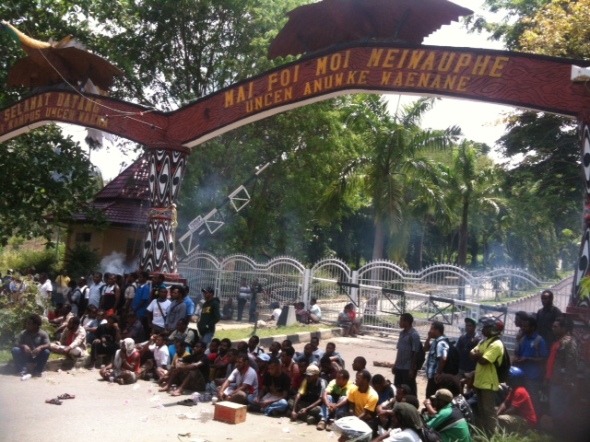
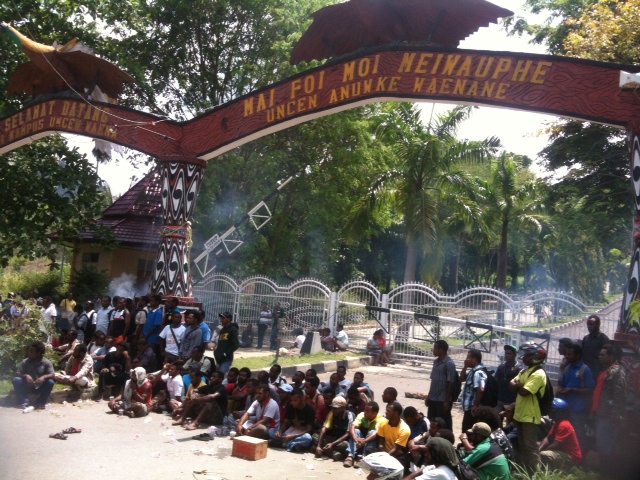
The Yakuhimo students at the dormitory were angered by the event, but held a peace blockade outside the gates of the Uncen campus in Waena, independent sources at the campus told West Papua Media. No reports were received of any forced dispersal, however tension is high and all West Papuan students are in fear that that they could be arrested or disappeared at any moment, according to human rights sources.
Yakuhimo students and supporters blockade outside Uncen Waena after the Detachment 88 raids, October 12 (West Papua Media)
These actions came after a campaign of arrests from late September of at least eight people in the highland town of Wamena after police targeted homes and offices of KNPB members, accusing them of involvement in bombings and terrorism, despite KNPB being committed to non-violent civil resistance tactics.
In a statement, UK based human rights group Tapol said that “The targeting of KNPB activists appears to have intensified after the killing of the KNPB leader Mako Tabuni, on 14 June 2012. Officers of Indonesia’s counter-terrorism unit, Special Detachment 88 (Densus 88), funded and trained by Australia, the US and the UK, are thought to have been involved in the killing of Mako Tabuni and the arrest of the KNPB members in Wamena.”
Tapol has called for Indonesian authorities to “end the campaign of terror, intimidation and violence against human rights defenders and political activists, particularly members of KNPB,” and to guarantee the safety of Fanny Kogoya, Viktor Yeimo, and others who have been targeted.
Tapol has also called on Jakarta to “end the deployment of Densus 88 to Papua, investigate all allegations of human rights violations by Densus 88 officers and other security forces personnel and bring those responsible to justice.”
Whilst tension remains high during the crackdown, KNPB activists have also warned their members not to be taken in by SMS messages that are being spread by intelligence personnel attempting to incite violence and horizontal conflict. Activists have circulated a list of mobile numbers that are responsible, and are urging all recipients to document any numbers that continue to spread these messages.
Many people have reported to West Papua Media of an upsurge in Special Forces activity, even around those who are not active on Papuan independence issues. There has been a significant increase on the presence of intelligence officers on the street. Selfius Bobii, the former Front Pepera leader serving out a three sentence at Abepura prison on a treason conviction for his role in the 3rd Papuan People’s Congress of October 2011, still maintains close and effective communications with a network of activists throughout Papua.
In an SMS sent to West Papua Media, Bobii described how the TNI “have stooped to making themselves out to be civilians, to carry out undercover operations in order muffle the independence aspirations.”
“Some are posing as Bakso (Beef offal noodles) Sellers on roadsides, some are posing as motorbike repair people and so on,” Bobii said.
Bobii described the following factual account: On 11 Oct at 2303 hours in Nabire, Yance Agapa was heading home and was given a lift by an ojek (motorbike taxi) rider to the front of the Indonesian Air Force Quarters in front of the ‘Glory’ internet cafe. When they arrived at Malompo he gave the driver Rp20000 (approx. AUD$2) who hurriedly put it into the pocket of the black jacket he was wearing. Then a pistol fell out of his jacket. Yance startled in fright to which the driver responded “Brother don’t be frightened because I’m from Ambon but my mother is from Sentani. I’ll tell you straight, I’m a member of DENSUS 88 sent from Central to get the government program happening. So let our people from the community know to be careful using hire motorbikes. ”
West Papua Media has independently verified this account.
KNPB activists, most living underground currently, have expressed significant fears for their safety and survival from the crackdown. Yohame begged in his testimony, “the condition of our current times is so dire, (we need) all my friends and the international support groups to be able to monitor our current situation. Virtually all KNPB activists are threatened at this time. “
It is unclear whether these intensified crackdown tactics will work on those close to DPO suspects to give up not just Fanny Kogoya, but other non-violent activists who are simply attempting to raise their universal human rights of self-determination and freedom of expression.
Certainly these hunting parties have confirmed one thing: that Australian trained counter-terrorism troops are without any doubt being used to suppress peaceful political activity, outside their legal mandate of counter-terrorism. This should be deeply concerning for Australia in its quest for advocating internationally the Rule of Law – and at the moment that it has just taken up a position on the UN Security Council it might prove to be an inconvenient turning of a blind eye.
Sweeps engineered to justify annihilation of Papuan resistance by Australian-funded troops: Churches
by Nick Chesterfield, with Westpapuamedia stringers
October 15, 2012.
Special Investigation
Amid an intensification of armed security sweeps against West Papuan clanspeople around Wamena, Church leaders in West Papua have condemned Indonesian security forces for falsely engineering conditions to justify eliminating Papuan civil resistance to Jakarta’s colonial rule.
Credible reports continue to be received of an ongoing security sweep against highland villages that has reportedly resulted in hundreds of civilians fleeing to take refuge with pro-independence guerrillas in the mountains several days walk from Wamena.
Activists from the pro-independence West Papua National Committee (KNPB) are reportedly being targeted in a worrying crackdown against free expression. Carloads of heavily armed police and soldiers are cruising around the districts surrounding Wamena, pouncing on any civilians suspected of having affiliation to the KNPB, according to church sources in communication with West Papua Media stringers.
KNPB sources have expressed great fear that the latest offensive by Indonesian security forces against their members is an attempt to wipe out the Papuan people by eliminating their ability to organise acts of peaceful free expression and to campaign for a referendum to determine Papua’s future.
A joint taskforce led by officers from the Australian funded counter-terror unit Detachment 88, together with soldiers from the notorious Wamena based Army (TNI) Battalion 756, and Police paramilitary Brimob Gegana alleged bomb “disposal” officers have joined the sweep, which initially targeted the villages of Wesagaput, Tulem, Jibama and Jbele, outside Wamena.
“Residents have sought refuge and are temporarily displaced from their homes as a result of a meeting by district office of Jayawijaya and the TNI/POLRI police who carried out raids, and accused local activists for planting a bomb in a house at Jalan Irian. The situation is described as tense and locals are in grave fear,” a pastor who has fled to the hills with the residents told West Papua Media by SMS on October 10.
Repeated attempts over the weekend by West Papua Media to contact the Jayawijaya police commander, and the new Papua Police Commander, former Densus 88 chief Tito Karnavian, have gone unreplied.
It is not known the strength of the taskforce, but unconfirmed reports have claimed up to two Satgas companies are involved, totalling at least 200 armed troops. Historically police and military raids against villages in the Baliem Valley have resulted in signficant human rights abuses, village burnings and repeated incidents of brutality and torture (some infamously captured on mobile phones and leaked via YouTube).
Messages sent late on Thursday night from the pastor explained “We are now in the jungle, two other crew are still the main target by the security forces and they are still in Wamena town.” The source described how his own, and KNPB members, photos have been displayed on Wanted posters (Daftar Pencarian Orang, DPO) across a small airstrip and the main market of Wamena town. The pastor has joined with the residents in order to provide a measure of protection and communication, and to be on hand for any negotiations.
He continued, in Wamena “the security presence (is) blocking the airstrip, market and the surrounding area and makes it difficult for us to send fast reports.” The pastor reported that on October 10, he and KNPB members who were attempting to file human rights reports were chased by a military vehicle. It was an “Avanza with fully armed military personnel, I believed to be Densus 88, which forced us to flee into the into the jungle with some documents. At the moment, kaka with other committee members in the jungle and soon kaka will be without reception. Please pray for us.”
It is believed that the villagers have fled to the protection of National Liberation Army guerrillas further in the hills, a long utilised last resort in an area that has been subject to generations of significant human rights abuses by the Indonesian military.
The villages being targeted are the home villages of KNPB members arrested in brutal raids by Detachment 88 and TNI troops on September 29. The activists led by Simon Dabi, the Baliem KNPB chairman, are still under arrest by Detachment 88 counter-terror officers, controversially accused of involvement in a bombing campaign that has been widely blamed by church sources to be the work of Indonesian special forces new force – the shadowy “unknown persons” that are never investigated properly by Police. It is feared by most observers that the activists will not receive any chance of a fair trial, as no international observers are allowed.
According to human rights sources in Wamena, the raids have occured after Indonesian intelligence agents interrogating the arrested KNPB activists accused them of hiding bomb making materials in their clan members’ houses. Church sources in Wamena who have had contact with the detainees have reported to West Papua Media that Densus 88 interrogations appear to have focussed on the connection between KNPB and UK-exiled Papuan highland leader Benny Wenda, and have targeted members of the extended Wenda clan for specific repression.
“Targeting indigenous people based on their blood and clan relations is a clear violation of human rights, and has nothing to do with proper police work,” said a senior church leader in Wamena to West Papua Media‘s stringer. “The situation in Wamena is now incredibly dangerous for anyone thought to support KNPB,” he said.
Further reports emerged overnight claiming that more KNPB activists were arrested over the weekend in Wamena, however these reports have not been able to be verified.
Church sources have departed from their usually restrained language, and have vehemently condemned the current operation as a conspiracy by security forces to justify slaughter of West papuan people opposed to Indonesian violence.
A statement by the Moderator of the Papuan Baptist Church, Reverend Socratez Sofyan Yoman, demanded security forces immediately cease their engineering of bombings in Papua.
“The case of the bombings that occurred in two place (at the Honorary Council Workspace Jayawijaya on 1 September, and Wamena traffic police at Jalan Pos Irian on 18 September) are a Really Big Lie by Indonesian police. False allegations that security disturbances were carried out by the people of Papua, more specifically KNPB in Wamena, in our opinion is untrue. Major public fraud like this is unacceptable to the conscience and sense of logic,” said Rev. Yoman.
Rev Yoman explained that “Crimes Against Humanity in the form of police lying is part of a huge security operation and mission of the Government of Indonesia in Papua,” and included the murder of Moses Mako Tabuni on June 14, 2012 by Detachment 88. “The whole process by security forces is very embarrassing to us and disturbs our conscience, but at the same time really damages the reputation of the security forces in the eyes of the people of Papua, the Indonesian people and the international community.”
Sofyan Yoman outlined an 8 point scenario of the motivations for Detachment 88 to conduct these raids, when they know that Papuan people have nothing to do with thee terror tactics.
The operation aims are as follows, Yoman said:
“1. Destroy the peaceful struggle of God’s people in Papua who demand justice and respect for the dignity and fundamental rights of Indigenous Papuans;
2. Knocking out all the pillars of the struggle of the people and the nation of Papua, demanding a peaceful dialogue between the Indonesian government and the Papuan People be unconditionally mediated by a neutral third-party… that continues to gain sympathy and support of the international community, academics, humanitarian workers and the people of Indonesia;
3. Creating a sense of fear, silence, dilemma and trauma of the Papuan people to not take the fight against Crimes Against Humanity committed by the TNI and the police defending sovereignty of the Republic of Indonesia from 1961 to 2012;
4. Destroy the peaceful struggle of West Papua National Committee (KNPB), which has been the voice of the suffering of the people of God in the Land of Papua.
5. Justifying (menjastifikasi) the construction of more military and police bases in the Land of Papua;
6. Confirming the presence of Detachment 88 in Papua, to pursue and kill civilians by utilising separatist stigma and treason (makar) charges against Papuan people.
7. Build the image to the international community that the violence and crimes against humanity in Papua are (caused by) Indigenous Papuans and KNPB (instead of the Indonesian colonial system).
8. And of course, the security forces to obtain additional funding from the budget or Papua province and district / city on the grounds of security control area and the State.”
The sweep is also occurring in other parts of Papua currently. Detachment 88 officers on October 14 arrested a former senior National Liberation Army figure Gidi Wenda outside Sentani, near Jayapura. Several police Avanza cars full of armed Densus 88 officers made the raid at a house behind the headman’s office at 3am, according to human rights sources. Wenda has not been heard from since, nor seen at the Police HQ, and relatives are concerned for his safety.
Despite the crackdown, KNPB activists have vowed to continue to engage in free expression, and call for the international community to prevent Indonesia from killing more Papuan people. “We will demand the United Nations to immediately send a team of observers to our territory, because from day-to-day, we are getting (sic) extinct under Indonesian military operations, just as we demand the right of self-determination which has been guaranteed by international law,” KNPB Chairman Victor Yeimo said in a statement released on October 15.
Mass rallies have been planned across Papua on October 24, which are likely to meet with significant repressive measures by Indonesian security forces.
“We will continue to demand our rights even the world seems concerning with the political economy of the occupiers and oppressors,” said Yeimo. “Many of our activists have been killed, imprisoned and intimidated under Indonesian rule, and we will not give up until our demands are heard by the world,” he noted.
LEIGH SALES, PRESENTER: An Australian funded counter-terrorism unit in West Papua is facing new accusations of abusing its power in the troubled Indonesian province.
The notorious squad known as Detachment 88 has launched a fresh crackdown on independence activists, in the wake of an expose by this program in August.
Eight men have been detained and accused of bomb-making.
Separatist leaders claim the explosives were planted and they’ve been framed to justify the squad’s activities.
Hayden Cooper has this report.
HAYDEN COOPER, REPORTER: Jayapura, West Papua is a city marred by violence and tension, where independence leaders have been arrested, beaten, killed. And where police have been confronted by unruly and angry demonstrations.
When 7.30 travelled to the province in August, the crackdown on the independence movement was already severe, resulting in several deaths, including of this man, independence leader Mako Tabuni, shot in this street, witnesses say, by the Australian trained and funded police unit Detachment 88.
ERSON WENDA, RELATIVE (last month, voiceover translation): Clearly, it was them who killed him because we saw them shoot him and take him to their hospital.
HAYDEN COOPER: Since then, the crackdown has worsened. Victor Yeimo succeeded Tabuni as leader of the West Papuan National Committee, KNPB. This week, he sent this video to 7.30.
VICTOR YEIMO, CHAIRMAN, KNPB: We are the non-violent activists in West Papua. We will fight for our right of freedom according to the peaceful means in West Papua. We demand our right of self-determination to a referendum to be held in West Papua by UN peacefully and democratically.
HAYDEN COOPER: But the Indonesian authorities don’t believe his claim of non-violence and they’re pursuing KMPB like never before. In June, Indonesian soldiers went on a rampage in the highlands town and KNPB stronghold of Wamena, and now in a new development, police have raided the homes and offices of KNPB members in the area. Last weekend eight were arrested and witnesses say once again Detachment 88 was involved.
VICTOR YEIMO: When they arrest the KNPB brothers in Wamena, we saw Detachment 88 with one car, and another car with police, joined in by TNI.
HAYDEN COOPER: Indonesian police accuse the eight KNPB members arrested of making bombs and claim to have found explosives during the raid. Victor Yeimo rejects that and says his group is being framed as terrorists to justify Detachment 88’s presence.
VICTOR YEIMO: This is how Indonesia is now making a scenario with the terrorist issue in West Papua. As you know that in West Papua we never know how to make a bomb, how to create bomb.
HAYDEN COOPER: Some international observers and West Papuan advocates back that view
CAMMI WEBB-GANNON, SYDNEY UNI: I don’t think that the KNPB has any reason to be making bombs because they believe in a peaceful approach to pursuing independence. They want a referendum on independence in West Papua.
HAYDEN COOPER: In West Papua the Institute for Human Rights Advocacy, known as ELSHAM, has studied the arrests and suspects the explosives recovered by police were part of an elaborate set-up.
CAMMI WEBB-GANNON: They don’t have the capacity to gain the materials, so ELSHAM has actually said that the materials were probably planted in the KMPB members’ houses where they found the explosives and that’s not an unusual thing for security forces to do.
HAYDEN COOPER: The weekend raids follow the appointment of a new police chief in Papua, Brigadier General Tito Karnavian. His background as the former head of Detachment 88 generates serious unease among some Papuans, despite his assurances of a new inclusive approach.
CAMMI WEBB-GANNON: They will be opposed to his former role as the head of Densus 88, and as a police chief this just – it doesn’t seem to mesh with his new approach of working – to win the hearts and minds of Papuans.
RONNY KARENI, WEST PAPUAN EXPATRIATE: I have no doubt there’ll be definitely more crackdowns on KNPB members and those who are very active and very vocal in pursuing and calling for independence for West Papua, and that is for sure, that that’s one thing that Jakarta is aiming to shutting down political activists in West Papua.
HAYDEN COOPER: Ronny Kareni is one of many West Papuans living in Australia. He uses music to promote the independence cause on behalf of his friends at home.
RONNY KARENI: Every day, like, I got SMS coming through my phone and then the information is that their lives are under intimidation and they always live in state of fear and they’re being followed and it’s sad, but this is the reality in West Papua.
HAYDEN COOPER: 7.30 put several questions to the Indonesian Government but received no reply. Attempts to contact the new Papuan police chief were also unsuccessful.
As for Victor Yeimo, he is pushing for the release of the eight activists arrested on the weekend, and with his supporters here, he’s pressuring Australia to rethink its funding for Detachment 88.
RONNY KARENI: The Papuans will be pretty much living like prisoners in our own land where our movement, what we do, will be censored, will be monitored, will be followed, and as I said, there’s no room for democracy at all.



 West Papua Media Alerts