by Ank @ Pusaka (Heritage) Foundation to empower community rights
15 April 2013
Merauke, Papua: Without the knowledge or consent of local landowners in Kampung Onggari, Malind district, Merauke, two subsidiaries of the Rajawali Group, PT Karya Bumi Papua and PT Cenderawasi Jaya Mandiri, are destroying ancestral forest, evicting areas of importance and swamps belonging to the people. It is believed that this has been occurring since the end of 2012.
Stephanus Gebze, a well-known figure and leader of one of the landowning clans in Kampung Onggari revealed that, “the Malind people of Kampung Onggari have never sat down and discussed this together, nor have we agreed to give permission or surrender our land to the Rajawali company”.
In 2010, the Rajawali company presented its project plans at the Malind district office, in Kampung Kaiburse, but community members from Onggari who were present stated their opposition to the company’s operations in Onggari, as they needed the forests and swamps to be able to support future generations of villagers. In 2011, Rajawali built a church in Onggari, but the people never agreed to give their forests and swamps over to the company. “We accepted the help to build the church as a contribution to us in Onggari. We cannot be coaxed into giving up our land just because a church was built for us”, said Paulinus Balagaize.
Several local people have already surveyed the site where clearing has taken place, known as Tiptidek, Kopti and Kandiput. They have found that their forests and swampland, known as Deg, Palee, Bob, have already been flattened. “These are the places we go hunting, fishing, collect wood and medicines. There are animal habitats and burial grounds of the Malind ancestors. The company has destroyed them all”, said Stephanus Mahuze, another prominent member of the Onggari community. expressing his disappointment with Rajawali for clearing the forest without permission.
The Onggari village government and other community leaders met with the leader of the Malind District, Martinus Dwiharjo, on Thursday 11th April 2013. They complained about how Rajawali was clearing the forest without permission. “This is harassment, and a violation of our traditional rights as Marind people”, said Stephanus Gebze.
The community is demanding that Rajawali’s activities are stopped until settlement is reached according to Marind customary law. There must be compensation for all the various losses the people suffer, including for grasses and other plants and disruption to animal life. The community wishes that these problems can be resolved peacefully and according to the Marind people’s traditional mechanisms.
Martinus Dwiharjo said that he had no knowledge that Rajawali had been clearing people’s land in Onggari. Martinus has offered to facilitate a meeting to resolve the issue with Rajawali as soon as possible, on
Tuesday 16th April 2013. Martinus also wishes to lend his support to resolve any questions about the location of the boundary between land belonging to the clans of Kampung Onggari and Domande. The majority of Kampung Domande’s land has already been given over to Rajawali.
Who knows how often Rajawali has overstepped the line? In November 2012, the people of Kampung Domande, Malind district, imposed a penalty on Rajawali according to their customary laws because the company had
cleared land on the Sanggayas burial ground. Fransiskus Kaize, the village head, explained this penalty consisted of a seven million rupiah fine, one pig and twelve kava plants. The Sanggayas Burial ground has
now been cordoned off with a coconut leaf fence to show that it is forbidden to destroy the surrouding areas.
When a company clears forest without permission, it is grabbing land, insulting indigenous traditions and breaking the law. It is only right that the Malind people of Onggari take action to uphold their customary law against such companies.
from West Papua Media, with local sources in Yapen
Ongoing repression on peaceful dissent and acts of torture on civilians by Indonesian police (Polri) in Yapen has drawn a sharp reaction from West Papuan pro-independence guerrillas, who have captured and carried out an arrest of the local Police chief for human rights abuses committed under his watch.
Details have emerged from the remote island district that the North Yapen Sector Chief of Police (Kapolsek), Bripka (Chief Brigadier) Saimima, was apprehended in Yobi village outside Serui just after 9pm local time on Wednesday March 13 by a small group of men led by local pro-independence West Papua National Liberation Army (Tentara Pembebasan Nasional or TPN) commander Ferdinand Worabay.
Local human rights sources have reported that the action, which is being treated as a hostage taking action by Indonesian security forces, was carried out as a lawful arrest under international law for crimes committed under the Kapolsek’s command, and is being claimed by TPN sources as a legitimate assertion of both Papuan sovereignty and the rule of law on alleged human rights abusers.
The apprehension of Bripka Saimima was carried in retaliation for his alleged involvement in continual violence against Papuan community members, carried out by Indonesian police officers on duty in the Yapen archipelago, according to TPN spokespeople.
There are unconfirmed reports from local human rights sources that at least 100 heavily armed police have been sent into the area to free Bripka Saimima. It is believed that a tense stand off between the highly mobile guerrillas and heavily armed police and army is continuing, though heavy exchanges of gunfire were reported in the area from 9.15 pm Thursday night (local time).
More unconfirmed reports on March 17 claimed that the Kapolsek has been freed after three days in TPN custody , though further details have yet to surface, and no reports of attacks on civilians have been received at time of writing. Most armed assaults by Indonesian security forces result in significant civilian casualties.
The captured police officer, Saimima, is well known in Yapen for his alleged human rights abuses. Whilst under the command of notorious torturer, the former Yapen Police Chief Roycke Henry Langie, Saimima was allegedly involved at a command level in the systematic torture, arbitrary arrests and repression of local nonviolent activists and civilians, including the brutal torture and disappearance of political activist Lodik Ayomi in October 2012.
According to TPN sources, another reason for his apprehension is the detention and torture carried out by Polres Yapen officers against members of the TPNheld at the Polres Yapen station.
Local activist sources have told West Papua Media that the demands surrounding the release of Saimima are nothing more than basic bail conditions for any criminal suspect. It is not known if Worabay’s men have demands to hand over Kapolsek Saimima to human rights prosecutors, an unlikely tactic given the lack of trust Papuan people have for human rights violations being successfully or honestly prosecuted under Indonesian law.
However, Worabay has attached clear political demands to the arrest. Worabay claimed responsibility for the arrest of the Kapolsek of North Yapen, telling West Papua Media stringers by phone that the objective of the hostage taking was to demand the release of all Papuan political prisoners in all prisons in Indonesia, including particularly a local activist Decky Makabori, who is imprisoned in Sarmi Polres.
Worabay also demanded that both Polri and the Indonesian Army (TNI) immediately halt the violence in Puncak Jaya, Paniai, Wamena and other districts, and for the Indonesian government to “immediately enter into dialogue with the transitional Government of West Papua.”
“If these demands are not responded to seriously in order to be resolved …. there will be effects on the situation which will be worse,” Worabay told WPM stringers.
Meanwhile, at 5am on March 15 in a separate incident on Jalan Pasir Putih (White Sands Road) in the Serui sea village, an exchange of gunfire occurred between police and members of Rudy Orarei’s local TPN Yapen unit. The TPN unit were surrounded and ambushed by three members of the Brimob from Yapen police headquarters, but Rudy Orarei returned fire from his house, according to local sources. Two police were injured in the shootout, with Orarei reportedly fleeing the police cordon into the bush. The area remains tense under heavy police occupation, according to witnesses.
Local residents in Paniai regency are bracing for more repression in sweep operations by Indonesian security forces after two separate incidents across the Paniai have intensified ongoing crackdowns on West Papuan independence sentiment, torturing a local priest and even banning the possession of traditional music.
The latest crackdown, imposed in Paniai after guerrillas from Paniai commander Jhon Yogi’s Paniai unit of the West Papua National Liberation Army (TPN-PB) were involved in armed engagements with the Indonesian army (TNI) and Police throughout February .
Reliable human rights sources in Paniai have reported to West Papua Media that an influx of joint TNI and police have “arrived with total war equipment” to bolster sweeps and raids across Paniai against civilians accused of holding pro-independence sentiments.
“In order to confront the TPN PB and on orders from President SBY, a brigade of TNI / Police have arrived with total war equipment. There were drops of TNI/POLRI in Paniai on 3 March 2013. The brigade arrived by 7 ‘Inova’ vehicles via the coast road,” the source told West Papua Media.
Helicopters belonging to illegal gold miners in Degouwo were again being used by Indonesian troops to support the operation, similar to the massive offensive against Paniai people during 2011 and early 2012, according to both human rights and church sources.
“A yellow and white helicopter owned by an illegal business in Degouwo at 13.00 WPB (west Papua time) made two drops of personnel and logistical war equipment. The first drop was to the Enarotali airport in Paniai district, and the second helicopter drop of the brigade forces together with war equipment was at Obano also, in the west of Paniai district,” the human rights source told West Papua Media.
Independent sources are also reporting that Indonesian colonial occupation forces are putting massive pressure on local civilians, with routine violations of civilian’s dignity, and arbitrary strip searches, that have created opportunities for brutality and torture on local people.
The notorious battalion 753 from Nabire has erected scores of “state of emergency tents” every 5-10 kilometres along the main road between Nabire and Paniai, according to witnesses. “TNI are carrying out very strict checking of everything. The TNI from unit 753 are undoing the clothes of every passenger in the area to check them including females. Advocacy and monitoring is requested,” said the human rights worker.
Military Destruction of traditional culture amounting to cultural genocide
Papuan independent media outletTabloid Jubi has reported remarkable accounts of the extraordinary measures Indonesian police commandos from Paniai police headquarters are taking to destroy traditional Papuan culture by banning music.
Father Saul Wanimbo, the Director of the Commission for Justice and Peace (SKP) in Timika diocese, told Tabloid Jubi that during police sweeps, local people are being forced to hand over their mobile phones. They analyse the memory cards on the mobile phones to find songs in Papuan language, and if the memory card is found to contain either one or many Papuan folk songs, police will smash the memory card with stones, according to Fr Wanimbo.
“The police are sweeping HP (Handphone) memory cards of Enaro society (people) for the last two months,” Wanimbo told Jubi, citing his own experiences and stories directly from Enaro residents from 1-20 Febrruary 2013. Wanimbo said that Paniai people have been so demoralised that they just accept the oppressive actions of the occupation forces.
Wanimbo said that the actions by Police were killing three values: “There is destruction of cultural values, murder of the people’s creativity, and character assassination.”
“The situation is conditioned in such a way so that people cannot resist. How can the people fight if the area has a variety of (security force) members lurking there,” Fr Wanimbo told Jubi. The police acts were morally and legally wrong, police could not arbitrarily violate people’s privacy for no apparent reason, and such actions must be done with a warrant, he said.
“Paniai Police must explain the meaning of this sweeps. Or the Papua Police chief must stop the actions of the Kapolresnya (local police command) men in Enaro. This is serious. We can say it’s the beginning of the genocide, ” he said.
Priest tortured by police who then demand bribe for his release
Meanwhile, again in the Paniai regional centre of Enarotoli, local human rights workers have documented a serious case of torture of a local priest. According to human rights workers attached to the Kingmi church, at 8.30 in the morning on March 2, Reverend Yunus Gobai (55 years) was arrested, threatened and tortured by local and Brimob commando police at the Enarotali (Kapolresnya) police compound in Paniai district.
According to the report received and confirmed by West Papua Media, as a result of beating Gobai’s nose was bleeding, his upper and lower lips were split and bleeding, and he sustained abrasions on his hands, swelling on his forehead and cuts on his head, after which he he was put in a cell at the Police Sector command (Polsek) in Enarotali.
Family members went to request his release from the Police station, but the Paniai police demanded a bribe or ransom money to free him, according to the report. Family members reported they were forced to gather money in order to pay the police, and a Paniai member of the DPRD directly handed over to police one million rupiah (about US$103) at Polsek Paniai. Reverend Gobai was then released at 1030am local time, and taken straight home to his village by his family, according to the report.
Rev Gobai is the former pastor and head of the council of the community of KINGMI Maranatha Nabire. According to his family, after Rev Gobai became pastor of the community he suffered from (an undefined) mental disturbance together with epilepsy. Gobai’s family reported that he would regularly be seen “shouting for no reason or running around shouting”.
Reverend Gobai was arrested after exhibiting these symptoms outside the police station in Enarotoli, causing his arrest, but police did not treat the issue as an illness and used unwarranted torture and inhumane treatment on the pastor, according to the report.
(WPM Editor’s Comment: Whilst the KINGMI report uses unclear terminology describing the pastor’s behaviour as “mental illness”, often random outbursts of unintelligible shouting and psychotic visions are perfectly normal and accepted behaviour of Christian pentecostal pastors, Muslim imans, Hindu holy people, and almost all other religious leaders and clerics across human history. To arrest and torture someone for this behaviour is to ignore the experience of humanity.)
Paniai is no stranger to unrestrained Indonesian security force violence and torture against local people, primarily made up of members of the Mee tribe. Previous offensives in the Paniai since December 2011 have displaced tens of thousands of civilians, and burnt down hundreds of villages. Paniai was the scene of widespread military operations between 1963-1969, 1977-1978, and again in 1981-1982. During this period U.S. supplied Bronco aircraft were used to bomb villages while helicopters strafed Papuans with machine gun fire.
There is much that is strange in the process of the trial over the killing of Pastor Fredrika Metalmeti (38) on November 21st 2012 in Boven Digoel, Papua. The conduct of Military Tribunal III-19 Jayapura gives the impression of protecting the shooter. What is this process? Read below.
On November 21st 2012, a dark history began for the big Metalmeti and Imogoti families in Boven Digoel province and Merauke province, Papua, Pastor Frederika Metalmeti (38), first child of George Metalmeti (68) and Ida Imogoti, was found horribly killed on the Trans Asiki road, Boven Digoel, Papua.
Unscrupulous members of the military, Defendant Sergeant Irfan (right) is wearing a hat (Photo: Oktovianus Pogau / SP)
Initially, at around 6:00am, the Head of Komba District, Manyu Waremba (46) together with his wife and child came to the scene of the crime, and found the victim’s body lying in bushes, near the Trans Asiki Road.
“My house is about 200 metres from the scene, early in the morning around 3:30am I heard someone calling for help accompanied by the sound of gunfire. Because I was scared, I intended to investigate in the morning together with my family” said Waremba, in Military Tribunal testimony Dock 5, Jayapura, 11th February 2013.
Waremba immediately reported his discovery of the corpse to three police officers on guard at the police post not far from the location of the body. The three police officers together with local residents eventually came to the scene. Indeed, the body of the woman lay bloody, motionless and stiff.
“After this I called the police station and together with local people we went to the scene, and we found the victim sprawled in bushes with much blood on her body” said Manggaprouw, member of Boven Digoel Police, in their testimony at the Military Tribunal, Jayapura.
Then, the Boven Digoel Police Chief immediately arrived at the scene, accompanied dozens of his men. When attending the crime scene, police found three pieces of ammunition, type FN 45, that were still active.
A pink helmet, belonging to the victim, was also found, as were jeans (denim) shorts. The victim’s shirt was opened to cover her face, which was a men’s shirt reading ‘Kwarcab Digoel District Scouts’.
At approximately 8:00am, police took the body to the Regional General Hospital for autopsy.
Before this, several nuns were asked to bath the victim who later became known to be Frederika Metalmeti, Pastor of the Bethel Church of Indonesia (GBI), Boven Digoel.
The nuns who bathed the corpse claimed to find three gunshot wounds on the victim’s body. The first of these shots on the side right of the head, the second on the left of the chest, and the third on the victim’s right arm.
According to the nuns, the face and back of the victim’s head had been shattered by a blow from a blunt object. Allegedly, the accused wanted to erase the remains of the gunshot wound on the victim’s head.
To determine the perpetrators of the shooting, the police summoned parties believed to have been close to the victim for questioning. There were seven witnesses from the Metalmeti family that were interrogated by Boven Digoel police.
One witness that was summoned was the victim’s younger sister, Helen Metalmeti (30). In testimony to the investigator, Helen told of all she know of the victim whilst she lived, including whom the victim was close to.
“Mr Lieutenant Colonal Eko Supriyanto, former commander of 1711/Boven Digoel, who now serves as the Head of Korem 174/ATW Merauke, was the person most close to the victim. We know that my sister was dating him, and Mr Eko had come to our home to announce it,” said Helen, when meeting with suarapapua.com recently in Jayapura, Papua.
According to Helen, the relationship between the former Commander of 1711/Boven Digoel and the victim could be said to be very close, as there was an intention to hold a wedding in Malang, East Java, the home region of the former commander.
Whilst the Boven Digoel police were investigating the case which scandalised the residents of Boven Digoel, the Indonesian Military (TNI) in District Military Command 1171/Boven Digoel also conducted an investigation into several of their men.
In Boven Digoel district, no entity, including the Police and the Special Forces Task Force, has arms of type FN 45, except for members of the TNI Intelligence Unit, District Military Command 1711/Boven Digoel.
“After the Boven Digoel Police Chief Commander called the Dandim (Regional Military Commander), I together with several members also visited the scene to see the victim’s body, but because it had already been closed off by police, we could not enter,” said Captain Riki Pelani of District Military Command 1171/Boven Digoel Intelligence unit, when giving a testimony to the Military Tribunal on 19th February 2013.
According to Captain Riki, after knowing of the discovery of ammunition type FN 45, all men of the District Military Command 1171/Boven Digoel Intelligence Unit, totalling 12 people, were gathered to investigate each weapon.
Because, he says, if one has just recently been used to shoot with, then when smelt there will be the smell of smoke at the end of the weapon.
“I ordered First Sergeant (Sgt) Sumarlianto to gather all of our men’s guns, and after this I, together with (the) Dandim, investigated all of their guns in the room. Only the gun of Sgt Irfan was very clean and shiny because it had been cleaned with oil,” said Captain Riki.
According to Captain Riki, since then both himself and Dandim suspected Sgt Irfan as the culprit, as it also became known that Sgt Irfan was close with the victim for the past few months.
“We also received news that indeed Irfan was close with the victim. Dandim ordered us to hold Irfan, and First Sgt Marlianto and I were ordered to investigate Sgt Irfan,” asserted Captain Riki.
Then on November 22nd 2012, at 8:00am after morning assembly, Sgt Irfan was detained in the intelligence room and examined until 6:00pm that afternoon.
“Sgt Irfan did not confess during the questioning. At a meeting with Dandim at 7:00pm that evening, we received a report that Sgt Irfan had escaped.” said Captain Riki.
The escape strengthened the Dandim’s and his suspicions that the person who shot Frederika was Sgt Irfan, so he spread his men to several places to arrest Sgt Irfan.
During two days of searching, the members did not find Sgt Irfan. On the third day, 25th November 2012, he received news that the culprit was hiding in transit, in the Sudirman family home.
“Together with Dandim, several men and I immediately headed to the hiding place of the accused, and we immediately arrested him, and then took him to Korem 174/ATW Meruake for further investigation,” said Captain Riki.
Later, on his way to Korem 174/AWT Merauke. Sgtt Irfan confessed to the shooting of Pastor Frederika Metalmeti, on 21st November 2012.
How is the investigation of the accused progressing with the Police/Military in Merauke? Are the families being informed of the latest of the case investigation? Why did Sgt Irfan recklessly kill Pastor Frederika so sadistically?
Part 2 of this investigation will soon be presented.
Oktavianus Pogau is an independent Papuan journalist and founder of indigenous media outlet SuaraPapua.com.
Major Reprisals begin with house to house searches, village and church burnings in Tingginambut by Indonesian Security Forces after TPN shoot dead 8 Indonesian special forces soldiers.
from the West Papua Media investigative team*
February 28, 2013
EXCLUSIVE: Special Investigative Report
Local communities around Sinak, Gurage, Mulia and Tingginambut in Puncak Jaya regency have felt the first effects of Indonesian military reprisals, after West Papuan independence guerrillas under General Goliat Tabuni confirmed that they had killed eight Indonesian special forces soldiers and four non-Papuan civilians on February 21 in two separate incidents.
The shootings were carried out after Kopassus officers continued to build military posts on a local sacred burial site, despite being requested not to by both community representatives and emissaries from the West Papua National Liberation Army (Tentara Pembebasan Nasional Papua Barat – TPN-PB) under Tabuni. TPN spokespeople have said that the shootings were done “to assert West Papuan sovereignty against Indonesian colonial occupation”, and to assert West Papuan cultural rights to defend their customary practices against ongoing military brutality.
A spokesman for the Goliat Tabuni’s TPN-OPM command, Nikolas Tabuni, told West Papua Media in a statement that the killings were not without cause.
“Prior to the incident TNI had wanted to make a military post in the region of Tingginambut and the TPN OPM had sent a letter to the TNI asking them not to’ go ahead with the military post construction at Tingginambut. As that is an area of which the land is formally claimed to be owned by the TPN OPM, and as it is also a sacred area under indigenous customary law of the indigenous community of that area. However TNI disregarded the request (in principle) and continued with the construction. As a result TPN OPM carried out the shooting on 21 February,” the statement read.
Nikolas Tabuni also denied statements from the Indonesian President and Police that the shootings were connected with Indonesian election campaigns in Papua. “This shooting had absolutely nothing to do with the election of the Bupati (Regency leader) for the region of Ilaga in the Regency of Puncak Jaya in the Province of Papua, and had nothing to do with the general election of the Provincial Governor. The shooting was purely concerned with Papuan independence and the activities of the TNI in West Papua.”
Evidence of collective punishment emerges
Despite an effective information blockade imposed by thousands of Indonesian army (TNI) troops and Police, and unchallenged by a compliant Jakarta-based colonial media, detailed reports are beginning to filter through from independent sources in the area of the military offensive, painting a vastly different picture to that reported by Indonesian and international media since the shooting of the Kopassus soldiers.
At least 1000 members of various Indonesian security forces are currently occupying and laying siege to entire communities around Puncak Jaya, with thousands more troops being sent in from other centres in Papua, according to local church, human rights, and sources in contact with West Papua Media stringers across the conflict area.
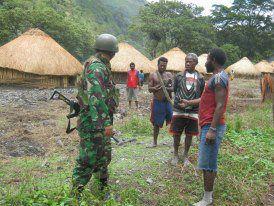
TNI 753 Btn interrogating locals in Sinak (photo: Malanesia.com)
According to these sources, the villages of Tingginambut, Trugi and Nelekom have been occupied by TNI forces since Sunday February 24, with villagers being forced to give all their food and houses to soldiers, and being subject to arbitrary and harsh interrogations. TPN sources have also stated that troops are using the villages as strategic hamlets to prepare for a hunt and destroy mission to flush out the forces of Tabuni, who have claimed they are well prepared for guerrilla defence.
In Nambut and Gurake (Gurage) villages in Sinak District, security forces began to carry out house to house sweeping operations on February 26, and in villages in Tingginambut, Puncak Jaya. According to our sources, the TNI Commander in the area has commanded “that the sweeping operation is to be continued until the culprits from last Thursdays killings are arrested”. The TNI have stated to local people they “need to see 11 persons sentenced,” according to the reliable source.
Two civilians were said to be arrested on February 27, according to Indonesian military reports, however independent sources could not confirm if any other civilians have been arrested.
As of February 26, at least 18 houses have been burned to the ground, 5 GIDI churches razed, 2 schools and a library have been destroyed by the combined Police/TNI forces in Tingginambut, according to reliable church sources who have safely relayed data from witnesses to West Papua Media stringers. Witnesses have also reported that soldiers are deliberately burning and destroying food gardens and shooting livestock, including over one hundred pigs. There are fears of a major humanitarian disaster unfolding with the reports of the destruction of food gardens and livestock, an act of collective punishment on a civilian population.
Thousands of people from the surrounding villages have fled to the high mountains and according to church sources, the entire community populations have fled throughout the area of Gurake, Sinak, Tinggi Neri, Trugi and Nelekom. Exact numbers are not currently known but local sources indicate that several thousand people, mainly subsistence farmers, live in the area.
Human rights workers have also reported from Mulia in Puncak Jaya that townspeople are greeting news of the offensive with panic and preparing to flee.
Reports are difficult to verify as the only media personnel allowed into the operations area are those with approval from the Indonesian army, and very few of these journalist have actually ventured into the area. Stringers for West Papua Media in Puncak Jaya and the Baliem Valley have reported that independent journalists and human rights workers have been prevented from travelling into the area by a de facto Military Operations Area being applied across the entire highlands, including the regional centre of Wamena.
Civilians are staying off the streets as reliable local sources report a massive combat army and police show of force, including house to house searches. On the morning of February 28, witnesses have reported to West Papua Media stringers that 8 Brimob trucks have left
Troops patrolling Wamena – February 25 (photo: supplied)
Wamena heading to Puncak Jaya this morning, with large numbers of troops patrolling the streets across Wamena also..
Thousands more troops flooding in to attempt to destroy Tabuni’s TPN.
Thousands of heavily armed combat soldiers from Battalions 751 (Jayapura), 753 (Nabire) , and supported by the Wamena 756 Batallion, are reportedly being flown into Tingginambut over the next few days from several centres across Papua. They are joining together with over 1000 extra Brimob paramilitary police (in addition to the at least 1000 Polda Papua police already in the highlands), and allegedly several units of the notorious Australian-funded Detachment 88 anti-terror commando, to hunt for Tabuni’s forces. Several media reports in Indonesia are also claiming a Kostrad (Strategic Reserve) battalion is being deployed from outside Papua, though this has not been independently confirmed.
Local sources have reported that each TNI platoon is accompanied by a platoon of police, as the operation is officially under control of the Police as a “law enforcement” operation. However, the witnesses have reported that the TNI are clearly in command. TNI spokespeople in Jakarta have told Indonesian media outlets that there is no plan to increase non-organic troop presence in the area, but local sources are reporting a vastly different story.
West Papua Media sources in Wamena observing the airport have confirmed that two TNI Puma Helicopters are involved in the operation constantly ferrying troops between Wamena and Tingginambut, and stopping only for refuelling and crew changes. Three Hercules c130H aircraft have each made 3 drops to Wamena then the troops have entered by road from Wamena. Observers in Nabire have also noted daily departures of three trucks of troops from the notorious Battalion 753 Nabire, to the west of the highlands to reinforce the offensive in Tingginambut.
Human rights and church sources in Puncak Jaya and internationally have expressed deep concern about the potential for heavy civilian casualties to occur with the intensified military campaign, given extra impetus after the Indonesian President, General Susilo Bambang Yudoyhono, called for firm action on Tabuni.
Multiple narratives from Jakarta
The exact circumstances of the deaths of the eight Kopassus special forces soldiers are now mired in claim and counter-claim, with soldiers’ personal accounts of the attack conflicting with the official narrative picked up by Jakarta media. What is confirmed is that the eight commandos – Sertu (Chief Sergeant) Udine, Sertu Frans, Sertu Romadhon, Pratu (Private 1st class) Mustofa, Sertu Edy, Praka (Chief Private) Jojon, Praka Wempi and Sertu Mudin – were killed by a cascading attack led by guerrillas of Goliat Tabuni’s TPN group as they went to the Sinak airstrip to collect cellular monitoring equipment designed to track international phone communications in the area.
However, one survivor of the attack testified in the Jakarta Post that his group was attacked by men, women and children all carrying spears, machetes and knives. According to the TNI survivors as relayed to JP, the platoon of Kopassus was unarmed at the time of the attack, which happened as the soldiers were installing and moving communications monitoring equipment.
Troops in Tingginambut after being shot at in helicopter by TPN, Feb 21 (Photo: TNI)
TPN forces also opened fire on a Puma helicopter that was evacuating the wounded commandos, lightly injuring three helicopter crew.
West Papua Media sources have provided a highly credible and technical but unconfirmed report that two “very large weapons” that were being moved into Sinak, and went missing during the raid by TPN. According to our sources, there is “extreme concern from the TNI around this particular issue.”
“Apparently they have been trying to find out the whereabouts of these weapons, which suggests they might be too heavy to quickly and easily move,” explained the source. Further investigation is still required, but credible observers in the area believe that these heavy weapons may be artillery pieces – the presence of which in Puncak Jaya represents a serious and dangerous escalation of TNI hardware to be used against civilians. West Papua Media believes any confirmed presence of artillery is connected with the TNI’s stated aim to destroy Goliat Tabuni’s group, but any use of these weapons will place a large number of civilians at risk. It is not the first time the TNI have used artillery against West Papuan civilians: the Bloody Wamena massacres of 2000 and 2003, as well as the aerial bombardment campaigns in the 1977 and 1984.
Indonesian outrage fuels civil society questions on Papuan motivations for resistance
The killings of the soldiers have generated outrage in Jakarta, with nationalist politicians calling for cordon and destroy missions in what human rights observers have said amount to collective civilian punishment by an occupying force.
Sjafrie Sjamsoeddin – indicted as a war criminal
Indonesian Deputy Defence Minister Lieutenant-General (LG) (Rtd) Sjafrie Sjamsoeddin – indicted as a war criminal by the UN for his role in East Timor – on Friday ordered the TNI to conduct heavy “tactical actions” in order to prevent the shooting from occurring again. “The tactical action includes to chase, apprehend and destroy,” the deputy minister said here on Friday. He said the latest shootings by the separatist rebels did not affect TNI`s strategic policies in Papua. TNI so far did not have a plan to send more troops to Papua, he added.
However SBY also claimed in an interview with MetroTV that “no violence” would be used to solve the situation. The situation on the ground has illustrated that security forces have no interest in making SBY’s words truthful.
Despite the nationalist rhetoric, there are many in Indonesia who are seeing this as a wake up call to end Jakarta’s use of state violence against civilians in Papua as it default policy.
The Indonesian Regional Representatives Council, or DPD, called for a necessary cessation of military operations to end the prolonged violence in Indonesia’s easternmost provinces, according to a report in the Jakarta Post on Wednesday.
The presence of the non-organic personnel from TNI special forces cause animosity among Papuan groups, who have launched attacks against them, according to the report. “If Jakarta wants to end violence, the militaristic approach has to stop, and all non-garrison troops from the military elite forces must be withdrawn from the two provinces because their presence and their irregular operations have triggered attacks on garrison troops and innocent civilians,” DPD deputy chairman Laode Ida said on Tuesday.
A coalition of Papuan human rights groups urged the National Commission on Human Rights (Komnas HAM) to conduct a thorough investigation into the soldiers’ killings, saying the presence of Komnas HAM could prevent human rights violations that occurred during TNI sweep operations after shooting incidents, according to a report in the Jakarta Globe.
“We encourage law enforcers to be professional in carrying out their tasks. They must ensure that their attempts to find the perpetrators do not turn into seeking revenge against all Papuans,” Ferry Marisan from the Institute for Policy Research and Advocacy (Elsam) said in Jayapura on Monday.
“One has to remember that soldiers who were shot were Kopassus special forces who have been involved in ongoing human rights abuses right across Puncak Jaya, including village burnings, collective arrests and punishment, burning of villages, and acts of torture. Many observers suspect these soldiers were part of units involved in conducting many OTK (Unknown persons) shootings blamed on West Papuans,” a long time human rights worker in the highlands told West Papua Media by email. “These are not innocence, nor babes in the woods; Kopassus are the original wolves in the forest.”
Still, other observers believe the actions point to an assertion of tribal identity, as a complex motivator behind the declaration of Papuan sovereignty inherent in the armed resistance against Indonesia’s militarist policy in the highlands. An Australian church worker who worked for many years with highland communities in Puncak Jaya made the observation to West Papua Media that this was not simply an act of resistance to Indonesian colonisation, but an assertion of traditional and indigenous Papuan law and cultural survival against the onslaught of an occupying colonial army.
“This must be looked at from another perspective that is relevant. As many indigenous communities including Australian Aboriginal Peoples and traditional highland Papuan people, observe around the world, if outsiders came into their sacred lands, they would also feel compelled at whatever cost to themselves to spear the outsider to compensate (violations of) their traditional law if they belonged to the clan that was legally responsible (under customary law) to guard that site,” she explained.
“Indigenous Law is simply not negotiable on things like that. Things have only changed in Australia because non-Indigenous systems have for years now in Australia been locking up those indigenous peoples who have acted to maintain their law,” the former church worker explained.
“As I understand the TNI despite warnings were acting in a way that broke the Papuans’ traditional laws regarding adat (Customary law), and as the TPN are still holding strong to their traditional laws, so they acted in accordance with the laws they are living by. I can’t see any difference at that level as Melanesian peoples separated historically but only a short distance of water. The difference is that the TPN OPM represent groups that have not yet been overcome by the laws of a colonising power whereas RI does not recognise the traditional Papuan customary laws,” she said
A prominent Papuan human rights activist, Yasons Sambon, has reported that the killings are causing many military families to reconsider their support for the Indonesian colonial occupation of Papua. In an interview with the wife of one of the eight soldiers killed at Sinak, recorded on February 23 after the soldiers funeral in a car by the old market in Sentani, the widow called for Indonesia to abandon its occupation of Papua.
Funeral of Sentani based Kopassus officer killed in SInak incident, Feb 24. (supplied)
The wife of an Indonesian soldier from Sentani said in a regretful tone, “SBY would be better off giving independence to the people of Papua if it meant our husbands wouldn’t become victims. Our husbands have been murdered. What will be my fate, and the fate of my children, now that my husband has been murdered? We want to hold onto our husbands but they also have a duty to the country. They are murdered and it’s the women and children who become victims, because if they aren’t at work, then what will we eat?”
“It’s better if independence is given to the people of Papua so that we can be safe,” she said.
*from the West Papua Media Editorial team, with additional reporting from stringers in Wamena, Tingginambut, Jayapura, Nabire and sources in Jakarta.





 West Papua Media Alerts