Indonesian security forces conduct violent sweeps, detain scores ahead of mass demos in Jayapura for May 1

West Papua Media

May 1 2013

Indonesian police and army units have conducted heavily armed security sweeps across Jayapura ahead of mass demonstrations to commemorate the 50th Anniversary of Indonesia’s annexation of West Papua.

Thousands of members of civil society organisations are today converging on Jayapura, West Papua, to hold the demonstrations, however, reports from West Papua Media stringers on the ground in Jayapura have documented a series of brutal raids to prevent public participation in the planned rallies.

Led by a coalition of pro-independence networks including activists from the National Federated Republic of West Papua (NFRPB) and the West Papua National Committee (KNPB), the demonstrations are intended to “show a peaceful expression of continued and universal opposition to Indonesia’s colonial violence against indigenous West Papuans,” and continue to call for self-determination for Papua’s people, a basic human right now denied by Indonesia with the May 1 50-year anniversary of Papua’s annexation, according to organisers from the NFRPB.

Organisers have also called for rolling and widespread strikes, particularly amongst Papuan members of the Indonesian civil service, and for Papuan university and high school student to join the rallies and use May 1 as a “public holiday for West Papuan people’s future”.

The raids began at 0300 (3am local time) on April 30, after the new Papuan Governor Lukas Enembe endorsed a decision by Chief of the (Indonesian) Papua Police, the Australian-trained former head of the notorious counter-terror unit Detachment 88, Inspector General Tito Karnavian, to criminalise all public gatherings for May 1.  Karnavian made significant public statements in both Indonesian and Papuan press saying that he will not tolerate dissent to be publicly expressed today, despite this ban being a breach of the of freedoms of expression and association guaranteed under the Indonesian Constitution.

Police have announced to Jayapura residents and rally organisers, that if demonstrations occur, Police will first attempt to use persuasion to disperse the approach of rally participants, and if rally participants ignored persuasion, then they would use force and “destroy” any gatherings.

Organisers have reported that on top of the extra thousand heavily armed police announced by Karnavian, hundreds of heavily armed plain clothes special forces police and soldiers have arrived in the city, with most moving around on motorbikes.  In addition, hundreds of soldiers from the Indonesian Army (TNI) were yesterday witnessed riding on motorbikes whilst in full battle kit in a clear show of force and intimidation against Papuan civilians.

Several student dormitories housing rally delegates from various centres across Papua were raided by heavily armed police on April 30, allegedly including Australian-trained members of the counter-terror Detachment 88 attached to the Jayapura ResKrim (Criminal Investigation Branch), as part of a sweep to capture key organiser and West Papua National Authority Manokwari Governor Markus Yenu.  In one raid, police from ResKrim detained for 15 hours an elderly former political prisoner named Alfred Kapisa (72), beat, interrogated and subjected him to violence, because according to human rights sources, he was found with a rally flyer on his kitchen table and was suspected of being involved as an organiser.

A raid on the Manokwari student dormitory at 1442 local time, where Yenu was present with the Manokwari rally delegations, ended with police left empty-handed after the students told the police that the delegation were the student’s official guests.

After Yenu and the Manokwari delegation moved to the Mamberamo dormitory, the Abepura police chief allegedly pressured the Chairman of the GKI (Indonesian Christian Church) Synod Alberth Yocku to issue an eviction demand for delegates to vacate the dormitories, managed by the GKI.   A platoon and several carloads of heavily armed Police then arrived in the courtyard of the dormitories, and gave the delegates an hour to vacate, upon threat of arrest.  The GKI had often come under criticism from Papuan civil society, churches and even Papuan politicians in the Indonesian parliament as being no more than a puppet of Jakarta.

Meanwhile, Indonesian civil society organisation National Papua Solidarity (NAPAS) has condemned the Papuan police decision to ban public dissent, saying in a statement that the ban “represents a reactive, paranoid and discriminative approach of the Indonesian government that limits the exercise of the civil and political rights of Papuans.”

“Furthermore, the decision would undermine the existing processes and initiatives to find a peaceful solution for Papua conflicts,” NAPAS coordinator Zely Ariane said in the statement.

“The ban to commemorate the 50th anniversary event illustrates the Indonesian government position that aims to monopolies the interpretation of Papuan history for the sake of the state, not for Papuans,” Ariane said.

“When both the Governor of Papua and the Chief of Police of Papua deliberately ban any activities of Papuans to commemorate this historic moment, history repeats itself. Papuan’s rights of free speech of free speech and freedom of movement and of assembly were not protected and guaranteed then and now. Therefore, we question both the local authorities in Papua and the national authorities of Indonesia whether they treat Papuans as citizens or just inhabitants,” said Ariane.

Credible sources in Jayapura have reported to West Papua Media that members of the military and police are very wary of KNPB involvement in the 50 year anniversary demonstrations, after these sources spoke with Kopassus officers posing as ojek (motorbike taxi) drivers.  Indonesian security forces have long blamed KNPB members for major acts of violence including “unknown persons” (OTK) shootings, though no credible evidence has ever been proven.

However, organisers have reported to West Papua Media that consolidation and planning meetings for today’s commemorations were held between all participant components of Papuan civil resistance, and successfully developed an understanding for joint action, highlighting the goals of Negotiations, Referendum and Recognition as three points of an agreed campaign pathway agenda.  Additionally, all components have reaffirmed their commitment to peaceful actions and non-violence as a strategy for all civil resistance mobilisation.

Activists are pressing on with their plans to hold rallies and commemorate today’s anniversary.  Whilst activists are expecting a violent police response, they are prepared with a diversity of civil resistance and non-violence tactics to maximise the strategic backfire on Indonesian security forces.

Reports from the ground in Jayapura have detailed fears of a major escalation in repression by security forces.  Currently over a thousand police have illegally set up a camp on the Papuan land that is the gravesite of Indonesian assassinated Papuan independence hero Theys Eluay.  Human rights sources have expressed concern that this military occupation of one of Papua’s most important sacred site for self-determination and freedom expression is a deliberate provocation by the military to create outrage and potential violence in public gatherings today.

Elsewhere in Papua, unconfirmed reports have emerged from Sorong that a May 1 rally being held there has already been forcefully broken up by police.  Human rights sources have reported that two civilians, Tomas Blesia and Abner Malagawak were shot dead, and Salomina Klaibin and Herman Lokden were wounded by security force gunfire, reportedly as people gathered peacefully for the rally.  Conflicting reports have claimed that the victims were members of the West Papua National Liberation Army (TPN), but West Papua Media has not been able to independently verify this claim.

More updates will appear on West Papua Media throughout the day, and urgent breaking news will be available on our Twitter feed @westpapuamedia. 

Note: Journalists needing comment or contact numbers for speakers inside Papua are encouraged to call the West Papua Editorial team on +61401222177.    This contact is bilingual in English and Bahasa Indonesia.  The Coordinating Editor can be reached intermittently throughout the day on +61450079106, but not for immediate comment.
BREAKING NEWS: Indon police allegedly detain and torture non-violent activist on Yapen Island

From West Papua Media sources in Serui:

April 30, 2013

Credible but unconfirmed reports have been received via sms by the West Papua Media team on Sunday, April 28, detailing Indonesian police behaviour of torture Yahya Bonai, a 33 year old, non-violent activist from Menawi village in the district of Angkaisera, east of Serui on Yapen Island.

Local stringers told West Papua Media team that Mr Bonai’s seizure was for suspicion of connection with a fatal attack at the home of Chief Brig. Jefri Sesa, an officer from the Angkaisera subprecinct police station at around 2:00am, West Papua local time, by unidentified group of assailants (OTK), three hours prior to Mr Bonai’s arrest on Saturday.

In response to Chief Brig. Jefri Sesa’s death, the Indonesian police directed the efforts on Mr Bonai as the prime suspect, according to his family.. At 5:00am on Saturday, April 27, Indonesian police went to Menawi village, where Yahya Bonai lives and viciously attacked him while he lay suffering from internal illness in bed with his family.

According to Bonai’s wife, “Yahya suffered a stomach ache and has not left the house since Friday evening,” said Karolina Karubaba. “We are so devastated to see him being beaten up, dragged out of the house, and we (family) watched helplessly as the police vandalised our home.” cried Karolina Karubaba.

Mr Bonai’s wife and kids have taken refuge into neighbouring villages. Local stringers and human rights observers also find it extremely difficult to visit Angkaisera due to the restriction and the curfew in Menawi village by fully armed police and military patrolling on high alert.

Mr Bonai is currently detained in Serui Police custody and has been denied any visits by friends or families.

Angakaisera district has been a pro-independence hotspot, and subject to an ongoing blockade and village raids by Indonesian security forces. Targeted non-violent activists have reported that they have “always experienced ongoing terror, intimidation and fear tactics conducted by Indonesian police.”

West Papua Media teams made several attempts to call the Chief of Police in Yapen today but received no response.

A Human rights monitor in Yapen told West Papua Media, “We need people to advocate by calling the Chief of Police on +6281344621189 and +6285216186194”.

westpapuamedia

Edison Waromi in Abepura Prison: Reflections from behind the Iron Bars of Indonesia

Opinion/Analysis

By Edison Waromi in Abepura Prison

A MORAL APPEAL ON BEHALF OF THE JAYAPURA FIVE

APRIL 29, 2013

Brothers and Sisters of one nation and one country of West Papua, who are now moving between and under trees, in the deep and wide forests of Papua, on the coastal areas, down the valleys and on the swampy areas, who are now fighting for our rights openly or in a clandestine manner, even to the diasporas around the globe (Pacific, Europe, America, Australia, Africa and Asia).

It has been 50 years since the 1st of May 1963 when the people of West Papua and the Land of West Papua were integrated into the Republic of Indonesia by means of military invasion after the TRIKORA  (Tri Komando Rakyat, “People’s Triple Command”) speech by President Soekarno on the 19th of December 1961.  Since then the people and the land of West Papua have been experiencing human calamities resulting from a conflict without a peaceful and fair resolution. Hundreds of thousands of the indigenous West Papuans have been murdered, slaughtered and imprisoned by the Republic of Indonesia.

Our land of abundance in natural resources has been exploited for the sake of capitalism and development. The capitalism only brings up colonialism. And, that is why the development for the people of West Papua is always under the operation of the militaristic intelligence (services). So, when our people demand a fair compensation due to the use of their traditional land for development,  they are always named as the members of Free Papua Organization (OPM) or separatists. Such a condition sets a fire of revolt, Free Papua ideology, which is never put down.

Today, our history of the long-lasting Free Papua struggle is added to a long list of the sufferings of the people of West Papua. This should have become a reflection for all of us. Why did Xanana Gusmoa, Ramos Horta and Bishop Belo end the sufferings of the people of Timor Leste within a period of 24 years integration with Indonesia? Why has it been 50 years but the Free Papua Organizations has not shown any sign of accomplishment? Is this because our egocentric attitude is weakening us? Or has our loving God not been in our side yet?

From our Christian perspective, a 50-year (anniversay) is a jubilant year. It is a year of freedom, a year of recovery for a nation. However, a period of the 1st of May 1963 to the 1st of May 2013 making such a jubilant year has not yet been materialized as being expected to be. Therefore, let us crucify our egoisms, our faction-centered views, our primordial attitudes in order that the pulse of the Papuan nationalism is beating freely to unite a coordinative resolution agenda between civil revolt institutions, guerrilla fighters, and diplomats.

Now, the bargaining position of the people of West Papua is the declaration of the Federated Republic of West Papua (NRFPB) in the Third Congress of West Papuan on the 19th of October 2011. May this bargaining position become a juridical foundation for the Melanesian Spearhead Group (MSG) to accept us as one of the members of the group. And then, such recognition of the independence of the NRFPB may also enter into a regional resolution mechanism in the Pacific Islands Forum (PIF) – sixteen countries – which is an integral part of an international resolution instrument to bring our case to the United Nations mechanism.

Finally, United We Stand Divided We Fall! Therefore, let us join our hands together to have a coordinative resolution agenda to bring the people of West Papua to enjoy a peaceful, free and full sovereignty.

Abepura Prison, 25 April 2013

Edison Waromi is the Prime Minister of the National Federal Republic of West Papua, and is currently held in Abepura Prison serving a 3 year sentence for his role in organising and participating in the Third Papuan People’s Congress.

Sugar company Rajawali is destroying forest without permission in Malind district

by Ank @ Pusaka (Heritage) Foundation to empower community rights

15 April 2013

Merauke, Papua: Without the knowledge or consent of local landowners in Kampung Onggari, Malind district, Merauke, two subsidiaries of the Rajawali Group, PT Karya Bumi Papua and PT Cenderawasi Jaya Mandiri, are destroying ancestral forest, evicting areas of importance and swamps belonging to the people. It is believed that this has been occurring since the end of 2012.

Stephanus Gebze, a well-known figure and leader of one of the landowning clans in Kampung Onggari revealed that, “the Malind people of Kampung Onggari have never sat down and discussed this together, nor have we agreed to give permission or surrender our land to the Rajawali company”.

In 2010, the Rajawali company presented its project plans at the Malind district office, in Kampung Kaiburse, but community members from Onggari who were present stated their opposition to the company’s operations in Onggari, as they needed the forests and swamps to be able to support future generations of villagers. In 2011, Rajawali built a church in Onggari, but the people never agreed to give their forests and swamps over to the company. “We accepted the help to build the church as a contribution to us in Onggari. We cannot be coaxed into giving up our land just because a church was built for us”, said Paulinus Balagaize.

Several local people have already surveyed the site where clearing has taken place, known as Tiptidek, Kopti and Kandiput. They have found that their forests and swampland, known as Deg, Palee, Bob, have already been flattened. “These are the places we go hunting, fishing, collect wood and medicines. There are animal habitats and burial grounds of the Malind ancestors. The company has destroyed them all”, said Stephanus Mahuze, another prominent member of the Onggari community. expressing his disappointment with Rajawali for clearing the forest without permission.

The Onggari village government and other community leaders met with the leader of the Malind District, Martinus Dwiharjo, on Thursday 11th April 2013. They complained about how Rajawali was clearing the forest without permission. “This is harassment, and a violation of our traditional rights as Marind people”, said Stephanus Gebze.

The community is demanding that Rajawali’s activities are stopped until settlement is reached according to Marind customary law. There must be compensation for all the various losses the people suffer,  including for grasses and other plants and disruption to animal life. The community wishes that these problems can be resolved peacefully and according to the Marind people’s traditional mechanisms.

Martinus Dwiharjo said that he had no knowledge that Rajawali had been clearing people’s land in Onggari. Martinus has offered to facilitate a meeting to resolve the issue with Rajawali as soon as possible, on
Tuesday 16th April 2013. Martinus also wishes to lend his support to resolve any questions about the location of the boundary between land belonging to the clans of Kampung Onggari and Domande. The majority of Kampung Domande’s land has already been given over to Rajawali.

Who knows how often Rajawali has overstepped the line? In November 2012, the people of Kampung Domande, Malind district, imposed a penalty on Rajawali according to their customary laws because the company had
cleared land on the Sanggayas burial ground. Fransiskus Kaize, the village head, explained this penalty consisted of a seven million rupiah fine, one pig and twelve kava plants. The Sanggayas Burial ground has
now been cordoned off with a coconut leaf fence to show that it is forbidden to destroy the surrouding areas.

When a company clears forest without permission, it is grabbing land, insulting indigenous traditions and breaking the law. It is only right that the Malind people of Onggari take action to uphold their customary law against such companies.

Source:
http://pusaka.or.id/2013/04/perusahaan-tebu-rajawali-membongkar-hutan-tanpa-ijin-di-distrik-malind.html

Available in English at https://awasmifee.potager.org/?p=334

Timika Six plead for international intervention after sentence passed despite unproven case

by West Papua Media, with Oktovianus Pogau at SuaraPapua.com

April 18, 2013

Six West Papua National Committee (KNPB) activists from Timika were each sentenced to one year in prison on Tuesday by judges from the Assembly District Court in a trial deemed as opaque and farcical by observers.  Sentenced on charges of carrying dangerous weapons and makar (treason/subversion), defence lawyers insisted that the six non-violent activists had no case proven against them and will immediately be lodging an appeal.

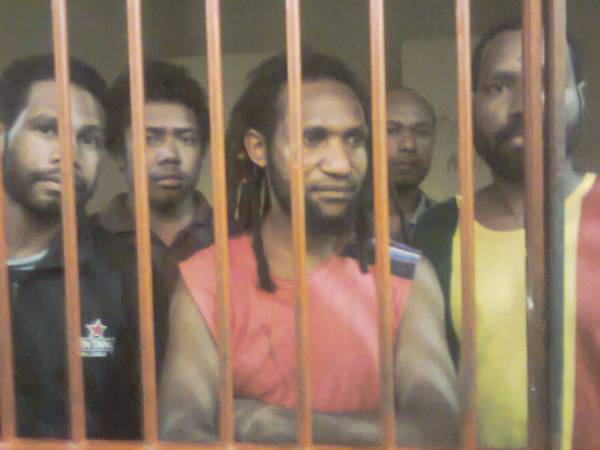
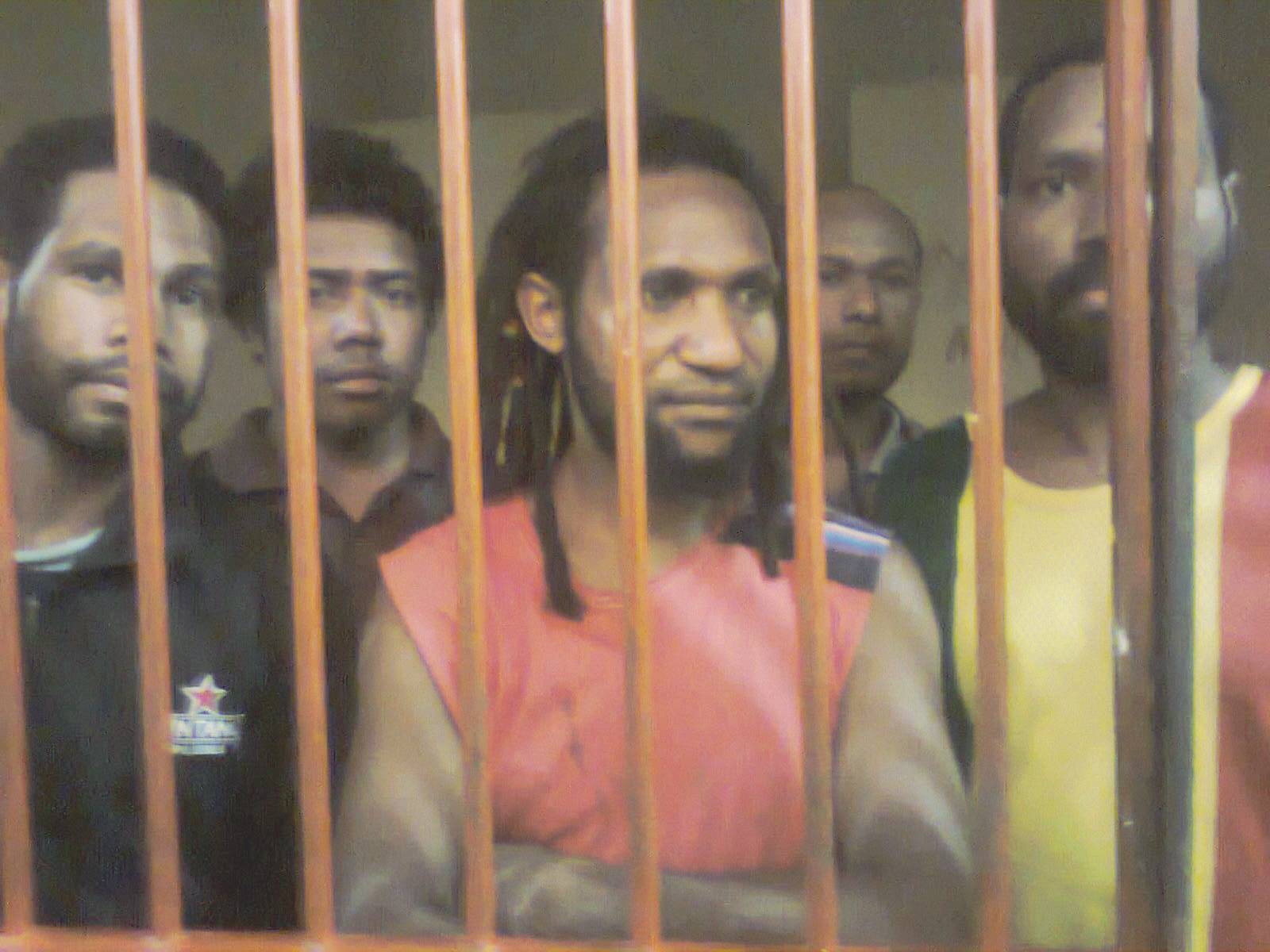
The KNPB Timika 6 back in their cells, photo taken April 17, after trial hearing. From L-R, (photo KNPB/ West Papua Media)
The KNPB Timika 6 back in their cells, photo taken April 17, after trial hearing. (photo KNPB/ West Papua Media)

The six, Romario Yatipai, Steven Itlay, Yakonias Womsiwor, Paulus Marsyom, Alfred Marsyom and Yanto Awerkion, were arrested on October 24, 2012, amidst a spate of high publicity arrests of KNPB activists by the Australian-funded counter-terror unit Detachment 88.  The then-incoming Papua Police Chief, former Detachment 88 chief Tito Karnavian,  exploited the brutal arrests to increase justification for use of Detachment 88 against political activists at a time when OTK (unknown persons, now known as Orang Terlatih Khusus or Specially Trained Persons) killings were spiralling out of control across Papua.

Despite Jakarta pinning the blame for the killings on non-violent activists from the

KNPB Timika Activist  Romario Yatipai
KNPB Timika Activist Romario Yatipai

KNPB, no credible evidence had been able to prove KNPB responsibility despite highly politicised and farcical trial processes.  Most independent observers have linked responsibility for OTK incidents in Papua squarely in the hands of agents of the Indonesian special forces.

In SMS and email communications to West Papua Media from the prison before and after the trial, KNPB activist and detainee spokesman Romario Yatipai said that the assertions made by police were “Simply lies”.

534937_10152766823260010_1179983606_n
“We are KNPB activist in Timika, West Papua. Indonesia Police jailed us with no reason.” – Romario Yatipai

“Indonesian police say that KNPB activist are criminals, terrorists, Makar (treason), separatist and so on,” Yatipai explained.

“Actually, KNPB activists in Timika always make peaceful demonstrations with all West Papuans.    We always make peaceful demonstrations to demand Referendum, as the best solution for West Papua,” he said.

Central to the police case was that the accused were allegedly carrying explosives to be used against Indonesian police posts and military targets, yet no evidence was furnished that could prove that the accused possessed explosives before t

Despite the Australian Federal Police providing Detachment 88 with state-of-the-art explosives and ballistic forensic testing capability to secure counter-terror convictions, none of this equipment or personnel were deployed in Papua for any of the OTK  trials, and no forensic proof was available at the Timika 6 trials that could have linked any of the defendants to use of explosives.

The trial heard wild accusations from prosecutors and police, but defence lawyers led by Gustaf Kawer, objected and expressed surprise when Yanto Awerkion (19) was sentenced.

As to who had ownership of explosives, Kawer explained to Suara Papua, none of the witnesses saw the defendant carrying explosives, but officials forced the defendant to claim possession of explosives.

“Since the moment of the defendant’s arrest along with five colleagues, there were absolutely no explosives he possessed … Yet when he reached the Mimika police station, the officers brought explosives and used it as evidence, and compelled the accused to confess  having an explosive. It’s very strange,” Kawer told Suara Papua.   “Our legal counsel will conduct a plea on April 23, 2013. The sixth defendant must be released immediately because of  not proven guilty, ”

Kawer also objected to the sentencing of the other defendants under makar provisions, saying the judges decision “did not correlate with the examination of the facts.”

“For the first case, it’s not proven that the five defendants were in the possession of sharp weapons.  And concerning the  treason related article, also during the course of investigation (there was) not any reference to it, but nevertheless the judge decided one year in prison by saying treason  that was proven – so we will appeal, ” Kawer told suarapapua. com.

After the defendants returned to the prison cells that have been their home since October 2012, they made a video appeal on their mobile phones, calling on the international community to do more to ensure that Indonesia ceases its persecution of peaceful political activists.

“We hope (the) International community, Amnesty International, IPWP, ILWP support us and pressure Indonesia government, Indonesia Police in Papua and Timika,” Yatipai told West Papua Media.  “West Papua activists, and all West Papuans need UN Observers,  UN Humanitarian workers, and International Journalists now in Papua.”

“Please support us with prayer and monitoring for us” said Yatipai.

westpapuamedia

Create a website or blog at WordPress.com

Up ↑
