Preliminary report into Waghete deaths and sweepings

Report compiled by Selpius Bobii in Abepura

September 26, 2013

On Monday 23 September 2013 in the town of Waghete which is the main town of the region (kabupaten) Deiyai (district Tigi) at 11.30 am local time, an action of violence by the Indonesian armed forces causing death and bloodshed of unarmed civilians occurred. The incident arose as a result of arbitrary sweeping carried out by joint forces of Paniai based BRIMOB (‘Mobile Brigade’ being an Indonesian National Police special operations force unit), Paniai regional Police together with Indonesian military Unit Timsus 753 (TNI) based at the Paniai Koramil (Regional military headquarters). The sweeping was carried out under the command of the Head of the Paniai Regional Police High Police Commissioner Sammy Rony.

The target of the sweeping which included confiscation of items was as follows:

  1. Sharp weapons including smaller knives, larger (machete type) knives, axes and bows and arrows;
  2. Hand shovels;
  3. Mobile phone cards for checking of any activist photos or other photos related to the Papuan Freedom movement such as the Morning Star Flag;
  4. Civilians with long dreadlocks or long beards, who are all suspected by the Indonesian armed forces of being members of the TPN/OPM (these persons were to be detained).
Waghete villagers mourning the police murder of priest’s son Alpius Mote

During the sweeping the Police detained 15 people based on nonsensical reasons, and at this time they are all incarcerated in the jail cells at the Paniai District Police Command headquarters. These include a female by the name of Alfrida Dogopia. They were detained under conditions of torture, intimidation and insult carried out by the TNI Timsus (Tim Khusus or Special Team unit from Kopassus special forces)unit, BRIMOB and Paniai regional police.

The local community responded to the above by protesting to the local police. The Head of the District Police commanded those under him to shoot any civilians that protested to the operation. Accordingly BRIMOB, ordinary police and the TNI joint forces responded to any behaviour of protest by civilians with extremely excessive violence by shooting civilians. The consequence was 3 civilians were shot by members of BRIMOB in the Waghete field (open grassed area in the town) at approximately 11.30 am local time.

The shooting victims were as follows:

  1. Alpius Mote, a student at the Deiyai Upper Secondary State School in Waghete, child of the local Church Minister Daud Mote. He was shot dead. The bullet entered on the right side of his chest and went through exiting his back.
  2. Alex Mote, a youth from Deiyai was shot. He is presently being treated at the Paniai Hospital.
  3. Yance Pekey, an English Teacher from the Deiyai State Upper Secondary School. News is that he was shot and beaten at the school offices and at this time is being detained at the Paniai Police District Headquarters.

The local community didn’t accept the actions of the joint armed forces and considered them to be extremely excessive. The body of the shooting victim was taken to the police offices by community members  at 19.00 hours and the police were asked to take responsibility for the death.  Until this moment the Waghete community is still struck by fear by the events that occurred.

According to the Head of the Paniai District Police High Police Commissioner Sammy Rony, the sweeping was carried out to make the area safe for civilians and intended against those who were in the practice of gambling, getting drunk and carrying sharp instruments. According to Rony property of local government was damaged as a result of the drunkenness. He said the disturbance had started five days before the shooting incident. “Since last Wednesday a group of people  have done damage to a number of houses of government officials in the town of Waghete, including that of the Deiyai Region Bupati (i.e. Head of the local regional (kabupaten) government) Dance Takimai and of the Kabupaten Secretary Basilius Badii” stated Rony.  He claimed that the damage to the officials’ houses was suspected to have been carried out by a group of supporters of a certain candidate for the bupati position that failed to be elected in the recent elections for the head of the Deiyai Kabupaten. “So in this there is an influence from alcohol and also problems regarding local elections” Rony stated to a journalist from Tempo, Jerry Amona.

According to the Head of the District Police Command the alleged culprits of the damage to the officials’ houses who were also suspected of intentionally starting the commotion at the time of the mobilisation of the joint police and Indonesian military armed forces to carry out the sweepings through the town of Waghete. “ Suddenly a group of people arrived and attacked our forces, hitting them with pieces of wood. I immediately gave the order to shoot” he stated (source: m.tempo.co/read/news/2013/09/23/058515978).

According to the spokesperson for the Papuan Provincial Police AKBP Sulityo Pudjo Hartono, the conflict between the civilians and the joint armed forces occurred at the moment the sweeping was being carried out to “make the area safe from a number of social sicknesses including gambling, drunkenness and carrying of sharp implements”. According to Hartono, the civilians didn’t accept the raids and there was even provocation with civilians throwing rocks at the armed forces, who responded by shooting into the air.  However according to Hartono, the civilians were becoming increasingly anarchist even to the point that one of the military was hit, so the joint forces fired in the direction of the civilians shooting one civilian. Hartono stated that the citizen shot critically aged 25 years was evacuated to the Paniai hospital, however he died before arriving at the hospital.

The spokesperson for the Papuan Provincial Police tried to justify the act of the police from a legal perspective, stating that the shooting of the forces was in accordance with procedure as the civilians were increasingly anarchist. He said if they hadn’t fired the actions of the civilians would have developed into something bigger (source: www.news.viva.co.id/news/read/446352-bentrok-aparat-dan-warga-di-papua–1-tewas).

However the a local activist at Waghete, Yohanes Mote, contradicted the statement of the Police that the community attacked the joint armed forces.  According to Mote, the community did not attack the police (BRIMOB and ordinary regional police) and TNI with arrows, wood or otherwise, but rather it was the police and TNI carrying out the sweeping with excessive use of agression that caused the disturbance amongst the community.

“I was there at the location at the time it happened. The community was not using arrows and did not attack in any way.  We were disappointed about the way the police were carrying out the checking operation to the point that they were even checking inside the koteka (i.e. traditional penis sheath worn by males) of men.   As there can be nothing possibly inside a koteka other than the male genitals. So why did they have to check inside the koteka? We want to ask why did the police not confiscate and ban the drinking of alcohol and gambling! It’s the alcohol and gambling that kills Papuans but they (armed forces) didn’t ban those, but rather acted to annihilate our people”  Yohanes Mote, human rights activist in Waghete.

To respond to this bloody tragedy, youth and students of Papua in Jayapura have united to form ‘In Solidarity and Concern for the Shooting of the State Upper Secondary School’ and carried out a demonstration on the office of the Papuan Parliament (DPRP) on 25 September 2013.  The student demonstration was received by the Chairperson of Parliamentary Commission (A) Ruben Magai together with a member of Parliamentary Commission (D) Nason Utty, where the students demanded the Head of the Indonesian National Police to remove from office the Head of the Papuan Provincial Police, the Head of the District Police in Paniai and the Head of the Sub-District Police Command, being those 3 persons being responsible for the Waghete incident. The students also demanded that those responsible for the shooting be forced to face transparent legal process and strongly urged the Papuan Parliament to immediately form an Investigative Team to look into the case at hand.  Together with a number of representatives from the student demonstration the DPRP this date formed an Investigative Team for the Bloody Tragedy at the Kabupaten of Deiyai.  It is planned that in the immediate future that this team will travel to Deiyai to gather accurate data from all parties involved at Deiyai (source; www.sindonews.com/read/2013/09/25/26/787221/gedung-dprd-papua-diduduki-mahasiswa).

In regard to this same incident, the community demanded that the Head of the Paniai Kabupaten Police who gave the instruction to shoot at the civilians and the member of BRIMOB who carried out the fatal shooting be required to face legal process as they have both committed serious human rights violations. It was requested that the Head of the Indonesian National Police that the Head of the Tigi Kecematan (i.e. Sub-District) Police, the Head of Paniai Kabupaten Police and the Head of Papuan Provincial Police all be stood-down from their positions as they were all assessed as not acting responsibly.

It is also hoped by the community together with the youth and students that the Deiyai Case Investigative Team that has been formed by DPRP in Jayapura would go immediately to the District of Tigi in Waghete to gather accurate data that can be trusted in relation to this incident.

Reported by: Selpius Bobii, General Chairperson – Front PEPERA –

(NOTE: WPM HAS CONFIRMED ALL FACTS IN THIS REPORT)


1 dead, 3 shot in Waghete, Paniai by Brimob for refusing to shave dreadlocks

by West Papua Media team

September 25, 2013

West Papua Media (WPM) stringers have received credible disturbing reports of a major escalation in Indonesian police operations against civilians in the Waghete, outside Enarotali in Paniai, resulting in the shooting of three civilians and the death of one.

Three men were shot by Brimob paramilitary police on September 23 after refusing to cut their hair or beards, and another two were arrested.  Alpius Mote (20) was shot dead by Brimob in the chest and died on the spot.  Fransiskus Dogopia (30) is in a critical condition after being shot with automatic fire by Brimob in his stomach and in the right side of his neck.  The third shooting victim, Alex Mote (29), has unknown gunshot injuries and his condition is also unknown at time of writing.
Police also arrested Frans Bukeja (21) and Yance Pekei (22), also for refusing to cut their hair, according to human rights workers.  Bukeja has been since released by Police, however Pekei is still being detained at the Enarotali District Police Command Post, and his family is gravely concerned for his safety, according to WPM sources.

According to local witnesses, speaking to WPM by telephone on condition of anonymity,  the operations in Waghete occurred on Monday, September 23, with house to house sweeps by hundreds of heavily armed Brimob, looking for any supporters of Papuan independence, and confiscating mobile phones searching for Papuan pro-independence songs and music,  and searching for nukens (dillybags) with any image of the banned Morning Star Flag.

During Monday night’s raids, all Papuan men with long hair, long beards or dreadlocks were allegedly ordered at gunpoint by Brimob officers to cut their hair or beards on the spot or they would be shot dead.  Long hair or beards are stigmatised by Indonesian occupation forces as an indicator of pro-independence activities, and “offenders” are summarily punished regularly in Paniai for their hairstyles, according to local human rights workers, and previous investigations by WPM.

These sweeps have been a weekly occurrence since  Operation Matoa began in late 2011, putting the Paniai regency in a unofficial war zone in a bid to wipe out armed and then nonviolent civilian resistance to Indonesian occupation.  West Papua Media reported in December 2011 on the ruthless Operation Matoa which was launched across the region to destroy the TPN forces of Jhon Yogi – resulting in the displacement of over 14,000 people, almost 150 villages burnt down and the failure of basic services that is still ongoing.

These latest sweeps, local human rights workers who visited Enarotali told WPM, are an extension of Operation Matoa, but Indonesian security forces have openly told sweep targets that nothing less than total loyalty to Indonesian security forces will be tolerated.  Extreme state violence is justified by security forces, to make an example of anyone who questions Indonesian rule, according to the human rights sources.

Local sources have also reported to WPM that a large number of security forces have amassed around Enaratoli together with several companies of the notorious 753 Battalion of  Indonesian army (TNI).  Local residents are preparing to survive another arbitrary military offensive against civilians, according to the sources.

 Several attempts to contact Police in Enaratoli or Paniai in the last 24 hours have been rebuffed.
Westpapuamedia.info


Bobii: The Creation of New Regions in Papua – A Blessing or Disaster?

Opinion/Analysis

By Selpius Bobii (inside Abepura State Prison)

17 September 2013

 The relatively recent accelerated formation of new provinces, kabupaten (regencies), cities, districts and villages in the land of Papua is causing new areas to spread like a mould, appearing in every direction in Papua. The Indonesian Government’s most recent plan is to create five new provinces in Papua which together with the two existing ones will mean a total of seven provinces in the land of Papua. In order to meet its own requirements for the formation of these planned five new provinces, the government is busy at this time accelerating at a rapid rate the formation of other lower level divisions so as to satisfy their own criteria for creating new provinces. Indonesia claims their reasons for this push are totally associated with welfare of Papuans, but what is the real truth behind why they rapidly opening up so many new regions by dividing others? What is the real reason they want to split Papua into seven provinces and all the endless divisions they are creating within that? The following article takes an inside look at what is really going on in Papua.

Ideally the primary reason for such divisions should be to reduce the extent of the area that must be reached in order to provide government services to any one community. There may be also other lesser reasons also taken into account regarding history, culture, economic factors and perceived fairness. The legislative and executive bodies of the government have the authority to form new regions and it is also their responsibility to have carried out proper research into what is appropriate. In particular there are a number of extremely important criteria that are supposed to be met in the process of approving the formation of a new region. However the reality is that many of the new regions created throughout Indonesia have not in fact fulfilled those conditions. The Centre for Regional Autonomy Studies in Indonesia concluded that the majority of new regions being created throughout Indonesia are in fact nothing more than decisions based on mere emotions and not on rational reasoning[1].

When it comes to the matter of the greatly accelerated opening of new regions in Papua – that are at present mushrooming at a rapid rate – the question begs are they decisions based on proper research of what is suitable or is some other hidden agenda of the Indonesian Government behind that.  Based on observation and study of the matter by the Writer until this time, it’s clearly evident that decisions for the creation of new regions in the land of Papua are loaded with political, security and economic interests of Indonesia and its allies[2].

In looking at the unceasing divisions into new areas in Papua one needs to keep in mind the political ideological conflict that exists between the state of Indonesia and the nation of Papua[3]. Indonesia’s aim is to seize the economic opportunity for as long as possible whilst at the same time working to destroy the wholeness of Papua in a systematic, planned and measurable way. It is only when approached within this framework that we can start to understand the real reasons behind the rapid expansion of new areas in Papua. In the following paragraphs we look at some of the real impacts of these endless dvisions of the land in Papua.

First and foremost the practice of dividing the land into many new regions is providing an open door for Indonesia and its allies to destroy the natural order of the oneness of the creation (both natural resources and the broader environment). The oneness of plants and animals of both land and waters. The destruction is resulting from a number of factors but primarily the effects of multinational companies (mining of minerals, oil and gas), logging companies (legal and illegal), and burning and felling of the forests for other reasons including the development of local district / kabupaten (administrative offices etc), plantations, transmigrants and large-scale farming.

The continual divisions of the land are also creating structural poverty amongst indigenous Papuans.  By destroying the natural order and arrangement of the natural environment the indigenous people of Papua are lose their very source of livelihood. With the lands of their ancestors taken from them or destroyed, the people experience hunger and / or struggle for survival, which on a wider scale leads to annihilation of the race.

With the creation of new regions, doors are opened for transmigrants from outside of Papua to move into the area.  The usual practice has been that the government forces Papuans off an area of land with the ‘help’ of the military and police, then builds new housing areas for transmigrants. When newcomers arrive and are given a house, the right of ownership of the land then is lost forever to the indigenous Papuans as has passed to the government or transmigrant.  In recent times both the government and migrants have started buying the land from those who have the traditional customary rights to that site, although it is widely known that at times where the person with the traditional customary right has not agreed to surrender their right to the land in return for money, that they have been ‘escorted’ to a certain place and persuaded by military or police to do so.

Furthermore, the creation of new divisions allows Indonesia to engender discrimination and marginalisation against indigenous Papuans. As the centres of economics in the new locations are usually controlled by the newly arrived transmigrants[4], so with the loss of their lands and natural resources together with the effects of monopolies over local economics by newcomers, Papuans as a result experience severe marginalisation and discrimination in the very lands of their ancestors.[5]

 With each new division is opened the way for the development of new divisions of the military and police in that location.  New divisions of Regional Military Commands (Kodam), Military Command Posts (Korem), District Military Commands (Kodim), Provincial level Police (Polda), District Level Police Command Posts (Polres), Sub-District Police Command Posts (Polsek) and then the many posts of both the military and police. The impact of this ever increasing ‘security’ apparatus that is obvious every way one looks in Papua, is literally threatening the very right to life of indigenous Papuans. Particularly that of Papuan Freedom activists who struggle for the most basic rights of Papuans.

 With the creation of endless new regions there is also seen a proliferation of social sicknesses, diseases and the spread of epidemics that have entered from outside Papua.  By way of example, the number of ‘officially approved’ brothels as well as those not officially approved, that have been established in these newly created regions, all of which receive protection from the government due to the taxes and fees they generate. The government doesn’t open its eyes to the terrible impact that this is having on the local people in undermining their social morality plus with the lack of proper controls in place the spread of diseases including HIV/AIDS and other sexually transmitted diseases.  The result as the Indonesian government data now shows, is that Papua has now the second highest number of HIV / AIDS cases in Indonesia after Jakarta.

The creation of new regions also acts like a bridge for Islamisation. There are now whole village areas that were previously Christian who have now converted to Islam and what was a primarily Christian population is now becoming a minority.  People have been influenced by ‘hardliners’ in the Muslim faith by a variety of cheap offers to attract them and it has frequently occurred that the door into the area for Islam has been through ways opened with the government’s creation of new divisions. By no means is it my meaning in saying this, to try and prevent Papuans who are Christians from becoming Muslims as it is the human right of every human being to choose their own religious beliefs; however the methods that have been used until the present time to  cause Papuans to covert to Islam by luring them with a range of cheap offers and promises that are blatant lies, are far from praiseworthy. The extent of constructions of Islamic mosques in new regions in Papua is mushrooming at such a rapid rate that it is clearly pointing to the real possibility that Papua may at some time become a central area for Muslims in especially the eastern part of Indonesia.  This presents a most serious threat to the continued existence of the Christian indigenous community in the land of Papua.

 The creation of each new land division within Papua gives rise to organisations that are focused only on that region’s needs and from this is growing a destructive egocentric and clan-centric attitude amongst Papuans.  Manipulation of clan-centric tendencies against the people was actually a method used previously during the Dutch Regime to deal with the Indonesian liberation movement. Since then it has been used as a primary method of ‘divide and rule’ used by Indonesia against Papuans.  The cumulative effect of all these negative impacts combined with other covert and overt means is a slow-moving but certain genocide against the ethnic Papuan race.

 The creation of new divisions in the land of Papua is not the solution to bringing an end to the problems in Papua and in fact is an act that threatens the very existence and continuation of life of ethnic Papuans. Accordingly all parties involved, including the Indonesian Central Government, Provincial Governments, certain organizations, certain key figures of religious institutions and certain traditional customary bodies of Papua and strongly urged to immediately cease creating new regions in Papua, whether provinces, regencies, wider city areas, districts or village level divisions. Whilst regarding other nations of the world and the United Nations together with the international community, it hoped that they will not allow themselves to be manipulated by the propaganda and provocation of the Indonesian Government in relation to the latter’s plans to create new divisions in Papua. As the hidden agenda behind those divisions is absolutely to destroy the oneness of the creation and in so doing to bring suffering and annihilation of the ethnic Papuan race.

 It is strongly recommended that there be held dignified non-conditional consultations / dialogue between the Republic of Indonesia and the nation of Papua facilitated by a neutral party and held in a neutral location. Let’s unite and step together to make these consultations/dialogue become a reality as a means to finding a dignified solution to the problems.


[1] The results of research by the Centre for Regional Autonomy Studies led by Dr Nurjayadi Pribadi and Associates showed that:

i)  The reasons for the creation of new regions in Indonesia are based on emotion and not on rational matters.

ii) The implications of the creation of new regions is an increased financial burden on the state.

iii) The criteria applied in making the new divisions relate to Regulation No 29 (2000) however the reality is that those regions never show the progress that was stated in the proposals for their formation

 (www.pkkod.lan.go.id/index.php?mod=6&d=62)

[2] The political and security interests of Indonesia are closely related to the political ideological conflict between the state of Indonesia and nation of Papua (west). That conflict can be referred to as the conflict between those adherents of the Indonesian Pancasila ideology and those of the Papuan Mambruk ideology.

[3] A conflict that has been intentionally prolonged by Indonesia and its allies so as to be able to ‘justify’ Indonesia’s actions in Papua whilst at the same time continuing to use the land of Papua like some type of ‘farm’ or ‘kitchen’ to provide for the rest of the world.

[4] Most of whom migrate from areas of Bugis from southern Sulawesi, from Buton - an island off the southeast peninsula of Sulawesi - from Macassar, Java and the island of Madura.
 [5] The division of lands into new areas also creates a type of dependency for the local Papuan community. With Papuans having lost their lands and newcomers controlling the local economics, the Papuan cultural ethic of working hard is undermined as the majority of civilians feel empowered and just wait in hope for assistance from the government such as rice for the poor or other assistance. However in providing such aid the government is not empowering the local community but rather disempowering both the individual and the potential of that particular region.

Selpius Bobii is the General Chairperson of Front PEPERA &  Papuan Freedom Political Detainee held in Abepura Prison, Jayapura


What should be the role of the Australian government as a member of the UN Security Council ?

Opinion / Analysis
By Herman Wainggai
September 11, 2013

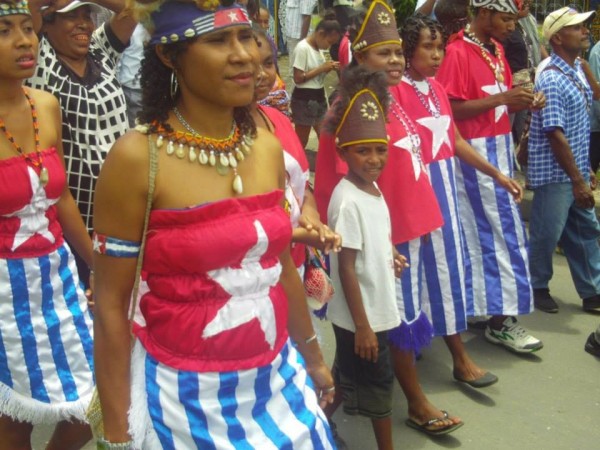
Papuan women wearing the banned Morning Star flag as clothing at Manokwari demo to welcome Flotilla (Photo: West Papua Media stringers)

Knowing  the history of the Indonesian state’s Army and Police invasion of West Papua there is no surprise in the fresh news of increased Indonesian military troops to the region, who are growing rapidly on this Melanesian ground like fertile mushrooms.

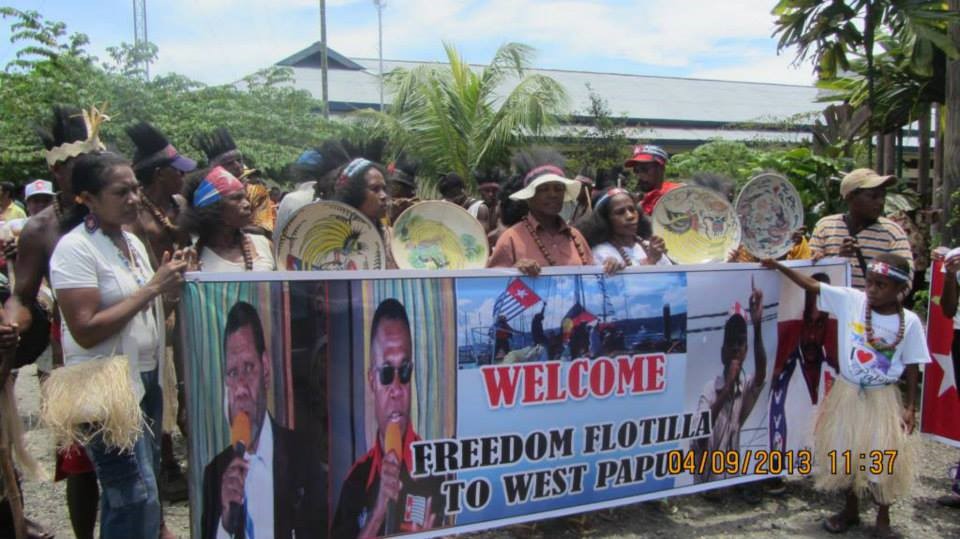
The Freedom Flotilla sailboat is currently on its voyage from Australian waters to the land of West Papua , and it has been confirmed that it is due to arrive within the next few days. Throughout the land of West Papua citizens and activists have been holding a number of peaceful demonstrations as a signal to welcome this boat. Thousands of West Papuans have bravely taken to the streets, high in enthusiasm and taking with them a variety of traditional instruments used in West Papua – ukuleles , guitars , drums , flute drums. They are also wearing traditional dress, and along with raising banners of the Freedom Flotilla sailboat, they are also displaying the national symbols of West Papua – the Morning Star flag.

This represents a challenge to and hope for the Indonesian government, that it ‘opens up’; that Jakarta demonstrates that it possesses genuine democratic maturity to negotiate peacefully with the political leaders of West Papua.  The people of West Papua, moreover, sincerely look forward to the newly elected Australian Federal government, especially in its new role as one of the member states of the UN Security Council, to act as a  mediator and by standards of international law help resolve the long running political conflict between the Indonesian government and the people of West Papua.

Demonstration welcoming Freedom Flotilla, Sorong (photo: supplied from Herman Wainggai, NFRPB)

Our hope is that the precise opposite does not happen – that the Australian Government merely lets the Indonesian government continue to unilaterally kill the political, human rights and democracy activists of West Papua. This has been their lot for over 50 years – arrests, kidnapping, detention, shooting, killing, raping, long imprisonments.

The people of West Papua also hope that the Australian government will not forget this tiny Freedom Flotilla who will be facing the storm of the Indonesian military whose numbers have been newly swelled in the border area. Whatever happens, Australia needs to be assured that the people of West Papua will maintain their struggle to govern themselves, and will fight for that freedom by non-violent means.

The Freedom Flotilla to West Papua logo

The history of Indonesian brutality in West Papua over decades must be stopped by the international community, which includes Australia in its significant roles in the UN and  the Asia-Pacific region.  The data has been clearly documented from year to year – how long must West Papuans continue to be slaughtered like animals? The question is very pertinent then – what will be Australia’s role, and the USA and the United Nations – in regards to West Papua?  This land of the Mambruk – the beautiful Crowned Pigeon and symbol of Papua – which we love, shall we close our eyes and stop our ears to the injustices?

In the same way that attention is currently being given to the political situation in Syria, so must attention be given to the little Freedom Flotilla, and to the suffering people of West Papua, who have struggled for freedom and justice under the brutal regime of the military of the Indonesian state

Destroying sago trees will kill the Papuan people

JUBI,
6 September 2013

Merauke:  A member of the Regional Legislative Assembly of Merauke  has once against drawn attention to the activities now under way  by a company called PT Dongeng Prabawa. The crucial issue he raised relates to  the sago trees  belonging to the people living in various kampungs in the District of Ngguti.

‘I want to say to the company that  if the sago trees which have been protected and looked after by the Marind people for generations are felled  to make way for an investment project, you will be killing the indigenous Papuan people. Sago is the basic foodstuff for the indigenous people and it is unacceptable for the you to destroy their trees.’.

Hendrikus Hengky Ndiken said areas where the sago trees grow must not be dealt with in this way by the company. It is unacceptable for these areas where local people live to be exploited. What are the people going to eat if their source of food is destroyed?

He also insisted that the company abide by the agreement to pay for their land.which amounts to Rp30 billion. They must  pay up now and not pay in instalments. ‘They have billions of rupiahs so how can it be that they cannot  comply with their obligations to the people? If you can’t pay up, then you had better get out, he said.

He went on to say that he had visited a kampung called kampung Senegi and asked the people what they had received from the company. They said that they had received nothing except for a church.

The local district chief Romanus Mbaraks said that not all the trees belonging to the people had been destroyed. In some sacred areas, the people  had guarded their trees. ‘I ask the people to report to us if their sago trees have been destroyed by the company.’

Translated by TAPOL


Create a website or blog at WordPress.com

Up ↑