This is the 90th in a series of monthly reports that focus on developments affecting Papuans. This series is produced by the non-profit West Papua Advocacy Team (WPAT) drawing on media accounts, other NGO assessments, and analysis and reporting from sources within West Papua. This report is co-published with the East Timor and Indonesia Action Network (ETAN). Back issues are posted online at http://etan.org/issues/wpapua/default.htm Questions regarding this report can be addressed to Edmund McWilliams at edmcw@msn.com. If you wish to receive the report via e-mail, send a note to etan@etan.org.
Summary: Indonesian security forces attacked a mass gathering in the Papua capital, Jayapura, and striking workers at the Freeport mine in the southern highlands. At least five people were killed and many more injured in the assaults, which show a renewed pattern of overt violence against peaceful dissent. A brutal and unjustified October 19 attack on thousands of Papuans exercising their rights to assembly and freedom of speech resulted in the death of at least three Papuan civilians, the beating of many, detention of hundreds and arrest of six, reportedly on treason charges. The Obama administration has largely ignored the egregious violation of human rights, instead advancing U.S.-Indonesian military ties. U.S. Secretary of Defense Leon Panetta, who arrived in Indonesia in the immediate wake of the Jayapura attack, avoided criticism of the assault and reaffirmed U.S. support for Indonesia’s territorial integrity, a snub to Papuans quest for self-determination. Panetta also reportedly commended Indonesia’s handling of a weeks-long strike at the U.S.-based Freeport McMoRan mine which has seen eight killings and revealed cash payments by Freeport to the police. Indonesia’s response to the growing crisis in West Papua is to increase the militarization of the territory and to dispatch a special unit that is headed by a notorious former military officer whose record in dealing with Aceh bears ominous implications for the Papuans.
Contents:
- Obama Rights Agenda to Advance Military Ties
- Indonesia Beefs Up Occupation Forces in West Papua
- Notorious Military General to Head Jakarta’s Conflict Resolution Unit in West Papua
- Indonesian Security Forces Still on the Take from Freeport
- U.S. Secretary of Defense Praise for Indonesian Handling of Freeport Strike
Obama Administration Abandons Human Rights Agenda to Advance Military Ties
On October 19, hundreds of Indonesian military and police personnel attacked a peaceful gathering of several thousand Papuans engaged at a congress which had convened to assert Papuans long-denied right to self-determination. The Congress, only the third such event in the last 50 years, sought to exercise rights of free speech and assembly guaranteed by the Indonesian Constitution and international accords, including the International Covenants on Civil and Political Rights and on Economic and Cultural rights and Social rights, the Universal Declaration on Human Rights.
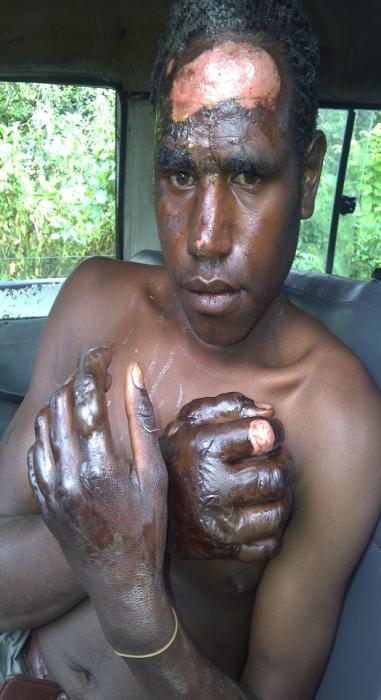
The brutal assault by Indonesian security forces killed at least three Papuans and resulted in the disappearance of others and the detention of approximately 300. At least six leaders were arrested and are expected to be charged with treason. Separate accounts suggest that the number of Papuans killed could be as high as 17 and the number of those detained and beaten while in custody could be as high as 800. Among those arrested were Forkorus Yasboisembut, President of the Papuan Customary Council (DAP). The security force violence and arrests followed the Congress’s declaration of independence for West Papua.
Security forces pursued the peaceful demonstrators, beating participants. One of those killed was reportedly shot in the back. Two other victims were found beaten to death, their bodies dumped behind a police station. An Australian eye witness to the assault, interviewed on Australian television’s ABC on October 28, identified the attacking security forces as including the Indonesian military (TNI), the Indonesian specialized police (BRIMOB), regular police units and the Indonesian “anti-terror” force, Detachment 88. The Detachment 88 team is funded and trained by the U.S. and Australian governments. It has repeatedly been charged with extrajudicial killings and torture.
The Police Commander for Papua publicly defended the assault, as have senior officials in Jakarta who contended that the military operation against civilians was provoked by Congress leaders who sought to declare West Papua’s independence. “The government did not find any abuse of power nor mismanaged approaches by the security officers,” said presidential spokesman, Julian Aldrin Pasha. “Police officers and security forces just accomplished their (as) duties mandated by the state.” Djoko Suyanto, Coordinating Minister for Political Legal and Security Affairs also defended the assault. (See also statements made by the Defense Minister, Purnomo Yusgiantoro: for example, see Made Arya Kencana, Banjir Ambarita and Ulma Haryanto, “ Jakarta Gives US Its Side of Story in Papua Deaths,” The Jakarta Globe, 23 October 2011.
International human rights organizations and some elected officials such as U.S. Congressmember Eni Faleomavaega and Australian Greens Senator Richard Di Natale immediately and strongly condemned the violence. Faleomavaega urged the release of those detained and specifically raised the assault with U.S. Secretary of State Hillary Clinton when she appeared before the House Foreign Affairs Committee. Senator Di Natale urged dispatch of an investigatory mission to West Papua and that Australia immediately suspend all support for the Indonesian military.
While comments by Faleomavaega and Di Natale echoed the calls of the many international nongovernmental organizations, there was scant word of condemnation from other governments. The silence rendered the international community complicit in the attack.
Particularly egregious, in this regard, was the reaction of the U.S. government. U.S. Ambassador Marciel in Jakarta called for an investigation of the incident. While appropriate, that response was manifestly inadequate. His failure to condemn the assault, conveys to the Indonesian government that use of lethal and military force against peaceful civilians is acceptable.
WPAT Comment: In attempting to understand the rationale for the Obama administration’s abandonment of human rights concerns it is essential to note the presence of U.S. Secretary of Defense Panetta in Jakarta at the time of the assault. Panetta’s visit inaugurated the resumption of full U.S.-Indonesia military to military cooperation. It appears that the Obama administration was not prepared to criticize Indonesian security forces with whom it was announcing a strengthened partnership. This abandonment of principle by the Obama administration is reminiscent of the collusion of previous U.S. administrations in the invasion and occupation of East Timor by the Suharto dictatorship.
see also Tapol, WPAT, ETAN: Indonesian crackdown on Papuan Congress sparks outrage
Indonesia Beefs Up Occupation Forces in West Papua
In the wake of the assault on the Third Papuan Congress (see above), continuing violence associated with police efforts to quell an ongoing strike at Freeport (see below), and the killing of a local police chief in remote Mulia district in the central highlands, the Indonesian government announced the dispatch of hundreds of additional security personnel to augment the existing Indonesian occupation force in West Papua.
The Jakarta Post reported that provincial police spokesman Wachyono saying that “So far 260 [extra] personnel from the police mobile brigade (Brimob) have landed in Papua province to help maintain security in two districts.” Troops were sent to the Puncak Jaya and Paniai highlands in central Papua, he said, adding that they will join an existing force of 14,000 police and paramilitary troops in Papua.
Wachyono said they were still “hunting” the police chief’s killers. Authorities have said that based on preliminary investigations they are believed to be separatists. (WPAT Comment: the launch of “hunting” indicates that security force sweep operations may be underway. These operations routinely displace large numbers of civilians as their villages and gardens are destroyed.)
Numerous Indonesian non-governmental organizations criticized the dispatch of ever greater numbers of military and police elements to West Papua. “The militarization of West Papua has the clear intent of intimidating Papuan civilians who are courageously pursuing a course of peaceful dissent in defense of their rights, including worker rights and the right to self determination” said Edmund McWilliams, a former senior U.S. diplomat who served in Indonesia. “Jakarta authorities,” he added, continue to employ security forces and thug militias to suppress Papuans’ peaceful resistance to ethnic genocide implicit in Jakarta’s support for transmigration-colonization and its denial of vital services to Papuans.”
Notorious Military General to Head Jakarta’s Conflict Resolution Unit in West Papua
On October 29, the Yudhoyono administration announced formation of a special unit tasked with settling the conflict in West Papua. The “Unit to Accelerate the Development in West Papua and Papua” (UP4B) was actually formed in September. In mid-October, Yudhoyono signed a decree, appointing Lt. Gen. (ret) Bambang Darmono to the chairman of UP4B. It will report to a board headed by Vice President Boediono. http://www.thejakartapost.com/news/2011/10/30/sby-s-papua-team-ready-roll.html
The announcement aid that the team will be led by Bambang Darmono, the former commander of military operations in Aceh (2002-2005) and a key Indonesian figure in negotiations that produced the 2005 Memorandum of Understanding (MOU) which ended formal conflict between the Acehnese Freedom Movement (GAM) and Indonesia security forces. Darmono is the former Secretary General of the National Defense Council.
Darmono’s record as commander of Indonesian security forces is replete with credible charges of human rights violations including the execution of seven teenage Acehnese on May 21, 2003, thoroughly reported by Tempo magazine. His troops allegedly also executed Muzakkir Abdullah, an Acehnese peasant in the hamlet of Seumirah, Nisam district, in June 2003. Several Indonesian soldiers abducted him earlier that day. Abdullah’s sister was photographed screaming when she saw his body. The photo by a Reuters photographer won a World Press Photo award. Darmono appeared prominently in a documentary, “The Black Road” by William Nessen, in which Darmono denied the involvement of his troops in the arrest and torture of a human rights defender. He had admitted that his troops had sometimes became abusive and he arrested some of them for shooting chicken.
In a June 26, 2007 interview with the U.S. Public Broadcasting System, Darmono strongly sided with Javanese transmigrants whose government-sponsored resettlement in Aceh mirrored government-sponsored transmigrant settlement of West Papua. To many Papuans, like many Acehnese, such government-sponsored transmigrant schemes amount to colonization. Darmono’s past championing of such policies in Aceh raise concerns for Papuans. Such concerns are particularly strong given predictions by the “ Papua Road Map Project,” a plan by academics to promote peace in West Papua, that the percentage of non-Papuans living in West Papua will rise from 41 percent in 2005 to 53.5 percent by the end of 2011, rendering Papuans a minority in their own homeland.
The Indonesian government’s failure to carry out key elements of the 2005 MOU, including the failure to establish a promised Human Rights Court for Aceh and a “Commission for Justice and Reconciliation,” according to many as a consequence of military opposition to such steps, led in large measure by Darmono.
The appointment of Darmono to the special unit for West Papua is indicative of the manner in which the Yudhoyono administration intends to “settle” the conflict in West Papua.
Indonesian Security Forces Still on The Take from Freeport
Indonesian security forces in West Papua, notably the police, continue to receive extensive direct payments of cash from Freeport McMoRan. National Police chief Timur Pradopo admitted on October 28 that officers had received close to $10 million annually from Freeport. Prominent Indonesian NGO Imparsial puts the annual figure at $14 million. Pradopa described the payments as “lunch money.” The payments recall even larger payments made by Freeport to Indonesian military forces over the years which, once revealed, prompted a U.S. Security and Exchange Commission investigation of Freeport and questions as to Freeport’s liability under the U.S. law (the Foreign Corrupt Practices Act).
The revelation of payments to the police has prompted widespread criticism in Indonesia. The respected Indonesian NGO KontraS (Commission for Missing Persons and Victims of Violence) accused the police of a conflict of interest in West Papua. KontraS said that based on its investigations, the police had become involved in ongoing labor disputes that have led to violence and interruptions in Freeport operations (see following item). KontraS cited specific examples of police intimidation, including death threats targeting union organizers. It said Sudiro, SPSI’s chief workplace organizer for Freeport’s Grasberg mine, had reported that Timika Police Chief Denny Siregar called him and made a death threat. KontraS also pointed to instances of police verbal harassment of other union leaders. “From the testimonies collected by KontraS [in Timika] on the sidelines of negotiations between workers and Freeport, the police chief pressured the SPSI leader to comply with the company’s wishes” Kontras investigator Haris Azhar told media on October 28.
Police, according to Haris, also accused the striking workers of treason. “All they did was make demands for their improved welfare. How can the police accuse them of being separatists? It makes no sense,” he said.
KontraS said the presumed reason for the police taking the gold and copper mining company’s side was Freeport’s documented direct payments to police officers based in the area. Haris added that the flood of money to police had created a conflict of interest when its people, nominally public servants, handled cases related to the company. “When there’s a problem between Freeport and their workers, of course they choose to support Freeport,” he said. Haris said Kontras would report its findings to the Coordinating Minister for Politics and Security and the Corruption Eradication Commission (KPK).
U.S. Secretary of Defense Praise for Indonesian Handling of Freeport Strike
The Jakarta Post reported on October 25 that U.S. Secretary of Defense Leon Panetta, visiting Indonesia, had “praised Indonesia’s handling of the strike at Freeport.” The strike has seen at least 8 killings in October and a partial shutdown of mining operations. The protracted struggle for worker rights has also involved police assaults on demonstrators and, according to the respected Indonesian NGO Kontras, police death threats to a union leader and harassment and intimidation targeting other union officials.
The violence has accompanied renewed reports of police receipt of Freeport cash, according to the national police commander as “lunch money.” The lunch money amounted to at least $10 million (see above report). Freeport’s labor difficulties are compounded by growing calls for a renegotiation of Freeport’s contract and by demonstrations targeting its office in Jakarta and its headquarters in Phoenix, Arizona.
Panetta’s exact comments regarding Indonesian “handling” of the strike were not reported and the U.S. Embassy has not provided text for Panetta’s remarks to his Indonesian hosts. Meanwhile the strike, which began in September largely over wage issues, continues.
see also WPAT/ETAN: Statement on Strike at Freeport McMoran’s Mining Operation in West Papua
Related articles
- Breaking News:First Demos since Papuan crackdown to demand Indon take abuse responsibility (westpapuamedia.info)
- Violent Tactics Backfire In Papua (westpapuamedia.info)
- Maire Leadbeater reflects on West Papua’s ‘Arab Spring’ (westpapuamedia.info)
- AWPA: Increasing tension in West Papua (westpapuamedia.info)




 West Papua Media Alerts