Treason trials hand down guilty verdict on Congress leaders: reports

from West Papua Media sources in Jayapura

March 16, 2012
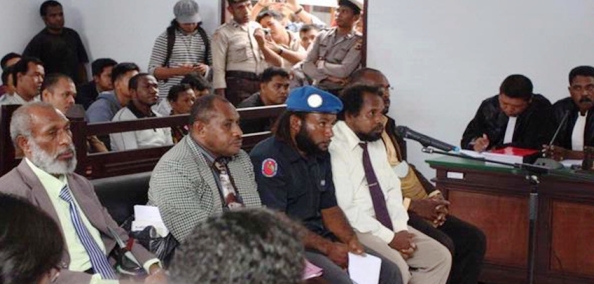
Papuan leaders accused of treason on trial in Jayapura, January 30, 2012

(Jayapura):  Hundreds of security forces are on the streets around Jaypura, West Papua, in a show of force as an Indonesian court found five Congress leaders guilty of Makar (treason), and sentenced the defendants each to three years in prison.

The five defendants, Forkorus Yaboisembut, Edison Waromi, Selfius Bobii, Dominikus Sorabut, and Agus Kraar, were leaders and organisers of the Third Papuan People’s Congress held on October 19 2011, which was brutally broken up by Indonesian security forces after Forkorus  – the Chairman of the Papuan Tribal Council elected as President of the Federated Republic of West Papua – unilaterally reaffirmed West Papua’s independence from Indonesia.

Today’s hearing at the Jayapura Class 1A District Court, the 15th hearing in a trial described by international observers of “descending into farce”, closed after the panel of judges led by Jack Johan Oktavianus declared that the defendants had committed treason under Article 106 of the Indonesian Criminal Code.

During the trial, several Indonesian Brimob paramilitary police officers who opened fire on the Congress gathering, admitted they had no proof that the accused had committed treason before they opened fire on unarmed civilians.

No member of the Indonesian security forces, who during the breakup of Congress were filmed committing acts of brutality and violence on unarmed civilians, were criminally charged and so far have not receive any sanction for the unprovoked attack.

On March 14, another defendant from the Third Papuan Peoples’, Gat Wenda, was also found guilty of makar charges, but was sentence to five months gaol, less time he has already served since his arrest.

Lawyers for the defendants, themselves under threat of prosecution and harassment by Indonesian security forces for their advocacy for the accused, have planned to appeal the decisions, saying “we think this decision is a disaster.”

In SMS messages sent from the legal team to West Papua Media, senior lawyer Olga Hamadi said “we think the judgement from the full bench is out of tune with what actually happened.  We will appeal this to the High Court”.

Gustaf Kawer, another senior member of the legal team, also told West Papua Media via SMS that “the judges considered ambiguous and inconsistent testimony.  (Yet) there is evidence of free expression and democracy that was ruled,” Kawar said, referring to the democratic rights and obligations adhered to by the Congress leaders.

A massive show of military hardware has caused major fear on the streets of Jayapura, with most poeple staying away from demonstrations for fear of an imminent military crackdown.  600 Heavily armed Brimob riot police and 300 Indonesian army soldiers are surrounding the streets around the court, backed up by several water cannon, 13 Barracuda armoured vehicles, and seven Army Panzers (assault vehicles).

Security forces today have, according to local civil resistance sources, used this show of force to actively prevent supporters of the accused to attend court.

The atmosphere has been described as highly tense with Papuan supporters of the convicted men outraged, but terrified, according to SMS messages from sources on the ground.

westpapuamedia

This is a developing situation – please stay tuned.

HRW: Five Papuans Convicted for Peaceful Protest

English: Human Rights Watch logo Русский: Лого...
Image via Wikipedia

For Immediate Release

From HUMAN RIGHTS WATCH

Indonesia: Five Papuans Convicted for Peaceful Protest
Amend Treason Law to Uphold Free Speech

(New York, March 16, 2012) – The Indonesian government should drop the politically motivated treason charges against five Papuan activists who were convicted on March 16, 2012, and order their release, Human Rights Watch said today.

The district court in Jayapura, the Papuan provincial capital, convicted the five men and sentenced them to three years in prison for statements made at a Papuan People’s Congress in October 2011. The demonstration was brutally suppressed by the authorities, leaving at least three people dead. The five men convicted on March 16 are Selpius Bobii, a social media activist, August Sananay Kraar, a civil servant, Dominikus Sorabut, a filmmaker, Edison Waromi, a former political prisoner, and Forkorus Yaboisembut, a Papuan tribal leader.

“If the Indonesian government wants to make an example out of these people, then it should free them as a symbol of its commitment to free expression,” said Elaine Pearson, deputy Asia director at Human Rights Watch. “Instead, the legacy of the Papuan Congress crackdown will be five unjust convictions, while those responsible for the violence go unpunished.”

On October 19, 2011, in Jayapura, Indonesian security forces used excessive force to break up a three-day People’s Congress demonstration supporting independence for Papua, Human Rights Watch said. After Yaboisembut, one of the leaders, read aloud the 1961 Papua Declaration of Independence, police and the army fired warning shots to disperse the approximately 1,000 Papuans gathered. The security forces then used batons and in some instances firearms against the demonstrators, killing at least three and injuring more than 90 others. Witnesses said that demonstrators had been struck on the head and several suffered gunshot wounds.

Following the incident, 17 police officers, including the Jayapura police chief, Imam Setiawan and seven of his subordinates, were given written warnings for committing a disciplinary infraction by not giving priority to the protection of civilians. However, no other action was taken against police or military personnel for possible misuse of force.

The trial of the five activists raised serious due process concerns, Human Rights Watch said. During the trial, the defense told the court that police questioned their clients in the first 24 hours of arrest without the presence of lawyers. The defense also alleged that the men were beaten by police while in custody. Police allegedly kicked Yaboisembut in the chest and beat his head with a rifle butt. Sorabut testified that the police beat him on his head with a pistol and struck his body repeatedly with an M-16 assault rifle. Kraar said he was hit by police twice on the head with a pistol.

Human Rights Watch renewed its call for the Indonesian government to release all political prisoners and allow human rights organizations and foreign journalists unimpeded access to Papua.

The Indonesian Criminal Code should be amended to ensure that no one is prosecuted for treason for exercising their rights to peaceful protest protected under the Indonesian constitution and international law, Human Rights Watch said. The constitution, in article 28(e), states, “Every person shall have the right to the freedom of association and expression of opinion.” Article 28(f) provides, “Every person shall have the right to communicate and obtain information for the development of his/her personal life and his/her social environment, and shall have the right to seek, acquire, possess, keep, process, and convey information by using all available channels.” The International Covenant on Civil and Political Rights, which Indonesia ratified in 2006, similarly protects the rights to free expression and peaceful assembly.

Human Rights Watch takes no position on claims to self-determination in Papua. Consistent with international law, however, Human Rights Watch supports the right of everyone, including independence supporters, to express their political views peacefully without fear of arrest or other forms of reprisal.

“Throwing activists in prison on charges of treason will just reinforce Papuans’ beliefs that the Indonesian government uses the law for political purposes,” Pearson said. “And while the government is busy prosecuting peaceful protesters, it seems to have had no time to investigate adequately the violence against them.”

To read the October 28, 2011 Human Rights Watch news release, “Indonesia: Independent Investigation Needed Into Papua Violence,” please visit:
http://www.hrw.org/news/2011/10/28/indonesia-independent-investigation-needed-papua-violence

To read Human Rights Watch’s report on political prisoners in Indonesia, please visit:
http://www.hrw.org/reports/2010/06/23/prosecuting-political-aspiration-0

For more Human Rights Watch reporting on Indonesia, please visit:
http://www.hrw.org/asia/indonesia


AUSTRALIAN MUSIC LOVERS MAKE HISTORY FOR FREE WEST PAPUA

PRESS RELEASE FROM BLUE KING BROWN
AUSTRALIAN MUSIC LOVERS MAKE HISTORY


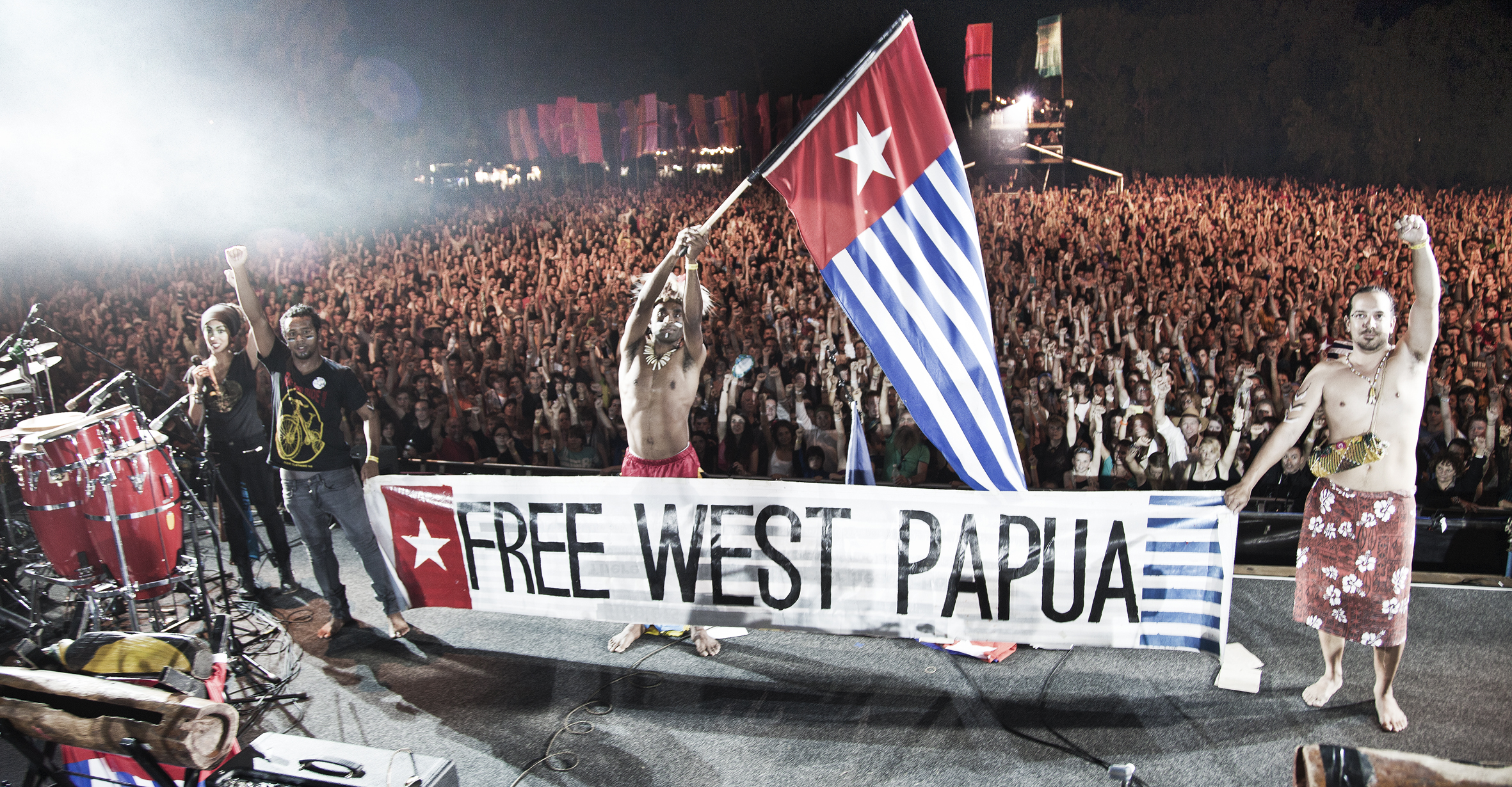
On Sunday 11 March at WOMADelaide, an amazing main stage performance by Blue King Brown with artists from West Papua gave life to a beautiful moment of solidarity when over 10,000 people raised their fists in the biggest public display of Australian support for West Papuan self determination.

Blue King Brown invited members of the 43 asylum seekers, who were granted entry into Australia from West Papua in 2006, and co-founders of ‘RIZE of the Morning Star‘, to join them on stage. ‘RIZE of the morning star’ is a campaign that is calling for a peaceful, nonviolent solution to end the inhumane treatment of West Papuans. West Papua is only 250km from Australian shores and the support of the Australian people and Government will play a vital role in creating independence for this country.

“I feel that the majority of Australians will be shocked as well as saddened to hear about what is happening in West Papua, almost 50 years of human rights abuse. We support human rights and justice, not just for West Papuans, but for all people everywhere around the world, and you can see that our global community is starting to demand that our voices be heard,” says Natalie Pa’apa’a of Blue King Brown.
The West Papuan message is simple, they want self determination and are calling upon the international community for support.
Please take a moment and sign the petition to show your support for West Papua here: http://www.rizeofthemorningstar.com

Forkorus is waiting for international support: Verdict to be announced on 16 March

Bintang Papua, 12 March 2012<Illustration at the beginning of the report shows the defendants addressing their sympathisers outside the court.>

The  twelfth hearing of the trial of the five defendants – Forkorus Yaboisembut (‘President of the Federal Republic of West Papua), Edison Waromi (‘prime minister’). Agustinus M Sanany Kraar, Selpius Bobii, and Dominikus Sorabut – was held in the Jayapura district court on 12 March. As had happened at the time of previous hearings,  a large crowd had gathered along the Abepura highway, causing a traffic jam around the courthouse, because of the presence of security force people who were also trying to regulate the traffic.

The defendants also stuck to their routine of saying prayers before the hearing and as well as giving speeches afterwards.

After the hearing concluded, Forkorus and his co-defendants  left the courthose while singing hymns making speeches in which they said that  reject the trial and reject the whole process of charging them with makar – treason. They also said that what they wanted was their unconditional release and they were now awaiting  responses from international lawyers who they had approached for international support. They said that none of the charges against  them were true but were the result of manipulations.

At 8.51 local time, the five defendants arrived at the Jayapura courthouse and as they got down from the coach, they sang hymns together with their supporters and  members of their families for fifteen minutes. This slightly delayed the start of the hearing.

At 9.05, the panel of judges consisting of  five people took their positions on the bench along with two secretaries.

The chairman of the panel of judges had to delay the start of the hearing briefly  because the chief prosecutor had not yet arrived.

This session was held to hear the response by the prosecutor – replik – to the defence statement by the defendants as well as by their legal team.

The chief prosecutor, Julius Teuf said that they firmly rejected the defence statement  as well as the statements made by each of the defendants.Teuf then said that they stood by their earlier  demand that the five defendants should be sentenced to five years imprisonment.

Freddy Latunussa, an expert member of the defence legal team, said that the statement by the chief prosecutor that the defendants had tried, called upon and urged  others to take part in an act of treason  had not been proven under Article  106 of the Criminal Code as had been alleged by the prosecution.

According to the observations of Bintang Papua, the defence team of lawyers  rejected all the demands  made against the defendants as stated in the Replik because the Criminal Code does not allow statements to be read out but should have been presented in writing. As the panel of judges had previously said that this should have been done in writing, the chairman of the panel said that they had given the prosecutors three days to do this in accordance with an agreement reached during a previous hearing.

A 9.20, the chairman of the panel of judges closed the hearing  and said that the trial would continue on Friday, 16 March, when the panel of judges would announce their verdict.

Two West Papuan Community led Ecological Struggles

From our friends at Hidup Biasa

http://hidupbiasa.blogspot.com/2012/03/west-papuan-community-ecological.html and http://hidupbiasa.blogspot.com/2012/03/tablasupa-nickel-minings-drilling-rig.html

Two West Papuan Community Ecological Struggles

On the sidelines of the Papuan People’s struggle for self-determination, at a local level Papuan communities continue to resist the logging and mining industries that are destroying their forests. Here are two stories of recent community resistance from areas close to the Papuan capital Jayapura, translated from the Alliance for Democracy in Papua website http://www.aldepe.com.

1. Seeing their forest destroyed, Arso Villagers Burn Five Logging Camps.

Annoyed by hearing the sound of chainsaws almost every day, and in addition the reports of villagers who regularly enter the forest telling of finding loggers’ camps there, around 20 people from Arso, both young and old, agreed to check the forest for themselves.

Community Resistance against logging (file photo: "The forest eats the forest-eater" by manukoreri.net/westpapuamedia)

This area of forest is commonly called the ‘Golden Triangle’, and is divided between the territory of three villages, Arso, Workwana and Wambes.

As they had guessed they would, once inside the forest they found two sites used by loggers, which had been connected with a track made from offcuts of wood which the loggers would use, dragging the wood from behind a vehicle.

At the first site there was only one camp. At this camp they confiscated two chainsaws and took statements from three loggers who were at the location. They then forced the loggers to leave.

The group continued to the next location. Possibly because the loggers had received information from their friends at the first site, there was only one person left, and they didn’t find any chainsaws.

As their emotions rose some people almost hit out at the logger, but were held back by others. At this second location, four camps were found, complete with televisions, speakers, supplies of food and clothing and so on.  Two vehicles used for dragging wood were also found.  In their emotional state, the people destroyed and burned the camps and everything they found there, along with the camp at the first location.  The two vehicles were also burnt.

According to statements from the loggers, they had been given permission by the customary chief of kampung Workwana, although the Arso villagers felt that they had been cutting trees far inside the Arso territory.

Several people interviewed in kampung Arso on Tuesday 6th March explained that they were still angry “It’s so sad to look at that forest, they even cut very small ironwood trees.” said Wenderlinus Tuamis, a youth who had participated that day.

Meanwhile, according to Franky Borotian, they had been allowing the logging to continue because previously a villager from Workwana had asked to use wood to build her house “a sister had asked for permission to build a house, but then it turned out someone used that permission for business purposes”, he said.

The problem has been passed over to the Customary Council (Dewan Adat).  Villagers asked the Customary Council to use their wisdom to resolve the situation so that conflicts between the people would not emerge.  Especially since the Golden Triangle had become the area which people rely on for food, as other areas have been taken over by two big oil palm plantations, state-owned PTPN II and PT Tandan Sawita Papua (Part of Peter Sondakh’s Rajawali Group)

source: http://www.aldepe.com/2012/03/merasa-hutannya-dirusak-warga-arso.html

2. Tablasupa Nickel Mining’s Drilling Rig Burned, Three Imprisoned

On the morning of 8th February 2012, local people from kampung Tablasupa, near to the Papuan capital Jayapura, burned a drilling rig belonging to the mining company PT Tablasupa Nikel Mining.   The action was connected to an ongoing conflict between local people and the company, which plans to mine nickel on 9629 hectares of land, and is currently carrying out exploration activities.   Although the company has been given a permit by the local Jayapura Bupati’s office, the people of Tablasupa feel that their rights as the holders of customary rights over the land have not been respected.

Two weeks after the machine was burnt, on February 20th,  police arrested
three villagers. Saul Sorontouw, Lambertus Seibo and Kanisius Kromisian.
They have been charged under article 170 of the Indonesian penal code, and are being held in Jayapura police headquarters. While in prison Saul Sorontouw has been ill with gout, which has caused swellings in his knees.  On February 28th police demanded statements from another six villagers, but they were allowed to go home that evening.

The following statement was released by villagers of Tablasupa the day
before the action:

Statement of opinion of the Sorontou-Okoseray-Kiswaitou Ethnic Group
As holders of rights to customary lands on the area covered by PT Tablasupa Nickel Mining’s Mine Enterprise Permit (IUP), Mining Rights (KP) and the Bupati’s recommendation that allows exploration in Kampung Tablasupa, Jayapura Regency

Regarding the as yet unresolved problems around PT Tablasupa Nickel Mining commencing exploration activities on customary land belonging to the people of kampung Tablasupa, the Sorontou- Okoseray- Kiswaitou ethnic group wishes to make the following declaration:

“Reject PT Tablasupa Nickel Mining” conducting exploration and mineral exploitation activities within the customary boundaries of the Sorontou- Okoseray- Kiswaitou ethnic group.

The reasons for our rejection of mining activities are as follows:
1. The whole territory of kampung Tablasupa is unsuitable for mining
activities.

2. The impact of mining activities would also damage the environment of
areas that fall within the territory of neighbouring villages.

3 To avoid mining activities causing conflict with the people and nearby villages.

4. The effect of mining activities will damage and desecrate the environment, and industrial pollution from the mine will contribute to global warming and affect the sources of clean water from the Cyclop mountains.

5. No consensus has been reached through a musyawarah system that would
represent an agreement between the people of Tablasupa and neighbouring
villages.

6. The holders of customary rights to the land have not given their approval (under the Law on Mineral and Coal Mining 4/2009 article 135, companies holing a Mine Enterprise Permit can only commence activities if they have obtained agreement from the holders of customary rights on that land).

7. The customary and human rights of the Sorontou- Okoseray- Kiswaitou
ethnic group must be respected and valued by all.

A solution to the development of kampung Tablasupa which supports the
social economy and also contributes to local business could include:
-building beach tourism and hotels
-developing fishing
-selling fresh water.

Such development would involve all the people of Tablsupa either as workers or taking roles in a management structure and could take the form of an enterprise or foundation that was formed by the people of kampung Tablasupa.

This is the message that the Sorontou- Okoseray- Kiswaitou ethnic group wishes to be known by the general public.

Tablasupa, 07 February 2012 .

Sources: http://www.aldepe.com/2012/02/polisi-menahan-3-tiga-warga-sehubungan.html ; http://www.aldepe.com/2012/03/saul-sorontouw-sakit-di-tahanan-polres.html ; and other articles on http://www.aldepe.com
statement: http://groups.yahoo.com/group/Komunitas_Papua/message/2952

Create a website or blog at WordPress.com

Up ↑