by a Special Correspondent for West Papua Media in Abepura
March 19, 2012
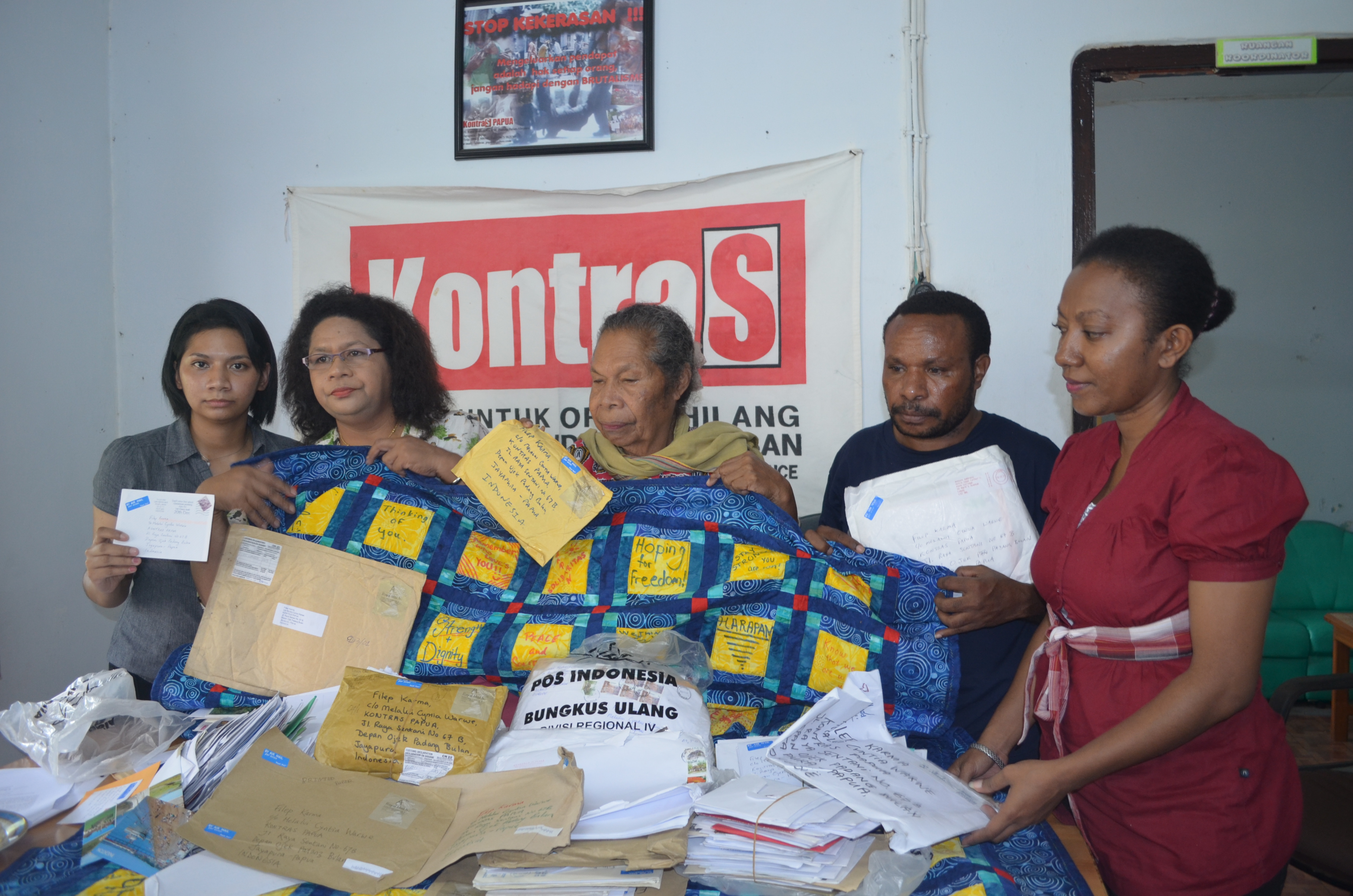
Kontras and Filep Karma's family with some of the nearly 7300 letters sent by international supporters of Karma (Photo: West Papua Media)
Filep Karma, is one of the political prisoners given sentences of 15 years of imprisonment by the government of Indonesia, by raising the Morning Star flag, on December 1, 2004, at Trikora field, Abepura. Ever since a period of 7 years, and 3 months of his prison sentence have lasted in Abepura prison. During captivity Filep Karma received letters of solidarity sent by the International community through the office of the Commission for missing people and victims of violence in Papua (KontrasPapua). Nearly 7292 letters of support have been sent in the period of 2011 untill 2012.
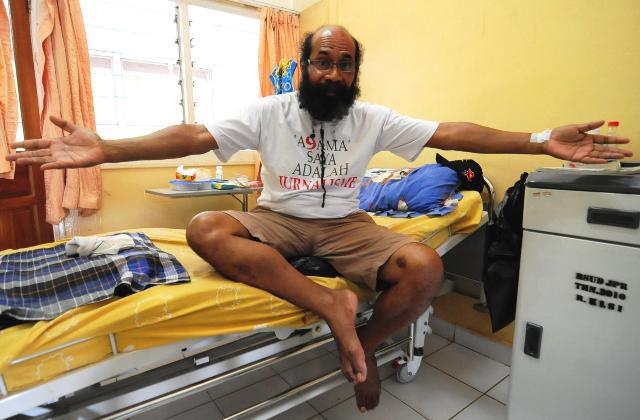
Filep Karma inside the prison hospital (Photo: West Papua Media)
United for the truth (BUK) and Kontras Papua held a Press Conference on March 19, 2012, and immediately submit a letter of support to the family representative of Filep Karma. Andrefina Karma, Filep Karmas second daughter said ” International Community support is strong solidarity for the freedom of my father, the people there once a month hold a simple campaign in front of the Indonesian embassy and called for the unconditional release of Filep Karma”, she said.
Letters that came from different parts of the world proved that there is support for political prisoners in Papua. Olga Hamadi, Director of Kontras Papua says” the government should not close her eyes for the injustice suffered by political prisoners in Papua, both in conditions of health and food at the prison, which received less serious attention”, she said. She also denied the statement by the Minister of Justice and Human Rights Republic of Indonesia during a visit to Papua saying that there are no political prisoners in Papua.
Filep Karma is one of figures of political prisoners who never made a compromise with the Government of Indonesia. He rejected any form of clemency, amnesty, and abolition that is given by the Government. ” If I receive clemency, that means I ask for forgiveness to the government, but I do not feel guilty at all, I am just making a peaceful protest. Indonesia is a democratic country, am I wrong to fight for the basic rights of indigenous Papuans?
“I will continue to undergo a period of detention up to 15 years in prison, if you want to release me, I ask to be released unconditionaly”, Filep Karma said, as he was undergoing physiotherapy treatment in DOK II general hospital.
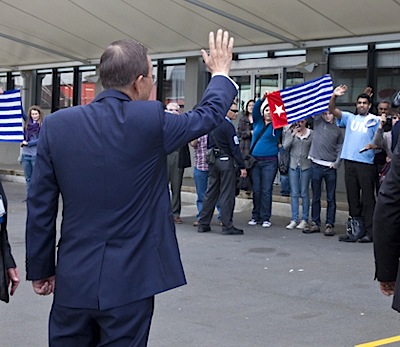
Ban Ki-moon waves to protestors for West Papua, PIF NZ Sept 2011
by John Pakage for West Papua Media
Opinion
President Susilo Bambang Yudhoyono (SBY) and UN Secretary General Ban Ki-moon held a bilateral meeting at the presidential palace in Bogor, West Java, on Tuesday (20/03/2012). In the meeting, human rights abuses in Papua were also discussed.
UN Secretary General Ban Ki-moon certainly knows in detail about the development of human rights abuses in Papua because he sought a diplomatic answer from the President of Indonesia.
“Papua is Indonesia and we are obliged to maintain its security, but if there are violations of human rights then there is law enforcement action,” said SBY.
Of course with this kind of diplomatic answer, SBY wants to hide the number of cases of gross human rights that have occurred, and are continuing to occur now in Papua. Only at few days before the arrival of Ban Ki-Moon to Indonesia, Forkorus Yoboisembut, Gladius Waromi Edison, Augustine M. Sananay Kraar, Selpius Bobii and Dominic Sorabut were sentenced 3 years in prison on Friday (16/3) with charges of treason for forming the state of West Papua.
The implementation of the Third Papuan People’s Congress went ahead with official permission from the Indonesian government, both from the central government and the police to hold a congress in Jayapura. But Indonesia’s military attacked and captured civilians at the Congress without first showing any arrest warrant, in accordance with Indonesian regulation.
Again and again, military and police forces shot live ammunition at civilians at the Congress, inconsistent with legal process, in stark contrast with Yudhoyono’s promises to Ban Ki-Moon at the Bogor Palace.
The multitude of human rights abuses in Papua, which is tightly closed by state policy that prohibits foreign media and international NGOs from entering Papua, gave rise to human rights lawyer Jennifer Robinson (lawyer for Wikileaks founder Julian Assange) calling on new Australian Foreign Minister Bob Carr, to immediately urge Indonesia to open Papua up, and allow incoming international NGOs into Papua to conduct human rights investigations independently (see Radio Australia, March 20, 2012).
Indonesia’s policy to cover up human rights abuses in Papua has been harshly rebuked by Human Rights institutions around the world; (see for instance a press release by Franciscans International, TAPOL, the Asian Human Rights Commission, Faith Based Network on West Papua (FBN) and West Papua Network.)
Legal rights agencies lament the unjust decision facing the five civilians who were detained while organising the Papuan Congress, sentenced to three years in prison. According to these institutions, the Congress was a form of free expression and a fundamental tenet of democracy for communicating opinions.
In addition, humanitarian agencies deplore the attitude of the Indonesian military who with full weaponry arsenal stormed and attacked the Congress participants. This Indonesian Military attack and killed several Papuan civilians. (See: Franciscans International, Release March 16, 2012.)
Ban Ki-Moon is certainly more aware now of what has happened in Papua since 1969 when Indonesia invaded Papua. So SBY’s diplomatic answer of “SBY diplomacy” might make the number one person in the world confused.
Ban Ki-Moon also mentioned that South Sudan is an example of an area of extended conflict that has embraced the process of ending its fighting. The UN successfully held a referendum for citizens to determine their aspirations – and they chose independence from the Sudan.
Of course the conditions of ongoing human rights abuses in Papua, covered up by the state policy of denying access to foreign media and international NGOs to Papua, could by its very nature invite a humanitarian intervention to end the conflict in Papua, with (or without) the Indonesian government.
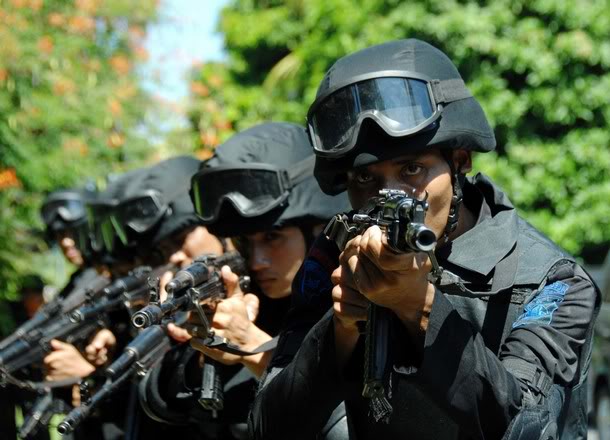
A division of the Indonesian military has shot dead five terrorism suspects over the weekend, who they’ve accused of plotting to attack a popular bar in Bali. The Australian government supports the Indonesian Detachment 88 to fight terrorism, and this division was involved in the shooting.
A daily Papuan perspective of Australian-funded Detachment 88 from Indonesia's occupation forces (West Papua Media)
But there are many critics who blame Detachment 88 for human rights abuses against civilians and question their quick resort to violence.
Featured in story
Nick Chesterfield, editor of West Papua Media group
Peter King, convenor of the West Papua Project at the Centre for Peace and Conflict Studies
After an Indonesian court on March 16 sentenced five Congress leaders guilty of Makar (treason) three years in prison each, lawyers for the men have today launched a formal appeal against the sentences in the Jayapura Class 1a district court.
The five defendants, Forkorus Yaboisembut, Edison Waromi, Selfius Bobii, Dominikus Sorabut, and Agus Kraar, were leaders and organisers of the Third Papuan People’s Congress held on October 19 2011, which was brutally broken up by Indonesian security forces after Forkorus – the Chairman of the Papuan Tribal Council elected as President of the Federated Republic of West Papua – unilaterally reaffirmed West Papua’s independence from Indonesia.
An SMS just sent to West Papua Media from the legal team defending the five men said “promptly at 15:00 (West Papua time), our team of legal advisors has stated appeals in Class IA Jayapura District Court in connection with the Makar case on behalf Forkorus, et al, against 3 year prison sentence imposed by the judges of (the) Court, for being convicted of a crime of attempted treason”.
The SMS stated that the crimes the men were convicted under “also referred to in Article 106 of the Criminal Code, Article 55 paragraph (1) of the Criminal Code, together with Article 53 paragraph 1 of the Criminal Code, (we have lodged) a statement of appeal of the verdict of Class IA Jayapura District Court”
“This judgement does not have the force of law, then the case must be reviewed by the Jayapura High Court Judge,” according to the SMS.
“The reason we (have) appealed the decision of the Court of Jayapura (is because it is) essentially inconsistent with the facts of the trial, both from witnesses, evidence and the testimony of the defendant,” the legal team said. “Also it is not in agreement with the Book of the Law of Criminal Procedure.”
The date that the appeal is set down to be heard is not known at the time of publication, as the lodged appeal had yet to be processed by the court.
Five West Papuans were given jail terms on Friday for peaceful expressions of political opinion. Alex Rayfield reports on a trial that will only amplify calls for independence.
Last Friday presiding Judge Jack Johanis Oktavianus sentenced the men known as the Jayapura Five to three years in prison. The Five — Forkorus Yaboisembut (the president-elect of an independent West Papua), Edison Waromi (prime minister-elect), Dominikus Surabut, Agus Krar and Selphius Bobii — were charged with treason for their role in organising the peaceful Third Papuan People’s Congress which took place in October 2011.
Forkorus Yaboisembut outside court. Photo: West Papua Media
The Five’s legal team immediately declared they would appeal to Indonesia’s High Court in Jakarta. Outside the packed District Court in Jayapura hundreds of Papuan protesters sang, danced and prayed. Many carried banners calling for a referendum. Ringed around the Papuan crowd were Indonesian riot police, military personnel and a fleet of armed troop carriers, army assault vehicles and water cannons.
The Third Papuan People’s Congress, a three-day open air gathering that was attended by thousands of Papuans last year, ended with Forkorus Yaboisembut reading a declaration of independence from Indonesia. After he had finished the 74-year old tribal leader thanked the police and military for allowing the Congress to take place and retired to a nearby monastery.
Forty minutes later — and for no apparent reason — the police and military opened fire with live ammunition. Five Papuans were killed by the Indonesian security forces. Witnesses told New Matilda that some of the police who opened fire on the unarmed crowd were members of the Australian and US-funded, armed and trained Detachment 88.
But rather than the Indonesian police being arrested and charged with murder, Forkorus and his colleagues were the ones dragged before the court. The police and military officers that opened fire last October were given a slap on the wrist. Seventeen police officers received little more than a written warning.
The Jayapura Five were charged under antiquated sections of Indonesia’s Criminal Code that date back to the Suharto era and before that to Dutch colonial times. But given the fact that treason can fetch life imprisonment in Indonesia, the three-year sentences handed down last Friday were much less than many people expected.
When New Matilda asked Gustaf Kawer, the senior legal counsel for the men, whether the three-year sentence could be read as a signal that the Indonesian legal system was asserting more judicial independence his response was an emphatic “no”.
“The Five invited the Coordinating Minister for Political and Legal Security and the Minister for Home Affairs to attend the Congress. The gathering was held in the open and everyone was welcome to attend. It would be much better if the court and police did not attempt to obstruct their democratic right of freedom of expression,” Kawer said.
Kawer and other members of the legal team told New Matilda that the trial was marked by irregularities, interference and intimidation. There was a heavy presence of armed members of the security forces at all 15 court hearings — inside and outside. Question marks also hang over the extent to which the court acted independently. Immediately prior to sentencing the judges met with senior military commanders, police and government officials for a one-hour closed meeting, according to Tapol. Kawer has also been threatened with prosecution by the police for defending the Five.
In an interview with the Jakarta Globe, Indonesian presidential spokesperson, Teuku Faizasyah, asserted that the court did act independently. “Our political system today fully respects trias politica and the ongoing legal process.”
Faizasyah went on to say that the right to freedom of speech in Indonesia does not extend to separatist activities. According to Faizasyah, declaring independence from Indonesia is separatism and the European Union classifies separatism as a form of terrorism. “Any expression of separatism in the EU is thus considered an act of terrorism” said Faizasyah.
In the case of the Jayapura Five the men operated openly. They were unarmed and behaved in a disciplined and non-violent manner. They may be revolutionaries — but they are not violent.
In an SMS from prison a defiant Selphius Bobii told New Matilda that sentencing the Five to prison sends a message to Papuan activists that Indonesian law is incapable of delivering justice for the Papuan people.
“The police, Attorney General, and Indonesian judges … cannot deliver justice for the people of West Papua. They cannot imprison democracy and they cannot imprison the peaceful struggle for a free West Papua. It is the Papuans who possess sovereignty over our land … and the Papuan people will continue to struggle,” wrote Bobii.
Dominikus Surabut, another member of the Five, told New Matilda that it was illogical to accuse West Papuans of wanting to separate from Indonesia when it was Indonesia that invaded and annexed West Papua. Surabut argues that the invasion and continued occupation of West Papua by the Indonesian state is in violation of the right to “free choice” that the United Nations guaranteed West Papuans but failed to deliver.
For people like Surabut and Bobii and their three jailed colleagues, and for the Papuans who watched the treason trial unfold, state repression in West Papua is evidence that Indonesia can never lay claim to being a democracy while West Papuans are denied the chance to freely and fairly determine their future.
The jailing of the Jayapura Five pushes West Papuans further down the path of insurrection. The denial of free speech invites the international community to join Papuans on that journey.
“Holland didn’t fall over when Indonesia became independent, and neither will Indonesia when we do,” says Herman Wainggai, a West Papuan independence leader and former political prisoner living in the United States. “Bali principles, Lombok treaties, peace centres in West Java … these are all meaningless while Indonesia continues to escalate its troops and its judiciaries against us”.








 West Papua Media Alerts